Germany news: Merz says Europeans 'not subordinates' to US
Published January 29, 2026last updated January 29, 2026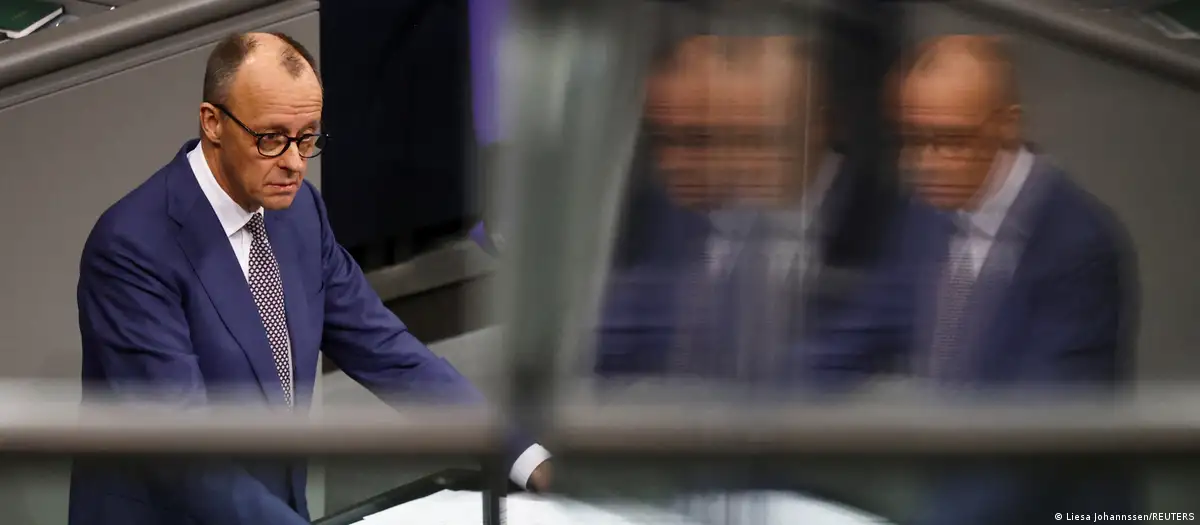
What you need to know
- Chancellor Merz has called for a more self-confident Europe in a foreign policy address
- Merz also criticized US President Donald Trump's claims about European troops in Afghanistan
- Deutsche Bank has announced record profits one day after a money-laundering raid
- Borussia Dortmund and Bayer Leverkusen could meet in all-German Champions League playoff
This blog is now closed. Thanks for reading our coverage of of what Germany was talking about on Thursday, January 29.
Merz weighs European nuclear shield alongside US deterrence
German Chancellor Friedrich Merz has been saying a possible German role in a European nuclear protection framework would complement, not replace, shared nuclear deterrence with the United States.
"We know that we have to reach a number of strategic and military policy decisions, but at the moment, the time is not ripe," Merz said while speaking in Berlin alongside Lithuanian Prime Minister Inga Ruginiene.
Merz said Germany is bound by two international treaties not to possess its own nuclear weapons — the Two Plus Four Treaty that allowed the reunification of Germany and the Nuclear Non-Proliferation Treaty — adding it is not Germany's decision or responsibility to host its own nuclear arms.
He said this did not rule out discussions with other European states on joint nuclear deterrence, stressing such talks were compatible with nuclear sharing arrangements with the US and could serve as a supplement, similar to the current roles of France and Britain.
"These talks are taking place. They are also not in conflict with nuclear-sharing with the United States of America," he said.
Germany is not a nuclear power, but under NATO’s nuclear sharing concept it provides combat aircraft that could be equipped with US nuclear weapons stored in Germany in a defense scenario.
Teachers strike over pay in German states
Around 12,000 education workers have been striking nationwide, according to the Education and Science Workers' Union GEW, as unions step up pressure in pay talks for state public sector staff.
Teachers and other employees held central rallies in five cities, with GEW chair Maike Finnern accusing the Association of German States Employers of maintaining a blocking stance in negotiations in Berlin.
The unions are demanding a 7% pay rise, or at least €300 (roughly $360) more per month. Strikes and actions have involved school teachers, social workers, early childhood educators, university staff and student employees. GEW said about 3,500 people joined protests in Berlin, 3,000 in Leipzig, 2,500 in Hamburg, around 2,000 in Mannheim and 700 in Cologne.
Further warning strikes are expected ahead of the third round of talks, scheduled for February 11 to 13 in Potsdam. The dispute covers the pay of about 2.6 million state employees, around half of whom work in education. State finance ministers have rejected the union demands as excessive and have so far presented no concrete offer, instead proposing a framework that would largely limit increases to inflation compensation over a 29-month term.
German court orders damages over ethnic discrimination by realtor
Germany's top civil court has ruled that a real estate agent must pay damages after discriminating against a prospective tenant because of her ethnic background.
The Federal Court of Justice (BGH) said on Thursday that the agent violated the General Equal Treatment Act.
In November 2022, Humaira Waseem applied online for a viewing appointment for an apartment in the town of Gross-Gerau, just south of Frankfurt. She used her Pakistani first and last name, but all of her inquiries were rejected.
Further viewing requests made either by the claimant herself or at her instigation under foreign-sounding names were also unsuccessful.
However, when the 30-year-old tried again using the names "Schneider," "Schmidt," and "Spiess" — with otherwise identical information about her income and occupation — she was offered viewing appointments.
Waseem demanded compensation from the real estate agent. Last year, the Darmstadt Regional Court awarded her €3,000 ($3,590) plus reimbursement of her legal fees. Because the agent appealed the ruling, the case went to the BGH, which agreed with the regional court.
Presiding Judge Thomas Koch stated that this was a "clear case of discrimination." He added that real estate agents, too, must adhere to the legal prohibition against discrimination.
The court said it was lawful for the claimant to create comparable test applications, including using other names or third parties, and saw no sign of abusive litigation.
Waseem expressed her relief after the decision and said, "A huge weight has been lifted from my shoulders."
Germany to harden critical infrastructure amid Russia fears
The German parliament, the Bundestag, on Thursday voted in favor of legislation requiring key infrastructure and service providers to reduce their vulnerability to terrorism, industrial accidents, natural disasters and public health emergencies.
The move comes as a response to fears of sabotage and other national security threats amid worsening relations with Russia.
"Germany is not at war, but we are the target of hybrid warfare, sabotage, espionage, aggression by foreign powers, terrorism," Interior Minister Alexander Dobrindt (CSU) told parliament ahead of the vote. "We have a responsibility to ensure that we implement resilience measures."
Earlier this month, Germany experienced a wake-up call when an arson attack on a high-voltage cable left thousands of households in Berlin without power for nearly a week in the midst of winter – the longest power-outage the city had suffered since the Second World War.
The attack, which has been claimed far-left militants calling themselves the Vulkangruppe (Vulcan Group), and the ponderous response, prompted public fury and has sparked the conservative-led government into action.
The new legislation passed on Thursday aims to bring Germany in line with European Union directives by obliging some 1,700 essential services providers to step up physical security and alarm systems, carry out regular risk assessments and promptly report incidents.
The measures cover facilities that provide critical services to at least 500,000 people in sectors including energy, water, food, health, transport, IT, telecommunications, financial services and waste disposal.
While security experts have welcomed the bill's provisions in principle, Konstantin von Notz from the opposition Green Party believes the horse has already bolted.
"We remain miles away from the urgently needed uniform protection of our critical infrastructures," he told the AFP news agency, calling the government's response "wholly inadequate, far too late and too poorly crafted."
SAP: Turnover and profit up — but share price collapses
German software giant SAP has reported an 8% increase in turnover and a 28% increase in overall profit for 2025, but the company has still seen its share price on the German stock exchange (DAX) drop by around 16%.
The €36.8 billion turnover and €10.4 billion profit are a result of steady demand for SAP's cloud-based storage solutions in a climate where customers increasingly value "digital sovereignty," according to financial director Dominik Asam.
German media, including the dpa news agency and financial newspaper Handelsblatt, also highlighted substantial personnel cuts.
However, customer interest in cloud products is also a reason for the drop-off in SAP's share price from €283 in February 2025 to just €165 in January 2026 – its lowest for two years.
Unlike traditional software licenses, which were paid up front, SAP customers are now switching to monthly subscription models to access cloud-based services via the internet. And those clients include government agencies and local authorities who, for budgetary and legal reasons, often include cancellation clauses in their contracts. As a result, SAP might be receiving more regular payments, but it can't post the full potential value of contracts that might not be fulfilled in their entirety.
Furthermore, according to Handelsblatt, investors are concerned about the potential effects of geopolitical uncertainty on the software industry, especially in light of US tariffs, and of artificial intelligence.
Indeed, SAP is not the only software giant to suffer a fall in share price; Microsoft shares also dropped by around 7% on Thursday morning, despite equally solid financial results.
"I've been doing this job for six years and I've experienced many highs and lows," said SAP chief executive Christian Klein, insisting that, while the current share price isn't ideal, SAP is nevertheless "uniquely positioned" to adapt to the challenges posed by AI in the industry.
Calling on colleagues to focus on pursuing their strategy regardless of short-term market trends, he promised: "We will see better times again."
Champions League: Potential all-German playoff clash
Bundesliga sides Borussia Dortmund and Bayer Leverkusen could potentially be drawn against each other in the Champions League playoff round next month after both failed to qualify directly from the tournament's league stage on Wednesday night.
Direct progression was already impossible for Leverkusen — and only mathematically possible for Dortmund ahead of Wednesday's games, but the German teams ended up 16th and 17th respectively, meaning that they could face each other in a two-legged playoff when the draw is conducted on Friday.
Leverkusen's comfortable 3-0 win over Spanish side Villarreal saw them secure a seeded position in the playoff draw while Dortmund's 0-2 defeat to Italian giants Inter Milan saw them finish one point behind Leverkusen in an unseeded position — hence why the two could now meet.
Bayern Munich had already qualified automatically for the knock-out stage ahead of their 2-1 win away at Dutch side PSV Eindhoven, and will not have to go via the playoff round.
Eintracht Frankfurt had already been eliminated, but their 0-2 defeat at home to English side Tottenham Hotspur saw them finish fourth-bottom of the league table with only four points.
Berlin rabbi loses appeal in sexual abuse case
A German rabbi who was dismissed from his position due to allegations of sexual abuse has seen a second appeal thrown out by a state labor court.
The rabbi was sacked by the official Jewish Congregation in Berlin (Jüdische Gemeinde zu Berlin or JGzB) in 2023 after being accused of forcibly kissing a woman during a one-on-one therapeutic session and claiming it was part of a "healing" ritual.
The rabbi claims any sexual contact between the pair was consensual. A first appeal was dismissed by a city labor court in Berlin and a second appeal has now been dismissed by the state labor court for Berlin and the surrounding state of Brandenburg.
The court found that the sexual harassment constituted an abuse of the trust placed in the claimant as a rabbi and therefore that his dismissal was justified.
Weidel: Merz turning down 'Board of Peace' invite was an 'error'
The co-leader of the populist Alternative for Germany (AfD), Alice Weidel, criticized Chancellor Merz when responding to his parliamentary address on foreign affairs on Thursday.
She said the German government had made a "mistake" in turning down, at least for the moment, an invitation to Donald Trump's "Board of Peace" along with the majority of its European allies.
She called the initiative "a chance to resolve the many blockages caused by a UN that is incapable of action."
Weidel, whose AfD has enjoyed support from some prominent Trump allies, not least Vice President JD Vance and tech mogul Elon Musk, hit several other talking points aimed at the current US administration.
She said it was "in Germany's interest to rapidly bring an end to the war in Ukraine," amid continued US-led efforts to broker a compromise between Moscow and Kyiv.
Weidel also criticized Berlin's handling of Trump's Greenland demands last week.
"To send a dozen soldiers to Greenland and order them back the next day is slapstick, if you'll pardon my saying so," she told the chamber.
Several European NATO members sent small numbers of troops to Greenland on an impromptu reconnaissance and fact-finding trip last week, in a bid to counter Trump's allegations that the defense of the massive island was being neglected. It was always billed as a short and small operation, but received considerable attention given the broader atmosphere.
Merz: Germany needs 'technological sovereignty'
Friedrich Merz said on Wednesday that Germany and Europe need to obtain greater technological independence in order to reduce reliance on the United States, given more antagonistic attitudes in Washington.
The German chancellor called for "measures to reduce dependencies, dependencies which we have entered into all too flippantly in the last years and decades, measures for more sovereignty and in particular technological sovereignty."
However, the German government's own Federal Office for Information Security (BSI) said Germany's reliance on foreign and particularly US-led cloud services, artificial intelligence and other tech products will not be overcome in the near future.
"When it comes to digital sovereignty, the use of European or German services for satellites or AI, we have to be honest," BSI President Claudia Plattner told the dpa news agency.
"The biggest firms, especially in the USA, are already ten years ahead in terms of investment."
For Plattner, it's "unrealistic to believe that we'll be able to do everything ourselves in the short term."
Merz: Europe 'must learn to speak the language of power politics'
Chancellor Merz has hailed Europe's "unity and determination" in standing up to US President Donald Trump's tariff threats over the Greenland crisis and called upon the continent to act with greater self-confidence on the global stage.
"We were all in agreement that we would not allow ourselves to be intimidated by tariff threats," he told the German parliament, the Bundestag, in Berlin. "If anyone in the world thinks they can play politics by threatening tariffs against Europe, they now know that we can and will defend ourselves."
Merz called on Europe to learn from the experience, saying: "We have seen with our own eyes, perhaps for the first time, that we can be a power — founded on values which we don't want to give up."
"However, we will only be able to use this activity and this self-confidence for our benefit, and we will only be able to implement our ideas in the world, at least in part, if we ourselves learn to speak the language of power politics, if we ourselves become a European power."
Merz slams Trump criticism of NATO troops in Afghanistan
Chancellor Merz also delivered a strong rebuke to Donald Trump after the US President criticized the deployment of European troops in Afghanistan in support of the United States.
"We will not allow that deployment – which was carried out in the interests of our ally, the United States – to be scorned and demeaned as it has been," he said.
59 German troops were killed in Afghanistan and over 100 injured, many seriously, after Germany and other NATO countries responded to the only ever invocation of Article 5 in the alliance's history, following the September 11 terror attacks on the United States.
"I would like to tell our soldiers on deployment: your service was and is valuable," Merz said. "It is for our freedom, for freedom across the world, and the Federal Government will always stand behind you."
Merz: 'We are partners and allies, not subordinates'
German Chancellor Friedrich Merz has insisted that Germany and other European nations will not submit to the increasingly belligerent foreign policy demands of the United States under President Donald Trump.
"As democracies, we are partners and allies, not subordinates," Merz told the German parliament, the Bundestag, in Berlin on Thursday.
"We want to be part of a dynamic and agile network of sovereign states who want to continue working within a rules-based order."
He said Germany will always be open to cooperation with the United States but only as long as those basic principles remain.
"The transatlantic alliance and transatlantic trust still have value," he said. "Especially for us in Germany."
German population sinks for first time since 2020
The number of people living in Germany has sunk slightly for the first time in five years, according to new figures released by the Federal Statistics Office on Thursday.
According to the figures, about 83.5 million people were living in Germany at the end of 2025 — around 100,000 fewer than at the end of 2024.
The last population decreases were recorded between 2003 and 2010, but Germany's population had been steadily increasing between 2011 and 2024 — with the exception of the pandemic year 2020.
As in every year since German reunification in 1990, the country recorded more deaths than births but, unlike in previous years, this wasn't compensated by immigration in 2025.
According to the official figures, between 220,000 and 260,000 more people arrived in Germany than left the country at least 40% fewer than 2024, when immigration to Germany outweighed emigration from Germany by about 430,000.
Deutsche Bank announces record profits
On Thursday, Deutsche Bank, Germany's biggest bank, announced a record pretax profit of €9.7 billion ($11.6 billion) — up 84% from 2024, when various legal battles took their toll on the balance sheet.
The net profit of €6.1 billion ($7.3 billion) is more double that of the previous year. Total turnover increased by 7%, to €32.1 billion ($38.4 billion).
"We have reached all our financial targets for 2025," said chief executive Christian Sewing. "This puts us in the best possible position to execute the next stage of our strategy.
The announcement comes a day after prosecutors raided Deutsche Bank's Frankfurt headquarters and another office in Berlin as part of an investigation into money laundering by foreign companies linked to the bank — including some linked to Russian billionaire Roman Abramovich, who has been sanctioned by the European Union due to his close ties to the Kremlin.
The raids were a setback in a big week for Deutsche Bank as it looks to restore its reputation following a series of scandals.
Welcome to our coverage
Guten Morgen! Welcome to DW's coverage of what Germany is talking about on Thursday, January 29.
Chancellor Friedrich Merz is expected to make a foreign policy statement this morning. We'll bring you what he has to say.
Domestically, just one day after its offices were searched as part of a money laundering investigation, Deutsche Bank has announced record profits.
And new statistics show that Germany's population fell slightly in 2025.