You need to enable JavaScript to run this app.
Skip to content
Skip to main menu
Skip to more DW sites
Latest videos
Latest audio
Regions
Africa
Asia
Europe
Latin America
Middle East
North America
Germany
Topics
Climate
Equality
Health
Human Rights
Migration
Technology
Categories
Business
Science
Environment
Culture
Sports
In focus
Iran
Ukraine
Ebola
Latest audio
Latest videos
Live TV
Advertisement
Asia
Skip next section Top Story
Top Story
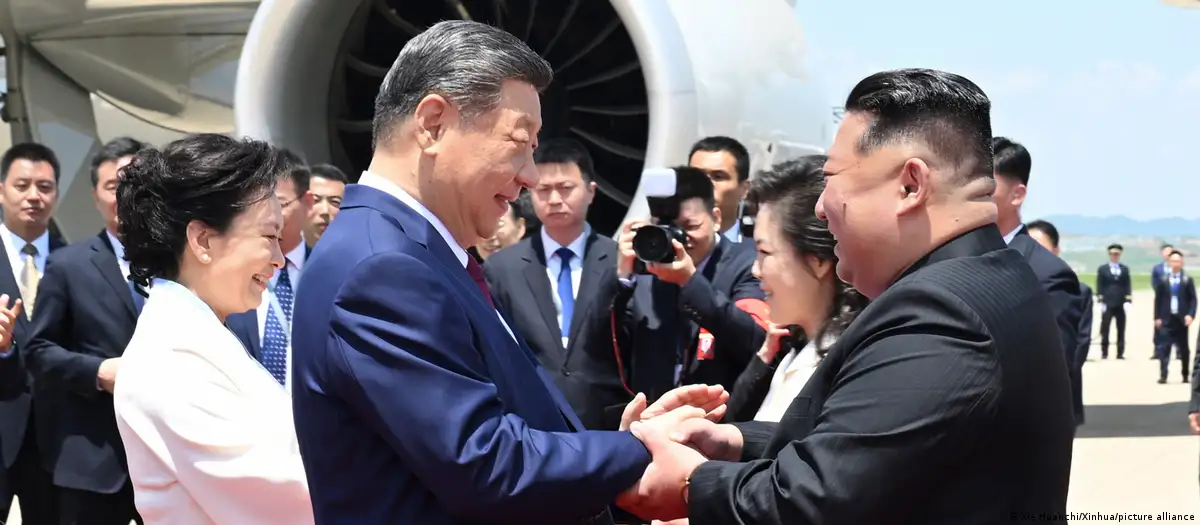
Can Xi bring North Korea closer into Beijing's orbit?
Advertisement
Skip next section News
News
06/08/2026
June 8, 2026
China's Xi begins rare North Korea visit
06/08/2026
June 8, 2026
Philippines lifts tsunami alert after deadly 7.8 earthquake
06/07/2026
June 7, 2026
India news: CJP demands minister's removal in seven days
06/07/2026
June 7, 2026
Taiwan deploys vessels in response to Chinese operation
06/07/2026
June 7, 2026
North Korea says nuclear program 'absolutely nonnegotiable'
Show more
Skip next section Reports & Analysis
Reports & Analysis
Philippines top diplomat on UN setback and alliance with US
Philippines top diplomat on UN setback and alliance with US
Secretary of Foreign Affairs Tess Lazaro speaks about her country's failed bid for a temporary Security Council seat.
India's worst air pollution crisis isn't in its megacities
India's worst air pollution crisis isn't in its megacities
Delhi's air quality crisis is well known, but women in the coal belt towns showed their air is far worse, forcing change
India's 'Cockroach' movement — and why it matters
India's 'Cockroach' movement — and why it matters
Thousands of supporters of India's Cockroach Janta Party took to the streets of New Delhi, taking the movement offline.
Pakistan's paradox: Rising power, fragile state?
Pakistan's paradox: Rising power, fragile state?
Pakistan is back on the global stage, but at home, the country faces deep challenges that could hold it back.
North Korea quietly ramps up its nuclear program
North Korea quietly ramps up its nuclear program
This week, Kim Jong Un took a publicity tour of a new nuclear fuel facility while promising to build more bombs.
Tiananmen dissident lambasts China on massacre anniversary
Tiananmen dissident lambasts China on massacre anniversary
Wu’er Kaixi, who played a key role during the 1989 protests, talks about his personal loss and decades in exile.
Show more
Advertisement
Skip next section In the spotlight
In the spotlight
Taliban, Russia are cozying up to each other — why?
Russia has agreed to help the Taliban repair Soviet-era weapons as the Islamist regime seeks leverage against Pakistan.
India, Pakistan could be ready to talk 1 year after standoff
A statement from a prominent Hindu nationalist has sparked optimism for dialogue between the South Asian neighbors.
Inside India's ghost villages, where new life is returning
Rising heat emptied more than 1,700 villages in northern India. Now a younger generation is returning with new ideas.
India: The toxic beauty of marble waste
Beautiful yet dangerous, Kishangarh's marble dumps attract tourists but spread toxic dust and pollute groundwater.
How China keeps North Korea's economy alive
Pyongyang relies on China for 95% of its legitimate trade; hacking, arms deals and remittances also help it stay afloat.
How can Kazakhstan navigate ties with Russia and China?
Kazakhstan is stuck between Russia and China. It needs to deal with both, without depending too much on either.
Skip next section Living
Living
Berlin's new Hindu temple
Many Hindus in Berlin are aiming to keep their faith alive far from home.
In India, a simple pair of glasses brings new hope
New vision aids are restoring sight in India and creating new opportunities for education, work and independence.
US bourbon bets big on India's growing market
The US bourbon industry, facing its most serious inventory crisis in decades, is looking to India to boost sales.
Advertisement