Germany updates: Protestors derail AfD leader's interview
Published July 19, 2025last updated July 20, 2025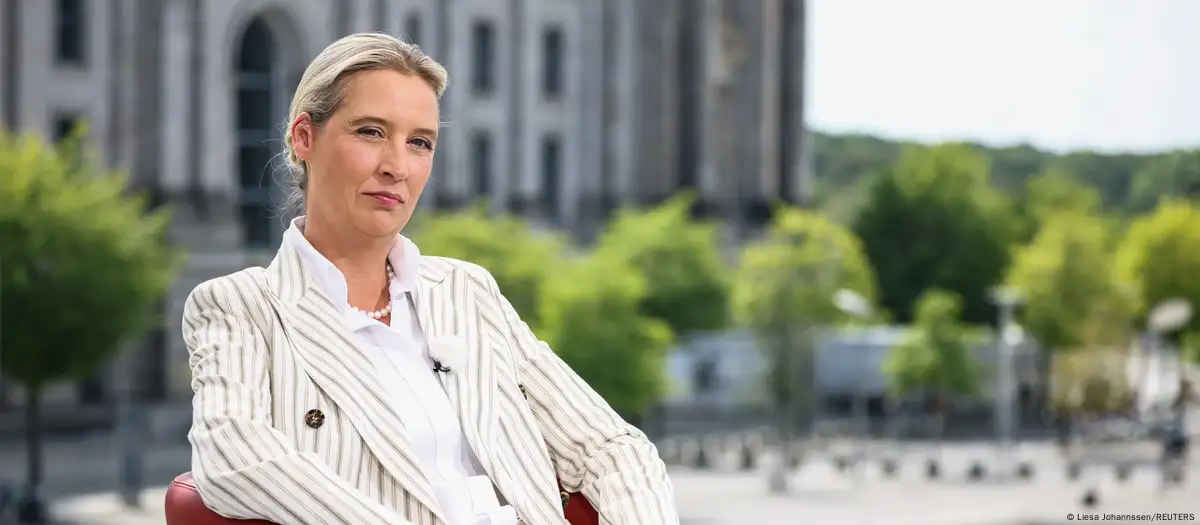
What you need to know
Bundestag President Julia Klöckner says Germany's lower house of parliament is under constant cyberattack.
On Sunday, she called for beefed-up cyber defenses as well as expanded rights for parliamentary police when screening visitors.
Meanwhile, Vice Chancellor Lars Klingbeil is pushing to revive a postponed Bundestag vote on law professor Frauke Brosius-Gersdorf's controversial nomination to Germany's top court.
Also in Berlin, Alternative for Germany (AfD) leader Alice Weidel found herself unable to hear the questions during a prime-time interview when rowdy protestors broke out into song and dance below where they were filming.
This blog is now closed. For the latest updates on Monday, July 21, follow our new Germany updates blog.
Here's a roundup of events, backgrounders and analysis in Germany on Sunday, July 20:
Green Party leader says Merz government lacks climate ambition
Environmentalist Green Party leader Franziska Brantner has accused the federal government of deceiving voters and taking a step backwards on climate protection.
In a summer interview on ZDF television on Sunday, Brantner said the black-red coalition government led by Chancellor Friedrich Merz of the conservative Christian Democratic Union (CDU) was lacking ambition when it came to climate policy.
"I find it alarming when I see that Mr. Merz obviously does not recognize the seriousness of the situation when it comes to climate protection," she said.
Brantner was referring to statements made by the chancellor, in which Merz said it would be pointless for Germany alone to be climate neutral.
The Green Party leader emphasized the importance of Germany taking a leading role in new technologies such as electricity storage, hydrogen or the digitalization of electricity grids.
Meanwhile, Brantner went on to criticize the government's plans to build new gas-fired power plants. Economics Minister Katherina Reiche (CDU) recently pushed for it to be done quickly.
"Ms. Reiche is focused on fossil fuels," said Brantner, describing her as "rather petrified in the head."
When asked during the interview, Brantner also expressed scepticism about the CDU as a possible coalition partner in the future: "The CDU is currently not promising," she said.
Protestors decry planned baboon killings at Nürnberger zoo
Animal rights activists chained themselves to the baboon enclosure at a Bavarian zoo to protest against the planned killing of healthy animals on Sunday.
"With the planned killing of baboons, the zoo is setting a precedent that will enable other zoos to kill healthy primates at will in future, which has not been permitted up to now," argued Emilia Schüler of the Animal Rebellion group.
She described the zoo's plans as "not only a setback to animal rights, but an absolute crossing of red lines."
Silent protest created little distruption
Six people carrying posters led a peaceful silent protest at the Nürnberger Tiergarten, police said. Five of the protesters chained themselves to the barrier around an enclosure.
As they were leading a silent protest they refused to communicate with officers and did not heed instructions by the zoo director to leave or use a protest venue outside the zoo, police added.
Since the action barely disturbed visitors and operations at the zoo, police and management agreed to refrain from using force to remove the protesters.
A protestor who had not chained herself to the railing ended her demonstration in the afternoon and was detained and processed before being released.
Shortly before the Tiergarten closed, the police again ordered the protesters to unfasten their chains and leave the park. If they failed to comply, they were warned that the fire department would remove the chains, which would incur corresponding costs.
The five remaining protestors removed the locks themselves at around 18:45 and once their identities were established and the police processed them, they were removed from the square.
The six individuals will face criminal charges on suspicion of trespassing.
Over-populated Guinea baboons were to be killed
In February 2024, the city-run Nürnberger Tiergarten zoo announced plans to kill some of its Guinea baboons because the group had become too large for the facility. It had led to an increase in conflicts within the group that led to animals getting injured, the zoo argued.
The facility says it has been trying for years to reduce the size of the Guinea baboon group and sell off animals, but without success so far.
Germany honors Nazi resistance on anniversary of Hitler assassination attempt
Leading German politicians gathered in Berlin Plötzensee on Sunday to mark the 81st anniversary of a failed assassination attempt on Adolf Hitler, and to honor those who stood up to Nazi repression despite grave danger to themselves and their families.
Federal Justice Minister Stefanie Hubig told those gathered that the best way to honor the bravery shown by the men behind the failed 1944 attack was to stand up in the defense of democracy today.
"Law and democracy are under threat; we all know it, we feel it every day," she said. "Today, it requires all of us to defend that order. And how easy it is to do today compared to then."
Speaking of Claus Schenk Graf von Stauffenberg and those with whom he carried out the plot to kill Germany's dictator, Hubig said, "They followed their conscience… and the thing that bound them together was their desire to lead Germany back to lawfulness and humanity."
Federal Cultural Minister Wolfram Weimer and Berlin Mayor Kai Wegner both spoke of the "incredible courage" not only of those who stood up to the injustice of the Nazi regime, but also that of their families — with both emphasizing the very real threats of expropriation, prison and execution for anyone, be it wives, mothers or children.
Actor and author Matthias Brandt, the son of former German Chancellor Willy Brandt, also spoke at the memorial. He recalled his father's own exile after fleeing the Nazis, as well as the opprobrium he and others who fought them faced after the war was over, describing how they were defamed as "traitors."
Brandt warned that racism and exclusion was again creeping into German society, admonishing "We must not remain silent."
Sunday's ceremony took place at the site where Stauffenberg and his accomplices were executed. He himself was executed just hours after his July 20, 1944, assassination attempt.
In all, some 2,800 political prisoners were beheaded or hanged at the site, which served as an army officers' headquarters, between 1933 and 1945.
Protest action derails far-right leader's big interview
Alice Weidel, one of the co-chairs of the far-right Alternative for Germany (AfD), was due to give the big "summer interview" that the leaders of the country's main political parties traditionally give to public broadcaster ARD.
However, as she was preparing to begin the question and answer session on a terrace in Berlin's government quarter, demonstrators arrived nearby.
Breaking out into loud singing, dancing, and chanting, they made it extremely difficult for Weidel to hear the questions she was being asked.
She pressed interviewer Markus Preiss to continue despite the difficulty, resulting in what Preiss described as an "acoustically difficult situation."
"At points we really couldn't understand each other," he said afterward.
Germany faces EU plan to ban combustion fleet sales by 2030
The European Commission is preparing to ban combustion engine vehicles for company fleets and rental car providers starting in 2030 — a move that some in the industry say would hit Germany's auto market especially hard.
According to Bild am Sonntag, the plan would affect about 60% of all new vehicle sales across the EU, with only 40% of the market made up of private buyers. In 2023, 10.6 million vehicles were sold EU-wide.
The Commission intends to present the proposal by late summer and launch the legislative process. Approval by both the EU Council and European Parliament will be required. A Commission spokesperson confirmed work on the regulation but declined to provide details.
German voices are already pushing back. European lawmaker Markus Ferber, from Bavaria's conservative Christian Social Union, urged Commission President Ursula von der Leyen to scrap the plan. In a letter seen by Bild, he warned that fleet operators would be forced to buy only electric vehicles to meet quotas.
Rental firm Sixt board member Nico Gabriel called the measure unrealistic. "Vacationers will hardly use rental cars anymore, and consumers will barely be able to lease vehicles," he said, pointing to a lack of charging infrastructure across the EU. Other rental firms told Bild they expect prices to rise as a result.
Klingbeil insists on court nominee, calls for new vote
Vice Chancellor Lars Klingbeil, from the Social Democratic Party (SPD), is standing by the nomination of Frauke Brosius-Gersdorf to the Federal Constitutional Court and has called for a repeat of the judge election in the Bundestag.
Speaking to Bild am Sonntag, Klingbeil said alleged plagiarism concerns raised by the opposition had been addressed, adding: "We can now put the vote back on the Bundestag agenda."
The Christian Democratic Union/Christian Social Union (CDU/CSU) remains cautious. "We are not under time pressure and will discuss this calmly within the coalition," a parliamentary group spokesperson told the Rheinische Post newspaper. They added that plagiarism was never the main issue, saying: "There are fundamental, substantive concerns within the parliamentary group."
Brosius-Gersdorf has become the focus of a rare political clash over appointments to Germany's highest court. The CDU/CSU initially approved her nomination alongside two other candidates, but last Friday abruptly withdrew its support and urged the SPD to drop her candidacy.
Opponents of the nominee, a law professor, have cited her perceived liberal views, with some media portraying her as "ultra-left" views on issues such as abortion.
Brosius-Gersdorf insists her opinions have been misrepresented, accusing the media of "inaccurate and incomplete, unobjective and non-transparent" reporting.
Klingbeil framed the controversy as a test of principle. "It's a fundamental question of whether we yield to pressure from far-right networks that have smeared a highly qualified woman," he told the Bild am Sonntag newspaper.
Correction 23.7.2025: A previous version of this post referred to Lars Klingbeil as chancellor-designate when he is in fact the vice chancellor. This has now been corrected, DW apologizes for the mistake.
Bundestag president calls for new parliamentary police law to protect lawmakers
Julia Klöckner also called for a new parliamentary police law to better protect the Bundestag and politicians against potential physical attacks — specifically when it comes to ID checks among visitors to the popular institution.
Currently, says Klöckner, domestic security services cannot share information about an individual visitor's criminal records or threat potential with Bundestag police, a situation she blasted as "absurd."
Germany's Bundestag is the most-visited parliament in the world according to Klöckner, with more than 2 million citizens attending sessions each year.
Bear that killed runner in Italy moves to German sanctuary
A female brown bear, known as JJ4 or Gaia, that killed a jogger in Italy in 2023 has been relocated to a wildlife sanctuary in Germany.
The move follows legal battles and protests, after the bear — originally set to be euthanized — became the center of a debate over human-wildlife conflict.
Parliament under constant cyberattack, says Bundestag President Klöckner
Bundestag President Julia Klöckner, speaking with German press agency DPA, called for increased defensive capabilities at the country's parliament, saying it is under constant attack.
"We are recording numerous hacker attacks… the Bundestag is a prime target," said Klöckner, whose position as president of the body is similar to that of the speaker in many other countries.
"We will have to boost our capacity to resist against cyberattacks," she said in remarks to be published Sunday.
"If the German Bundestag were to be shutdown during the reading of a bill or a vote, for example, and deadlines could not be met… that would be a triumph for hackers," said Klöckner. "Defending ourselves against this has to do with the stabilization and resilience of our democracy," not only the protection of the parliament.
The last overhaul of the system was prompted by a May 2015 cyberattack in which the computers of numerous parliamentarians — and even Chancellor Angela Merkel — were infected with spyware.
Five years later, Merkel announced that an investigation had turned up "hard evidence" of Russian involvement.
Russia was also accused of being behind a 2023 cyberattack on the email accounts of then-Chancellor Olaf Scholz's Social Democratic Party (SPD). It remains unknown who was behind a 2024 cyberattack on the headquarters of Klöckner's own Christian Democratic Union (CDU) party.
Wadephul warns USA against escalating tariff war
German Foreign Minister Johann Wadephul has warned the United States against escalating the tariff war with the European Union (EU).
"This would lead to everything becoming more expensive for consumers in the USA," he told the Bild am Sonntag newspaper. "The European Union is not defenseless."
Wadephul insisted that EU member states were standing together and that he didn't fear an end to the resistance.
"Indeed, there are states which are demanding more stringency and toughness than Germany thinks is right," he said.
Wadephul reiterated the German government's belief that "the complete dismantling of all tariffs" is the preferred approach, and that "we can reach a positive agreement with the USA through negotiation."
He said that Chancellor Friedrich Merz is heavily involved in the discussions, saying: "Germans can count on the fact that there is a chancellor standing up for our interests and European interests in Washington."
German Foreign Minister open to deportations to Syria
After the new German government resumed deportations to Afghanistan this week, Foreign Minister Johann Wadephul has floated a similar approach for Syria – despite the current unrest in the war-torn country.
"It's possible that, in future, Syrians who have committed criminal offenses [could be] deported," he told the BILD am Sonntag newspaper. "I think that's possible in principle – provided the country develops in [the right] direction."
Southern Syria has been rocked by violence again this week, with the new Islamist-led regime in Damascus struggling to prevent clashes between Druze and Bedouin factions in Sweida and powerless to stop Israeli intervention. Hundreds of people have reportedly been killed.
"We are watching Syria with concern," said Wadephul, calling on the interim government under Ahmed al-Sharaa to ensure that all sections of the population and all religious groups can co-exist.
"No-one should have to fear for life and limb," he said. "But as it stands, we are of the opinion that we have to give this interim government a chance."
Euro 2025: Germany beat France on penalties to reach semi-final
Germany spectacularly reached the semi-final of the Women's Euro 2025 on Saturday night, beating France 6-5 on penalties despite having been reduced to ten players for the majority of the evening.
Kathrin Hendrich was sent off in the 13th minute for tugging on an opponent's hair in the penalty area, after which Grace Geyoro gave France the lead from the penalty spot. But Sjoeke Nüsken headed Germany level just nine minutes later.
What followed was 100 minutes of defensive attrition from Germany to somehow reach extra-time and then penalties, where goalkeeper Ann-Katrin Berger was the heroine.
Germany will face Spain in the semifinal on Wednesday. The other semifinal sees defending champions England play Italy.
Stuttgart: Police shoot man after shots fired from house
German police on Saturday shot dead a man who had fired shots at passersby and neighboring buildings in the small town of Leonberg, just west of the city of Stuttgart in the southwestern state of Baden-Württemberg.
Local police and state prosecutors said the 44-year-old German man had indiscriminately fired shots from the second floor of his house, fortunately injuring nobody.
When armed police entered his apartment, he reportedly threatened officers with his weapon and was subsequently shot.
Police secured the weapon which turned out to be a non-lethal gas pistol. Whether or not this was the weapon used to fire the shots from the house was not immediately clear.
The state criminal police office (LKA) is also investigating the police's use of firearms in the operation.
Merz: Germany must be safe space for Jews
German Chancellor Friedrich Merz on Saturday honored the Central Council of Jews in Germany for its role in society on the 75th anniversary of its founding.
"Jewish life is a part of us," wrote Merz on the messaging platform X, adding that the organization reminds everyone in the country of something "that should be obvious: Germany must be a safe space for Jews."
Federal President Frank-Walter Steinmeier also honored the day, saying that he was "deeply thankful" that the organization's first leaders had determined to "rebuild Jewish life in Germany in the aftermath of the Shoah [Hebrew for catastrophe, refers to the Holocaust, the ed.]."
Steinmeier said that beyond not letting Germany forget the crimes of its Nazi past and fighting antisemitism, the Central Council of Jews in Germany served as "an important driving force behind the democratic development of German society after 1945."
The institution, which functions as Germany's main political, societal and religious representative for Jews in the country, was founded on July 19, 1950, in Frankfurt — just five years after the end of World War II and the industrial-scale murder of more than six million European Jews at the hands of Germany's Nazi dictatorship.
Today the council comprises some 105 communities and associations, and 100.000 individual members.
Most Germans oppose far-right AfD ban, poll finds
A majority of Germans have opposed banning the far-right Alternative for Germany (AfD), according to a new poll.
The survey by the Allensbach Institute, published Saturday by Frankfurter Allgemeine Zeitung, found that 52% of respondents reject a ban on the party, while 27% support it. In eastern Germany, two-thirds of those surveyed said they were against such a move.
According to the researchers, one key reason is that many Germans know AfD supporters personally. In the West, 67% said they had AfD sympathizers in their social circles; in the East, that figure rose to 88%. While 54% of respondents described the AfD as far-right, only 5% viewed their acquaintances who back the party in the same way.
Another factor behind the opposition to a ban is mistrust toward the parties advocating it. Many respondents suspect those parties are mainly trying to eliminate a political rival that has grown too strong.
The idea of a ban is divisive within Germany’s governing coalition. The center-left Social Democratic Party voted unanimously at its June 29 party congress to prepare proceedings and called for a federal-state working group. The center-right Christian Democratic Union/Christian Social Union has pushed back, citing steep legal hurdles and urging a focus on political argument.
Two parties have been banned in (West) Germany, an openly neo-Nazi party in 1952 and the Communist Party (KPD) in 1956.