MSC: EU eyeing new security strategy, says Kaja Kallas
Published February 13, 2026last updated February 15, 2026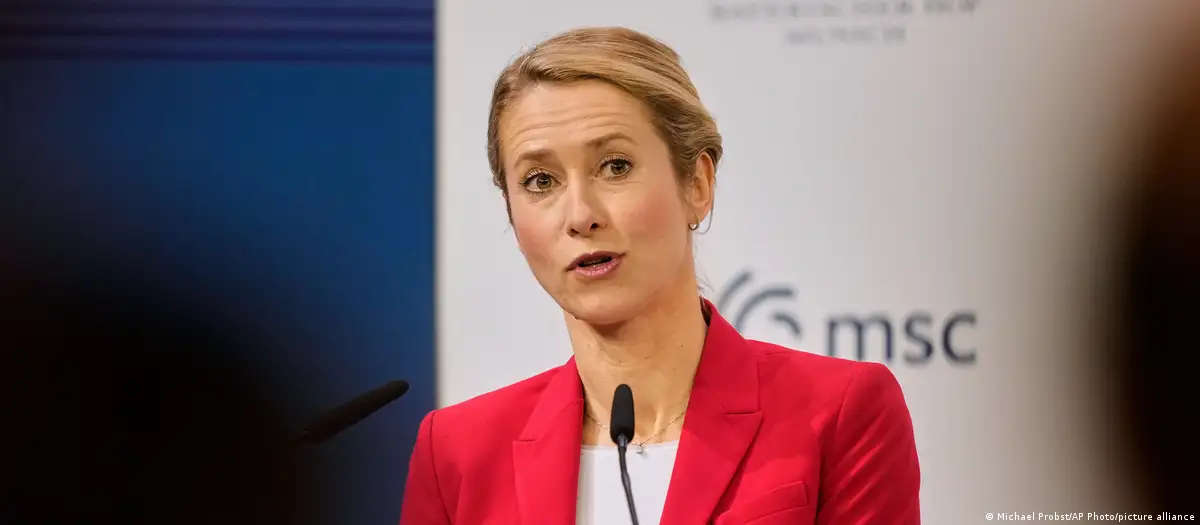
What you need to know
- EU foreign policy chief Kallas says she is working on a 'new European security strategy'
- Ukrainian President Volodymyr Zelenskyy says Russia's Vladimir Putin is a 'slave to war'
- Danish Prime Minister Mette Frederiksen says Trump is still 'very serious' about acquiring Greenland
- US top diplomat Marco Rubio highlights Christianity, cultural ties with Europe at the Munich Security Conference
- China's Wang Yi defends the UN and slams US-led 'return to the law of the jungle'
- Germany's and India's foreign ministers also defend multilateralism and the UN
This blog is now closed. Thank you for joining us on the weekend of February 13 - 15 for special coverage of the 2026 Munich Security Conference (MSC).
MSC 2026: Key moments and takeaways
This year's Munich Security Conference came amid growing differences in the US-European trans-Atlantic partnership under the Trump administration. Last year's MSC was roiled by a speech from US Vice President JD Vance, who chided Europe over free speech and migration, leading to backlash from European officials at the conference.
The 2026 MSC occurred as Russia's invasion of Ukraine soon enters a fifth year. It also comes as Palestinians in Gaza look towards the future amid the rubble after the Israel-Hamas war.
Here's a look at the key moments and takeaways from this year's event:
German Chancellor Merz urges new 'partnership' with US
- German Chancellor Merz, in his speech, urged a 'revival of 'trans-Atlantic trust'
- In a rebuke of Vance, Merz said 'the culture war of the MAGA movement is not ours'
- The German chancellor said in an era 'of great power rivalry' the US cannot go it alone
Germany's ties with China, India could get stronger
- As US-Europe ties grow uneasy, Germany might be strengthening its ties with other 'great powers'
- Chinese FM Wang Yi told German Chancellor Friedrich Merz at the MSC that he hopes to boost ties and trade
- Meeting with Indian top diplomat, S. Jaishankar, German Foreign Minister Wadephul called India 'one of the most important partners' for Germany
France's Macron, UK's Starmer were also in attendance at MSC 2026
- French President Emmanuel Macron said Europeans 'should be proud of ourselves'
- Macron urged Europe to not give into Russia's demands on Ukraine
- UK PM Keir Starmer called for a closer UK-EU defense partnership: 'We have huge defense capabilities'
- Starmer also announced at the conference that a group of British warships will be deployed to patrol Arctic waters
Rubio gives softer speech, but repeats Trumpian criticisms of Europe
- US Secretary of State Marco Rubio was the top official from the Trump administration at the 2026 MSC
- Rubio's speech was softer in tone than Vance's was a year prior
- The US and Europe 'belong together,' Rubio said, while noting Christianity ties the two continents
- At the same time, he criticized mass migration and efforts to combat climate change
Ukraine's Zelenskyy: 'Maximum pressure' needed on Russia
- Ukrainian President Volodymyr Zelenskyy urged the world 'exert maximum pressure on Russia'
- Zelenskyy said sanctions could be used to decrease the price of Russia oil
- He denounced Vladimir Putin as a 'slave to war' as Russia's invasion presses on
- Zelenskyy called on Trump to push Putin into a ceasefire to enable new Ukrainian elections
EU foreign policy chief rebukes Rubio, plans new security strategy
- EU foreign policy chief Kaja Kallas shot back at Rubio's earlier criticisms, saying 'Europe is not facing civilizational erasure'
- Kallas also said she is working on a 'new European security strategy' to counter Russia during a more hostile geopolitical era
- She called on EU members 'think more European' in their defense policies
Mass protests against Iranian regime near MSC
- As world leaders gathered at the MSC, 250,000 demonstrators gathered in Munich against the Iranian government
- Reza Pahlavi addressed the demonstrators and called for the US to intervene
Zelenskyy says allies to provide Ukraine with new energy and military aid
According to President Volodymyr Zelenskyy, Ukraine has agreed to new energy and military support packages with European allies within the next 10 days.
"In Munich, we agreed with the leaders of the Berlin Format on specific packages of energy and military aid for Ukraine by February 24," Zelenskyy wrote on X.
February 24 will mark the fourth anniversary of Russia's full-scale invasion of Ukraine.
"I am grateful to our partners for their readiness to help, and we count on all deliveries arriving promptly. Ukraine needs air defense every day to deprive Russia of leverage through terror," he added, thanking allies for help.
Zelenskyy also stated that Russia had launched approximately 1,300 attack drones, 1,200 guided aerial bombs, and dozens of ballistic missiles at Ukraine in the past week alone.
On Friday, after a meeting of the so-called Berlin Format of about a dozen European leaders in Munich, Zelenskyy said he had hoped for new support, including air-defense missiles.
Estonian FM Tsahkna at MSC: 'We will bring war to Russia' if Kremlin orders attack
DW's Chief International Editor Richard Walker spoke with Estonian Foreign Minister Margus Tsahkna regarding European defense and security threats from Russia.
Walker asked Tsahkna his view on US Secretary of State Marco Rubio's speech this weekend, and whether he feels "reassured" as Tsakhna's country is considered one of the most vulnerable countries of NATO.
"Actually, the story that Estonia is one of the most vulnerable countries in Europe is a fake news," Tsahkna replied. "We know exactly what to do. We're prepared for a probable Russian invasion and deterrence is really strong."
Tsahkna said the idea that Russia would attack Estonia as one of its first targets "is like a classical understanding about the invasion."
"And if you see the map that it's very logical," Tsahkna said. "But in real life what we do is that we are increasing heavily our capabilities. I think that NATO is stronger than ever before."
Tsahkna said Estonia has developed "new defense plans."
"If Russia is coming to our territorties and then fighting back, we will bring the war to Russia to strike capabilities," Tsahkna said.
In regards to trans-Atlantic relations, Tsahkna said "we will never see such a US anymore as it was in the past."
"But we cannot just be in a defensive position as Europe. We must move forward," Tsahkna said. "We have to have vision and self-confidence. And here in Munich, in different meetings, I see that it is starting to happen."
Rubio's speech is 'a poisoned declaration of love' to Europe says MEP
"A poisoned declaration of love" to Europe — that's how Marie-Agnes Strack-Zimmermann, chair of the European Parliament's Committee on Security and Defense, describes US Secretary of State Marco Rubio's speech at the Munich Security Conference.
"He was nice, but the message was the same. No talk of Article 5, democracy, shared values, or Ukraine — just 'you do your thing, we do ours,'" Strack-Zimmerman, who previously served in the German Bundestag as member of business-friendly Free Democratic Party (FDP), said.
On Ukraine, she warns Europe is absent where it matters most: "We should first fight to sit at the negotiation table, the US is no neutral mediator and we are missing."
She also called Rubio's trip to Hungary and Slovakia after Munich a signal toward nationalist forces: a "movement" that "wants to change the world order, without rules, the poison of nationalism that splits Europe." Both Slovakia's PM Robert Fico and Hungarian PM Viktor Orban are nationalist leaders who have expressed sympathies with Russia.
Strack-Zimmermann's takeaway: Shed naivety and act from strength — or others will decide Europe’s future.
Editors' note: We changed the quote at the start of the entry from "A poisoned love letter to Europe" to "A poisoned declaration of love," to Europe.
Former NATO chief Stoltenberg: Trans-Atlantic ties face 'serious problems' but are 'not over'
DW Brussels correspondent Teri Schultz spoke with former NATO Secretary-General Jens Stoltenberg on the sidelines of the Munich Security Conference about the state of trans-Atlantic ties during the second term of US President Donald Trump.
Stoltenberg, who is currently Norway's minister of finance, is expected to take over as chairman of next year's MSC event, succeeding Wolfgang Ischinger.
"It's obvious, everyone can see that the trans-Atlantic relationship is facing some serious problems, some serious disagreements. And I think we see a fundamental change in that relationship," Stoltenberg said. "But that doesn't mean that it's over."
"I believe strongly in Europe and North America working together because we are safer when we work together. And then we need to address the disagreements on tariffs, on trade, on Greenland. And I think that this Munich Security Conference actually was an invitation to do exactly that," he said.
Stoltenberg said this year's MSC is "calmer" than last year's event. During last year's MSC, US Vice President JD Vance chided Europe over issues such as the state of free speech and migration on the continent.
This year, US Secretary of State Marco Rubioled the delegation of Trump administration officials to the MSC.
'Calmer' MSC this year due to Rubio's message
"Things are calmer because the message from Secretary Rubio was that he wants to have dialogue with Europe. And he also recognized the importance of Europe and other allies, Canada," Stoltenberg said.
Amid Trump's push for US acquistion of Greenland, Stoltenberg said compared to "where we were some weeks ago or last year, we are in a much better place because now at least there is a process." The ex-NATO chief noted there is ongoing dialogue between the US, Denmark and Greenland pertaining to the issue.
Stoltenberg said it is a "valid point" that the Trump administration is calling for NATO allies to spend more on defense. He said Europeans "are delivering" on this issue.
Stoltenberg praised Mark Rutte, his successor as NATO chief.
"I have great respect for Mark Rutte," Stoltenberg said. "He has faced enormous challenges, and he has managed them in a good way."
US alliance with Arctic allies 'so important,' says Alaska senator
US Republican Senator Lisa Murkowski acknowledged that President Donald Trump's threat to seize Greenland has "not helped" trans-Atlantic ties, but said alliances with the seven Arctic allies were "so important."
"There's been some tension — and that is probably putting it mildly. But we must not lose sight of the true threat ... from Russia," Murkowski, the senator for Alaska, told DW on the sidelines of the Munich Security Conference.
"I'm looking at things right now through the lens of Arctic security. How do we push back against Putin and his ambitions in a way that demonstrates solidarity, strength and capability?"
Murkowski said she was confident that Trump's rhetoric over Greenland would now be "dialed down" as both Washington and Brussels "figure out how we come together based on our shared values."
She continued: "It's all about how ... how we approach the Arctic with a realism and a pragmatism," adding that the 1951 framework between the US and Denmark needs to be "modernized."
The deal, signed under NATO auspices, has long governed US military access to Greenland, including the operation of key facilities such as Thule Air Base.
Last month, on the sidelines of the World Economic Forum in Davos, the Trump administration agreed to the framework of a deal that helped defuse the Greenland dispute.
ECB's Lagarde says Trump's 'kick in the butt' is uniting Europe
European Central Bank (ECB) President Christine Lagarde said Sunday that "in times of crisis, Europe gets stronger, gets better together."
Lagarde was speaking during a panel discussion on the third and final day of the Munich Security Conference (MSC).
In addition to the crises stemming from the war in Ukraine and the rising cost of living, she said, US President Donald Trump's "change of attitude towards Europe" — which she described as "a kick in the butt" — does "bring the leaders of Europe, the policymakers, much closer together."
"That needs to continue," Lagarde said.
Alongside her on the stage, Estonian Prime Minister Kristen Michal said he believes Europe will emerge from the current security crisis "much stronger than we used to be."
Michal also called for Europe to modernize and develop a "simpler, more digitized environment" with fewer rules that hinder competitiveness, particularly in relation to the US and China.
Germany's Minister for Digital Transformation and State Modernization, Karsten Wildberger, said that while Europe has "so much to offer," it is being held back by regulation.
"We have overdone it with regulation, we need to really cut down and give the creative forces in our countries much more space — the companies, the entrepreneurs, we have to liberate that. We can't regulate everything," he added.
US 'deeply appreciates' European defense commitments, says senator
The United States welcomes the increased commitment to defense spending by NATO's European partners in recent months, US Democratic Senator Chris Coons told DW on the sidelines of the Munich Security Conference.
In another sign of easing tensions in trans-Atlantic ties, Coons, who has been critical of the Trump administration's foreign policy direction, said: "We deeply appreciate the investments being made by our NATO partners and allies."
"We have more resources dedicated to defense than in decades. Germany, in particular, is really stepping up," the Delaware senator continued, adding that there is strong and sustained support from the US delegation here for NATO and for US-EU ties.
Coons acknowledged that trans-Atlantic relations had been hurt by US President Donald Trump's tariffs and the threat to seize Greenland from European Union member Denmark, adding that it was important to "restore trust."
"Let us show you that we are trustworthy, that we are the reliable partners that you've come to count on for decades and find ways that we can share the burden of our shared defense and security needs and find a positive path forward," he added.
Kallas urges EU members to abandon 'national defense thinking' in favor of European approach
At the panel discussion following her speech, the EU's foreign policy chief Kaja Kallas called for EU members to shift their thinking when it comes to national defense.
She urged them to "think more European, not national."
"Think regional because the threat is European, so the answer should be European," she said.
Latvian President Edgars Rinkevics said one of the main obstacles to creating an agile and effective European army are the bureaucratic hurdles that block EU member states' militaries from crossing internal EU borders.
He said a "military Schengen" would be needed to facilitate the movement of military personnel and hardware, referring to the border-free zone within Europe that allows for the free movement of goods and people.
On the issue of boosting defense expenditure, French minister delegate for Europe, Benjamin Haddad, said increasing defense spending only to buy from abroad "makes no sense."
Haddad called for a "European preference" for arms procurement, calling such an approach "common sense."
The other member of the panel, NATO Deputy Secretary-General Radmila Sekerinska, agreed that alliance members — on both sides of the Atlantic — "need to produce more" weapons and military equipment.
What did Kallas say about Ukraine's bid to join the EU?
Kallas also addressed the issue of the timeline of Ukraine's accession to the EU, saying she does not get the sense that members are prepared to set a "concrete date."
"There's a lot of work to be done, and then the priority and the urgent need is to move, and show that Ukraine is part of Europe," she said.
EU eyeing new security strategy amid Russia threat, Kallas tells MSC
The European Union's foreign policy and security chief, Kaja Kallas, has said she is working on a "new European security strategy" with European Commission President Ursula von der Leyen.
The strategy will address "all dimensions of European security" to better deal with the threat of Russia and a more hostile geopolitical era.
Defense is a key priority. "This starts in Ukraine, but we know Russia's endgame is not the Donbas," she said, pointing to Russia's alleged hybrid warfare and sabotage of critical European infrastructure.
"Russia's maximalist demands cannot be met with a minimalist response," Kallas said.
Opening a panel entitled "Europeans Assemble! Reclaiming Agency in a Rougher World," Kallas hailed the bloc's identity, achievements and appeal in a pointed response to recent remarks from the US about the state of European civilization.
"Contrary to what some people say, woke, decadent Europe is not facing civilizational erasure," she said, before acknowledging that the EU "can be too slow" and "needs reform."
She also identified EU enlargement as "the antidote to Russian imperialism." Nine countries in Eastern Europe that were under the former Soviet Union's sphere of influence, including Ukraine, are candidates to join the bloc.
What is happening on Day 3 of the Munich Security Conference?
The Munich Security Conference (MSC) concludes on Sunday. Here is what to expect:
-
EU foreign policy and security chief, Kaja Kallas, will attend a discussion on how Europe can reclaim agency
-
Latvian President Edgars Rinkevics will also take part in that panel that starts at around 9 a.m. local time (8 a.m. UTC)
-
European Central Bank (ECB) president and former managing director of the International Monetary Fund (IMF), Christine Lagarde, will attend a talk on single markets
-
That talk, which starts from 10 a.m., will also feature Germany's Minister for Digitalization and Government Modernization, Karsten Wildberger, and Estonian PM Kristen Michal
-
Then, from 11 a.m., Norwegian Finance Minister Jens Stoltenberg, Croatian PM Andrej Plenkovic and the UK's Shadow Foreign Secretary Priti Patel will discuss the challenges to defending core European values that are increasingly under pressure
-
MSC chairman Wolfgang Ischinger will formally close this year's conference with his concluding remarks at 1 p.m.
Taiwan rejects China's defense of UN at MSC as hypocritical
Taiwan has accused China of hypocrisy and of being a threat to global and regional security.
Taiwan's Foreign Minister Lin Chia-lung was responding to comments at the Munich Security Conference (MSC) by his counterpart from China, Wang Yi, on Saturday.
During his speech in the southern German city, Wang fiercely defended the United Nations and the rules-based global order that are the foundations of world peace.
China's foreign minister also warned that some countries were trying to "split Taiwan from China" and blamed Japan for cross-strait tensions.
Under Beijing's "One China" policy, China considers the self-ruled island as a breakaway territory that will eventually be reunited with the mainland, either peacefully or by force.
China has also held regular rounds of military drills around Taiwan, with the latest war exercises near the island taking place in December.
Taiwan's top diplomat Lin on Sunday rejected Wang's claims that China is defending the United Nations Charter and that other countries are to blame for regional tensions.
"In fact, China has recently engaged in military provocations in surrounding areas and has repeatedly and openly violated UN Charter principles on refraining from the use of force or the threat of force," Lin said.
This approach "once again exposes a hegemonic mindset that does not match its words with its actions," the Taiwanese minister added.
China's FM eyes closer trade with Germany
Chinese Foreign Minister Wang Yi told German Chancellor Friedrich Merz that he hoped to upgrade bilateral ties and boost trade, according to a readout from China's state news agency Xinhua on Sunday morning.
During their meeting on the sidelines of the MSC on Saturday, Wang said that "China is willing to work with Germany to... push the China-Germany all-round strategic partnership to a new level."
Wang said that China's commitment to opening-up would provide "tremendous opportunities" for German companies, according to the readout. He also expressed hope that Germany would provide "a more fair and equitable business environment" for Chinese firms.
Wang also met with Canadian Foreign Minister Anita Anand, among others. He hailed the Canadian government's strategic partnership with Beijing, which the Chinese side called "an entirely correct choice."
Rubio covers all bases at high-level meetings
US Secretary of State Marco Rubio has posted on X about some of meetings with world leaders and foreign ministers at the MSC on Saturday, in which he broached a number of Washington's more contentious foreign policies.
He met with his counterparts from the Group of Seven advanced economies (G7) with whom he underscored Washington's mantra of "strength through peace" and discussed both Venezuela and Ukraine.
Rubio said he also met with Ukrainian President Volodymyr Zelenskyy to discuss "deepening defense and economic partnerships."
"President Trump wants a solution that ends the bloodshed once and for all," he said on social media.
Rubio also discussed defense spending with Finnish President Alexander Stubb. Meanwhile, with Norwegian Foreign Prime Jonas Gahr Store he discussed, among other things, "the strategic importance of Greenland."
After meeting with Japan's Foreign Minister Toshimitsu Motegi, Rubio also said he was "proud to strengthen the US-Japan alliance as we enter a new Golden Age" — echoing comments made by Japan's Prime Minister Sanae Takaichi after her landslide election victory last week.
WATCH: Rubio balances softer tone with 'Trumpian' worldview
DW's chief international editor Richard Walker said European leaders at the MSC had several reasons to be relieved by US Secretary of State Marco Rubio's address, which struck a more gentle note compared to Vice President JD Vance's speech last year.
But Walker also said there also several reasons why this relief might be premature — most notably because "the thinking behind [the two speeches] appears to be the same."