Germany updates: Merz attends papal inauguration Mass
Published May 17, 2025last updated May 19, 2025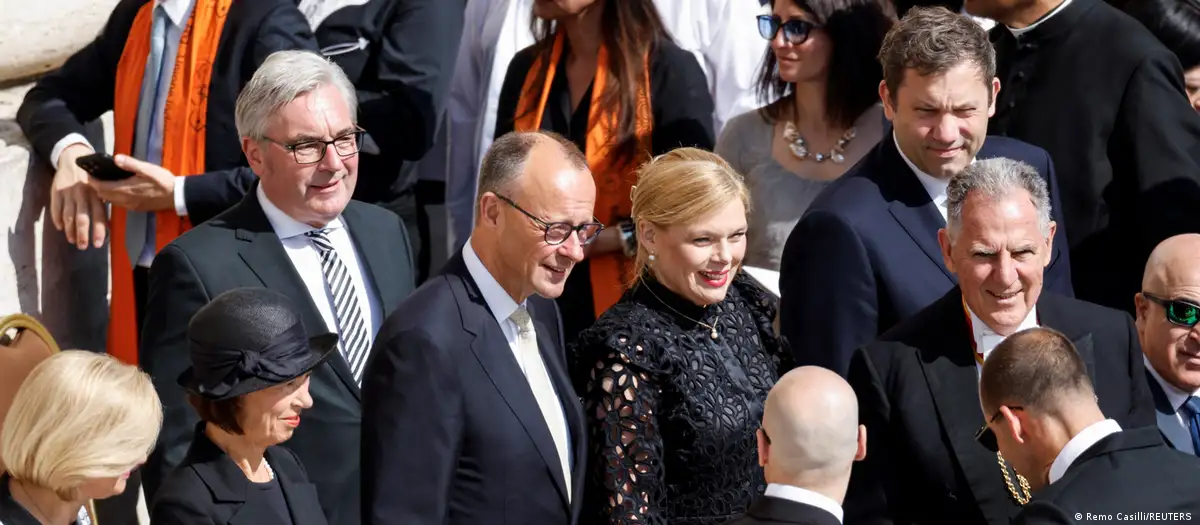
What you need to know
- German Chancellor Friedrich Merz attends Pope Leo XIV's inaugural Mass
- Merz met with several leaders, including Volodymyr Zelenskyy and top US diplomat Marco Rubio, after the ceremony at the Vatican
- Merz and European leaders hope speak to Donald Trump ahead of his call with Vladimir Putin on Monday
- Workers in Germany work fewer hours than most international counterparts — IW
This blog has now closed. Here are all the top news stories from Germany on May 18.
Germany boosts WHO spending by €10 million
Germany is increasing its support for the World Health Organization (WHO) to the tune of €10 million ($11.2 million) in response to the United States' announced withdrawal from the UN health body.
Berlin had already committed to an additional €2 million at the beginning of April, but has now increased that contribution significantly.
With the added contributions, the German government aims to support the Geneva-based organization following the departure of the US, its largest contributor.
The United States' withdrawal, at the behest of President Donald Trump, is set to take effect at the beginning of 2026.
Speaking during a meeting with WHO Director-General Tedros Adhanom Ghebreyesus in Geneva, German Health Minister Nina Warken said it was important for the health body to advance its reform process and focus on its core tasks.
These include global health monitoring, pandemic preparedness, disease control, and equitable access to medical care.
Warken is in Geneva for the opening of the WHO's annual assembly, which gets underway on Monday, during which a pandemic agreement is expected to be adopted.
This, she said, demonstrates what member states are capable of achieving: "Protecting the health of people worldwide through better cooperation."
Berlin has already supported the WHO by the amount of roughly €290 million during the 2024-2025 biennium, according to German health ministry figures.
German police hunt for suspect after 5 stabbed in Bielefeld
Police in Germany were searching for a man who allegedly carried out a knife attack at a bar in Bielefeld early on Sunday morning.
At least five people were injured, four of them seriously, police said in a statement.
One of the victims is in critical condition, the statement said. The injured are between 22 and 27 years old.
Police in the city in the western state of North-Rhine Westphalia said the alleged perpetrator had fled the scene on foot, warning that he might still be armed.
"According to current information, the suspect has attacked people indiscriminately. An intensive investigation is currently underway," Bielefeld police said.
Authorities have released a mugshot of the male suspect, who has been identified as a 35-year-old Syrian national, a resident of the nearby town of Harsewinkel.
German news agency DPA said the victims were soccer fans celebrating local team Arminia Bielefeld's victory on Saturday that secured the 3rd division league title.
Merz says Europeans to speak to Trump ahead of Putin call
German Chancellor Friedrich Merz has said that he and the leaders of the United Kingdom, France and Poland were hoping to speak to US President Donald Trump on Sunday evening ahead of his highly anticipated phone call with Russian President Vladimir Putin.
Trump has said he and Putin are due to speak on Monday to discuss ending the war in Ukraine.
Merz, who was in Rome on Sunday to attend the inaugural Mass of Pope Leo XIV, said he had discussed the matter with Trump's Secretary of State Marco Rubio.
"We agreed that we will speak again with the four state leaders and the US president in preparation for this conversation," Merz told reporters.
The German leader also said he had spoken to Ukraine's President Volodymyr Zelenskyy, who was also at the Vatican for the Pope's Mass on Sunday, about ongoing diplomatic efforts to end the war.
British Prime Minister Keir Starmer, French President Emmanuel Macron and Merz have spoken with Trump twice in recent days as Ukraine's Western allies align their positions in a bid to bring about a sustainable peace agreement with Russia.
Pope's inaugural Mass 'an uplifting moment' — Merz
German Chancellor Friedrich Merz said Pope Leo XIV's inauguration on Sunday was "an uplifting moment."
The conservative leader, who is a practicing Catholic, was in attendance at St Peter's Square in the Vatican along with thousands of believers and senior representatives from some 150 nations.
Merz, a former corporate lawyer who had a successful financial career, briefly met with the new Pope in St Peter's Basilica after the inaugural Mass.
During his homily, Leo XIV delivered a stinging critique of capitalism, slamming an "economic model that exploits the Earth's resources and marginalizes the poorest."
But Merz dismissed the notion that he was an intended target of the Pontiff's criticisms, which he said were one of the Catholic leader's "essential responsibilities."
"I believe the social market economy we have in Germany is only marginally addressed by that," Merz said, according to German news agency DPA.
Workers in Germany work fewer hours than most international counterparts — IW
In 2023, working-age residents of Germany worked an average of 1,036 hours, figures from an economic research institute showed on Sunday.
Only workers in two other of the 38 OECD countries put in fewer hours, according to statistics from German Economic Institute (IW) quoted by the weekly Bild am Sonntag: 1,027 hours in France and 1,021 hours in Belgium
New Zealand, the Czech Republic and Israel had the most industrious workers, with 1,402, 1,326 and 1,312 hours of labor, respectively, performed by working-age individuals on average.
Workers in Germany are spending longer working than they did just over 10 years ago, when the average was 1,013 hours.
That increase over the past decade has been far more marked in other European countries, however, with a 15% rise in Spain, 21% in Greece and 23% in Poland, compared with 2% in Germany.
The IW said it was "necessary to raise individual working hours in Germany."
The statistics come as new German Chancellor Friedrich Merz recently triggered a debate on working hours, calling on workers to make "a huge effort" and put in more time.
Business leaders have fueled the debate by calling for a public holiday to be canceled.
Merz attends papal inauguration Mass at Vatican
German Chancellor Friedrich Merz has attended the inauguration Mass of Leo XIV at the Vatican with a delegation that included Vice Chancellor Lars Klingbeil and Bundestag President Julia Klöckner.
Unlike his predecessor, Olaf Scholz, who was brought up as a Protestant before leaving the church and becoming Germany's first leader to not belong to any denomination, Merz is reportedly a practicing Catholic and as a student was a member of a Catholic student fraternity.
However, he has made few public statements regarding his religion.
On Saturday evening, he used his visit to Italy to hold a meeting with Italian Prime Minister Giorgia Meloni.
Merz mulls processing asylum claims in non-EU countries
German Chancellor Friedrich Merz, who has made curbing irregular migration one of his policy priorities, has suggested that asylum claims could be processed in countries that are not part of the European Union.
Merz's remarks came after his meeting in Rome with Italian Prime Minister Giorgia Meloni, whose right-wing government has tried to discourage illegal migration to Italy by sending asylum-seekers to Albania, which has been blocked by Italian courts.
Italy-built migrant detention centers in Albania as part of a scheme to deter irregular migrants picked up in the Mediterranean from traveling to Italy.
While her government has had to shelve those plans because of the judicial opposition, Italy has instead started using the camps to house migrants whose asylum claims have been rejected before they are eventually deported.
Despite the controversy over and resistance to Meloni's plans, Merz said Germany would consider a similar approach.
He acknowledged that while it is "certainly not the solution to the problem," the approach could "help make the problem smaller."
Merz also highlighted the urgent need to implement European asylum reform and improve the EU's ability to tackle irregular migration.
"We will no longer be hitting the brakes when it comes to solving the problems in the European Union," the chancellor said.
Merz wants Italy more involved on Ukraine
German Chancellor Friedrich Merz has called for Italy to play a bigger role in EU diplomatic efforts to bring about peace in Ukraine.
Merz, who was confirmed as chancellor on May 6, made the remarks after meeting with Italian Prime Minister Giorgia Meloni in Rome Saturday evening.
The German chancellor is in Rome to attend the inauguration of the new Pope Leo XIV on Sunday.
“We agreed that Italy must play a role here," Merz said, adding that he would speak with other European partners in the coming days.
"We must not allow ourselves to be divided in the European Union. There are also no first or second class members," the chancellor said.
Merz made a recent visit to Kyiv along with the leaders of the United Kingdom, France and Poland, but Meloni was not included in the trip.
Media reports in Italy suggest that Meloni's absence was something which French President Emmanuel Macron had insisted on.
Her predecessor, Mario Draghi, was included on a previous trip by European leaders to Kyiv.
While Meloni — who leads a right-wing, conservative coalition government — did not mention any names, she urged leaders to "abandon personal sensitivities that threaten to undermine the important and fundamental unity of the West."
Merz, whose center-right CDU-CSU alliance governs in a coalition with the center-left SPD, said Italy was an "indispensable strategic partner."
Lufthansa flight in 2024 went 10 minutes without pilot
A Lufthansa flight from Germany to Spain last year went without a pilot for 10 minutes after its co-pilot lost consciousness while the captain was in the restroom, the German news agency DPA reported on Saturday, citing a report from Spain's accident investigation authority CIAIAC.
The Airbus A321, which was carrying 199 passengers and six crew members from Frankfurt to Seville, ended up making a safe but unplanned landing in Madrid after the incident so the sick co-pilot could be quickly brought to a hospital, according to the report.
During the health emergency, the plane's autopilot ensured the jet was able to fly safely despite the fact that the unconscious co-pilot seemed to have unintentionally operated the controls.
The captain first unsuccessfully tried entering a regular code alerting anyone in the cockpit to open the door before resorting to an emergency code that would have allowed him to open it himself.
But shortly before the door would have opened automatically, the co-pilot managed to let the captain in despite his state, the DPA reported.
Consumers in Germany increasingly spurn US products
A growing number of people in Germany are looking for alternatives to US goods and services amid widespread rejection of the policies of President Donald Trump, a survey released on Saturday found.
The trend comes as the Trump administration seems to many in Germany and Europe to be turning its back both on the European continent and on democratic values once thought to be held in common with the United States.
Among other things, the support given to Germany's far-right AfD party by leading US figures is seen widely as symptomatic of a concerning political shift.
Altogether 34.3% of respondents said they were already using fewer US goods and services, with more than 17% saying they intended to reduce their consumption yet further, the Innofact poll said.
More than a third of respondents said they wanted to find or consider alternatives to US-made smartphones, while 30% of those surveyed were averse to using US computer hardware and wanted to limit or cease using social media services such as Instagram and X.
The messaging app WhatsApp, which, like Instagram, is owned by US tech giant Meta, appears however to have established itself as more vital to people's lives, with just under 17% saying they could imagine using an alternative.
Indeed, 36.3% of respondents said they thought US services such as WhatApp and Amazon were now so integral to society that they are indispensable.
The survey, conducted online on behalf of the Verivox comparison portal, was participated in by a total of 1,015 people aged 18 to 79 from April 30 to May 2, 2025.
Büttner appointed secretary general of FDP
Entrepreneur Nicole Büttner has been elected as the new secretary general of Germany's business-focused Free Democrats (FDP).
She received 80% of the votes cast at a party conference in Berlin. This is her first political role on a national level, despite having been a member of the FDP for 20 years.
After the FDP failed to reenter the Bundestag in February's elections, gaining just 4.3% of the vote, the party has elected new leadership.
Büttner is managing director of the Berlin-based AI company Merantix Momentum and is also a member of the board of the German Startups Association.
The new party chairman, Christian Dürr, nominated Büttner for the position and she replaces former Justice Minister Marco Buschmann, who withdrew from politics in February.
Dürr is succeeding former German Finance Minister Christian Lindner, who left his role in the party leadership after the FDP's electoral defeat.
In about-face, Austria backs Germany's tougher border controls
Austria's interior minister has said he supports Germany's tougher border control measures.
"We expressly welcome these controls as we can see that the number of illegal migrants is falling significantly," Interior Minister Gerhard Karner said during a visit from German Interior Minister Alexander Dobrindt on Friday.
Karner also said Austria would deepen its cooperation with Germany in the future to allow for deportations to Syria and Afghanistan.
What is Germany's new border policy?
Last week, Germany's new government ordered increased border checks with all neighboring countries, including Austria.
Germany also authorized turning away asylum-seekers at its borders, except for vulnerable groups such as pregnant women and children.
Germany argues that since it is surrounded only by EU member states (plus Switzerland), which are safe countries, any potential asylum applicants should have to present their case before they reach Germany.
This would respect EU legislation, known as the Dublin agreement, which says that asylum-seekers need to apply for protection in the first EU state they enter.
What will Austria do with those Germany turns back?
Karner did not answer the question posed by two journalists as to what will actually happen to people sent back to Austria from Germany, according to Austria's state broadcaster ORF. Like Germany, Austria is also surrounded by EU member states as well as Switzerland.
Earlier this year, Austria said it wouldn't accept any migrants turned away from Germany and forced back across the border to Austria.
Police officer in Berlin seriously injured in attack
In Berlin's Neukölln district, a 28-year-old man stabbed a police officer in the neck, causing life-threatening injuries.
According to a post on X by the police, the man had tampered with a police vehicle in front of a station. When an officer approached him late Friday evening, he allegedly pulled out a knife and stabbed the officer. The police stated that the man had previously tried to file a report at the station.
The officer is currently undergoing emergency surgery at a clinic, and his life is in danger, according to the post. The homicide squad has taken over the investigation.
Former minister Lindner bids farewell as his FDP picks new leader
Former German Finance Minister Christian Lindner bid farewell to his business-focused Free Democratic Party (FDP) by heavily criticizing Chancellor Friedrich Merz's new government.
On Friday, Lindner stepped down as chairman of the pro-business party after leading it to a disastrous result in February's national election, leaving the FDP without a seat in the Bundestag, Germany's lower house of parliament.
At a party conference, Lindner said the "majority of voters voted for less state and more freedom. What is now being delivered is more state and more debt."
In March, Merz's conservatives and the center-left Social Democrats, who were in talks to form a coalition, pushed through the outgoing Bundestag a debt reform to create a €500 billion ($558 billion) fund for infrastructure and to ease constitutionally enshrined borrowing rules to allow higher spending on defense.
"If the Merz government does not flank this new fiscal policy with reforms, then this decision on direction will first come back like a boomerang in economic terms and then at the ballot box in 2029," Lindner added.
In November, Lindner was fired as finance minister, leading the FDP to withdraw from former Chancellor Olaf Scholz's coalition. This triggered the early election.
On Friday evening, Christian Dürr, the party's former parliamentary leader, was chosen to replace Lindner as FDP chairman, receiving 82% of the vote.
Germany's Merz to meet with Italy's Meloni in Rome
Italian Prime Minister Giorgia Meloni will receive German Chancellor Friedrich Merz in Rome on Saturday.
Merz is traveling to the Italian capital on the occasion of the inauguration of Pope Leo XIV on Sunday and will use the opportunity for a bilateral meeting with Meloni on the eve of the event in the Vatican.
Merz is a member of the conservative Christian Democratic Union party. Meloni is Italy's first female prime minister since World War II and holds strong conservative views on issues such as migration.
Merz's visit comes after a media report suggesting that the German government has downgraded the importance of diplomacy with Italy caused a stir in Rome.
On Thursday, the conservative German daily Die Welt reported that an early draft of the new German government's coalition agreement listed Italy as an important partner and member of an expanded European axis, alongside France and Poland.
However, in the final agreement, Rome is no longer mentioned in this context. According to the newspaper, the center-left Social Democratic Party (SPD), Merz's coalition partner, reportedly insisted on the change.
Lars Klingbeil, a member of the SPD who serves as vice chancellor and finance minister, will be accompanying Merz on the trip to Italy.
Several high-ranking Italian politicians have expressed outrage at the news.
However, a German Foreign Office spokesman denied the report, stating that Italy is welcome as a member of the Weimar Plus format. This is an extension of the Weimar Triangle diplomatic forum with representatives from Germany, France and Poland.