Germany news: Energy cooperation with Saudi Arabia to expand
Published January 31, 2026last updated February 1, 2026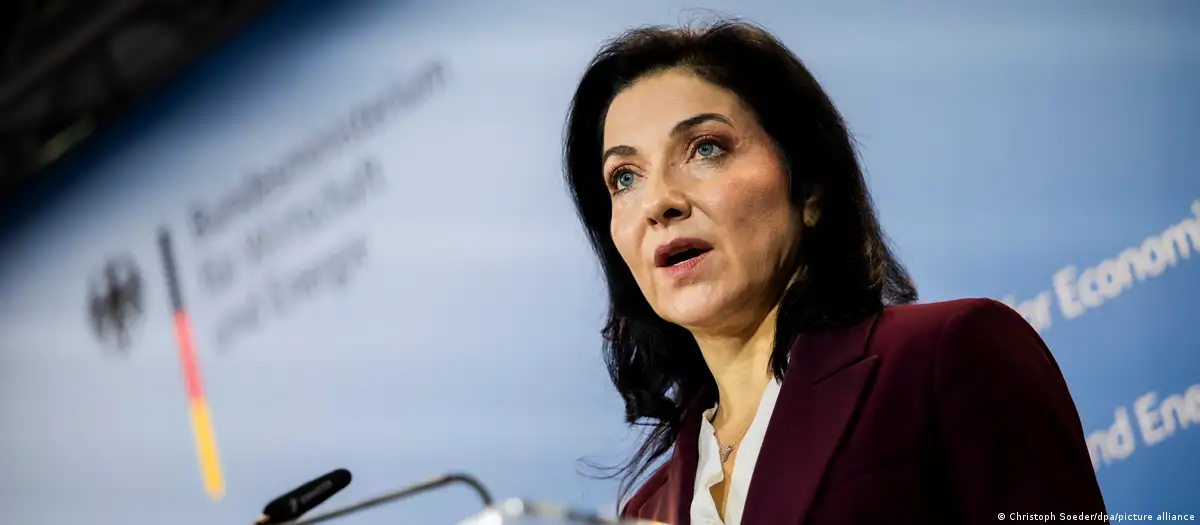
What you need to know
- Germany and Saudi Arabia will expand energy cooperation
- German Foreign Minister Johann Wadephul labels Iran's designation of EU armies as terrorists 'propagandistic'
- Former Bundestag president, minister Rita Süssmuth dies
This blog is now closed. Thank you for reading.
Below are some of the top headlines from Germany on the weekend of Saturday, January 31 and Sunday, February 1:
German union calls for nationwide transport strikes on Monday
German commuters are set to face heavy disruptions on Monday, as a leading Cerdi trade union has called for strikes across most of the country's public transportation network.
The strikes will affect nearly 100,000 employees at 150 municipal transport companies, causing most local services to grind to a halt.
However, Deutsche Bahn, the rail operator, said it would not be affected by the strikes. Suburban commuter trains in major cities, including Berlin and Munich, are also expected to continue running as they are not represented by Verdi.
Union representatives are demanding better working conditions, including reduced hours, longer rest periods, and higher bonuses for night and weekend shifts.
Handball: Germany lose to Denmark in Euro final
Germany lost 34-27 to co-hosts and pre-tournament favorites Denmark in the final of the men's European Handball Championship on Sunday evening.
For reigning world champions Denmark, it's their first European title since 2012.
Read the full report here.
Germany's gas reserves would carry country through winter — minister
German Economy Minister Katherina Reiche said she believes Germans have no reason to worry about the country's gas reserves, despite them only being 35% full as cold temperatures hit across the country.
"Worries are not necessary," Reiche said during a visit to Saudi Arabia, where an energy deal was struck with the local government.
The German minister said the situation is being monitored on a daily basis, and that the possibility of importing liquid gas is also bound to contribute to the situation.
Germany's opposition has criticized the current government, led by Reiche's conservative CDU party, about its handling of the gas reserves, with worries over rising energy and heating prices mounting.
Former Bundestag president, minister Rita Süssmuth dies
Former German Bundestag president Rita Süssmuth died at the age of 88, current Bundestag President Julia Klöckner said.
Süssmuth, who also served as a minister, made it public in June 2024 that she had been diagnosed with breast cancer.
German Chancellor Friedrich Merz paid tribute to Rita Süssmuth, saying she was a "great politician and a guiding star of our democratic community," while Klöckner said she was "one of the most substantial politicians" in Germany's modern times.
Read more about the politician who dared to break taboos, advocated for women's rights, and took part in a failed attempt to oust Chancellor Helmut Kohl as chairman of the CDU.
Germany, Saudi Arabia expand energy cooperation
Germanyand Saudi Arabia will intensify the energy cooperation between the countries, German Economy Minister Katherina Reiche said.
While visiting Riyadh, Reiche signed ten letters of intent for German companies to expand their cooperation with Saudi counterparts.
According to Reiche, the agreements cover "key areas for the future," including energy, artificial intelligence, hydrogen, and industrial innovation and value creation.
The German minister added the deal was part of Saudi Arabia's intent to diversify its sources of revenue due to falling oil prices, adding this was a way of "insuring against fluctuating oil prices, getting unemployment under control and giving the country's young generation prospects for the future."
The agreement also includes strengthening cooperation between the two countries' public and private sectors.
Wadephul labels Iran's designation of EU armies as terrorists 'propagandistic'
Germany Foreign Minister Johann Wadephul criticized Iran for its decision to designate EU armies as terrorist groups.
For more on the statement and Iran's tensions with Germany, the United States and other Western countries, please click here.
New partnerships needs due to developments, Germany's foreign minister says
Germany Foreign Minister Johann Wadephul said the country should look to increase its cooperation with other countries as the global balance of power shifts.
"We live in a time when old certainties are crumbling," the minister stressed, saying that international law was being threatened by powerful countries.
He said that international law was under pressure in both Europe and the Indo-Pacific region, pointing to Ukraine, Taiwan and the South China Sea.
In light of these changes, he urged Germany to "expand our global network of robust partnerships along our core interests."
Wadephul, who belongs to Germany's ruling conservative CDU party, begins a trip to Southeast Asia and the Pacific which will last until Friday.
German and European politicians have increasingly called for enhancing strategic autonomy in the face of uncertainties around the future of the US-led military alliance NATO.
Welcome back
Guten Tag from Bonn!
We are continuing with our weekend coverage of headlines from German news into Sunday, February 1.
Kurdish diaspora holds rallies in German cities
Thousands of members of the Kurdish diaspora in Germany demonstrated across several cities like Cologne, Düsseldorf and Bonn, where the largest concentration was convened.
Attendees rallied to protest the situation in Syria, where government troops and the Kurdish-led Syrian Democratic Forces (SDF) have been fighting for control of northeastern Syria in recent weeks. The two sides recently reached a ceasefire.
During Syria's civil war, the SDF was considered the United States' most important ally in combating the "Islamic State" group. However, Washington has moved closer to Damascus under the new interim President, Ahmad al-Sharaa, after his Islamist forces toppled Bashar Assad's government in December 2024. The US did not intervene militarily in this month's fighting, but it pushed the two sides to reach an agreement.
In the western German city of Bonn, some 15,000 people gathered to demonstrate against the current situation of the Kurdish population in northern Syria, local police said. Several hundred police officers were on site to monitor the protest and prevent disturbances. The gathering was peaceful and ended without incident.
Kurdish protesters also gathered in the cities of Stuttgart and Jena.
Dog sledding competition kicks off in Bavaria
More than 100 teams featuring over 500 dogs gathered at the southern border of Germany and Austria for an international dog sledding competition that drew race enthusiasts from across Europe.
The race will take place over the weekend, with a course stretched from Bad Hindelang in Germany's southern Allgäu region to the neighbouring Austrian town of Schattwald just across the border and back.
The routes range from 6 to 18 kilometres (3.5 to 11 miles).
The two-day race around Bad Hindelang, organized by the Baden-Württemberg Sled Dog Sports Club, is billed to be technically demanding, with the club saying it is "one of the most challenging races on the circuit, featuring spectacular descents."
Race categories are separated by the number of dogs pushing the sleds.
Teams from Germany, Austria, Switzerland, Czech Republic, Italy, the Netherlands, Poland and France, among other nations, are all participating in the event.
Holocaust items from canceled auction sent to Auschwitz
The Holocaust-related items of a planned auction in Germany were handed over to the Auschwitz-Birkenau Foundation.
"I am grateful that we have found a way to hand over the documents to the archives of the memorial sites concerned. Remembrance in archives and museums preserves the dignity of the victims and serves further research and education about the inhuman National Socialist persecution and extermination processes," said by Andre Kuper, the president of the state parliament of Germany's western state of North Rhine-Westphalia.
The items were part of a collection of planned auction in the western city of Neuss, near Düsseldorf, which sparked outrage about the event and prompted its cancellation.
Among the documents were concentration camp postcards, letters written by perpetrators, camp-issued currency, and worn Stars of David. There were records of companies forcefully sold to Nazis, as well as identification documents and passports of Jews who managed to flee persecution to Chile and Argentina.
The collection even included Nazi documents on a forced sterilization carried out at the Dachau concentration camp.
The Central Council of Jews in Germany welcomed the handover of the documents, with Vice President Abraham Lehrer saying it was vital for survivors and for the memory of those murdered during the Holocaust that the documents end up in the right places and hands, where they can be protected and preserved for future generations.
Germany's AfD bonds with Austrian far-right extremists
Officials from the far-right Alternative for Germany (AfD) party have been openly rubbing shoulders with Austrian right-wing extremist Martin Sellner.
The meetings between state and federal parliamentarians of the AfD party from the eastern German states of Brandenburg and Thuringia and Sellner were carefully orchestrated.
In Brandenburg, it was a panel debate, while in Thuringia, it was a discussion in the state parliament. The branches of the AfD in both states have been categorized as right-wing extremist by German federal security authorities.
While AfD leadership at the federal level is oriented more toward moderation, the AfD's regional associations in eastern Germany lean toward radicalism.
Read more to find out why AfD politicians are seeking closer ties to Sellner.
German conservatives draw level with far-right AfD — poll
Support for German Chancellor Friedrich Merz's conservative bloc is level with that of the far-right Alternative for Germany (AfD), according to a recent opinion poll.
If a federal election were held this Sunday, 26% of respondents said they would vote for Merz's Christian Democratic Union (CDU) or its Bavarian sister party, the Christian Social Union (CSU), according to a survey conducted by the INSA polling institute for tabloid newspaper Bild.
The CDU/CSU bloc gained one percentage point, while support for the AfD remained unchanged at 26%. The two parties were last tied in an INSA survey in September 2025.
Merz's junior coalition partner, the Social Democratic Party (SPD), also gained one percentage point, reaching 16%, its highest level since June 2025.
Support for other parties was unchanged. The Green Party polled at 11%, while the Left Party remained at 10%.
Two smaller parties, the BSW and the Free Democratic Party (FDP), received 4% and 3%, respectively, below the 5% threshold required to enter parliament.
The INSA poll was conducted between January 26 and 30 among 1,204 eligible voters in Germany.
EU asylum policy: What changes for refugees in Germany?
The German government is about to implement the EU's Common European Asylum System (CEAS) to limit irregular migration and speed up asylum procedures.
The CEAS is the European Union's legal framework to create uniform, fair and efficient standards for processing asylum applications.
The system's reform, agreed in 2024, will become legally binding in Germany and throughout the EU in June 2026.
What will that mean for refugees in Germany? Learn about all the changes here.
'No signs that Russia seriously wants peace,' says Pistorius
German Defense Minister Boris Pistorius has said he doubts that Russian President Vladimir Putin really desires peace as the US leads efforts to end Moscow's invasion of Ukraine.
In comments published on Saturday, Pistorius told the RND media group that although US President Donald Trump had given new impetus to diplomatic efforts toward peace, recent actions by Moscow seemed to speak a different language.
"So far, [...] I see no signs that Russia seriously wants peace," Pistorius said, noting that even while recent US-led negotiations in Abu Dhabi were going on, Putin had attacked Ukraine "in a way that has hardly been seen in this war."
Pistorius also rejected claims by the Kremlin that its attacks have never targeted civilians or civilian infrastructure, saying: "This is terror directed exclusively at the civilian population during a winter with temperatures of minus 20 degrees [Celsius] (-4 degrees Fahrenheit)."
The minister added that Putin has shown no willingness to compromise.