German election: SPD ready for 'serious' talks with CDU
Published February 26, 2025last updated February 26, 2025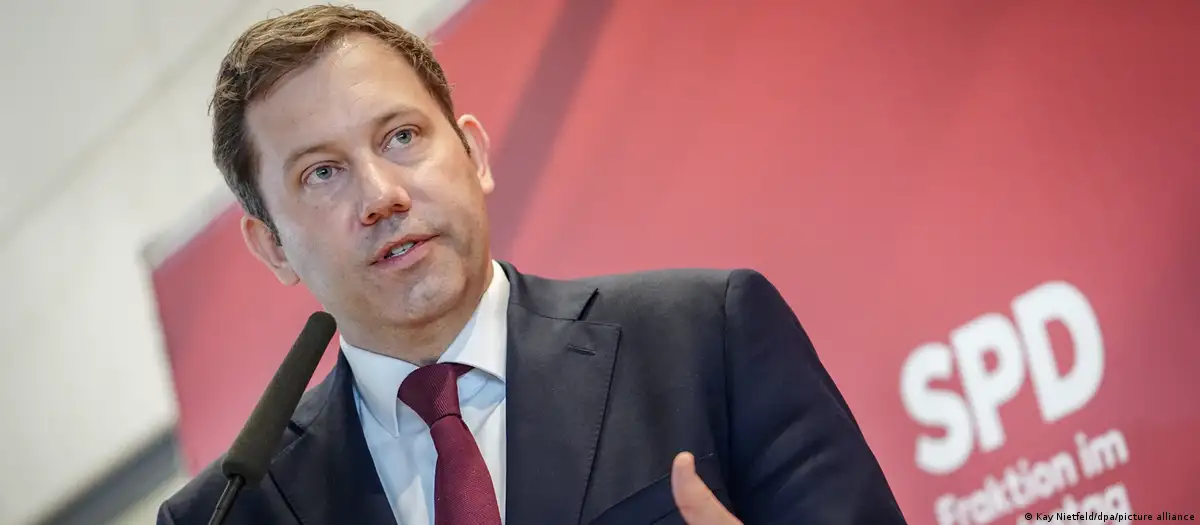
What you need to know
- Friedrich Merz's Christian Democratic Union (CDU) and the Social Democratic Party (SPD) continue to feel each other out ahead of likely coalition negotiations
- Controversial politicians from the far-right Alternative for Germany party (AfD) will enter parliament
- Meet the youngest members of Germany's new parliament
This blog is now closed. In it, we covered the latest political developments on February 26 following the German election.
Scholz won't bring Merz to key EU summit next month
German conservative leader Friedrich Merz, the country's presumed next chancellor, is not expected to accompany outgoing Chancellor Olaf Scholz to a special EU summit in Brussels next month.
Government spokesman Steffen Hebestreit said Scholz would not take Merz to the March 6 meeting, where EU leaders are expected to discuss the recent shift in US policy on the war in Ukraine. Merz does not need a "government internship" or "hand-holding" ahead of taking power in Berlin, Hebestreit added.
"Changes of government are very common in democracies," said Hebestreit, who argued that it would be impractical for all 27 EU leaders due to attend the meeting to bring their successors or opponents. "Arriving with two or more government leaders would not necessarily speed up the consultations."
Scholz, a Social Democrat, will remain in office until a new government is formed, likely under Merz's center-right alliance of the Christian Democrats (CDU) and the Bavarian Christian Social Union (CSU).
Jewish activist plans to leave Germany after election
German Jewish activist Hanna Veiler said she wants to move out of Germany given the far-right AfD's high share of votes in the federal election on Sunday.
"For me, a red line has been crossed in this federal election, and I have made up my mind: I will leave Germany," said the president of the Jewish Student Union of Germany.
One in five Germans, she said, "knowingly gave their vote to a party that is largely right-wing extremist."
The AfD won 20.8% of Sunday's vote, nearly doubling its support since the last general election in 2021. It is now Germany's second-largest party.
Veiler said she was not sure where she would go but added, "The main thing is that I need some distance from Germany."
Merz to meet Macron in surprise visit to Paris
Friedrich Merz is scheduled to meet French President Emmanuel Macron in Paris on Wednesday evening, US news magazine Politico and German largest newspaper Bild reported.
The spokesperson for Merz's party declined to confirm when asked about the Paris meeting, according to the German dpa news agency.
Merz's first trip overseas after winning Sunday's election will likely include a discussion on European defense in light of the abrupt US change in Ukraine policy.
Earlier in the day, Macron had informed other European leaders in a video conference about his recent talks with US President Donald Trump.
The French president was the first European leader Trump received in the White House in his second term. Macron and Trump met on Monday.
CDU criticized for questioning NGO funding
The conservative CDU/CSU bloc in the German parliament is facing criticism for submitting an official parliamentary request for information on the funding of non-governmental organizations (NGOs) — including many that supported recent street demonstrations against the extreme right.
Under the heading "Political neutrality of state-funded organizations," the parliamentary request regards funding of NGOs, including Greenpeace and Omas gegen Rechts ("grandmas against the far-right") and poses questions regarding how much funding an organization receives from state programs and whether an organization has "direct connections" to "certain parties or political figures."
Questions have also been directed at investigative platforms, including Correctiv, the research organization that published details of a secret meeting of right-wing extremists, including members of the CDU and AfD, in Potsdam in November 2023, at which Austrian identitarian Martin Sellner held a talk on the concept of "remigration" and participants reportedly discussed massive deportation plans.
Lawmaker Clara Bünger of the socialist Left Party slammed the parliamentary request, accusing the CDU of "taking revenge for the antifascist protests of recent weeks" and "launching an unprecedented attack on democratic society."
Sergey Lagodinsky, a member of the European Parliament for Germany's Green Party, criticized the CDU's "perverted understanding of democracy" and described the "almost Trumpian" move as a "very bad omen for the next four years."
On Saturday, on the eve of the election, CDU chancellor candidate Friedrich Merz himself had lashed out at what he called "left-wing nutcases" who had taken part in protests against his party's attempt to pass an anti-asylum motion through parliament with the help of AfD votes. Hundreds of thousands of people had taken to the streets of several major German cities across several weekends.
Nevertheless, Merz had told party members in Munich: "Left-wing politics are finished! There is no left-wing majority in Germany!"
German foreign minister calls for European defense fund
The European Union needs a common defense fund to help boost security and increase its deterrence capability, outgoing German Foreign Minister Annalena Baerbock said on Wednesday.
"It would be an important step to relax the EU's Stability and Growth Pact so member states can continue to increase their national defense spending," she said in a statement, but she cautioned that this alone would not be sufficient for all countries.
"That is why we need a European defense fund that is up to the challenge," she added.
Baerbock has served as Germany's foreign minister since 2021 but is unlikely to continue in her role after her Green Party slipped to fourth place in Sunday's election and is unlikely to be part of the next German governing coalition.
SPD ready for 'serious' coalition talks with CDU
The newly-elected leader of the SPD's parliamentary block, Lars Klingbeil, has called for "serious talks" with Friedrich Merz over the formation of a coalition government with the Christian Democrats (CDU).
Following his election on Wednesday, Klingbeil said it was also the "desire of the SPD" that Germany have a "functional government" as soon as possible, but placed the onus on Merz to make that happen.
"We are keen for these talks to take place swiftly but also thoroughly," he said, criticizing the CDU for prematurely going public with certain demands relating to Germany's debt brake or to the special military defense fund.
"If we're going to have serious discussions … we shouldn't be talking about these things in public. Any proposals which I hear first from the newspapers will be automatically off the table," he said.
"We also have an interest in strengthening the Bundeswehr [the German armed forces] and in encouraging greater investment in our economy. But it won't work if we're hearing suggestions via the press or the internet."
Russia's Lavrov says Merz has 'aggressive views'
Russian Foreign Minister Sergey Lavrov said on Wednesday that Germany's probable next Chancellor Friedrich Merz has expressed "aggressive views" regarding Russia and the current geopolitical situation in Europe.
"He has specific approaches to Russia," he told reporters at a press conference in Qatar. "For instance, unlike [outgoing] Chancellor [Olaf] Scholz, he has insisted on sending long-range Taurus missiles to Ukraine for attacks deep into the territory of the Russian Federation."
Merz has taken a hawkish stance on Russia's ongoing invasion of Ukraine, which began three years ago this week. In December, he traveled to Kyiv for a second time since the start of the war and repeated a promise to deliver German Taurus missiles.
"Our position is clear," he told Ukrainian President Volodymyr Zelenskyy at the time. "We want to give your army the capabililty to reach military bases inside Russia. Not to strike the civilian population, and not to strike civilian infrastructure."
When Alice Weidel of the far-right AfD lamented during a televised election debate that "Russia no longer sees Germany as neutral," Merz responded emphatically: "That's because Germany is not neutral! We are on Ukraine's side! And with Ukraine, we are defending our political order!"
Lavrov expressed hope that Merz's views may become "more realistic" if he becomes the next German chancellor.
He also said French and British proposals to send peacekeepers to Ukraine to enforce any potential ceasefire are aimed at "further fueling the conflict."
Meet Germany's youngest members of parliament
Luke Hoss (23) and Zada Salihovic (24) are the youngest members of Germany's new parliament, both representing the socialist Left Party (Die Linke).
Hoss, who was born in the Stuttgart suburb of Bad Cannstatt in the south-west of Germany in 2001, stood for election in the Bavarian town of Passau on the Austrian border. Despite only accruing 2.9% of first votes, he is set to enter parliament as the fourth candidate on his party's Bavaria list thanks to the surprisingly high number of second votes cast for the Left Party.
During the campaign, law student Hoss promised to donate most of his salary as a member of parliament (around €11,000 or $11,500 per month) either to his own party or to social initiatives helping people in financial difficulty, while keeping only around €2,500 for himself.
Describing growing up with his brother, single mother, "second-hand football boots and a fear of new bills landing in the letter box," he said: "I know that that's the reality for a lot of people in Germany."
Asked by WEB.de if he's not too young for politics, he said: "No, why? Parliament should represent all of society, and that includes young people."
Similarly, his colleague Zada Salihovic, the daughter of a Serbian father and German mother, will enter parliament as the fourth candidate on the Left Party's list in Saxony.
The eastern state is otherwise an AfD stronghold and home to founding member and honorary chairman Alexander Gauland who, aged 84, will be the oldest member of parliament, representing his home city of Chemnitz (32.2%).
What's the latest regarding the formation of a new government?
Friedrich Merz, the leader of the conservative CDU and Germany's probable next chancellor, is keen to pursue coalition talks with the Social Democrats in order to form a government as soon as possible.
Having ruled out a coalition with the far-right AfD, which emerged from Sunday's election as Germany's second-largest party, the SPD are the CDU's only realistic coalition partner.
The Social Democrats, who were the largest party in the previous coalition government, are set to elect party co-chairman Lars Klingbeil as the leader of their reduced parliamentary block on Wednesday, after which Klingbeil will enter into official negotiations with Merz.
While the two parties are likely to agree on the issue of defense spending, including a potential stocking up of Germany's special defense fund before the new parliament even convenes, there will be disagreements on immigration, energy and economic policy.
AfD politicians who played down Nazi past to return to parliament
Having won just over 20% of the vote in Sunday's federal election, the far-right Alternative for Germany (AfD) party will have approximately twice as many seats in the country's new parliament. That means a raft of new faces — but also some controversial old ones.
Among the new additions to the far-right block are Maximilian Krah and Matthias Helferich, two figures whose previous comments on Germany's Nazi past were too revisionist and too extreme even for the AfD.
Krah, a former lead AfD candidate in European elections, was banned from campaigning by his own party in 2024 after telling an Italian newspaper that "not everyone in the SS" — the Nazi paramilitary organization which was chiefly responsible for carrying out the Holocaust during the Second World War — "was automatically a criminal."
He was then placed under investigation over "alleged payments" received from Russian and Chinese sources.
Helferich, meanwhile, is on the record as having described himself in WhatsApp messages as "the friendly face of national socialism" and "democratic Freisler" — a reference to Roland Freisler, a senior Nazi lawyer who took part in the 1942 Wannsee Conference at which the "Final Solution to the Jewish Question" was discussed, leading to the ramping up of the Holocaust.
After meeting his new parliamentary colleagues this week, Helferich told reporters that he wanted to be on the culture select committee in order to carry out "patriotic cultural politics" and encourage "a positive approach to nation and people."
Sebastian Münzenmaier, vice-chairman of the AfD's parliamentary grouping and a close ally of party leader Alice Weidel, said: "I consider Matthias [Helferich] a very good speaker. He is intelligent and smart and does good work."
Welcome to our third day of coverage following the German federal election
Thank you for joining us this Wednesday as we continue to provide you with the latest updates and developments from German politics after Sunday's federal election.
It can take weeks or months until a governing coalition is made after the election, so don't expect the announcement of a new government anytime soon.
Nevertheless, the negotiations, when they officially start, will likely be tense, especially as all parties have refused to work with the far-right Alternative for Germany (AfD) who came second with around 20% of the vote.