Ukraine updates: Geneva peace talks end abruptly
Published February 18, 2026last updated February 18, 2026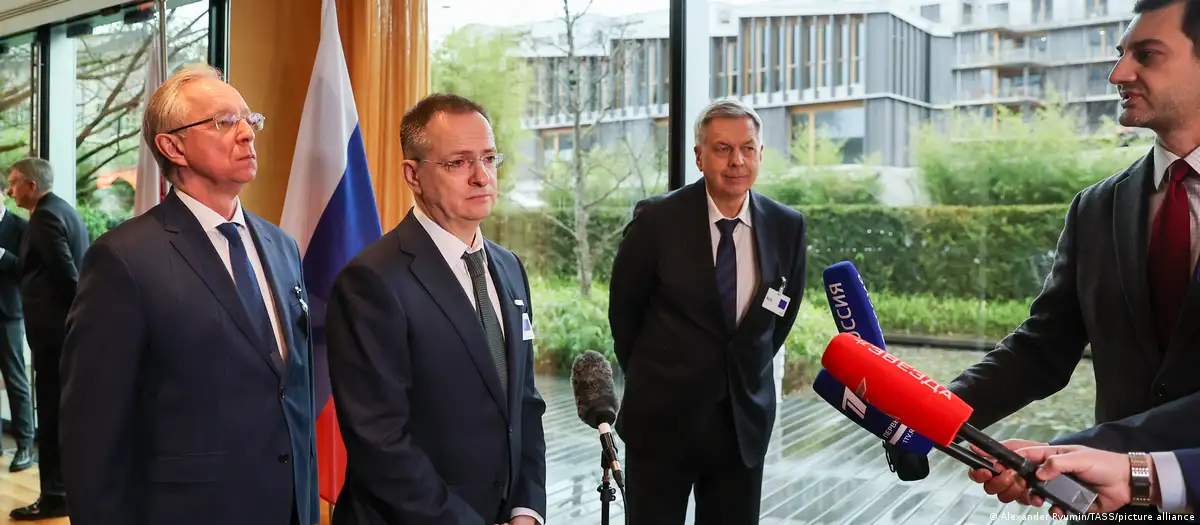
What you need to know
- Ukraine-Russia peace talks resumed in Geneva for a second day on Wednesday, but broke up just after two hours
- Volodymyr Zelenskyy said there was some progress but positions differed because "negotiations were difficult"
- Zelenskyy said in an interview that it was "not fair" that Trump kept publicly calling on Ukraine to make concessions
- Ukrainian officials to boycott Paralympics over Russian participation
These updates have been closed. Thank you for reading.
Below you can review development in Russia's war in Ukraine from Wednesday, February 18:
Four South Africans who fought on Russia's side return home
The South African Foreign Ministry has announced that four South African men who had been lured into fighting for the Russian forces in Ukraine have returned home.
The South African Broadcasting Corporation (SABC) broadcast footage of the men arriving at Johannesburg's main airport, after which they were escorted to a police holding area.
This follows talks held by South African President Cyril Ramaphosa with his Russian counterpart, Vladimir Putin, on the return of South Africans caught up in the war in Ukraine.
In November, Pretoria said it had received "distress calls" from 17 men who had been tricked into joining mercenary groups and were trapped in the epicenter of the fighting in Ukraine's Donbas region.
South African law prohibits its citizens from fighting for a foreign army without government authorization.
In November, Ukraine's foreign minister said that more than 1,400 citizens from 36 African countries had been identified among the Russian ranks.
Zelenskyy says he is dissatisfied with Geneva talks
In his nightly address, Ukrainian President Volodymyr Zelenskyy expressed dissatisfaction with the latest talks held with Russian negotiators in Geneva, noting that "sensitive political matters" had not been properly addressed.
"As of today, we cannot say that the result is sufficient," Zelenskyy said.
"The military discussed certain issues seriously and substantively. Sensitive political matters, possible compromises and the necessary meeting of leaders have not yet been sufficiently addressed," he added.
Zelenskyy added that Ukraine is counting on the next meeting, probably in February.
Hungary, Slovakia suspend Ukraine diesel shipments over oil pipeline dispute
Hungary said on Wednesday that it was suspending shipments of diesel to neighboring Ukraine until deliveries of Russian oil resume.
Slovakia's Slovnaft has also announced that it will suspend oil aid deliveries to Ukraine until further notice, in order to secure domestic fuel supplies.
Russian oil supplies to Hungary and Slovakia have been interrupted since January 27 after Ukrainian officials said the Druzhba pipeline, which carries Russian crude across Ukrainian territory and into Central Europe, was damaged by Russian attacks (see below).
But Budapest and Bratislava have accused Kyiv of attempting to "blackmail" them into ending their diplomatic and econcomic ties with Moscow by deliberately holding up supplies.
In a video posted on social media, Hungarian Foreign Minister Peter Szijjarto claimed the interruption to oil deliveries was "a political decision made by the Ukrainian president himself."
The Ukrainian government denies this is the case and has provided photo evidence of the burning pipeline. But Foreign Minister Andrii Sybiha did suggest that the Hungarians "open their eyes."
Ukrainian officials to boycott Paralympics over Russian participation
No Ukrainian officials or politicians will attend the opening ceremony or any other events at the Paralympic Games in Milan-Cortina next month in protest at the participation of a small number of Russian and Belarusian athletes.
The International Paralympic Committee (IPC) said on Tuesday that Russia and Belarus had been awarded ten wildcards and that the athletes would be permitted to compete under their national flags for the first time since the Sochi games in 2014.
"In response to the outrageous decision to let Russians and Belarusians compete under their national flags, Ukrainian public officials will not attend the Paralympic Games," said Ukrainian Sports Minister Matviy Bidnyi in a statement on Wednesday.
"We will not be present at the opening ceremony. We will not take part in any other official Paralympic events. We thank every official from the free world who will do the same. We will keep fighting!" he added.
According to the Russian state news agency TASS, wildcards will be handed to three-time alpine skiing champion Aleksey Bugaev as well as cross-country skiers Ivan Golubkov and Anastasiia Bagiian, who are both world championship medalists. The trio will therefore be among the favorites in their respective events, making it likely that the Russian anthem could be played and the Russian flag raised during at least one medal ceremony.
For the Ukrainian minister, the flags of Russia and Belarus are the "flags of regimes that have turned sport into an instrument of war, lies, and contempt" which have "no place at international sporting events which stand for fairness, integrity and respect."
Bidnyi accused Moscow of turning paralympic sport into a "support mechanism for those who [President Vladimir] Putin sent to Ukraine to kill — but who have returned [to Russia] with injuries and disabilities."
Slovakia declares 'oil emergency,' accuses Ukraine of 'blackmail'
Slovakia declared an "oil emergency" on Wednesday, enabling oil refining company Slovnaft to access emergency oil reserves to cover the country's needs while a key pipeline from Russia via Belarus and Ukraine is out of action.
Oil supplies to both Slovakia and Hungary via the Druzhba ("Friendship") pipeline were halted at the end of January as a result of Russian bombardment, according to Ukrainian authorities.
However, Slovakian Prime Minister Robert Fico has accused Kyiv of "blackmail" by delaying the resumption of operations.
In response, Fico has threatened to cut emergency Slovakian electricity supplies to Ukraine which Kyiv falls back on following Russian attacks on power stations.
"If [President Volodymyr Zelenskyy] believes these supplies are not important, we can decide to withdraw from the electricity supply accord," Fico said.
Slovakia, like neighbor Hungary, has maintained relations with Russia despite the ongoing invasion of Ukraine and remains largely reliant on Russian oil despite attempts by the European Union to reduce energy dependence on Moscow.
Slovnaft has been able to temporarily compensate for the disruption in supply by drawing oil from Croatia's Adria pipeline – but the refinery has said it could take 20-30 days for the pipeline to operate at full capacity.
Hungary's Prime Minister Viktor Orban also accused Ukraine of "blackmail" in a social media post on Wednesday.
Last week, Ukrainian Foreign Minister Andrii Sybiha posted a photo on social media which he said showed the Druzhba pipeline burning near the western Ukrainian town of Brody.
"We know that the Hungarian side is preparing to complain again about problems with Russian oil transit through the Druzhba pipeline," he said. "We can only advise them to approach their 'friends' in Moscow with these photos."
The European Commission said this week that it foresaw no short-term risk to oil supplies in Hungary or Slovakia since the two EU countries have ample emergency stocks.
"There are no short-term risks to security of supply, because both member states hold 90 days' worth of emergency stocks in reserve," said a spokesperson.
Russia demands proof of Navalny frog toxin claims
The Russian Foreign Ministry has demanded that European countries provide proof to support claims last week that the late Kremlin critic Alexei Navalny was poisoned with a dart frog toxin.
The United Kingdom, France, Germany, Sweden and the Netherlands said on Saturday that analyses of samples from Navalny's body had confirmed the presence of epibatidine, a toxin found in poison dart frogs in South America and not found naturally in Russia.
They said the Kremlin had the "means, motive and opportunity" to administer the poison to him, which Moscow flatly denies.
"All the accusations against Russia were of the 'highly likely' variety, there were no specific details," said Foreign Ministry spokeswoman Maria Zakharova.
"It was purely a proclamation to become the opening act of the Munich [Security] Conference and to overshadow the Epstein files," she claimed. "We demand they hand over concrete data on this issue."
Yulia Navalnaya, Navalny’s widow, said she welcomed the disclosure of the "truth" about her husband's death.
What are the sticking points in Russia-Ukraine talks?
Ukrainian and Russian officials met for two days of negotiations but were unable to reach an agreement. Zelenskyy said there was some progress in talks but that Russia was trying to drag out negotiations.
What's dividing the two sides?
- The main point of contention is a Russian demand that Ukraine give up territory that its forces control in the eastern Donetsk region. Kyiv has rejected the demand. Russian forces control about 20% of Ukrainian territory — including the Crimean peninsula that it illegally annexed in 2014 and areas that Moscow-backed separatists had taken prior to the 2022 full-scale invasion.
- Ukraine has called on its Western partners, particularly the United States, to provide security guarantees to deter a future Russian invasion. Moscow, however, has insisted that any security guarantees exclude Western troops in Ukraine.
- The future of the Zaporizhzhia region is also a major sticking point. The region is home to Europe's largest nuclear power plant, which, before the war, generated about 20% of Ukraine's electricity. Though it has been damaged in fighting and is not currently in operation, control of the power plant would cover some of its owner's energy needs.
No agreement on key issues after Geneva talks, Zelenskyy says
A third round of talks between Ukrainian and Russian negotiators in Geneva over the past two days have produced no agreement on key issues, according to Ukrainian President Volodymyr Zelenskyy.
"Negotiations were not easy," Zelenskyy said in a message to journalists after a second day of talks ended abruptly after just a couple of hours on Wednesday. "We can see that some groundwork has been done but, for now, the positions differ."
According to Zelenskyy, "sensitive issues" which remain unresolved include the fate of occupied territory in Ukraine's east and the future status of the Zaporizhzhia Nuclear Power Plant, which is currently occupied and controlled by Russian forces.
Leaving the Intercontinental Hotel in Geneva, the head of the Ukrainian delegation Rustem Umerov said discussions were "intensive and substantive," adding: "There is progress but no details can be disclosed at this stage."
He said the next step was to try to reach a level of consensus with the aim of "submitting the developed decisions for consideration by the presidents," adding that this would need not just a formal foundation but a practical one.
"Ukraine remains constructive," Umerov said. "The ultimate objective is unchanged: a just and sustainable peace."
Ukrainian and Russian delegation say meeting has ended
A second day of peace talks between Ukrainian and Russian negotiators in Geneva has ended after just two hours.
Russian state news agencies RIA and TASS cited Moscow's chief negotiator Vladimir Medinsky as saying the talks were "difficult but business-like" and that the next meeting would "take place in the near future."
A spokesperson for Ukraine's chief negotiator also confirmed to Reuters that talks had concluded.
Prior to the end of the talks, Ukrainian President Volodymyr Zelenskyy had said that the meetings were "difficult," accusing the Russian delegation of "trying to drag out negotiations that could already have reached the final stage."
Zelenskyy says Russia trying to 'drag out' talks
Ukrainian President Volodymyr Zelenskyy said Wednesday that talks with Russia and the US were "difficult" and accused Russia of delaying the process.
"Yesterday's meetings were indeed difficult, and we can state that Russia is trying to drag out negotiations that could already have reached the final stage," Zelenskyy said on social media after being briefed by his team ahead of a second day of talks in Geneva.
Starmer condemns Putin's 'barbaric attacks' during phone call with Trump
British Prime Minister Keir Starmer spoke to US President Donald Trump on Tuesday night after peace talks wrapped up in Geneva on the first day.
Starmer "reiterated his condemnation of Putin's barbaric attacks on innocent civilians in Ukraine," a spokesperson said.
Russia has launched repreated waves of missiles and drone strikes again Kyiv's power grid, as the Ukrainian capital faces its harshest winter of the war.
Belarus: Ukraine sanctions Lukashenko for supporting Russian invasion
Ukraine announced sanctions against the leader of Belarus, Alexander Lukashenko, for providing material assistance to the Russian war effort.
Long-time dictator Lukashenko, one of Russian President Vladimir Putin's closest allies, allowed the Russian army to launch its full-scale invasion of Ukraine from Belarus in February 2022, and has continued to tolerate the deployment of Russian military hardware in the country ever since.
"Today Ukraine applied a package of sanctions against Alexander Lukashenko, and we will significantly intensify countermeasures against all forms of his assistance in the killing of Ukrainians," Ukrainian President Volodymyr Zelenskyy said in a statement, also accusing Lukashenko of helping Russia avoid Western sanctions.
While the measures will have little practical effect, sanctioning a foreign head of state is a highly symbolic move.
Lukashenko has on occasion tried to present himself as a potential intermediary between Kyiv and Moscow, but Ukraine and its Western allies see him as little more than a Kremlin mouthpiece.
Second day of talks begin in Geneva
A second day of trilateral talks between Ukraine and Russia, mediated by the United States, has begun in Geneva, sources from both sides confirmed on Wednesday morning.
"Closed-door meetings have begun," a Russian source told reporters, while Kyiv’s chief negotiator also told the Reuters news agency that talks have started.
Trump putting Ukraine under unfair pressure, Zelenskyy tells Axios
Ukrainian President Volodymyr Zelenskyy has said that US President Donald Trump is exerting undue pressure on him in his attempts to end the full-scale Russian invasionof Ukraine that began four years ago.
As Ukrainian and Russian delegations met for a third round of peace talks in Geneva, Zelenskyy told US news website Axios that it was "not fair" that Trump kept publicly calling on Ukraine to make concessions for peace, but was not exerting similar pressure onRussia.
"I hope it is just his tactics and not the decision," Zelenskyy said, after Trump said twice in recent days that the onus was on Kyiv to compromise – notably by surrendering the part of the eastern Donbas region which Ukrainian troops still hold.
"Emotionally, people will never forgive this; they won’t forgive me, they won't forgive [the United States]," said Zelenskyy, adding that Ukrainians "cannot understand why" they should give up land. "This is part of our country, all these citizens, the flag, the land," he said.
Zelenskyy has said that any potential deal agreed with Russia would have to be put to Ukrainians in a referendum – and suggested that a freezing of the conflict along the current frontlines may be acceptable to voters.
"I think that if we put in the document that we stay where we are on the contact line, I think that people will support this [in a] referendum," he said. "That is my opinion."
Ukraine and Russia peace talks enter second day of discussions
Russian and Ukrainian officials resumed a second day of peace talks in Geneva.
Washington's envoy Steve Witkoff signaled optimism and progress towards ending the deadliest conflict since World War II. But the head of the Russian delegation played down hope for a significant step forward before talks began yesterday.
US President Donald Trump and officials in his administration have been pushing for an end to the war. But the deal appears to be stuck on the issues of territory and security guarantees. Two previous rounds of talks in Abu Dhabi have failed.
In Tuesday's meeting, which lasted six hours, the discussions focused on "practical issues and the mechanisms of possible solutions," Ukraine's lead negotiator Rustem Umerov said. A source close to the Russian delegation told AFP news agency that the discussions were "very tense."
Ukrainian President Volodymyr Zelenskyy, in his evening address, said he was ready to "move quickly towards a worthy agreement to end the war," but questioned if Russia was serious about peace.