Germany news: Merz urges innovation at Berlin digital summit
Published November 18, 2025last updated November 18, 2025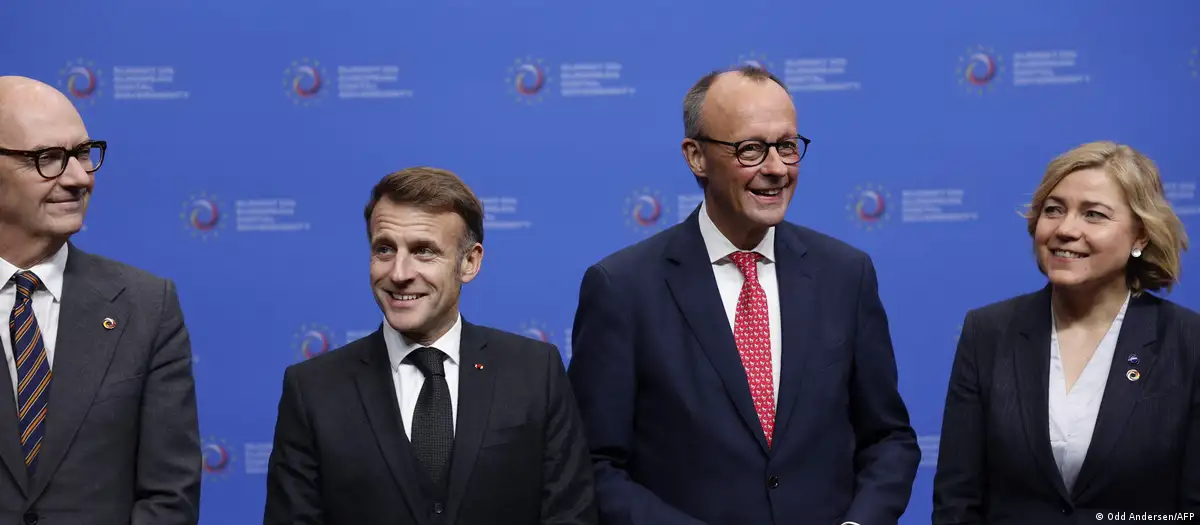
What you need to know
German Chancellor Friedrich Merz and French President Emmanuel Macron on Tuesday appealed for more European innovation and agency in budding tech sectors like artificial intelligence.
At a special summit in Berlin, Merz said Europe must seek greater digital sovereignty, "at least in those areas where it is possible and achievable."
Macron similarly said that Europe could not be reduced to just a client either of major corporations or of Washington and Beijing.
"Clearly, we want to conceive solutions of our own," he said.
The meeting comes as the European Union is set to propose a rollback of regulations on artificial intelligence and data protection later this week.
Berlin will also be hosting a two-day conference on European security that kicks off on Tuesday, with speakers including the German defense minister, Boris Pistorius.
And German Foreign Minister Johann Wadephul has spoken out in favor of EU Balkan expansion during a visit to Montenegro.
These updates are now closed. Read here for a rundown of the top stories from and about Germany on Tuesday, November 18, 2025.
Macron: 'We need to innovate before we regulate'
French President Emmanuel Macron told the audience in Berlin that Europe must exhibit a "refusal to be a vassal" in sectors like artificial intelligence.
"Let's be clear, Europe does not want to be the client of major entrepreneurs or of the major solutions proposed, whether they're from the US or from China," Macron told the audience. "Of course we want to conceive our own solutions."
Macron said there was currently "a fascination with non-European solutions," and proposed countering this with a "European preference" to incubate the rise of tech "champions" on the continent.
Macron also called for Europe to adopt more of a "move fast and break things" attitude, to paraphrase Google's famous old internal slogan, saying: "We need to innovate before we regulate."
The European Commission is expected to unveil proposed changes to its General Data Protection Regulation (GDPR) data privacy and security rules later this week.
'Europe can't leave this field' to the US and China, Merz says at tech summit
German Chancellor Friedrich Merz has appealed for Europe to go its own way, and to seek as much "digital sovereignty" as possible at a Berlin summit, "at least in those areas where it is possible and achievable."
The chancellor said the tectonic changes demanded more rapid action, with the technology currently hailing predominantly from the US and China.
"Europe cannot leave this field to them," he told a gathering of political and business and civil leaders.
Merz stressed that Europe valued openness and did not want to build any virtual walls. Nevertheless, he said it was also clear that it would not be possible to "politically regulate or subsidize digital sovereignty into existence."
"We will need to formulate it together with business, science and civil society," he said.
Merz said that in key technologies like artifical intelligence, quantum technologies, cloud computing and microelectronics, Europe needed to develop more capabilities.
"To thrive in the competition for digital technologies, we need the ability to innovate," he said. "I'd go a step further. We need to lead in innovation."
The summit has identified a well-known problem, Europe lagging well behind the US and China in these growing sectors. But critics worry it may struggle to address or rectify the underlying problems in regulation, cooperation, overlap and redundancies, and raw material availability affecting the alliance of dozens of small countries compared to the two more cohesive economic giants.
Germany and Sweden agree on tighter defense cooperation
NATO allies Germany and Sweden on Tuesday signed an agreement for closer military cooperation.
According to German Defense Minister Boris Pistorius, who signed the agreement with his Swedish counterpart, Pal Jonson, the two countries aim to conduct joint exercises, come up with joint strategies and harmonize developments by their defense industries.
The two defense ministers have been attending a two-day conference on European security in the German capital, Berlin.
Sweden only quite recently abandoned a longstanding military non-alignment stance to join NATO, officially becoming a member of the Western military alliance on March 7, 2024.
Its change in policy came amid Russian aggression as evidenced by Moscow's full-scale invasion of Ukraine, launched in February 2022.
NATO general urges stepped-up deterrence at Berlin security summit
NATO General Ingo Gerhartz has called on Germany to step up efforts to deter possible future attacks, as a two-day conference on boosting European defense kicked off in Berlin
"Our main challenge is deterrence, and deterrence today and against all types of oppression," said Gerhartz, a German general who heads NATO operational headquarters in the Dutch city of Brunssum.
"To transform pure investments into deterrence, institutions need to change, processes must be adapted, and most important, our whole society must come on board," he said.
Among other things, Gerhartz said the dispute on the new model for military service in Germany had gone on for too long and that the German process for procuring armaments is often too time-consuming, something that Russia — considered by many to pose a major security threat to Europe —had realized.
"It shows Germany as a whole has not yet reached the strategic maturity that our times demand," Gerhartz said.
He also called for discussion of future deterrence methods against hybrid attacks, a "gray zone" that does not necessarily come under the mutual defense clause laid out in NATO's Article 5.
"We must rethink our approach to deterrence," he said.
Merz calls for coordinated security concepts at Christmas markets
German Chancellor Friedrich Merz has urged that authorities come up with harmonized security measures to be applied at Germany's famous Christmas markets, which have seen two deadly attacks in the past decade.
"We naturally support any form of coordination and harmonization of security concepts, because we have this problem — namely the protection of Christmas markets — in all federal states," he said on Tuesday during a visit to the city of Halle in the eastern state of Saxony-Anhalt.
"It really upsets me that we can no longer organize Christmas markets even in smaller towns without having to have a comprehensive security concept," he said.
Last year, a man drove into crowds at the Christmas market in the Saxony-Anhalt capital of Magdeburg, killing six people and injuring hundreds of others. The driver, a Saudi doctor, is currently on trial at Magdeburg District Court.
In December 2016, there was a similar attack at a central Berlin market in which 13 people were killed.
Although some far-right commentators have claimed that many Christmas markets in Germany will not open this year because of unaffordable security costs, this fact-checking article by DW shows that this is not the case.
Snipers deployed in Berlin in urban warfare training drill
German military forces have begun a drill to train for urban warfare in the capital, Berlin, among other things deploying snipers with blank ammunition as they rehearsed responses to potential attacks on the country.
The German army, or Bundeswehr, cited Russia's full-scale invasion of Ukraine as one reason for enhancing defense preparedness.
The five-day exercise, which kicked off on Sunday, is focusing on rapid deployment and the protection of critical infrastructure in case of an attack.
Training has been taking place at several locations across the city, including an underground train station, where soldiers practiced tunnel combat, the Ruhleben police training ground and a former chemical plant site in Rüdersdorf.
Military officals said the narrow streets, high-rise buildings and underground tunnels for the metro in Berlin made specialized training necessary.
"The guard battalion fulfils its core mission in Berlin in the event of defense," the Bundeswehr said in a statement. "All activities are being carried out under strict security precautions and in coordination with Berlin authorities."
Germany looks ahead after qualifying for World Cup
Germany's national football teamhas qualified for the 2026 FIFA World Cup, which starts on June 11 in the USA, Mexico and Canada. But what is the team's plan between now and then? DW takes a look at the schedule for Julian Nagelsmann as they enter the most important part of their preparation ahead of the biggest World Cup ever.
Read more: Germany at the 2026 World Cup: What next?
Wadephul backs Balkan states' EU accession
German Foreign Minister Johann Wadephul has welcomed the aspirations of Western Balkan states to join the EU, saying that such an expansion was in the best interests of the bloc.
Speaking duringa visit to the Montenegrin capital of Podgorica, Wadephul said: "A strong and united European Union makes the best contribution to security and prosperity for the citizens of the entire EU."
He called on nations in the region wanting to join the bloc to overcome ethnic tensions and carry out the reforms required to become EU members.
Wadephul praised the "great progress" made by Montenegro in moving toward accession.
"If these efforts are intensified and if Montenegro does not ease off, then this path can be successful," he said, pledging German assistance. The country is aiming for EU membership by 2028.
Speaking later in Albania, Wadephul said Germany had always advocated EU enlargement but that it was "up to the candidate countries to fulfil the conditions."
There could be no shortcuts on the road to the EU, he asserted.
The Balkan states ofAlbania, Bosnia-Herzegovina, Kosovo, North Macedonia, Montenegro and Serbia are all aiming to join the EU, with Montenegro seen as furthest along the accession path.No date has, however, been set for their joining.
READ: German NGO accuses TotalEnergies of complicity in war crimes
The NGO European Center for Constitutional and Human Rights (ECCHR) has filed a criminal complaint against French energy multinational TotalEnergies for being allegedly complicit in war crimes, including torture and murder, committed by soldiers it was paying to guard an LNG project in Mozambique.
The company has previous denied knowledge of reports alleging that the soldiers had tortured civilians at the site.
You can read more about the case in this article:TotalEnergies complicit in Mozambique war crimes — NGO
Deaf girl in 'critical' condition after police shooting
A 12-year-old deaf girl is in a "critical but stable" condition in hospital after being shot in the stomach by a single bullet in a police operation on Monday in the western German city of Bochum, a spokesman said on Tuesday.
The spokesman said the girl had undergone surgery for life-threatening injuries after the incident.
The shooting occurred when police went to the home of the girl's mother early on Monday to look for the child after her regular carers reported her missing.
The police waited for an hour at the door of the apartment before being let in by the mother, who is also deaf.
Two officers then shot the girl, one with a Taser stun gung, the other with a service weapon, when she approached them holding knives.
The incident is under official investigation.
'Momentous': Catalogue of Bach's works gains two new entries
The Bach Archive in Leipzig has definitively attributed two organ works discovered three decades ago in Belgium to Johann Sebastian Bach.
Following decades of research, the director of the archive, musicologist Peter Wollny, identified the two chaconnes in D minor and G minor as being works by the famous German composer, who lived from 1685 to 1750, spending the last 27 years of his life working in the eastern German city.
A chaconne is a piece of music that takes a short repeated bass line or harmonic progression as a foundation for variations. It was a highly popular form in the Baroque era and was often employed by Bach in his works, including the famous D minor Chaconne for solo violin.
Wollny said Bach was about 18 years of age when he wrote the works, handwritten copies of which were found by Wollny in the Royal Library of Belgium in the early 1990s.
Wollny's research led him to establish that the copies were made by a little-known pupil of Bach in around 1705.
The works exhibited traits "found in Bach's compositions at that time, but in no other composer's work," he said, adding that his confidence in the attribution is now "99.99%."
German Culture Minister Wolfram Weimer called the discovery that Bach had written the works "a momentous occasion for the world of music" and described Wollny's work as "almost detective-like in its meticulous
detail."
The two works, each with a duration of around 14 minutes, were performed on Monday by renowned Dutch organist Ton Koopman in St. Thomas Church in Leipzig, where Bach served as musical director, or Thomascantor, from 1723 till 1750.
The performance, which was streamed on the internet, was attended by Weimer and Leipzig Mayor Burkhard Jung.
Berlin to host security summit for Europe
A two-day security conference is kicking off in Berlin on Tuesday, with politicians, military officials and defense experts gathering for discussions on how best to boost Europe's defense capabilities amid a range of threats, including potential Russian aggression.
More than 140 speakers, including German Defense Minister Boris Pistorius and Swedish Defense Minister Pal Jonson, are expected to deliver addresses at the gathering.
Among measures to be discussed are boosting arms production and the use of new technologies.
The Berlin Security Conference will be opened by German politician Marie-Agnes Strack-Zimmermann, chair of the European Parliament's Committee on Security and Defense.
German General Ingo Gerhartz, who commands NATO's Allied Joint Force Command in Brunssum, Netherlands, will be among miltary representatives at the meeting.
Germany welcomes UN Security Council's passing of Trump peace plan for Gaza
German Foreign Minister Johann Wadephul has welcomed the passing of US President Donald Trump's Gaza peace plan by the UN Security Council.
He said the plan to end the war in Gaza was "good news."
The minister was speaking after meeting with his Serbian counterpart in Belgrade during a trip to the Balkans.
He added that Germany was ready to "play a constructive role in [the] reconstruction of Gaza."
Merz, Macron to lead push for Europe's digital independence
German Chancellor Friedrich Merz and French President Emmanuel Macron will on Tuesday be hosting a meeting attended by ministers from EU countries and business leaders in Berlin that will focus on reducing Europe's reliance on tech companies from outside the continent.
Merz and Macron are to deliver the keynote speeches at the meeting, entitled the Summit on European Digital Sovereignty, which will include delegations for 23 countries.
German Digital Minister Karsten Wildberger said on Monday that the summit's "core message" would be that "Europe is ready to shape its own digital future, to reduce dependence."
One particular focus at the meeting will be on cloud computing, a field currently dominated by major US companies such as Amazon, Microsoft and Google.
The summit will look at how Europe can create its own infrastructure for storing government and corporate data in a secure fashion.
Software use in government agencies and public administration will also be under scrutiny.
Europe has also long been concerned about reliance on firms from China and other parts of Asia for hardware, from semiconductors to laptop components.
The summit comes as the EU is set to propose weakening rules on AI and data protection later this week after complaints about the restrictions by European businesses and US tech giants.
Critics of the rollback proposals says they prioritize competitiveness over citizens' privacy.
Welcome to our coverage
The DW newsroom in Bonn wishes a guten Tag to all its readers!
You join our coverage as the German capital, Berlin, is set to host two major meetings concerning Europe's future: one on the question of digital sovereignty, the other on defense amid a multitude of security challenges.
Germany has also given its backing to Balkan states as they bid for accession to the EU.
And one of Germany's most-famous musical sons, Johann Sebastian Bach, has seen his list of works grow 275 years after his death.
Our blog gives you the main talking points in Germany on Tuesday, November 18.