Germany news: 3 missing after Görlitz house collapse
Published May 19, 2026last updated May 19, 2026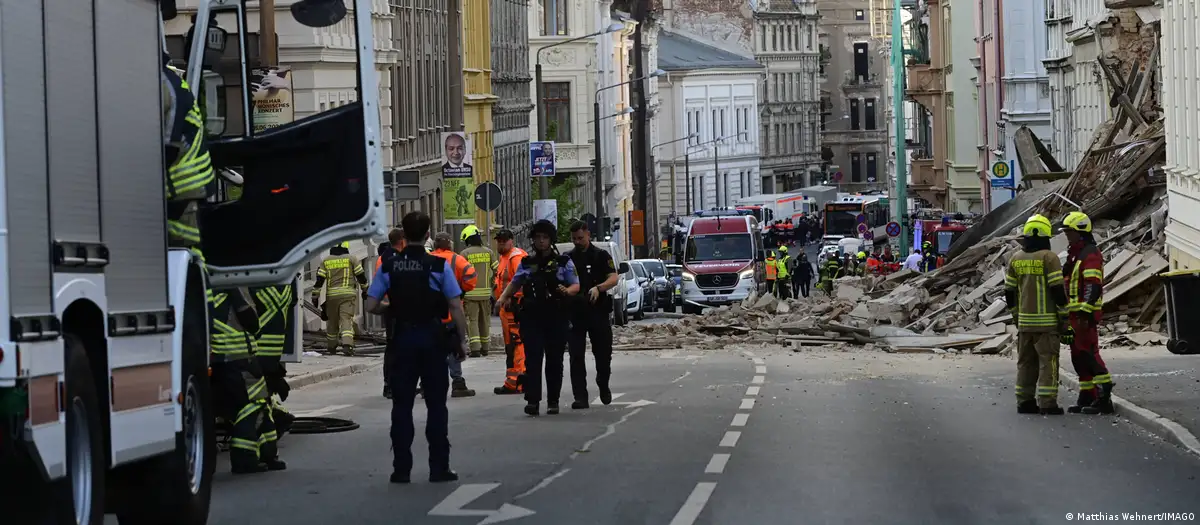
What you need to know
- Three people missing after house collapses in Görlitz
- One in five German petrol stations in breach of fuel price break — study
- German Chancellor Friedrich Merz to welcome Swiss President Guy Parmelinin Berlin
- Child abuse and pornography dominate online offenses — report
This blog has now closed. Read below for DW's coverage of what Germany was talking about on Tuesday, May 19, 2026. You can catch up on yesterday's news here.
Deutsche Bank London branch fined for Russia sanctions violations
The London branch of German global financial institution Deutsche Bank has been fined by UK authorities for violations related to Russian sanctions.
The UK Office of Financial Sanctions Implementation (OFSI) fined Deutsche Bank £165,000 ($221,066, €190,448) for processing two payments totaling £635,618.75 for a sanctioned Russian entity in June and July 2022.
The funds were reportedly sent to Okka, a Russian online video streaming platform, by a customer of the bank.
Deutsche Bank said the funds were transferred to JSC New Opportunities after a review by a third-party provider offering screening services. The reviewed data did not include information on the company or its owners and, as a result, the security check raised no red flags.
OFSI officials said Deutsche Bank ultimately bore responsibility for ensuring compliance.
A separate £1.1 million payment was made in 2022, but the bank was not penalized in that case due to changes to sanctions rules.
The UK and other countries have imposed sanctions on individuals and businesses believed to be aiding Russia's war effort in Ukraine.
OFSI said sanctions "imposed by the UK in respect of Russia were a strategic priority for the UK and its foreign policy" in 2022 and "remain so today."
Numerous individuals have faced investment bans and the risk of having their assets frozen.
About 20 companies, including Bank of Scotland, have been fined for breaching UK sanctions rules since 2019.
A Deutsche Bank spokesperson said Tuesday: "After identifying two payments to a Russian entity that had become affiliated with a sanctioned entity, we voluntarily disclosed this to OFSI. Deutsche Bank takes sanctions compliance extremely seriously. We have strengthened and continue to strengthen all aspects of our sanctions compliance framework and associated processes."
The bank received a reduced penalty because it voluntarily disclosed the violations.
Court jails 5 in driving license theory test doppelganger scam
A court in southwest Germany has jailed five men for their roles in an organized driving test fraud scheme.
The accused were found to have paid doppelgangers to take people's driving theory tests fraudulently in their name.
A defendant born in 1987 was given the longest custodial sentence, at 4 years and 3 months.
The court deemed that he had a central role in the organization, but still, the judge said he was "not the last in the hierarchy." The court said it believed that the men were part of a far-reaching system designed to subvert the driving license process.
Two other defendants, who operated driving schools in the Heilbronn and Göppingen area in the southwestern state of Baden-Württemberg, received sentences of 3 years and 9 months. The court said they had "profited financially the most from the system."
According to the prosecution, people looking to skip their theory test would typically pay around €2,000 (roughly $2,400), or considerably more in certain cases. It alleged that the quintet had earned more than €179,000 across 59 cases in a period of almost three years, splitting it among themselves.
The court noted in its ruling that the defendants had not created the system, it believed that they had taken up positions in a pre-existing organized crime network.
The judge noted that the defendants had been cooperative and quick to confess in a trial lasting just seven court days, saying that their penalties could have been "considerably higher" had they contested the case.
13-year-old calls emergency police hotline to complain of confiscated bus pass
Wilhelmshaven police issued what seemed to be a veiled public request to think twice before calling the emergency services on Tuesday, relaying details of an unusual and probably unnecessary callout for its officers the previous evening.
Police were dispatched at about 3:30 p.m. "after an emergency call from a child," the incident report began, at first written as if a potentially serious incident might ensue.
It transpired that the youngster, whose identity and gender was not revealed, was complaining about disciplinary measures within the family.
"The background was, among other things, that the child's bus pass had been confiscated, so that they could not visit friends as planned," police wrote.
"The police officers dispatched checked the situation on site. Indications of the child being endangered could not be identified in the process. It was possible to clear up the familial situation," law enforcement wrote.
The seemingly tongue-in-cheek report stopped short of explicitly asking people to weigh the merits of calling Germany's police emergency hotline on 110.
Wadephul: Europe must learn from Ukraine on energy security
German Foreign Minister Johann Wadephul has said that Europe must better protect its energy infrastructure from hybrid and outright attacks – and can learn from Ukraine in this regard.
"Critical infrastructure is increasingly a frontline of geopolitical confrontation," said Wadephul at an international conference on energy security in Berlin on Tuesday, warning that "neither Germany nor our allies and partners in Europe are immune."
Wadephul highlighted a rise in hybrid attacks on European infrastructure, including cyberattacks, drone sightings and damage to undersea cables, many of which have been attributed to Russia, which has been waging war against Ukraine for over four years.
"Today is about listening to Ukraine's political and economic decision-makers, communities, civil societies and experts to learn from their experience, their flexibility, their perseverance and their innovativeness," Wadephul said in the presence of Ukrainian Energy Minister Denys Shmyhal and representatives of the Group of Seven (G7), the European Union and NATO.
"Ukraine has accumulated the hard-earned expertise that the EU urgently needs to bolster its own resilience and energy security," he continued, highlighting the speed with which Ukrainian authorities are able to repair damage and restore energy supplies following Russian attacks.
"Highly centralized systems may be efficient in peacetime, but they can become an extra vulnerable crisis situation," the minister warned. "Distributed generation, mobile capacity, microgrids, energy storage and redundancy all increase survivability."
Attacks on German political party members up 40% — AfD most targeted
The number of attacks on members of German political parties increased significantly last year, with members of the far-right Alternative for Germany (AfD) overtaking those of the Green Party as the most targeted.
According to a government response to a parliamentary question submitted by the AfD, German police recorded 5,140 such attacks on representatives of all parties in 2025, a 40% increase on 2024 (3,690) and almost double the number in 2023 (2,790).
For the first time, members of the AfD were subject to most attacks (1,852), followed by members of the conservative Christian Democratic Union (CDU) whose members experienced almost three times more abuse (1,171 cases) than the previous year (420).
Of the attacks suffered by AfD party representatives, police classified 121 cases as physically violent crimes – as opposed to verbal abuse, hate speech or defamation.
"Those who constantly defame, delegitimize and dehumanize the AfD and its supporters shouldn't be surprised when enemies of democracy see in this a call to violence," said AfD interior spokesman Martin Hess.
Hess, a former police officer who Germany's police union (Gewerkschaft der Polizei or GdP) has attempted to exclude from its membership, is considered to represent the extreme right wing of the AfD and has defended and promoted the racist concept of "Remigration" in parliament.
Child abuse and pornography dominate online offenses — report
German authorities identified over 15,000 breaches of youth protection regulations on the internet in 2025, the vast majority of which involved child abuse (12,334 cases) and child pornography (1,091 cases), according to a new report.
Other offenses in areas such as political extremism, cyber bullying, adult pornography and violence made up a comparatively small proportion of the transgressions.
In 96% of cases (14,520), authorities were able to bring about the immediate deletion of illegal content, with criminal proceedings launched in almost 6,500 cases.
"These once again alarming figures show how far away we are from enabling safe and secure participation in the online world for children and teenagers," said Education and Youth Minister Karin Prien (CDU), lamenting that many internet providers still do too little to ensure child protection.
And since digital entertainment and artificial intelligence (AI) are becoming more and more central to young people's lives, Prien called for "security, protection and clear rules which keep up with technological advances."
Stefan Glaser, who heads up the state-funded Jugendschutz.net (youth protection) portal which produced the new figures, said that internet providers were continuing to "expand their manipulative business models" rather than implementing effective security measures.
He said that AI chat robots which take on the role of "emotional sparring partners" were particularly problematic, explaining: "Such semi-social relationships warp reality and make it more difficult [for young people] to identify what is artificial and what is real."
In some cases, the study warned, without adequate filters and security settings in place, there is a danger that AI bots could go so far as to describe and even encourage sexual activity among minors.
Football: Freiburg's Europa League final is proof another way can work
German Bundesliga club SC Freiburg face Premier League side Aston Villa in the UEFA Europa League final in Istanbul on Wednesday in the biggest game in the club's history — bigger even than the 2022 German Cup final.
Hailing from the Black Forest in southwestern Germany, 100% member-controlled Freiburg are proof that, in a professional football world dominated by big money, another approach is possible.
Read DW's exclusive report about what stands behind Freiburg's success..
German start-up founders younger than ever – study
The average age of start-up founders in Germany sunk to a record low of 34.2 years in 2025, while 40% were aged younger than 30, according to a new study by the state-owned German investment bank KfW.
By way of comparison, the average age of those setting up their own businesses in Germany at the start of the century was between 37 and 38, with only 24% of them under 30.
For KfW chief economist Dirk Schumacher, the social media presence of successful start-up influencers is inspiring other young entrepreneurs to follow suit.
"Many young people are reading in the media about successful start-up founders or influencers who are serving as role models for self-employment," he said.
But he cautioned that, while the average age of start-up owners is sinking, the overall number of start-ups is dropping, too.
"In contrast to the past, fewer businesses are actually being founded in Germany," Schumacher said.
Indeed, while the number of new start-ups increased from 585,000 to 690,000 last year, that's still half of the 1.5 million of business foundations registered in 2002.
But that might be set to change as new generations embrace a fresh Gründergeist, or "foundational spirit." While only 26% of the overall German population told the KfW study they would prefer to be self-employed, that figure rises to 36% among the under-30s.
Electric car subsidy: over 1,800 applications in first hour
A new German state subsidy for electric vehicles has attracted significant interest since applications began on Tuesday morning.
The German government has put aside €3 billion ($3.5 billion) to subsidize the purchase of electric or hybrid vehicles by private households, who are eligible for subsidies ranging from €1,500 to €6,000 ($1,740 to $7,000) depending on family size, annual income and vehicle model.
"We have already had 1,858 applications," said Mandy Pastohr, the president of the Federal Office for Economic Affairs and Export Control (Bafa), just 15 minutes after the government portal foerderzentrale.gov.de went live on Tuesday morning.
The subsidies are available until 2029 and can be backdated to January 1, 2026, with German Environment Minister Carsten Schneider (SPD) hoping to encourage the purchase of up to 800,000 environmentally friendly vehicles.
Thousands of German petrol stations breach 12 o'clock rule
Almost one in five petrol stations in Germany have breached a new law in the last month by increasing prices at non-permitted times.
The so-called "12 o'clock rule" was introduced on April 1 and stipulates that German petrol stations may only raise gas prices once per day — namely at midday.
The price break is intended to protect drivers from sudden, extreme price rises in the context of global shortages due to the war in the Middle East, and give them more planning security.
But a study by the lobby group "Mehr-Tanken" ("fill up more") has found that 2,995 out of 15,240 petrol stations had increased prices at non-permitted times on around 17,000 occasions between April 1 and May 11.
The highest rate of violation was in the southern state of Bavaria, where 25.6% of petrol stations were found to have broken the rules, while the lowest rate was in Berlin (8.2%).
Overall, 19.7% of petrol stations infringed regulations — almost one in five. But petrol station operators have rejected the accusations.
"We have received reports that we're dealing with the consequences of a badly designed law, not with intentional breaches," insisted Daniel Kaddik, head of the National Federation of Free Petrol Stations, in an interview with local newspapers in the eastern German city of Leipzig.
Kaddik claimed that submissions of price changes were being delayed in many cases by various automated systems, slow pipes or ongoing transactions, thus skewing the statistics.
Görlitz: Three missing after house collapse in eastern German city
Three people remained missing in the eastern German city of Görlitz on Tuesday after a residential building collapsed on Monday evening.
The precise cause of the collapse of the 19th-century house in the city center is still unclear, although local police suspect a gas explosion.
Emergency services are therefore proceeding cautiously with the help of gas readers, and also to prevent further collapses of rubble.
Initially, five people were listed as missing — but two were holidaymakers who had not yet arrived in Görlitz, and appeared shortly after midnight.
"They're fine, they weren't in the building at the time of the collapse," said police spokeswoman Anja Leuschner, explaining that the building housed rented accommodation and holiday homes. "They were lucky that they weren't there."
Görlitz, located in the eastern state of Saxony, is Germany's most easterly city, and lies directly on the border with Poland.
Welcome to our coverage
Guten Morgen! Welcome to DW's coverage of what Germany is talking about on Tuesday, May 19, 2026.
Emergency services are still searching for three missing people after a house collapsed in the center of Germany's most easterly city, Görlitz, on Monday evening. Local police suspect a gas explosion.
Meanwhile, a new study suggests that almost one in five German petrol stations have breached new rules limiting the amount of times they can increase fuel prices.
Later on Tuesday, German Chancellor Friedrich Merz will welcome Swiss President Guy Parmelin to Berlin, and we're also expecting the results of an inquiry into the car attack at Magdeburg Christmas Market in December 2024.