Germany updates: Berlin brings back EV subsidies
Published January 19, 2026last updated January 19, 2026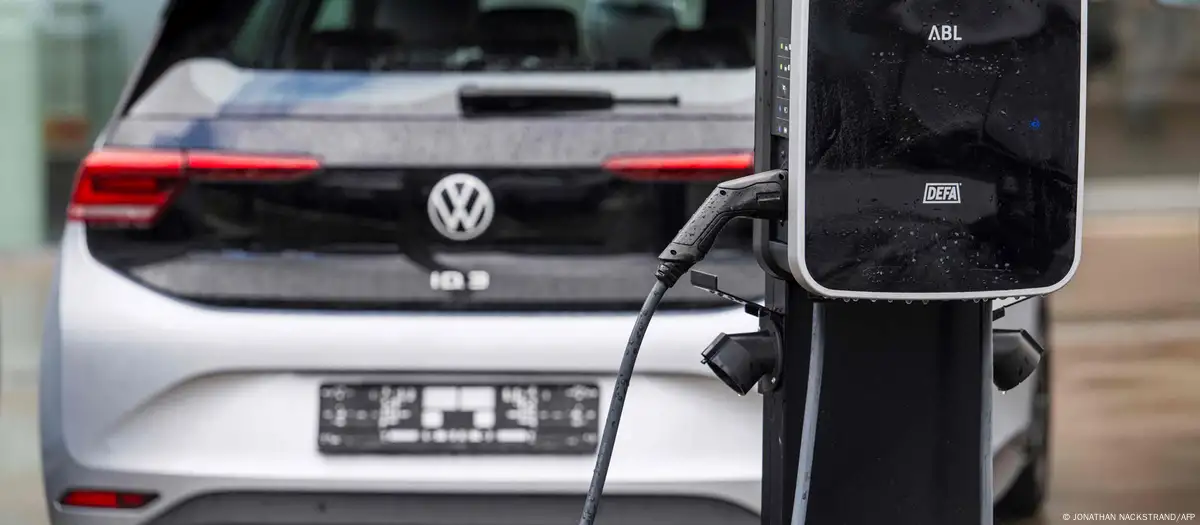
What you need to know
Several years after the previous subsidies for electric vehicles were scrapped, the coalition government of CDU/CSU and SPD has brought them back.
However, the Greens and environmental groups have criticized the new policy for including hybrid vehicles which have much higher emissions than just pure EVs.
Meanwhile, the International Monetary Fund (IMF), has made a more optimistic prediction about the German economy than even some German institutions.
This blog is now closed. Read below for the top headlines from Germany Monday, January 19. You can catch up with the weekend's news here.
We're pausing our coverage
We'll be back with the latest headlines in Germany tomorrow. Thank you for reading.
Merz anticipates Trump meeting on Wednesday
German Chancellor Friedrich Merz told reporters in Berlin that he expected to meet and talk with US President Donald Trump in Davos on Wednesday.
Trump is addressing the World Economic Forum in the Swiss Alps on Wednesday, and Merz is a keynote speaker the following day.
Merz said that he hoped to discuss the issue of Greenland as Trump becomes increasingly vocal on the matter.
"I don't want to do it, but if it is necessary, then of course we would defend our European interest and our German national interests," he said.
Merz said that he did not dismiss Trump's warnings about the strategic importance of Greenland and the need to defend it. However, he noted that there was a time during the Cold War when the US had more than 30,000 troops stationed on Greenland, before it evidently downgraded the priority.
"At the moment it is fewer than 200," Merz said. "So evidently the threat analysis, also from the US, is not as dramatic as is curently being portrayed. Which is not to say that it cannot become larger again."
Germany cautiously thankful for US invite to 'Board of Peace'
Germany on Monday thanked US President Donald Trump for extending Berlin an invitation to take up a seat on his so-called "Board of Peace."
German government spokesman Steffen Cornelius said: "We are thankful for this invitation. We share the aim of pursuing peace in the world. It is in Germany's core interest to end the conflict in Gaza for good."
Originally intended as a mechanism for rebuilding the devastated Gaza Strip, Trump has since framed the body as engaged in bringing about "enduring peace" worldwide.
"The Board of Peace is an international organization that seeks to promote stability, restore dependable and lawful governance, and secure enduring peace in areas affected or threatened by conflict," the board's charter reads.
Trump has now asked dozens of nations to join, saying that those who put up $1 billion (€860 million) in the board's first year will be allowed to remain a member beyond that time.
Among those invited by Trump — who appointed himself director of the proposed organization as well as dictating that he alone has the power to invite new members to it are Russian President Vladimir Putin, Belarus President Alexander Lukashenko, Hungarian Prime Minister Viktor Orban and numerous other heads of state.
France has suggested it will balk at the invitation, whereas Canada says Prime Minister Mark Carney will accept his invitation but added that Ottawa would not pay Trump's $1 billion membership fee.
Germany's Merz scoffs at Cabinet reshuffle rumors
German Chancellor Friedrich Merz on Monday dismissed a media report about alleged plans to reshuffle his Cabinet.
"I have no intention of reshuffling the federal Cabinet," said Merz on Monday after a meeting of his Christian Democratic Union party's executive committee.
"I am satisfied with the work of the federal Cabinet," said Merz, calling the rumors "nonsense."
Merz's comments came in response to a report in Germany's Spiegel magazine about major personnel changes in his administration.
Merz is said to be particularly dissatisfied with parliamentary group leader Jens Spahn, largely seen as responsible for a series of political gaffes in the Bundestag, Germany's lower house, last year.
Nevertheless, Merz insists he has a "good and trusting working relationship with Jens Spahn."
Merz recently shook up his team after just eight months in office when Jacob Schrot was succeeded as chief of staff by Philipp Birkenmaier, an economic expert.
New electric vehicle subsidies to 'boost' German car industry
German Environment Minister Carsten Schneider has welcomed a new raft of electric vehicle subsidies which he says will be a "major boost" for the country's auto sector.
"This is a program with which we are doing something for the environment, for the automotive industry, but especially for families who otherwise couldn't afford a new, environmentally-friendly car," he said.
The new subsidies allow consumers to claim between €1,500 ($1,743) and €6,000 in government aid to buy an electric vehicle, with eligibility extending up to a maximum income of €90,000 for households with two children.
"[This is] a boost for our domestic automotive industry, which offers powerful electric cars," said Schneider, adding: "This year, more and even more affordable models from German manufacturers will come onto the market."
Germany's largest trade union, IG Metall, welcomed the news, with chairwoman Christiane Benner saying it was "only right that people on lower incomes receive higher subsidies."
But environmental groups as well as Germany's opposition Green Party have criticized the fact that the subsidies will also apply to plug-in hybrids — cars that run on both electricity and fossil fuels — and vehicles with range extenders.
"In practice, plug-in hybrids emit up to five times more CO2 and therefore offer hardly any climate advantages compared to conventional combustion engines," said Jürgen Resch from the Environmental Action Germany (Deutsche Umwelthilfe or DUH) non-profit.
There has also been criticism from other sectors who fear that government subsidies for electric vehicles will have the effect of funneling consumers' limited spending power into car purchases at the expense of other industries.
"This kind of government-driven consumer spending does more harm than good," argued Jan Kurth, Managing Director of the Association of German Furniture Industry groups. "Consumers can only spend their money once," he said.
Cologne: Jewish carnival club receives antisemitic email
As the western German city of Cologne gears up for the climax of its carnival season in February, its only Jewish carnival association has reported receiving an antisemitic email.
According to Aaron Knappstein, chairman of the "Kölsche Kippa Köpp" ("Cologne Kippa Heads" in the local dialect), an anonymous author took issue with the association's carnival motto, "Mer dun et för Kölle" ("We do it for Cologne"), claiming that city isn't the association's home and that the motto ought to be: "Mer dun et för Israel" ("We do it for Israel").
"I have no idea who it's from," said Knappstein, who founded the association in 2017 marking the reestablishment of a Jewish carnival club for the first time since the Second World War.
"We've never experienced antisemitic hostility before, either as a group or as individuals. This is the worst that has happened to us."
On its official website, the Kölsche Kippa Köpp state that they celebrate carnival just like everybody else in Cologne. "We're part of the Cologne carnival family and want to show that Jewish life is anchored firmly and jovially in the city's civil society and its carnival."
However, despite an invitation last year, the group is yet to take part in the highlight of the carnival calendar, the Rosenmontagszug (Rose Monday parade). "I don't think that would be a good idea at the moment," lamented Knappstein, referring indirectly to reports of growing antisemitism in Germany. "I would never be able to forgive myself were something to happen."
Nevertheless, he said the Kölsche Kippa Köpp had received many messages of support since the publication of the antisemitic email, including from the official carnival committee.
"Most people react to us positively," he said, suggesting that antisemites probably don't have much to do with carnival anyway. "We're in a little bubble."
German court: Muslim women may not drive with full niqab face covering
Muslim women in Germany are not allowed to wear full face coverings while driving, according to a ruling handed down by a court in the southern state of Baden-Württemberg on Monday.
A Muslim lady in the city of Mannheim had argued that her religion requires the wearing of a full face-covering, known as a niqab, in public and that, as a mother of six, she was reliant on her car when going about her daily life.
But the judge decided that German traffic code (StVO) rules banning face-coverings take precedence over the right to religious freedom since they are designed to ensure the safety of other drivers on the roads.
However, the court also found that an initial ban on face-coverings issued by the German transport ministry was also problematic, since it didn't sufficiently take into account religious freedoms.
The ministry must therefore reconsider the complainant's appeal while explicitly considering her right to religious freedom — but this is still unlikely to result in a different outcome.
Germany's AfD receives millions in public funding
The right-wing extremist party Alternative for Germany (AfD) profits significantly from public funding.
Is democracy in Germany funding its own downfall?
Read DW's full report on why the AfD is receiving €500 million ($580 million) in public funds.
Germany's most powerful state leader wants to redraw the map
Bavaria's Markus Söder is calling for fewer German federal states, but the plans to merge have drawn criticism.
How realistic is a change in political lines?
German finance minister: Europe 'will not be blackmailed' by Trump
German Finance Minister and Vice-Chancellor Lars Klingbeil has insisted that Europe will not be "blackmailed" by the United States after President Donald Trump threatened to impose economic tariffs amid US claims to Greenland.
"We will not be blackmailed," said Klingbeil in a joint statement with his French counterpart, Roland Lescure, in Berlin. "There will be a united and clear response from Europe, and we are now preparing coordinated countermeasures with our European partners."
Klingbeil, who is the leader of the Social Democratic Party (SPD), the junior partner in Germany's conservative-led coalition government, said an escalation is in nobody's interest but warned that the European Union would examine countermeasures.
Follow DW's live blog on Trump's threats against Greenland and how Europe is planning to respond.
IMF predicting stronger German economic growth
Germany's economy is expected to grow more strongly this year than previously anticipated, according to new figures released by the International Monetary Fund (IMF).
Growth in 2026 is projected to reach 1.1%, 0.2 percentage points higher than forecast in October, the Washington-based IMF announced on Monday.
Among other factors, billions in German government spending are expected to provide a short-term boost, mitigating the impact of tariffs imposed by the United States.
The IMF predictions are significantly more optimistic than Germany's own Bundesbank and the Munich-based Institute for Economic Research (IFO), but remain more cautious than the German government, which is expecting growth of 1.3%.
The Berlin government's forecast relies primarily on domestic demand, with stable prices, wage increases and tax relief measures expected to boost disposable household income.
To put the IMF forecast into context, Germany is expected to grow more strongly this year than other G7 countries such as France at 1% predicted growth and Japan and Italy at 0.7%.
Welcome to our coverage
Guten Tag! Welcome to DW's coverage of what Germany is talking about on Monday, January 19.
There was some positive news for the German economy on Monday morning with the International Monetary Fund (IMF) forecasting stronger growth than previously expected and more than even some German institutions.
On the international stage, German Finance Minister Lars Klingbeil says the European Union will not be "blackmailed" by US tariff threats over Greenland.