Germany news: Lawmakers back €50 billion defense package
Published December 17, 2025last updated December 17, 2025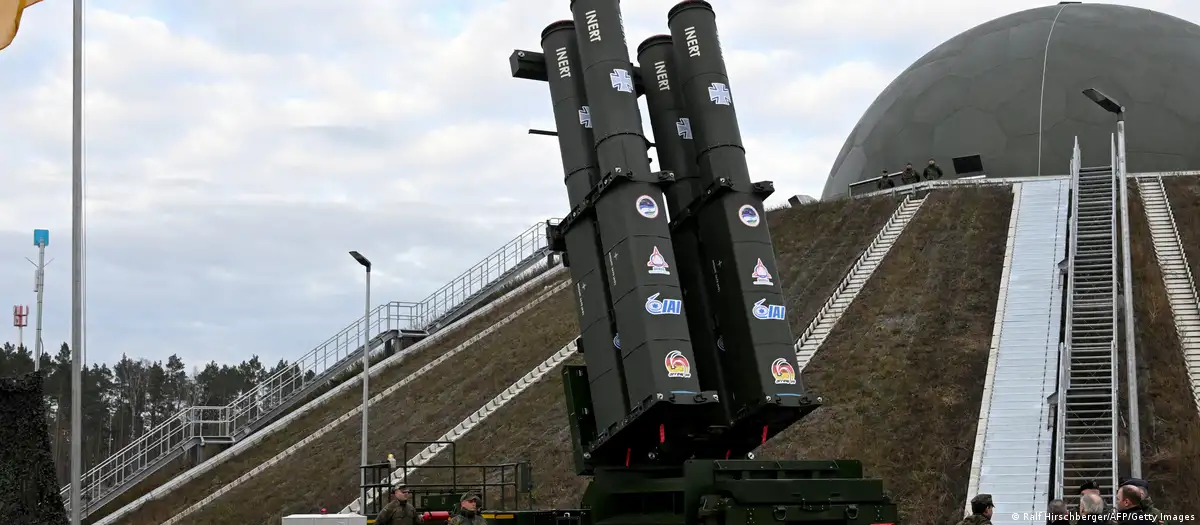
What you need to know
- The Bundestag budget committee has given the greenlight to tens of billions in military expenditure as the country rearms amid the threat of Russian aggression
- German automaker Volkswagen has launched in-house battery cell production
- The German government has decided on renaming the current "Bürgergeld" welfare program and on the introduction of stricter conditions for the current recipients of the payments
This blog has been closed. Thank you for reading.
Here is a roundup of news in Germany on Wednesday, December 17.
Police investigate after neo-Nazi music played at Christmas market
A 40-year-old is being investigated for having allegedly played banned neo-Nazi music at a Christmas market in Otterndorf, northern Germany.
According to reports, tracks by a banned neo-Nazi band were played in public, as well as antisemitic songs.
Police secured the USB stick with the music and are looking into whether the suspect worked for an external company hired to be responsible for the music at the market.
Playing the songs in public is illegal, while owning them is not.
German general attends topping-out ceremony at future Lithuania base
The topping-out ceremony for a staff building at a future German military base in Lithuania took place on Wednesday — ten months ahead of schedule.
"This is a huge step forward for our country and for the deterrence of our region," said Lithuanian Defense Minister Robertas Kaunas.
Once fully complete and operational, the base in Rudninkai, just south of the capital Vilnius and close to the border with Belarus, will become home to the German Bundeswehr's 45th Armored Brigade and its commander, General Christoph Huber.
"I am deeply impressed by what I have seen here today," said Huber, thanking the construction companies. "These works are of great importance because it will be our home, my home, the home of my soldiers."
The brigade is expected to be fully operational by 2027 with a total strength of 4,800 soldiers and 200 civilian employees.
"We are very grateful to Germany for taking the lead and taking responsibility for regional security," Kaunas told the dpa news agency.
The construction of the facility is the largest military infrastructure project in Lithuania's history and is being carried out in phases.
In the first phase, administrative buildings, accommodation for 600 soldiers, vehicle storage and maintenance halls and other buildings are being erected on a site covering almost 56,000 square meters.
In a second phase, the remaining infrastructure of the military town is to be built on an area of 170 hectares.
Amazon may not impose ads on Prime customers, says German court
US tech and e-commerce firm Amazon is not allowed to impose additional advertising on German customers who pay for its Prime Video streaming service, a court in Munich ruled on Wednesday.
Back at the start of 2024, Amazon informed Prime customers who had paid for ad-free streaming that they would start seeing a limited number of commercials. Amazon said customers could continue streaming ad-free for an extra €2.99 ($3.50) per month.
Germany's Federation of German Consumer Organizations (Bundesverband der Verbraucherzentralen or VZBV) took Amazon to court in the southern city of Munich, which found that the tech giant was in breach of fair trading laws and didn't have the right to unilaterally alter the terms of its contract with customers.
The court said that, when entering into the contract, customers had expected an ad-free service. And because Amazon had made ad-free programing the "subject of the contract," the company must be held to it.
"[The ruling] shows that additional advertising on Amazon Prime Video should not have occurred without the involvement of the affected consumers," said Ramona Pop, chairwoman of the VZBV, who described the judgement as "very important."
Amazon has now been instructed to send customers a "correction letter," but the judgement is not yet final, and Amazon may appeal the decision: "We will review the judgement to determine our next steps," said the company spokesman.
"Although we respect the court's decision, we don't agree with the reasoning. We informed our customers about the advertising update to Prime Video transparently, in advance and in accordance with the law," he added.
VIDEO: Merz: 'Democracies must be better armed than autocracies'
German Chancellor Friedrich Merz has said that financial support for Ukraine and economic sanctions on Russia are not enough when it comes to protecting both Ukraine and Europe from Russian aggression.
If democracies are to be able to defend themselves against autocracies, he told the German parliament, then they need to be better armed. "It's as simple as that," he said.
New German drone defense center opened in Berlin
Germany has opened a new national drone defense center (Gemeinsames Drohnenabwehrzentrum or GDAZ) which is intended to improve cooperation between the federal government, state governments, the police and the armed forces in the interception and elimination of drones.
Inaugurating the new center in Berlin on Wednesday, Interior Minister Alexander Dobrindt said that, while Germany is not at war, "we are the targets of hybrid war tactics, almost every day."
Chancellor Friedrich Merz has blamed a series of recent drone incidents near sensitive facilities such as airports and military bases in Germany and elsewhere in Europe on Russia.
"Every day Russia is transgressing with hybrid attacks, drone overflights, killings, sabotage, spying, cyberattacks and targeted disinformation," he told the lower house of the German parliament, the Bundestag, on Wednesday, accusing Moscow of wanting to "expand its area of influence well beyond its own borders into Europe."
A major problem hampering Germany's drone defense has been uncertainty regarding responsibility for combatting unmanned aerial vehicles (UAVs). While the armed forces (Bundeswehr) cannot constitutionally be deployed inside Germany, local police (Landespolizei) don't have the equipment or capability to shoot down drones. And if an airport or train station is threatened, they come under the jurisdiction of the federal police (Bundespolizei).
"The borders between internal and external security are becoming more and more blurred," said Armin Schuster, regional interior minister for the eastern state of Saxony. "The new drone defense center combines the civilian and military capabilities of both central and state government."
In order to enable future domestic Bundeswehr deployments to combat such hybrid threats, the government is in the process of updating Germany's air defense legislation, reforms which are currently passing through parliament. However, the new drone defense center will be operational as early as January.
"We're just getting it done," said Joachim Herrmann, regional interior minister for the southern state of Bavaria, at the inauguration in Berlin. "In the current situation, citizens quite rightly don't want us to be having these discussions about jurisdictions."
LGBTQ+ icon and director Rosa von Praunheim dies aged 83
Rosa von Praunheim, one of Germany's most productive and controversial film-makers, has died in Berlin.
The 83-year-old had married his life partner just days earlier.
The director had over 150 movies under his belt, focusing on gay, lesbian and trans topics.
Born Holger Radtke, he took on the name Rosa (pink in German) to remind people of the pink triangles homosexuals were forced to wear in Nazi concentration camps. Praunheim refers to the Frankfurt neighborhood where he grew up.
German automaker VW launches in-house battery cell production
Volkswagen on Wednesday officially started manufacturing operations at the first plant operated by its battery subsidiary PowerCo at the company's premises in the central city of Salzgitter.
Chief executive Oliver Blume described the new plant as a "signal for Europe" and a key element of the group's strategy.
He said Volkswagen had become the first European carmaker to establish its own development and production of battery cells, something that would strengthen its position and independence on the global market, currently dominated by China and other Asian manufacturers.
Although it will start by producing just a few hundred battery cells per day, that volume is eventually to rise to 60,000-70,000 cells daily at the Salzgitter facility alone.
VW plans to establish factories on the same model at two other sites: one in the Spanish city of Valencia and the other in St Thomas in Canada. They are scheduled to begin production within the next two years.
The manufacturing launch comes as the EU has watered down its previously planned phaseout of combustion vehicles, meaning that some types of car with combustion engines will still be able to be registered after the deadline of 2035.
However, PowerCo boss Frank Blome said that the recent change in Brussels did not change the company's view on the future of electric vehicles.
Quick analysis: Would Germany send troops to Ukraine?
German Chancellor Friedrich Merz would likely send troops to Ukraine to secure a truce if necessary, although he wouldn't spell it out in parliament.
While taking questions from lawmakers in the Bundestag today, he left no doubt that he would support Kyiv. But the chancellor seemed to fear a toxic public debate at home over German boots on the ground. Rightly so, Germany is a country still struggling to get used to the idea that security is no longer something provided by the United States.
A lawmaker from the far-right Alternative for Germany (AfD) party, Markus Frohnmaier, asked Merz whether Germany would send troops to Ukraine.
"There are questions in this world that are not as simple as you might imagine. This question is one of them," Merz said.
"We are talking about security guarantees for Ukraine after a ceasefire that must be agreed with Russia. I would add that, at least as long as I have a say in the matter, we will not repeat the mistakes of 2014 by continuing to expose Ukraine to Russia's influence without security guarantees," he added.
During the Ukraine negotiations in Berlin earlier this week, Merz signed off on the declaration of the coalition of the willing that foresees a European force to secure peace in Ukraine.
The fact that the far-right AfD is pushing the chancellor to make concrete commitments before a truce is even on the cards illustrates that German troops in Ukraine could fast become an issue for regional elections in Germany next year — a political risk for Merz.
Bundestag budget committee approves tens of billions in military expenditure
The budget committee of the Bundestag has given the green light to an expenditure of more than €50 billion ($59 billion) for military weapons and equipment.
The Defense Ministry has confirmed that it is the largest one-off sum ever approved for the use of the Bundeswehr, or German armed forces.
The largest item on the list submitted by the Bundeswehr is that for uniforms and protective equipment for individual soldiers.
The list also includes an order for 200 Puma infantry fighting vehicles worth €4 billion.
The approval comes as Germany boosts its defense capabilities in response to the threat of Russian aggression.
The country has invested more on the military over the last three years than in the eight years prior to that, noted DW's chief political correspondent Nina Haase.
Military expenditure in Germany has been exempted from the constraints otherwise put on public debt for the next few years.
The high sums for uniforms and protective equipment come as the Bundeswehr aims to increase the number of active soldiers from the current some 184,000 to at least 450,000 by 2035.
Cabinet backs legislation on wolf hunting
The German government has approved a draft law allowing regular hunting seasons for wolves in areas with a high-density wolf population.
The draft law would allow for the shooting of "problem" wolves that can break through fences intended to protect livestock.
The legislation would go further than the EU's habitats directive, under which the animals may be killed only under specific exceptional circumstances.
"The return of the wolf to Germany and Europe is a success of species conservation policy, but its increasing spread has also led to conflicts with livestock farming and with parts of the population," said government spokesman Stefan Kornelius, shortly after the Cabinet approved the draft law.
Wolves have killed increasing numbers of livestock in Germany in recent years, causing divisions between farmers on the one hand, and conservationists who see the return of wolves to the country as a win for the environment on the other.
Wolves in the wild were extinct in Germany for some 150 years but were reintroduced about 20 years ago.
Cabinet approves draft bill on Bürgergeld welfare scheme
The German government has decided on renaming the current "Bürgergeld" welfare program and on the introduction of stricter conditions for the 5.5 million current recipients of the payments.
The reforms have met with resistance from members of the Social Democrats (SPD), the junior partner in Germany's coalition government, though the draft bill including the changes has been proposed by Labor Minister Bärbel Bas from the same party.
What are some of the proposed changes?
- The name "Bürgergeld" (Citizens' Income) is to be changed to "Grundsicherung" (Basic Security)
- If recipients miss three appointments at the job center without valid reason, their benefits could be cut completely, with housing benefits also affected — but mentally ill people are to be exempt from the penalty
- The fixed term for disregarding recipients' assets is to be abolished
- In principle, recipients' own income and assets are to be used before any benefits are paid out
The changes, which have been criticized by several charitable groups, are not expected to bring large savings, with €86 million ($101 million) less in welfare payments expected in 2026 and just €70 million less in the following year.
Bas said on Wednesday that the reform aimed "to get people into permanent employment" but added that those who need help would still be able to "rely on the support of the state" in the future.
The changes still have to be approved by parliament.
Single recipients of Bürgergeld are paid €563 ($660) a month, which costs the government about €50 billion a year.
Some in Germany curbing winter travel and leisure in 2025 — study
Winter travel and leisure activities are being wound back by many people in Germany as rising costs and economic uncertainty make themselves increasingly felt, a survey has shown.
The poll by YouGov, commissioned by the DPA news agency, found that 15% of respondents were planning to trim their holiday plans, while another 15% wanted to cut back on leisure activities.
Around 25% said they would not spend as much in restaurants.
However, some 51% said they would keep up their normal winter leisure expenses.
But the survey also found that by far the most people in Germany, 81%, were not planning on any form of winter holiday, although Germans are known for their love of summer travel.
Nonetheless, the drop in spending by Germans could negatively affect the hospitality sector in neighboring countries, with almost half of hotel guests last winter in Austria coming from Germany, for example, and some 12% in Switzerland.
READ: Germany hails launch of EU Galileo satellites
Two EU Galileo satellites are headed to space on board a European rocket, marking a break from the reliance on the US — and pre-invasion Russia — for such launches over the past seven years.
The two satellites were built by the German company OHB, a fact highlighted by Germany's research, technology and space minister.
You can read more about the groundbreaking launch in this article by DW's Alex Berry: Ariane 6 rocket launches with EU Galileo satellite
Wolves could receive less protection
The German government intends to ease the currently strict rules protecting wolves, with the Cabinet discussing the possible inclusion of the animal in the list of permissible hunting targets under certain conditions.
The measures under discussion would mean that states with large wolf populations, such as Brandenburg, Lower Saxony and Saxony, would be permitted to cull wolves if the situation demanded.
Those wolves that have shown themselves capable of getting through protective fences would be able to be shot dead under the proposed measures.
Currently, there are 209 packs of wolves living in Germany. In 2024, some 4,300 livestock animals, mostly sheep and goats, were killed by wolves.
Cabinet set to approve stricter rules for welfare recipients
The federal Cabinet is expected to approve a reform of Germany's "Bürgergeld" (Citizens' Income) welfare scheme, including a change of name to "Grundsicherung" (Basic Security).
Under the stricter rules that are proposed, welfare recipients could see their payments reduced or even cut completely if they fail to accept suitable job offers. There would also be reductions if recipients do not turn up to appointments at the job center.
The welfare rights group AWO has criticized the planned reforms, saying the debate about "how to save money at the cost of the poorest" was "shameful for a rich country like Germany."
AWO President Michael Gross said that the proposals distracted from the real problems facing impoverished families in Germany, noting that food prices had gone up by more than 36% in the past five years.
"So while families are worrying about being able to put a warm meal for their children on the table at the end of the month, the government is looking at punishing missed appointments at the job center by cutting housing payments. That is a catastrophic debate," he said.
Currently, some 5.5 million people in Germany receive Bürgergeld.