Germany news: Fall of Berlin Wall, pogrom night commemorated
Published November 8, 2025last updated November 10, 2025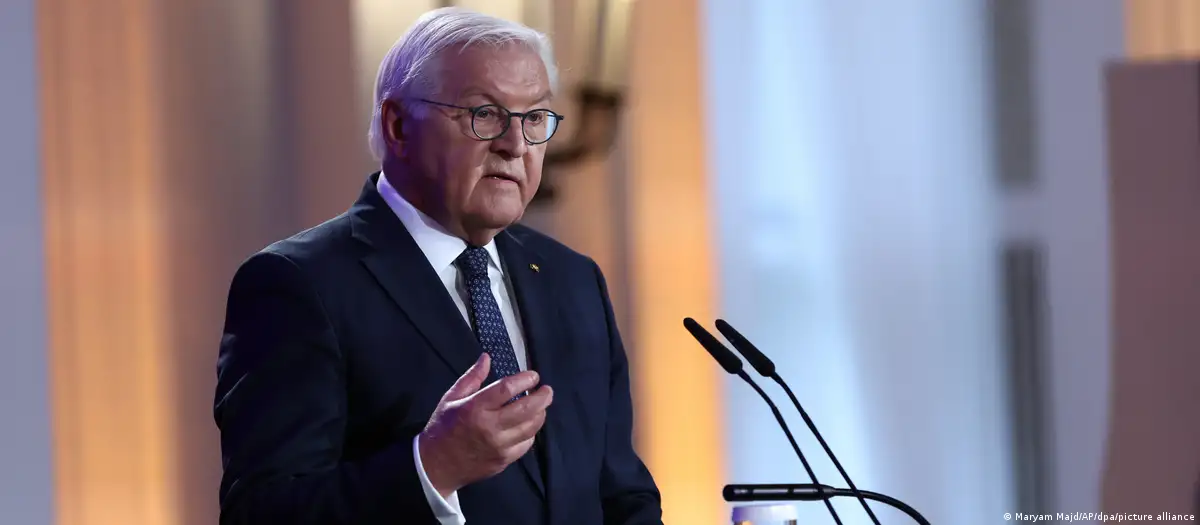
What you need to know
German President Frank-Walter Steinmeier gave a speech on Sunday focused on safeguarding his country's democracy, marking the anniversary of several notable events in German history.
Among other things, he recalled the pogrom night on November 9, 1938, during which synagogues, Jewish-owned businesses and members of the Jewish community were attacked with the complicity of the Nazi regime.
Meanwhile, Germany's coalition government is struggling amid infighting, rows over policy and dismal poll ratings, even as it tries to meet the challenge of a resurgent far right.
And Germany rejected many more asylum applications from Syrians in October, with some politicians saying that the country is now safe to return to under its new de facto government.
This blog is now closed.
Read on here for the main stories from and about Germany on Saturday, November 8 and Sunday, November 9.
Thank you for reading
Thank you for reading. On Monday, the trial for a man accused of carrying out an attack on a Christmas market in the eastern city of Magdeburg is set to begin Monday.
Be sure to check back for the latest on the topic and more news from and about Germany tomorrow.
Berlin hosts first regular season NFL game
Thousands of fans of the US National Football League (NFL) flocked to Berlin's history Olympiastadion for the first-ever regular season American football game to be held in the city.
The NFL had previously held five pre-season games in Berlin between 1990 and 1994. Sunday's regular season game featured the Colts and the Falcons.
The two teams delivered a thrilling game that ended in a tie and went into overtime. The Colts, who are current division leaders, ultimately prevailed in overtime for a 31-25 win.
Since 2022, the NFL has held four other regular season games in Munich and Frankfurt, each hosting two.
Berlin is expected to host up to three regular season games at Olympiastadion until 2029.
Suspect in Madeleine McCann case could leave Germany: court
The suspect in the disappearance of British toddler Madeleine McCann could be allowed to leave Germany following a court decision. The ruling in northern Germany partially overturned one of the conditions imposed on the suspect, "according to which he had to establish his residence in Germany," a court spokesperson told AFP on Sunday.
"Maddie" McCann was 3 years old when she vanished from her family's holiday apartment in Portugal's Praia da Luz in May 2007 while her parents were having dinner at a nearby tapas bar.
No trace of McCann has been found, and no one has been charged with her disappearance. But German national Christian B. has been formally identified as a suspect in the case.
Although the man has several convictions for theft, drug trafficking, assault, child pornography, child abuse and rape, he denies any involvement in the toddler's disappearance.
Christian B. was released from a German prison last year, after serving a sentence on separate rape charges.
The man is considered dangerous by prosecutors and has been required to wear an electronic tag, inform the court in advance of any change of address or residence in Germany, and obtain its approval.
The man now lives in a tent in a park in the northern city of Kiel, under the constant surveillance of two police officers.
Steinmeier warns of dangers to democracy in Germany in November 9 speech
German President Frank-Walter Steinmeier has used a speech marking November 9 as a historically significant date in Germany to call for the defense of the country's democracy as it confronts major challenges.
"Never in the history of our reunified country have democracy and liberty been so under attack," he said in the speech, held at his Bellevue Palace residence in Berlin.
He said these two aspects were currently threatened above all "by right-wing extremist forces that attack our democracy and are gaining public approval."
"Simply waiting for the storm to pass and taking cover for the time being is not enough," he said. "We have to act. We can act!"
Steinmeier said that far-right actors employed the "sweet poison of rage" to convince people that "those up top" are the enemy, luring the public "with the promise of authoritarian leadership" and of making Germany "great again."
But, he said, democrats had a great deal to offer to combat this: "We have law. Liberty. Humanity. The knowledge about where hate leads."
Steinmeier warns against cooperation with extremists
In a veiled reference to the far-right Alternative for Germany (AfD) party, which is gaining in popularity and is already the strongest opposition force in the national parliament, he said there must not be any political cooperation with extremists either in government or in parliaments.
He said, however, that banning a party was the last resort in a democracy and a step that needed to be carefully examined and weighed up.
But, he said, "we must not sit by passively" while considering such a measure.
Referring to the events on November 9 that have marked Germany — the proclamation of a republic in 1918, the pogrom night against the Jewish community in 1938 and the opening of the Berlin Wall in 1989 — Steinmeier said the date stood "for light and shadow, for the deepest abysses and the happiest hours of our history."
With regard to the November pogroms of 1938, the president noted that antisemitism had not returned to Germany but had "always been there."
"We have to fight antisemitism whatever direction it comes from," he said.
Peace coalition plans protests against potential military conscription
A coalition of German peace initiatives has condemned Berlin's plans to massively rearm the country in response to the threat posed by Russian aggression and called for a day of protests against the mooted reintroduction of military conscription.
"The war preparations by the federal government and the massive rearmament with all the drastic social consequences make it imperative to increasingly prepare joint actions of the peace movement," the Federal Peace Council Committee said on Sunday after a two-day meeting of peace activists in Kassel.
It further stated that "the looming conscription and the comprehensive militarization of society demand strong and creative forms of protest."
It called for a day of action against conscription for December 5.
Conscription in Germany has been suspended since 2011, but the government is currently considering a return to some form of military service.
A bill is set to come into force on January 1 that initially provides for recruitment on a voluntary basis, though a reintroduction of mandatory military conscription could be called for if recruitment targets are not met or if the security situation deteriorates sufficiently.
Israeli ambassador warns of left-wing antisemitism in Germany
Antisemitism from the left of the German political spectrum poses even more of a threat than that from the right or Islamist actors, according to the Israeli ambassador to Germany, Ron Prosor.
His remarks were published on Sunday, as Germany commemorates the night on November 9, 1938, when Germany's Jewish community was attacked in Nazi-backed pogroms.
Prosor told newspapers of the Funke media group that left-wing antisemitism "hides its intentions" and "always operates on the boundary between freedom of expression and freedom to incite — and has now clearly crossed that boundary."
"That is why left-wing antisemitism is, for me, the most dangerous," the Israeli ambassador said.
Prosor said this form of antisemitism was particularly in evidence at universities and in theaters in Europe.
"People like to present themselves as educated, moral and politically correct," he said. "But the red line of what is still covered by freedom of expression has long been crossed."
Among other things, he cited the example of Israeli conductor Lahav Shani being disinvited by the Flanders Festival Ghent in September, saying that while this had been recognized as a scandal now, "the boundaries of what can be said are shifting."
Recent studies have shown that antisemitism in Germany has increased since the outbreak of Israel's war against Hamas in the Gaza Strip.
Merz-led coalition government faces multitude of woes six months in
Germany's coalition government, made up of Chancellor Friedrich Merz's conservative CDU/CSU bloc and the center-left Social Democrats (SPD), has seen its popularity slide dramatically since it took office in May.
The director of the Forsa polling institure, Manfred Güllner, told the AFP news agency that there had "never been such widespread dissatisfaction with a government in such a short period of time" in German post-war politics.
The government's fall from public grace comes as the far-right Alternative for Germany (AfD), the largest opposition party, continues to gain support, drawing level with Merz's conservatives in recent polls.
The government has been beset by frequent infighting and differences over policy, while coming under criticism for failing to make good on pledges to revive the country's stagnant economy.
In one sign of internal tensions, the coalition partners were unable in July to agree on the appointment of three judges to the constitutional court, with the conservatives considering the Social Democrats' candidate too left-wing.
There have also been disputes over how to boost the country's military, with the Social Democrats leaning toward voluntary models while conservatives favor some form of conscription.
And the hard-line migration policy advocated by many conservatives in an apparent bid to outdo the anti-immigration AfD is also not accepted by all in the government.
Even a member of Merz's own Christian Democrats, Foreign Minister Johann Wadephul, has voiced reservations about sending back Syrian refugees living in Germany, a course urged by several politicans on the right fringe of the party.
Merz himself recently came in for a barrage of criticism after remarks he made that seemed to imply that migrants in some way disfigured German cities.
WATCH — A film portrait of Nazi war criminal Josef Mengele
Russian dissident filmmaker Kirill Serebrennikov has made a historical drama film about the later life of Josef Mengele, a Nazi SS doctor known as the "Angel of Death" for his inhumane experiments on prisoners at Auschwitz.
After the war, Mengele fled to South America and evaded justice. Kirill Serebrennikov’s film The Disappearance of Josef Mengele traces his life in hiding.
What is the significance of November 9 in German history?
November 9 is the date of several pivotal moments in Germany's history, both in a positive and negative sense.
In 1918, Kaiser Wilhelm II abdicated on November 9, two days before the end of World War I, leading to two proclamations of a republic just hours later.
The first was made at the Reichstag building by Philipp Scheidemann of the Majority Social Democratic Party of Germany (MSPD) and the second by Karl Liebknecht, the leader of the Marxist Spartacus League, at the Berlin Palace.
Both parties were among the rival groups fighting for ascendancy in the German Revolution on 1918-1919.
Scheidemann's speech prevailed, and the proclamation eventually led to the establishment of the Weimar Republic, a constitutional republic that collapsed in 1933 to be replaced by the nondemocratic rule of the National Socialists (Nazis) under Adolf Hitler.
Twenty years later, on November 9, 1938, that Nazi regime was complicit in attacks on Jewish-owned businesses, synagogues and Jews that historians view as a prelude to the Holocaust.
The pogroms have often gone under the name of "Kristallnacht" ("The Night of Broken Glass"), but that term has come under increasing criticism as being a euphemism for the atrocities committed.
The events of November 9, 1989, are seen in an altogether more positive light. On that day, people stormed the border crossings in divided Berlin, which led to the end of the second dictatorship on German soil in communist East Germany.
You can read more about what November 9 means in Germany in this article by DW's Marcel Fürstenau: November 9: A fateful day in the history of Germany
Steinmeier to host ceremony marking November 9 events
German President Frank-Walter Steinmeier is to hold a speech on Sunday in which he will recall a number of highly significant events that occurred on November 9 in Germany's history, using them to highlight the importance of protecting democracy.
The date saw the proclamation of the republic in 1918, the night of pogroms against Jews in 1938 and the opening of the Berlin Wall in 1989, which eventually led to the reunification of East and West Germany in 1990.
The president's office said November 9 reflected "both the dawn of democracy and freedom, and the horrors of tyranny and antisemitism."
It added that understanding "moments of courage and humanity, as well as the abyss of dictatorship and the destruction of human dignity, holds important lessons for the present."
Welcome back to our Germany coverage
Guten Morgen from DW's newsroom in Bonn!
You are joining our rundown of the top topics in Germany on November 9, a date that has seen several momentous events in the country's history.
German President Frank-Walter Steinmeier will be touching on these — the proclamation of the republic in 1918, the Nazi pogroms of 1938 against Jews, and the opening of the Berlin Wall in 1989 — in a speech at his Bellevue Palace residence in Berlin that will focus on the defense of Germany's democracy.
We will also be looking at how the coalition government under Chancellor Friedrich Merz is faring six months after taking office (spoiler alert: not too well).
Read on here for these and other stories from and about Europe's top economy.
We're pausing coverage now
Thank you for reading so far. We know President Frank-Walter Steinmeier is scheduled to deliver a speech on threats to democracy on Sunday morning.
So be sure to check back then for the latest news on the topic as well as other headlines from the country.
Hermann and Albert Göring: Two very different brothers
Hermann was Adolf Hitler's second-in-command, while the lesser-known Albert saved the lives of many Jews and dissidents whom the Nazis persecuted.
BSW party weighs rival name proposals ahead of December congress
Germany's populist Sahra Wagenknecht Alliance (BSW) is facing internal disagreement over a new name, with state branches pushing back against the leadership’s proposal.
The national leadership has proposed renaming the movement Alliance for Social Justice and Economic Reason, while keeping the abbreviation BSW.
The Rhineland-Palatinate state party leaders, Alexander Ulrich and Sina Listmann, have suggested redefining the BSW abbreviation as Citizens Create Change — Reason and Justice. They said the name, also backed by Saxony's state leader Ronny Kupke, would signal a stronger "sense of new beginnings" than the leadership’s alternative.
Party founder Sahra Wagenknecht told the DPA news agency there was no dispute, saying many "reasonable proposals" had been submitted and expressing confidence that delegates would make a "wise decision" at the upcoming party congress.
Thousands of suggestions for a new name have reportedly been received. The final decision will be made at the party’s December congress in Magdeburg.
After strong results in last year's European and eastern state elections, the BSW narrowly missed the 5% threshold to enter the Bundestag in this year's federal parliamentary vote. The party will compete in five state elections next year, including in Rhineland-Palatinate, Baden-Württemberg, Saxony-Anhalt, Mecklenburg-Western Pomerania, and Berlin.
Kane rescues Bayern late as perfect start ends with Union draw
Striker Harry Kane has salvaged Bayern Munich a point with a stoppage-time equalizer in a 2-2 draw at Union Berlin that ended the champions' record-breaking perfect start to the season.
Union defender Danilho Doekhi scored twice, either side of a stunning solo goal from Luis Diaz, before Kane struck in the 93rd minute for his 13th Bundesliga goal in 10 games.
Despite dropping points, Bayern remain six clear at the top after RB Leipzig and Borussia Dortmund also slipped up.
Bayern had won all 16 matches in all competitions before the trip to Berlin — the best season start ever recorded in Europe's top-five leagues — but looked weary after Tuesday's 2-1 win at Paris Saint-Germain, which they finished with 10 men.
Coach Vincent Kompany made only one change to his lineup, and the visitors struggled early as Union pressed hard. Doekhi opened the scoring after 27 minutes, sliding in from close range, before Diaz leveled with a moment of brilliance — keeping a ball in play, spinning past a defender, and blasting in from a tricky angle.
Doekhi struck again late on to restore Union's lead, but Kane's last-gasp header denied the hosts a first-ever victory over Bayern.