Germany news: 'Daughters' protest after Merz remarks
Published October 22, 2025last updated October 22, 2025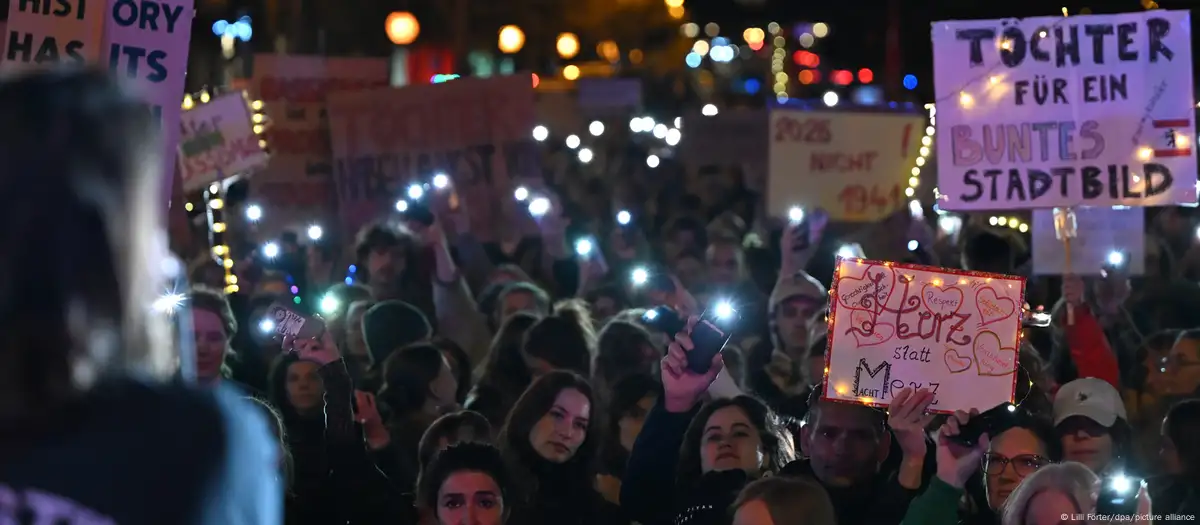
What you need to know
At least 2,000 people have protested at CDU headquarters in Berlin against remarks by Chancellor Merz that many see as racist
The president of Germany's Reserve Association has said although many volunteers for the armed forces are expected, he believes conscription will have to be reintroduced in the long run
This blog is now closed. Below is a roundup of news and human interest stories from and about Germany on Wednesday, October 22, 2025.
Merz tries to clarify remarks on city image amid criticism
Chancellor Friedrich Merz was again asked to comment on his controversial recent comments on migration while in London for a West Balkans conference on Wednesday. He said that people with migrant backgrounds were and would remain a crucial component of German society.
"Yes, we will also continue to need migration in the future," Merz said. "We can no longer do without them — regardless of where they come from, what color their skin is, and regardless of whether they are the first or second or fourth generation to live and work in Germany." He noted how most were already citizens.
However, Merz said, there were problems with individuals without lasting residency status, without employment and who "do not keep to our rules."
He said that such people sometimes had an oversized influence on the image of cities, in reference to his contentious use of the German word "Stadtbild," meaning city image or perhaps cityscape.
"That's why so many people in Germany and in other countries in the EU — this is not just a German issue — are afraid to move about in public spaces," Merz said, saying this could apply to train stations, subways, car parks or even entire districts, "which are also a cause of big problems for police."
He said a broader European strategy to restore public trust in the legal system was necessary and that he would address EU migration and asylum policies at Thursday's EU leaders' summit in Brussels.
Meanwhile, Merz's deputy and finance minister — and also his political rival as a leading Social Democrat Lars Klingbeil appeared to criticize Merz's choice of words in a speech to a trade union federation on Wednesday.
"I would like to live in a courty in which politics builds bridges and brings society together, rather than dividing with language," Klingbeil said. "And I will also say to you: I'd like to live in a country in which someone's appearance does not decide whether or not they fit in a city's image."
Far-right AfD lawmakers accused of asking parliamentary questions at Russia's behest
Politicians from Germany's far-right Alternative for Germany (AfD) party have been accused of filing parliamentary questions on sensitive issues as a way of spying for Russia.
AFD parliamentarians in the eastern state of Thuringia had filed 47 questions on topics like critical infrastructure, state Interior Minister Georg Maier told the Handelsblatt newspaper.
"The impression is almost unavoidable that the AfD is working through a Kremlin order list with its inquiries," Maier said, adding that the questions had demanded "increasing intensity and depth of detail."
The politicians had asked for information on transport, water supply and digital and energy infrastructure, according to Maier, a member of the Social Democrats (SPD), the junior partner in Chancellor Friedrich Merz's government.
Maier said AfD lawmakers had also filed similar inquiries elsewhere in Germany.
Ringo Mühlmann, an AfD politician in Thuringia's parliament, dismissed Maier's allegations as "bizarre conspiracy theories" and accused him of trying to "criminalize political opponents," adding that such inquiries were "a cornerstone of democratic oversight."
The AfD in Thuringia has been classified as "confirmed right-wing extremist" by Germany's domestic intelligence agency.
'Immigrant background' workers make up quarter of German workforce — Destatis
Official figures released on Wednesday have shown that many sectors of the German economy would face severe staff shortages if there were no workers who were immigrants or the children of immigrants.
The figures from the Federal Statistical Office (Destatis), based on a 2024 microcensus, show that such employees make up just over a quarter (26%) of the workforce in Germany.
The highest percentages can be seen among welding and joining technicians (60%) and chefs and food production workers (54%).
Elderly care and automotive manufacturing are two other sectors where immigrant workers make up a large proportion of employees, at 32% in each case.
However, relatively few immigrants or "immigrant background" workers are employed in the emergency services (8%), justice system (9%) and agriculture (15%), where there are currently workforce shortages.
Destatis' definition of "immigrant background" includes people who came to Germany themselves and those whose parents immigrated to the country after 1950.
The figures come as conservative parties in particular say they want to introduce ever-stricter migration controls.
Merz's 'cityscape' remarks will cause economic damage — research institute head
Chancellor Friedrich Merz's recent statements suggesting that migration has had a negative impact on German cities will have harmful economic consequences, the president of the German Institute for
Economic Research (DIW) said on Wednesday.
"His recent remarks exacerbate societal polarization and cause significant economic damage," Marcel Fratzscher told the business newspaper Handelsblatt.
"The chancellor's message weakens Germany's 'culture of welcome' and will exacerbate the shortage of skilled workers in Germany in the coming years," Fratzscher said.
Merz's remark last week implying that Germany had a "cityscape" problem caused by the presence of migrants has roused much criticism and protest, but has also received support from conservative allies.
So far, the chancellor has not retracted his comment and also given no explanation, saying only that if people asked their daughters, they would receive a "clear and unambiguous answer" — a response that has led to further criticism, with many women saying they do not want to be a pretext for harsh migration policies.
Opinion of US in Germany declines under Trump leadership — study
Most Germans have taken a more negative attitude to the US since President Donald Trump's second term began in January, a study by a political magazine has shown.
The survey by the opinion research institute Forsa for the magazine Internationale Politik indicated that almost two-thirds of respondents, or 65%, had a lower view of the US now than in the past.
Just 8% said they had a higher opinion of the country since Trump's inauguration, while 25% stated that there had been no change in their attitude.
The study showed sometimes widely differing opinions depending on the age, sex and political affiliations of the respondents.
Women were more likely than men (74% to 56%) to view the US under Trump negatively, and the youngest (18-29) and oldest age groups (over 60) had lower opinions than the average (70% and 71% respectively).
Supporters of the far-right, anti-immigration Alternative for Germany (AfD) party were most likely to approve of the direction the US has taken under Trump, with 27% saying their opinion had improved as against 47% who reported no change and 22% who said it had worsened.
Voters for the governing parties (conservative CDU/CSU bloc and center-left SPD) noted a significant deterioration of their opinion (76% and 80% respectively," while 91% od voters for the leftist Green and Left parties said their view of the US had become more negative.
'Conscription will be necessary," says reservist chief
The president of Germany's Reserve Association, Patrick Sensburg, says he expects many people to volunteer for Germany's armed forces, the Bundeswehr, amid a new enlistment drive, but said bringing back conscription would be necessary in the long run.
"I expect we will get far more volunteer applications than we think," he told the RND media group in remarks published on Wednesday.
"We are talking about up to around 40,000 volunteers whom we need to recruit from more than 600,000 men and women in a single age cohort. I bet we'll get them," Sensburg said.
But, he said, it would not be enough to rely solely on the reserves, which was "why, ultimately, conscription will be necessary."
His remarks come as Germany's governing coalition continues to debate the details of a new military service law that is set to go into force on January 1, which will initially rely on voluntary enlistment.
However, the government is discussing, among other things, what should be done if not enough volunteer.
Conscription in Germany was suspended in 2011, but the changed security situation in Europe amid the threat of Russian aggression has prompted calls for it to be reinstated.
'Daughters' protest at CDU headquarters over Merz 'cityscape' comments
Thousands of people gathered in front of the headquarters of Chancellor Friedrich Merz's Christian Democrats (CDU)on Tuesday under the motto "We Are the Daughters," a reference to a comment he made when asked to explain a remark that seemed to many to imply that migrants blight German cities.
Berlin police said some 2,000 people took part in the rally, while organizers claimed that 7,500 attended.
Merz last week noted with approval that fewer people were applying for asylum in Germany, but went on to say: "But we of course still have this cityscape problem, which is why the interior minister is facilitiating and conducting deportations on a very large scale."
Later, when asked to explain his comment, he said that if anyone were to ask their daughters, they would receive "a fairly clear and unambiguous answer," thus apparently suggesting that a harsh migration policy aimed to protect women from unwanted attention or harassment from certain immigrants.
Author and climate activist Luise Neubauer summed up the opinion of protesters at Tuesday's rally, saying that while she welcomed a debate on women's security, women were not prepared to be used as "an excuse and justification" for hard-line migration measures.
She accused Merz of making comments that are "nothing more than inacceptable, discriminatory and comprehensively racist."
The former co-leader of the German Green Party, Ricarda Lang, also spoke at the rally, saying women were "not a fig leaf for right-wing narratives."
Banners at the protest carried slogans such as "Racism is a problem in the cityscape" and "Daughters for a diverse cityscape."
Merz, who has so far refused to retract his remark, has, however, received support from several conservative politicians, including Bavarian Premier Markus Söder, who said opposition to the remarks was fueled by "a left-wing campaign" that was trying to "distract from the reality" of the situation.
Welcome to our coverage
The DW newsroom on the banks of the Rhine in Bonn wishes all our readers einen schönen guten Tag!
You join us in our Germany coverage as debate continues to rage over a comment by Chancellor Friedrich Merz that seemed to many highly denigratory toward migrants in the country, followed by one that seemed to imply that his government was pursuing a harsh migration policy to protect women.
Discussion is also continuing on whether to bring back compulsory military service, with the head of an association representing the interests of reservists saying he believed volunteers would not be enough tin the end.
Please read on for a summary of the German stories hitting the headlines on Wednesday, October 22.