Ukraine: Moscow drone attacks force airport closures
Published May 6, 2025last updated May 6, 2025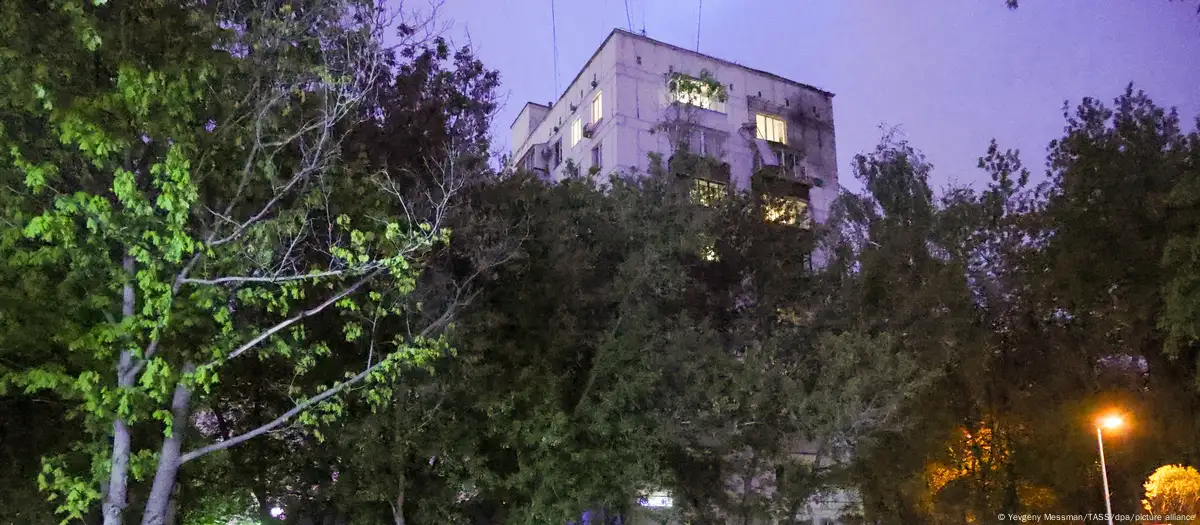
What you need to know
Ukrainian drone attacks forced the closure of numerous airports across Russia overnight.
Moscow is expecting allies to attend a major military parade in the capital on Friday.
Elsewhere, the EU will outline its plan to end all remaining Russian gas deliveries and stop future contracts from being signed.
This blog on the latest developments in Russia's war on Ukraine on May 6 is now closed. For more updates from May 7, follow our new blog.
European Commission sets 2027 deadline to ban all Russian gas imports
The European Commission unveiled a long-promised plan to phase out all remaining gas imports from Russia to the EU by the end of 2027.
"Today the European Union sends a very clear message to Russia: no more, no more, will we permit Russia to weaponise energy against us," EU energy chief Dan Jorgensen said as he set out the measures.
According to the plan, a ban on new contracts and short-term deliveries, so-called spot contracts, is to take effect by the end of this year. Existing long-term contracts are to be phased out by the end of 2027.
Two-thirds of Russia's imports of liquefied natural gas (LNG) and pipeline gas are based on long-term contracts.That prompted the European Commission, which wants to end the bloc's energy dependence on Moscow, to propose a two-stage ban.
"A phased approach to eliminating Russian gas imports would allow markets to better adjust and minimize market impact and potential implications for security of supply," a plan read.
The EU's executive branch said it would follow up with a legal proposal on the gas import ban in June.
Russian gas deliveries to Europe via the transit pipeline through Ukraine stopped completely on January 1 as contracts for 2019 expired.
However, around 19% of Europe's gas still comes from Russia via the TurkStream pipeline and LNG deliveries, compared to around 45% before 2022.
Russia and Ukraine exchange more than 400 prisoner of war
Ukraine and Russia exchanged hundreds of prisoners of war on the Belarusian-Ukrainian border.
According to the Russian Defense Ministry, each side released 205 people. "As a result of negotiations, 205 Russian servicemen were returned," the ministry said in a statement.
"In exchange, 205 prisoners of war of the Armed Forces of Ukraine were handed over," it added.
Ukrainian President Volodymyr Zelenskyy confirmed the news, writing: "Young and older men from almost all types and branches of the Armed Forces. Defenders of Mariupol and the entire front line."
"I thank our partners — first and foremost the United Arab Emirates — for their mediation and support," he added.
The two sides last exchanged prisoners in April.
Belarus seeks deeper ties with North Korea
North Korea's KCNA state media on Tuesday reported the arrival of a government delegation from Belarus. KCNA reported that the delegation is being led by Belarus Deputy Prime Minister Yuri Shuleiko.
The talks in Pyongyang are said to be focused on increased trade and economic cooperation. The visit is scheduled to last until Friday.
Both Belarus and North Korea are Russian allies and are generally regarded as international pariahs in their own right. Both have aided Russia in its illegal war of aggression in Ukraine.
Like Russia, each is also ruled by strongman dictators with an iron grip on power and entrenched, repressive regimes that oversee exceedingly impoverished societies.
Russia says Victory Day parade to be 'grandest' ever
Officials in Russia say President Vladimir Putin will deliver a speech Friday at what is being billed as the "grandest" Victory Day parade ever to mark 80th anniversary of the end of World War II.
Putin has elevated the May 9 celebration throughout the course of his 25-year reign, framing it as a massive celebration of Russian patriotism. He has also sought to justify his own war of aggression in neighboring Ukraine as a mission to "de-Nazify" the country — echoing the "Great Patriotic War" against Nazi Germany.
World War II was devastating for Russia, costing more than 20 million civilian and military lives after Adolf Hitler broke his non-aggression pact with the Joseph Stalin and the Soviet Union in 1941. Russian complicity in the early phase of the war is not spoken of in today's Russian Federation.
Ukraine has labeled the event a sham, saying it has, "nothing to do with the victory over Nazism," while adding that among those soldiers marching in Red Square are "quite likely" many who have engaged in war crimes against Ukrainians.
Kyiv has also denounced a Russian three-day ceasefire coinciding with the event as a gimmick "for the parade," noting that Moscow has ignored US calls for a 30-day pause to facilitate peace talks, continuing instead to shell Ukraine daily despite international outcry over the three-year invasion.
Latest Russian drone strike kills one in Odesa
Russia continued its drone strikes on the Ukrainian port city of Odesa on Monday, said Governor Oleh Kiper.
Kiper took to the social media channel Telegram to announce that one person had been killed in an overnight assault.
Russia has increased attacks on the city as US President Donald Trump pushes for a ceasefire.
Ukrainian President Volodymyr Zelenskyy recently called for more pressure to be exerted on Russian President Vladimir Putin — whom Trump has so far been soft on — to end his war of aggression after two people were killed in Russian attacks on the Black Sea port city last week.
Incoming German chancellor hawkish on Russia
Germany is expected to shift its policy toward Russia when Friedrich Merz is formally elected chancellor . Merz, from the conservative Christian Democratic Union (CDU), was expected to be elected chancellor Tuesday but surprisingly lost the first round of voting. He is considerably more hawkish on Russia than his predecessor, Social Democrat (SPD) Olaf Scholz.
Unlike Scholz, Merz has voiced support for sending German-made Taurus lang-range missiles to Kyiv as it defends itself against an ongoing Russian war of aggression that is now in its third year. Scholz had been loathe to supply the weapons for fear of Russian retribution over what Moscow has framed as a potential escalation.
Merz will also have a foreign minister at his side that shares his hawkish views. Johann Wadephul, a former soldier, has described Russia as Europe's "most acute" threat and has been a strong advocate for supplying Kyiv with Taurus missiles.
Germany is also set to greatly increase military spending under Merz as it attempts to make up for lost time with a depleted military and the looming threat of the US pulling back its own security commitments to Europe under President Donald Trump.
German Defense Minister Boris Pistorius, a holdover from the outgoing Scholz government, has backed the shift toward a more robust military, saying, "we must establish deterrence to make sure that it does not come to a worst-case scenario."
Pistorius has called for the country to become "war ready" by 2029 amid fears that Russian President Vladimir Putin's expansionist appetite may not be sated by swallowing parts of Ukraine but that he desires to push on further into Europe, directly threatening the Baltic states and Germany's neighbor Poland.
EU seeks to phase out remaining Russian gas imports
The European Union (EU) will present a "roadmap" for terminating all current and future Russian gas deliveries to the block on Tuesday.
Once the EU's top gas supplier, Russia fell out of favor with the 27-member bloc over its war of aggression with EU aspirant Ukraine.
Though there was relatively broad consensus that deliveries should end, the bloc has continued to feed Russian coffers as the result of the complicated unwinding of dozens of years of cooperation.
The EU now aims to end its reliance on Russian gas by 2027.
The European Commission is seeking ways to allow companies to withdraw from existing contracts, for instance, but legal experts say these could potentially face penalties or arbitration should they do so. Many European companies have so-called "take or pay" contracts that require them to pay for contracted gas whether they accept delivery or not.
Any changes now would depend on approval by the EU parliament and potentially a majority of member states depending on EU's legal approach.
The EU currently imports roughly 19% of its gas from Russia — in 2022, that number was 40%. Though sanctioning imports would quickly curtail deliveries, this would require unanimous EU support — Hungary and Slovakia, however, have refused to go along with the plan.
Overnight drone attacks close Russian airports
Russian authorities were forced to close a dozen airports for several hours Tuesday following a second night of Ukrainian drone attacks. Russian news agencies cited the Federal Air Transport Agency as having restricted flights at four Moscow airports, as well as in Nizhny Novgorod, Volgograd and elsewhere.
Moscow Mayor Sergei Sobyanin said that a total of 19 drones had been downed in the city overnight but that "no damage or casualties" had resulted from the assault. Dozens more drones were reported to have been shot down in other regions across the country including Kursk, Voronezh, Pena and others.
The scale of the attacks is unclear at the moment and Kyiv has yet to comment. Ukraine has increased strikes on infrastructure it says is key to Moscow's ongoing war of aggression — launched on February 24, 2022 — with Tuesday's assault being a reminder to citizens in the capital that the Kremlin's ongoing war is not be as distant as it appears.
The attacks come just days before a major military parade in the capital that is set to mark the 80th anniversary of the end of World War II, which Russia celebrates on May 9. The parade will see several Russian allies in attendance and feature a speech by Russian President Vladimir Putin, who last week declared a three-day ceasefire between May 8 and 10 in line with the celebration.
Ukrainian President Volodymyr Zelenskyy has scoffed at Putin's proposal, calling instead for the implementation of a US-proposed 30-day unconditional ceasefire. "The Russians are asking for a ceasefire on May 9 and are themselves firing at Ukraine every day," wrote Zelenskyy on Sunday in a social media post. "This is cynicism of the highest order." Putin has rejected the US plan.
Welcome to our coverage
Welcome to our coverage of Russia's invasion of Ukraine.
Overnight, Ukrainian drone strikes targeted several Russian airports, forcing them to close.
At the same time, the EU is working on a plan to stop all Russian gas deliveries to the bloc.
In Germany, Friedrich Merz, a staunch supporter of Ukraine, is set to be sworn in as the country's new chancellor.