Germany updates: Merz hails 'new chapter' in German-UK ties
Published July 17, 2025last updated July 17, 2025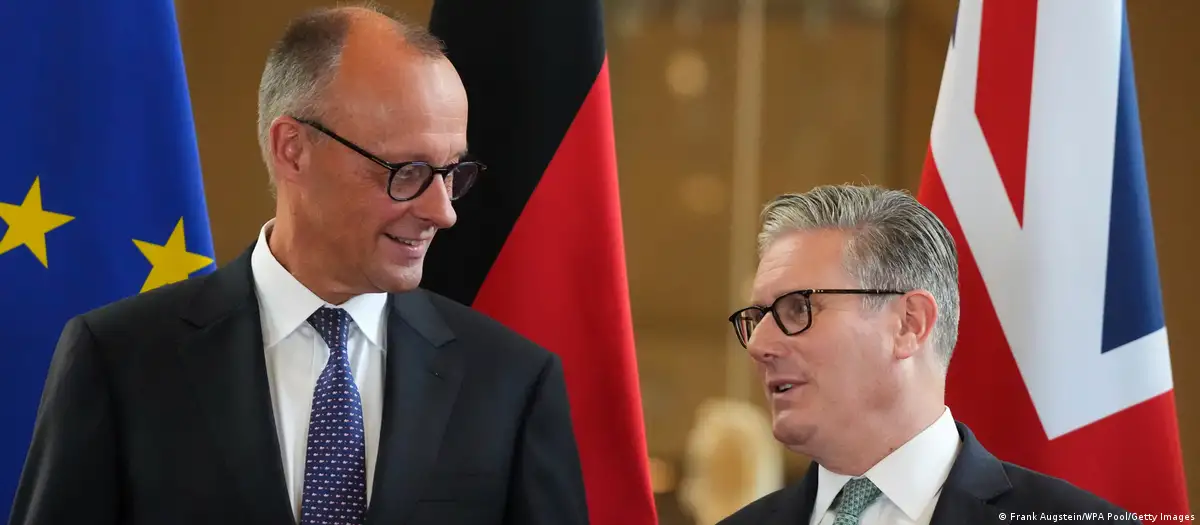
What you need to know
Chancellor Friedrich Merz has hailed a new treaty with the United Kingdom covering a range of issues from European security to migration to the economy.
Back in Germany, however, Merz begins the summer recess facing skepticism from much of the public, according to polling.
A survey found that 32% of eligible voters believe Germany has worsened since the new government took office in May.
This blog is now closed. It was a roundup of what Germany was talking about on Thursday, July 17.
Cash machine bombers handed long jail terms
A Frankfurt court has handed down lengthy prison sentences to six members of a criminal gang responsible for blowing up cash machines in western Germany in 2022 and 2023.
The men, aged between 27 and 33, received jail terms ranging from five years to 13 years and nine months, with the presiding judge stating: "ATM explosions have been punished too leniently for far too long."
State prosecutors had initially requested custodial sentences of up to 14 years for attempted murder, arguing that passers-by could have been killed by the uncontrolled explosions.
Given that no innocent people were ever hurt, however, they were ultimately convicted of causing an explosion with explosives.
Spokesman Georg Ungefuk said prosecutors were satisfied with some of the "heaviest sentences nationwide," which he said were a "just response to these crimes" and sent a "clear signal."
The gang, believed to be part of the Dutch ATM bombing scene, blew up seven cash machines in the western German states of North Rhine-Westphalia, Rhineland-Palatinate and Hesse.
The most serious incident occurred in Frankfurt in June 2023 and lasted less than two minutes, including getaway, according to local public broadcaster SWR.
One of the first robberies was in June 2022 in Jünkerath in the rural Eifel region, when the men only got away with €700 ($811) but caused €750,000 worth of damage.
Brandenburg makes recognition of Israel requirement for German citizenship
The north-eastern German state of Brandenburg has made recognition of the state of Israel a pre-requisite for naturalization and the acquisition of German citizenship, state interior minister René Wilke (independent) declared on Thursday.
Brandenburg thus becomes the second of Germany's 16 federal states to introduce the requirement after the neighboring state of Saxony-Anhalt in 2023.
In June 2024, new legislation making it easier to obtain German citizenship came into effect, including several new potential citizenship test questions on the subjects of antisemitism, Israel's right to exist and Jewish life in Germany – but there was no nationwide stipulation for applicants to explicitly acknowledge the state of Israel.
Declaring the new stipulation in Brandenburg, minister Wilke drew a clear distinction between the state of Israel itself and the Israeli government of the day, insisting: "This is not a commitment of solidarity or agreement with everything any head of government has ever done, or will do."
According to recent data, there were 484 incidents of antisemitism reported in Brandenburg in 2024, an increase of 28.4% on 2023. Of those incidents, 94 were found to be directly related to Israel.
In August 2023, a Syrian man was refused German citizenship because, when asked by an official in the Bavarian city of Regensburg whether he recognized Israel as an independent state, he replied: "There is no Israel."
Merz hails 'new chapter' in German-UK relations
German Chancellor Friedrich Merz has hailed a "new chapter" in relations between Germany and the United Kingdom, expressing a hope that both countries will "respond together" to challenges facing Europe.
Speaking at an Airbus factory in Stevenage, just north of London, after signing a wide-ranging "treaty of friendship" with British Prime Minister Keir Starmer, Merz said that security was the "red thread" running through the deal.
"The UK – to my deep and continuing regret – left the European Union, Russia is threatening our European security architecture, and our transatlantic relations are changing like never before," he said.
"Under these conditions, we want to secure the freedom, security and prosperity of our two countries. We will both do our bit to protect and defend the Euro-Atlantic space. That is the deal we have made today."
Merz's trip to the UK came just one week after French President Emmanuel Macron was honored with a state visit to London – and before Macron's trip to Berlin later this year.
"We, the E3, the three biggest European countries, are coming closer together," said Merz. "In terms of security, migration and the economy."
Germany rejects EU's €2 trillion budget proposal
German Finance Minister Lars Klingbeil has rejected the European Commission's proposed long-term EU budget, calling it disproportionate amid economic pressures.
Speaking at a G20 finance ministers meeting in Durban, Klingbeil said the €2 trillion plan for 2028–34 — which includes around €700 billion in new spending — would not be appropriate given current strains on national budgets.
"We absolutely must remain proportionate regarding the finances. I do not see this as being given," he said.
Germany is especially opposed to the commission's proposal for new revenue streams, including a levy on large companies with over €100 million in turnover and a cut of national tobacco tax revenues. Klingbeil said the tax ideas send "the wrong signal" and confirmed Berlin cannot support the tobacco measure.
The EU's executive wants to redirect the budget toward defense and competitiveness while introducing new income sources like an e-waste tax. Germany, the EU's largest economy, typically contributes nearly a quarter of the bloc's overall funds.
Germany and UK sign historic post-Brexit friendship treaty
Germany and Britain have signed a landmark friendship treaty, 80 years after the end of World War II. Chancellor Friedrich Merz and British Prime Minister Keir Starmer sealed the agreement — largely negotiated by the previous German government — during a meeting in London on Thursday.
The accord — dubbed the "Kensington Treaty" — includes plans for close security and defense cooperation, a mutual assistance clause in crises, and visa simplifications for school exchanges. Critically for the UK, it also features a pledge by Germany to assist in combating illegal immigration.
The two countries already signed a defense deal in October, the "Trinity House Agreement" to strengthen their ability to cooperate and conduct exercises on NATO's eastern flank.
Germany warns Syria must not be destabilized
German Foreign Minister Johann Wadephul has warned that Syria must not be turned into a battleground for regional conflicts, after Israeli airstrikes on Wednesday escalated tensions in the war-torn country.
The airstrikes, according to Israel, were aimed at protecting Syrian Druze communities.
"Following the Israeli strikes — including in Damascus — I urge all domestic and foreign actors to back off from any steps that could further destabilize Syria or derail the fragile transition process," Wadephul said Thursday.
Merz heads to London to seal UK-Germany pact
German Chancellor Friedrich Merz will make his first trip to London on Thursday to sign a sweeping friendship treaty with British Prime Minister Keir Starmer.
The agreement is part of a broader effort to reset post-Brexit relations and strengthen Europe's political core as war rages in Ukraine and transatlantic trust comes under pressure.
Merz's one-day visit comes on the heels of French President Emmanuel Macron's high-profile state visit to the UK.
The treaty — one of only a handful that Germany has — marks a significant step nearly a decade after the Brexit vote.
The agreement includes a mutual assistance clause — a pointed move in light of Russia's war in Ukraine and lingering uncertainty over US defense commitments under President Donald Trump.
"It comes at a time when Europeans are under real security strain," a senior German official said. "Transatlantic relations, let's say, are in motion. That's part of the backdrop."
Birth rate falls to lowest among German women since 1996
Germany's total fertility rate dropped again in 2024, reaching 1.35 children per woman — down 2% from 1.38 the previous year, according to the country's Federal Statistical Office.
A total of 677,117 children were born in 2024 — 15,872 fewer than in 2023.
Among German states, Lower Saxony reported the highest fertility rate at 1.42, while Berlin had the lowest at 1.21.
The fertility rate for women with German citizenship fell to 1.23, the lowest since 1996, when it was 1.22.
The rate for foreign women was significantly higher at 1.84, though it also declined by 2%, continuing a downward trend since 2017.
Migrants in Germany earn less across generations
Migrants living in Germany earn nearly 20% less than native-born workers, a study has found.
This isn't because they're paid unfairly for the same jobs, the authors of the study concluded, but because they're often shut out of higher-paying sectors.
The wage gap in Germany stands at 19.6% for first-generation migrants. But three-quarters of that difference comes down to limited access to better-paying industries, roles, and employers — not unequal pay for identical work.
The research was published by the journal Nature, with contributions from Germany's Institute for Employment Research (IAB) in Nuremberg.
It compared Germany to eight other Western nations: Canada, Denmark, France, the Netherlands, Norway, Spain, Sweden, and the US. While all showed income gaps between migrants and locals, countries like Sweden and Canada are closing those gaps faster — especially by the second generation.
In Germany, the wage gap for second-generation migrants still averages 7.7% — far above the 5.7% international average. Descendants of migrants from Africa and the Middle East remain particularly disadvantaged.
Among first-generation migrants, the largest wage disparities were found in Spain (29.3%) and Canada (27.5%), followed by Norway (20.3%), Germany (19.6%), and France (18.9%). The US, Denmark, and Sweden reported significantly smaller gaps.
Canada leads the way in generational progress — with just a 1.9% wage gap for second-generation migrants. In contrast, Norway still shows an 8.7% disparity.
Third of German voters say situation is worse since Merz took power
Chancellor Friedrich Merz has entered the summer break with lukewarm public support, a new YouGov poll for German news agency DPA shows.
According to the survey, 32% of eligible voters believe Germany has changed for the worse since Merz took office in May, while only 22% see an improvement. Another 37% say they see no change at all.
In his first government statement to the Bundestag, Merz had pledged that citizens would "already feel this summer that things are slowly improving."
Supporters of the conservative bloc, made up of Merz's Christian Democratic Union (CDU) and the Christian Social Union (CSU) were more positive, with 54% saying things had improved and only 11% seeing a decline.
Only 17% of respondents agreed with his recent claim that the current government is "one of the best in decades," while 71% rejected that statement.
Among CDU/CSU supporters, only 44% backed his view, but 41% did not.
Opinion was split on whether Merz's government would be able to keep the far-right Alternative for Germany (AfD) party at bay in the long term. Some 31% expected the CDU/CSU to lead over AfD by the end of his term, 26% foresaw a tie, and another 26% believed the AfD would be ahead.
In a summer interview with the broadcaster ARD, Merz acknowledged that his government's slim parliamentary majority created a "difficult balance of power" in the legislature.
The representative poll surveyed 2,192 eligible voters between July 11 and 14.
Welcome to our coverage
Guten Tag and welcome to our coverage from DW's newsroom in Bonn, by the Rhine River.
You join us as German Chancellor Friedrich Merz is headed into the summer break with a cloud of public doubt hanging over him.
A new poll shows many Germans haven't been feeling the progress that the conservative leader promised.
Merz is also set to head to the UK on Thursday for the first time since becoming chancellor.
Meanwhile, Germany's Finance Minister Lars Klingbeil is set to join international counterparts at the G20 summit in Durban.
Stay here with us for this and other news from Germany.