Germany news: Berlin advances Tomahawk, submarine deals
Published May 9, 2026last updated May 10, 2026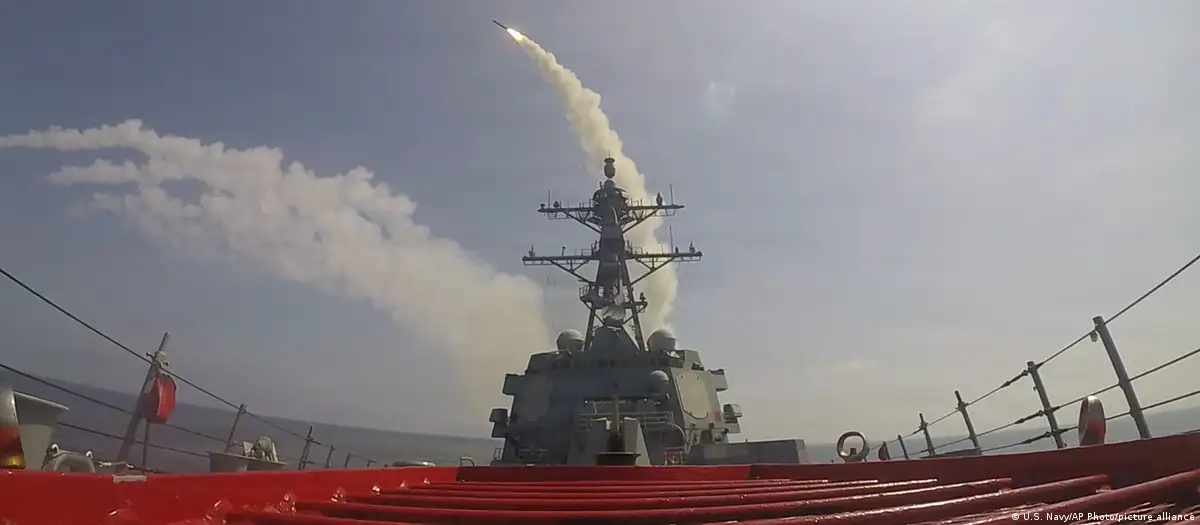
What you need to know
- Germany plans to push the US to agree a deal on Tomahawk missiles, according to a report
- Klingbeil pushes Canada to join a German-Norwegian submarine program
- Germany has already used up its share of the world's natural resources for this year
- Surfing has resumed in Munich's English Garden after the city's new mayor lifted a ban with a new city decree
- Chancellor Friedrich Merz defends NATO unity during a visit to Stockholm
This blog has been closed. Thank you for reading.
Below are the latest developments from and about Germany over the weekend of May 9 and 10, 2026.
SPD politicians are divided on Schröder for Ukraine negotiator
Senior officials in Gerhard Schröder's Social Democratic Party (SPD) have been giving their reaction to Vladimir Putin's suggestion of a mediator role for Germany's former chancellor in Ukraine peace talks.
Some think Schröder's links to the Kremlin and personal friendship with the Russian president make him unsuitable for a position at the negotiating table.
"[A mediator] cannot be Putin's buddy," Michael Roth, a former SPD lawmaker and chair of the foreign affairs committee, told the Tagesspiegel newspaper, adding that any mediator must be accepted by Ukraine.
Others within the party have been more open to Putin's suggestion, including lawmaker Ralf Stegner, who said the EU needed to play a more important role in peace negotiations.
"If someone like Schröder were to succeed in doing so, it would be negligent to reject it," he told Spiegel magazine.
The United States is brokering peace talks between Russia and Ukraine, with the EU in the back seat at what some experts say is a pivotal moment for Europe's future.
Cologne to evacuate thousands over World War II bomb
Around 4,100 residents of Cologne, in western Germany, will have to leave their homes temporarily on Monday as a World War II bomb is safely defused, the municipal government said.
The unexploded bomb from the Second World War was discovered in the "Am Mönchshof" area of the Lindenthal neighborhood during construction work.
It was described as an "American 1,000-pound bomb with a tail-mounted impact fuse."
In a statement, the government said residents within a 500-meter radius of the bomb would need to evacuate during the disposal process, including a local hospital.
It said all daycare centers and schools within the evacuation zone would be closed for the day.
Germany still clears huge numbers of unexploded WWII-era bombs every year, more than 80 years after the war.
In one state alone, North Rhine-Westphalia, where Cologne is located, more than 1,600 bombs were detonated safely in 2024.
Experts believe that there are still tens of thousands more lying across Germany, together weighing up to 100,000 tons.
Whale sustained scratches during German coast rescue, says law firm
New details have emerged about the release earlier this month of a humpback whale stranded since March on Germany'sBaltic Sea coast.
A Hamburg law firm representing the owner of the barge used in the towing operation published a statement on the rescue effort.
According to the statement from Cronemeyer Haisch, the whale bumped against the barge during towing and sustained scratches.
A first attempt to release the animal on May 1 failed, even after the barrier net was removed, leaving the barge open to the sea, the statement added.
A second attempt the following day was successful.
“The whale took another breath, then swam past the ships half-submerged and dived away,” the statement said.
The final release took place around 70 kilometres (43 miles) off Skagen in northern Denmark.
Animal welfare organizations had assessed the humpback’s long-term chances of survival as very low.
CSU's Söder warns against collapse of second coalition
Markus Söder, the leader of Germany's Christian Social Union (CSU) has warned against the collapse of Chancellor Friedrich Merz' coalition government.
In an interview with Welt am Sonntag newspaper, Söder said the coalition was given a mandate for four years and hopes it "fulfills" that objective.
"Anything else would be a disastrous signal," he said. "A democratically elected government must not fail for a second time in a row."
Söder was referring to former Chancellor Olaf Scholz's previous joint government, a three-way coalition made up of the Social Democrats (SPD), Greens and business-friendly Free Democrats (FDP).
Scholz's coalition collapsed in November 2024 following months of disputes over a massive budget hole.
Germany's current coalition is made up of Merz' Christian Democrats (CDU), the CSU and the SPD.
It has also been damaged by infighting over budget cuts, while dealing with the growing threat from the far-right Alternative for Germany (AfD) party, which recently took the lead in opinion polls.
Söder noted that the world was changing faster than ever, adding that German party leaders "must hold our own in this environment."
'No comment' after Schröder named by Putin over Ukraine peace talks
Gerhard Schröder's office has refused to comment after Russian President Vladimir Putin said he would like the former German chancellor as a possible European mediator in peace talks to end the Ukraine war.
Putin told reporters on Saturday: "Of all European politicians, I would prefer talks with Schröder."
The Russian leader also said he thought the four-year war was heading toward an end.
In response to a question from DPA news agency, Schröder's office said it would not comment on the matter.
News agencies cited anonymous German government officials as saying Putin's suggestion was "not credible" as Moscow had not altered its conditions for ending the war.
The sources added that a first test of credibility would be for Russia to extend this weekend's 3-day ceasefire.
The 82-year-old Schröder has courted controversy over his close ties to Russia, personal friendship with Putin and his role in Russian energy companies.
German cruise ship passengers to be flown home on Dutch plane
Spain said German nationals on board the MV Hondius cruise ship amid an outbreak of the hantavirus will be flown home on a Dutch evacuation flight.
The Hondius arrived off Spain's Canary Island of Tenerife on Sunday morning, where the evacuation was due to take until Monday afternoon to complete.
Spanish Health Minister Mónica García said her country's nationals would disembark the ship first, before being flown to Madrid to go into quarantine.
"The next country to take over evacuation is the Netherlands. It will also take nationals from Germany, Belgium and Greece, as well as some of the crew," she said.
Germany has confirmed that its nationals will be flown to the Dutch city of Eindhoven, close to the German border. From there, they will be flown to Frankfurt.
Six confirmed and two suspected cases of the hantavirus have been recorded by the World Health Organization. Three of the eight have died — an elderly Dutch couple and a German woman.
Report: Germany to renew bid to buy US Tomahawk missiles
Germany is quietly reviving its bid to buy Tomahawk cruise missiles from the United States, according to a Financial Times report.
Citing people with knowledge of Berlin's strategy, the business daily said Germany hopes to persuade the Trump administration to agree to the sale of the Tomahawks together with their Typhon ground launchers.
Germany is still awaiting an answer from Washington on a formal request submitted last July for up to several hundred Tomahawk Land Attack Missiles, along with the mobile Typhon launchers.
These systems would allow the Bundeswehr to strike targets hundreds of kilometers deep into enemy territory. Many experts say this capability is currently missing from Europe's arsenal.
Defense Minister Boris Pistorius is now planning a trip to Washington to push the deal forward, the FT reported.
The US military's Tomahawk stockpiles have been significantly depleted, particularly during the Iran war.
In February, the Pentagon signed a major seven-year contract with Raytheon to ramp up production for its own use.
Kingbeil urges Canada to join German-Norwegian submarine program
Germany has again pitched Canada on its joint submarine project with Norway, hoping the North American country will order the attack submarines, German Vice Chancellor Lars Klingbeil said.
Klingbeil, who is on a two-day visit to Canada, met with Prime Minister Mark Carney on Saturday to discuss deeper cooperation between their countries.
He said both sides agreed to expand their partnership in artificial intelligence (AI), energy and critical raw materials.
Germany and Norway are cooperating on a new stealth submarine project built by ThyssenKrupp Marine Systems.
Although the submarines will be powered by diesel, they will also have large electric batteries that drive the vessels underwater quietly, making them virtually undetectable by passive sonar.
Klingbeil said it was important for Germany to bring Canada on board the €5.5 billion program.
Germany has ordered six submarines, while Norway has opted for four, with an option for two more.
Our coverage continues
Good morning. It's a beautiful spring day here in Bonn, on the banks of the Rhein River.
We are continuing our live blog of the top stories from across Germany, including a Financial Times report that Chancellor Friedrich Merz' government wants to restart efforts to acquire Tomahawk missiles from the United States.
Vice Chancellor Lars Klingbeil is in Canada, seeking closer cooperation and for Ottawa to join a German-Norwegian submarine project. The two countries are jointly building next-generation stealth subs to replace their old fleets.
We've paused coverage
We'll be back with the latest headlines on May 10.
Pull out of Bundestag construction project: German lawmakers
Amid the current pressure on public spending, two senior lawmakers want to pull out of plans for a major construction project around Germany's parliament, the Bundestag.
The Luisenblock Ost II project, which was first mooted in 2009, would provide additional office space for lawmakers in Berlin's government district.
Bundestag President Julia Klöckner told Germany's Spiegel magazine that "when budgets are tight, we must not push ahead with expensive parliamentary expansions that we do not strictly need."
Bundestag Vice President Omid Nouripour said it was important to "focus on what is essential."
According to Spiegel, the goal is to save at least €600 million ($707 million) in construction costs alone, which will help the federal government’s tight budget situation.
Luisenblock Ost is divided into two parts. The first will house new Bundestag offices and secure meeting rooms and has been approved. Construction is due to begin within the next year.
The second, Luisenblock Ost II, is the larger of the two projects. If it proceeds, the second will provide housing and stores as well as its parliamentary function.
Nouripour plans to call a special meeting of the Bundestag’s Building and Space Commission at the end of the month to formally recommend dropping the project.
Merz says NATO unity remains strong
German Chancellor Friedrich Merz has said he remains confident in NATO unity despite rising tensions with Washington and plans to reduce US troop numbers in Germany.
Speaking during a visit to Stockholm, Merz said NATO's strength depends on goals rather than troop levels. He said the alliance's unity remained intact.
"NATO's strength depends not solely on troop numbers, but on shared objectives — and that unity still prevails," Merz said at a press conference in Stockholm. "I have no doubt that the United States has a strong interest in having a robust European pillar of NATO by its side — and vice versa."
The comments came after the Pentagon announced plans to withdraw about 5,000 US troops from Germany. Around 39,000 American soldiers are currently stationed in the country.
Relations between Merz and US President Donald Trump have become strained over the conflict in the Gulf.
Pope urges sustainability after Augustiner visit
Employees of Munich's Augustiner-Bräu brewery brought beer gifts to Pope Leo XIV during an audience at the Vatican, where the pontiff thanked them for their "thoughtful gesture of solidarity."
The pope recalled his own connection to the brewery through the Order of Saint Augustine, whose members brewed the beer until the early 19th century. He noted that food and drink were part of God’s creation and quoted from predecessor Pope Francis' environmental writings, saying “everything is a caress of God.”
Leo XIV urged his Bavarian visitors to use resources wisely and promote justice as a condition for peace. He encouraged them to continue contributing professionally and personally to protecting creation “for the common good” after returning home.
Augustiner-Bräu says it is the Bavarian capital’s oldest still-operating brewery. It was founded by Augustinian hermits in the early 14th century and later supplied nobility. After the monastery was dissolved in 1803, the brewery survived and was eventually taken over by the Wagner brewing family in 1829. Today, the Edith-Haberland-Wagner Foundation holds just over half of the company.
German football bosses in talks over World Cup player bonuses
The German Football Association (DFB) has been negotiating bonus payments with the national team ahead of the FIFA World Cup.
DFB President Bernd Neuendorf said no agreement had yet been reached, though discussions with the players' council were ongoing and constructive.
Talks come weeks before the tournament kicks off across Canada, Mexico and the US, with the German Football Association aiming to finalize terms in time.
Germany’s 2014 World Cup winners each received €300,000 ($354,000), while a title at Euro 2024 would have earned €400,000 per player. More recently, players took home €100,000 each after reaching the quarterfinals at Euro 2024.
Former Germany captain Philipp Lahm has said reaching at least the semifinals should remain the benchmark, with coach Julian Nagelsmann expected to lead a renewed push after recent World Cup disappointments.
Neuendorf has said Germany belongs among the wider group of contenders, alongside teams such as England, France, Brazil and Argentina.
Germany hits 2026 resource limit
Germany has already used up all of the natural resources that should last for the entire year.
The date, known as Earth Overshoot Day, is calculated annually by the Global Footprint Network for individual countries and for the planet as a whole.
If everyone on Earth consumed as many natural resources and produced as much carbon dioxide as people in Germany, the planet's annual biocapacity would already be exhausted within the first third of the year.
According to the German Federation for the Environment and Nature (BUND), Germany consumes far too many resources, mainly because of its heavy reliance on fossil fuels. The main contributors are energy-intensive industries, the building sector, road transport and industrial livestock farming.
As a result, the consequences are already being felt through droughts, heavy rainfall and increasing heat in cities.
"Our current way of living and doing business is not sustainable," BUND chairman Olaf Bandt said. "Instead of switching to renewables, we are continuing to rely on coal, oil and gas."
Electricity from solar and wind power, along with heat pumps and lightweight, small and efficient electric cars, would instead provide independence, planning certainty and climate protection, Bandt said.
In 2025, Germany's Earth Overshoot Day fell on May 3. The fact that the date shifted back by a week in 2026 was not the result of a more environmentally friendly lifestyle, but updated data and changes in calculation methods.