Germany news: Passenger attacks conductor on ICE train
Published February 26, 2026last updated February 26, 2026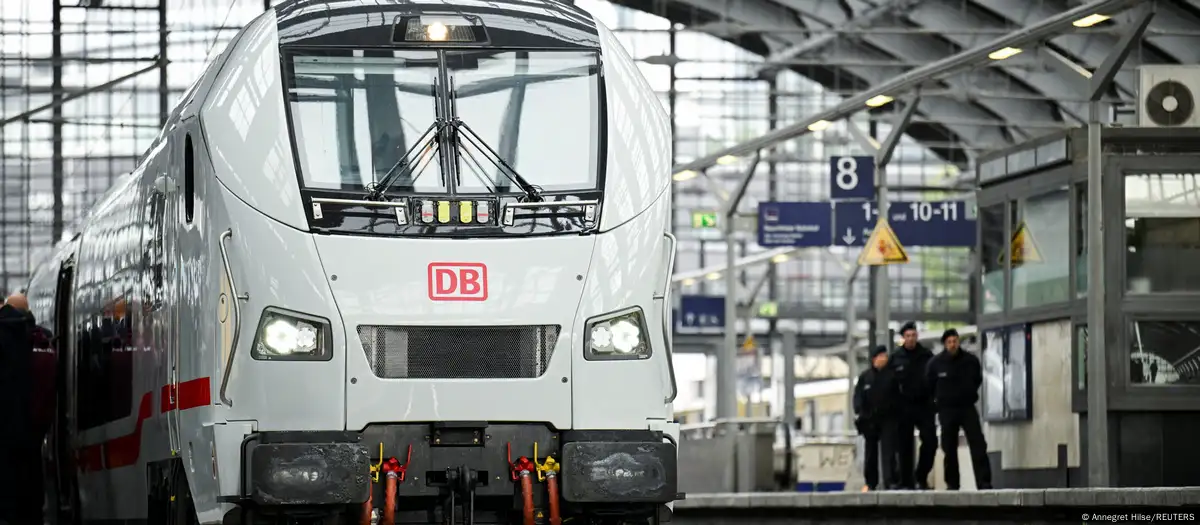
What you need to know
- Authorities are pressing charges against a passenger in another violent attack on a train conductor
- Plans for renovating Bellevue, the federal president's official residence, have been made public
- Chancellor Merz resumes his trip to China
This Germany news blog is now closed. Thank you for reading.
Here are the headlines, reports and analyses from across Germany on Thursday, February 26:
Interior Minister Dobrindt says waiting on final AfD verdict
Interior Minister Alexander Dobrindt said that the federal government had taken note of Thursday's initial ruling on the AfD.
"Now it's time to wait for the main hearing," Dobrindt, a member of the Bavarian CSU, told reporters.
In the mean time, he said, the BfV intelligence agency would continue to montior the AfD as a suspected extreme right wing case, not a certified one — so as the second tier of three observation levels rather than the highest.
The legal spokeswoman for the Social Democrats, Carmen Wegge, said her party disagreed with Thursday's decision.
"I am still of the firm conviction that the AfD is anti-constitutional and in violation of the constitiution and that the party should be evaluated by the constitutional court," Wegge said, indicating her party intends to continue seeking a bid to ban the party before the country's highest court.
However, for the moment, this is little more than a threat frequently made, not a motion moving through parliament or toward the court in Karlsruhe.
WATCH: German Carnival artist charged in Russia for defaming Putin
A German artist is accused of defaming the Russian state by creating carnival floats featuring satirical depictions of President Vladimir Putin.
Jacques Tilly is being put on trial in absentia in a Russian court.
AfD and Weidel celebrate a 'big win' for party 'and also for democracy'
AfD politicians celebrated Thursday's initial ruling in Cologne, including party co-chair Alice Weidel.
"Not only is the domestic intelligence agency no longer allowed to classify the AfD as 'certified extreme right wing,' the Cologne Administrative Court also indirectly put a stop to the fanatics who want to ban the party," Weidel wrote. "A big win not just for the AfD, but also for democracy and the rule of law!"
Weidel's co-chair Tino Chrupalla told journalists that the verdict was the a victory in the first stage and that the next step was to celebrate the partial victory.
"And that's what we'll do today," he said. Chrupalla also said the decision would be a shot in the arm for campaigners in the states of Baden-Württemberg and Rhineland-Palatinate ahead of regional elections in March.
While a much less powerful force in western states, the AfD is nevertheless eyeing substantial gains in both regions, polling somewhere around or approaching 20%.
The lawyer representing the AfD, Ralf Höcker, wrote online that he considered the decision an indication of the bigger ruling still to come.
"This is an emegergency hearing, but the court's reasoning is clear and quite decisive," Höcker argued. "Summarized in short: In a decmocracy it is not sufficient to point to a few crazed party members in order to ban a party in its entirety. With this a ban of the AfD is no longer plausible. It is off the table."
Although the intelligence designation is not directly connected to some politicians advocating for a move to outlaw the AfD — something that has only happened twice in post-war Germany, and not at all since the 1950s — it would likely be used as a part of any potential case in favor if it came about.
AfD wins court injunction against intelligence agency's extremist label
The Alternative for Germany (AfD) party has won a temporary court injunction that prevents the domestic German intelligency agency (the BfV) from labeling the party as "certified extreme right wing" (gesichert rechtsextrem in German).
The designation is the highest of three observation levels available to the BfV when designating extremist orgnaizations as a potential threat to public security. Securing it enables easier and more extensive surveillance of the organization and its members.
The BfV first designated the federal chapter of the AfD as such last May, before the party challenged it in the courts.
Thursday's preliminary ruling is the first legal decision on the appeals, but is not a final verdict. Instead it is an injunction based on a preliminary evaluation by the court after the AfD requested an emergency decision.
Cologne's administrative court said that based on its preliminary evaluations there was not sufficient evidence to establish an "anti-consitutional general tendency" across the entire entity, which it said would be necessary for the designation.
It said that individuals and individual policies clearly fitting this description were not necessarily enough.
A full verdict will follow later, it's not yet clear when, but Thursday's decision prevents the BfV from using the designation and pursuing the party accordingly on a temporary basis.
Germany deports Afghans, for first time in coordination with Taliban
Germany has deported 20 people back to Afghanistan in the first deportation batch directly agreed with the Taliban since the militants' return to power in 2021.
The German Interior Ministry said on Thursday the charter flight took off from the eastern city of Leipzig en route to Kabul, carrying 20 convicted Afghans.
Though Germany has deported several Afghan citizens in recent years, such deportation flights were previously mediated by Qatar. This is the first such flight to be based on an agreement with the Taliban and coordinated with them.
German Interior Minister Alexander Dobrindt said the agreement "creates a reliable basis for direct and permanent deportations to Afghanistan."
Contact with the militant group is highly controversial as the German government does not maintain diplomatic relations with Afghanistan under the Taliban rule.
The topic of deporting people to Afghanistan has been similarly controversial, with rights groups and several politicians arguing over the validity of deportations to countries where unrest remains.
The government of Chancellor Friedrich Merz has vowed to step up deportations since assuming power in May last year.
German carrier Lufthansa subsidiary votes to strike
Cityline, a subsidiary of the German flag carrier Lufthansa, voted on Thursday in favor of a strike.
The Cockpit Association (VC) union's ballot saw 99% in favor of the strike, with a 95% turnout.
No strike date has been made public.
The votes comes merely two weeks after Lufthansa pilots held a one-day strike, which saw over 800 flights cancelled and some 100,000 passengers affected.
Cityline, the Lufthansa subsidiary, operates regional feeder flights to hubs in Munich and Frankfurt. It has around 500 pilots.
The union is planning the strike to address a dispute over collective bargaining negotiations, as the VC pushes for annual 3.3% pay increases.
Cityline's operations are due to be phased out next year, a highly unpopular move among employees and unions, who fear adding burdens to Lufthansa staff.
READ: Berlinale future hangs in the balance
An emergency meeting Thursday morning of the organization that manages the Berlin International Film Festival, or Berlinale, has left the future of the festival's current head, Tricia Tuttle, open-ended, as the festival continues to reel from controversy related to the Israel-Hamas war.
The meeting had been called by State Minister for Culture Wolfram Weimer to discuss incidents at the recent Berlinale in which, among other things, artists expressed solidarity with Gaza and criticized festival and jury leadership for their approach to handling the conflict within the festival sphere.
Weimer's office said after the meeting that discussions between Tuttle and the board "over the Berlinale's future direction will continue in the coming days."
Read more about the controversies surrounding this year's Berlinale here.
German Skating Association reportedly bans 2 journalists from press conference
Two sports journalists who reported on irregularities at the German Speed Skating and Short Track Association (DESG) were banned from a press conference organized by the association to address the report, the German DPA news agency said.
Journalists Hajo Seppelt and Jörg Mebus played a key role in the report produced by the German broadcaster ARD, which also addressed the strained relationship between some athletes and the DESG leadership ahead of the Milan/Cortina Winter Olympics.
The Association of German Sports Journalists (VDS) described the ban in a letter to DPA as a "clear violation of press freedom."
"Your community is funded by public money, and we would like to remind you emphatically of the responsibility that this entails," the VDS wrote.
German companies raided over alleged illegal imports from Russia
Custom officials have raided three companies in Germany's northern city of Hamburg over accusations of illegal imports from Russia.
Authorities said on Thursday the companies are suspected of illegally importing goods worth over €4 million ($4.7 million), in violation of sanctions imposed on Russia over its war in Ukraine.
Custom officials said a managing director is suspected of violating sanctions in over 900 cases.
Two luxury cars were seized during the search, alongside documents and storage devices that were taken as evidence. Authorities also froze assets belonging to one of the companies, worth €3.5 million.
Merz discusses Ukraine war with Xi
During his trip to China on Thursday, German Chancellor Friedrich Merz raised the issue of the ongoing war in Ukraine with Chinese President Xi Jinping.
Merz spoke of ending the war, which marked its fourth anniversary earlier this week. The German chancellor said he hoped he was able to convey to his Chinese counterpart the importance of such a step.
Xi said diplomacy was "key to the issue," according to Chinese state agency Xinhua.
Russia has inched closer to China since launching its fullscale invasion of Ukraine in February 2022, with Western countries arguing Beijing has enough leverage to influence Moscow.
Ukrainian President Volodymyr Zelenskyy has often blamed China for supporting Russia.
Germany most reliant on cash payment in Europe, survey finds
Germany is the country most reliant on cash in Europe, a new survey shows, with Austria a close second, making the neighbors Europe's cash strongholds.
The survey by market research institute YouGov was conducted on behalf of consulting firm BearingPoint.
Of the 2,026 adults surveyed in Germany, 73% said cash was their most common payment method. This is even higher than last year's 69%.
In Austria, 71% of the 1,000 surveyed also said they mostly use cash.
Coins and banknotes are used much less frequently in the seven other European countries surveyed.
Frequent cash use stood at 61% in Switzerland, 58% in Ireland, 51% in France and 46% in the Netherlands.
Nordic countries were even less reliant on cash, with Finland at 42%, Denmark at 32% and Sweden at 25%.
Some 27% of the respondents in Sweden said they don't use cash at all, alongside 18% in Denmark. In Germany, this stood at a meagre 2%, with only 1% in Austria saying they don't use cash.
German companies losing momentum for climate protection, report shows
Climate protection and sustainability are losing momentum among policies of German companies, a new report showed on Thursday.
The report, published by the Bertelsmann Foundation, said companies blamed political uncertainty and weak market incentives for the drop.
Over 800 companies were surveyed for the report. Almost 60% cited an internal decline in sustainability.
Some 73% of firms in the real and financial economy are still adhering to responsibility for sustainability at board and executive level. The figure is unchanged from last year.
However, many companies seem to be slowing their efforts. The share of companies planning new sustainability initiatives was down by 7 percentage points.
Jakob Kunzlmann, sustainability expert at the Bertelsmann Foundation, warned that sustainability risks entering a phase of stagnation, amid the absence of clear and reliable signals from policymakers and markets.
Meanwhile, 59% of companies were setting their own climate targets, up from 53%, with banks also up to 65%, from 46%.
The German government has committed to achieving climate neutrality by 2045, standing by that declaration despite rolling back projects and laws that would make it possible to reach that goal.
Chancellor Merz visits Beijing's Forbidden City on second day of China trip
German Chancellor Friedrich Merz is on the second day of his official visit to China.
On Thursday, he visited Beijing's Forbidden City, which served as the palace of China's emperors for over 500 years.
Merz also visited the Chinese tech hub of Hangzhou on Thursday, accompanied by a delegation of German entrepreneurs including representatives of auto giants Volkswagen, BMW and Mercedes.
Follow our blog here for more on Merz's state visit to China.
President's official residence in need of renovations worth some €600 million
Plans for a long-overdue renovation of the Bellevue palace, the official residence of the German president, have been made public, with the makeover set to cost around €600 million (roughly $709 million), ARD reported on Wednesday evening.
Citing the Federal President's Office, the broadcaster said the €601-million figure includes a €71 million contingency for construction price increases and a €188 million for risk reserve, including potential pollutants that could be found at the building's structure.
The renovations could begin as early as the summer, with eight years considered a "realistic" timeline, according to Petra Wesseler, head of the Federal Office for Building and Regional Planning responsible for the project.
President Frank-Walter Steinmeier would have to move to a temporary residency, probably an office tower block near the residence.
Steinmeier himself commented on the renovations, suggesting they were overdue. The president mentioned not being able to use the residence to its full capacity while hosting events due to safety risks, as well as plumbing leaks.
Passenger injures conductor of ICE train during trip to Berlin
A passenger punched a train conductor on a long distance InterCity Express (ICE) train to the capital Berlin, public broadcaster ARD reported on Wednesday.
A 35-year-old female passenger showed an invalid ticket during a routine train inspection and then was asked to get off the train. She then proceeded to attack the conductor, who suffered abdominal pain, prompting him to cut his shift short.
The incident forced some 100 passengers to prematurely get off the train and wait for a replacement.
Criminal proceedings have been launched against the attacker, including for fraud, trespassing, assault and property damage.
The incident comes after the death of another train conductor in the state of Rhineland-Palatinate sparked a debate over whether more security measures are necessary aboard German trains. The conductor was also attacked by a passenger during a ticket check. He later died of his injuries.
According to official figures from national rail operator Deutsche Bahn (DB), an average of five staff members are physically assaulted every day, with four more facing threats.