Germany news: 13-year-old boy killed in Witten stabbing
Published March 28, 2026last updated March 29, 2026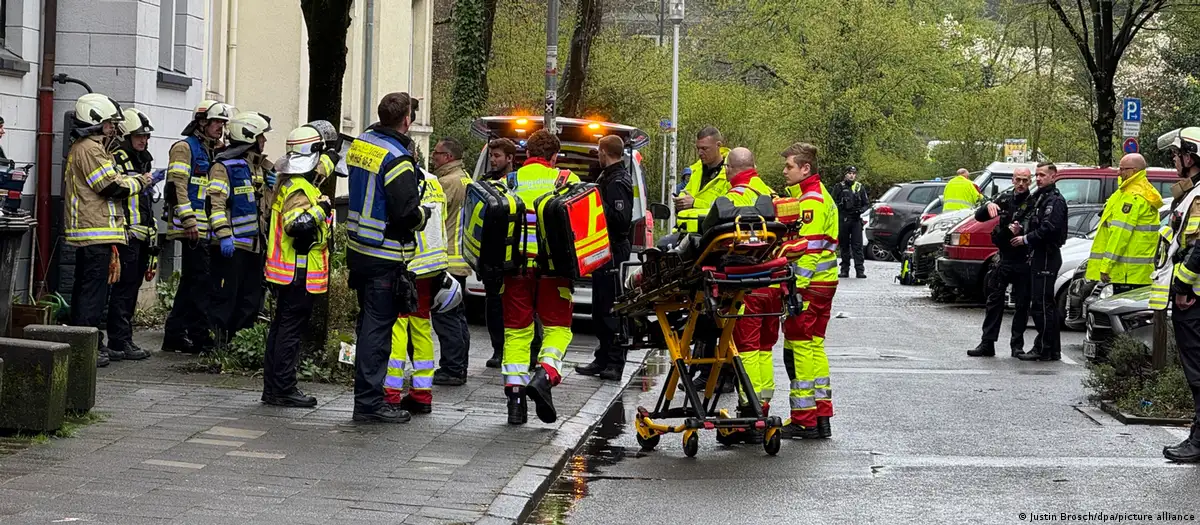
What you need to know
- A 13-year-old boy has died from stab wounds in Witten, western Germany
- Survey: A third of Germans expect the cost of living to increase
- Merz accuses Trump of "massive escalation" in Iran war
- Chancellor says German army could help clear mines from Strait of Hormuz
- German FM Wadephul says Germany now has clarity on US war aims
- Buy Deutschlandticket to offset rising fuel prices, transport minister says
Read below for the latest developments from across Germany on Saturday, March 28, and Sunday, March 29.
Bavarian state premier visits Texas, South Carolina
Bavarian state premier Markus Söder is traveling to the United States for the first time in his current role.
The destinations of his trip are the economically powerful US states of Texas and South Carolina.
The last time a Bavarian state premier — Germany's equivalent of a state governor — visited the US in an official capacity was Edmund Stoiber in 2002. Unlike that time, Söder will be giving the capital, Washington, DC, and US President Donald Trump a wide berth.
Among the highlights on Söder's itinerary is a visit to the NASA Mission Control Center in Houston and a cowboy ranch.
The German Aerospace Center (DLR) in Oberpfaffenhofen near Munich has long maintained a direct line to Texas — a connection that Söder aims to strengthen.
According to his own statement, Söder has already been to the US twice, "once to New York in 2012 and once to the West Coast in 2014."
This is his first official trip as head of Bavaria's government. “We want to forge alliances with power regions," he said.
As the largest states in their respective countries, Texas and Bavaria share some other similarities. Both southerly economic powerhouses have their own conservative and distinct cultures, each having existed as independent countries in the past.
As well as Texas, the visit also takes in South Carolina — where there's already a close connection to Bavaria. Munich-based carmaker BMW operates its largest and most important overseas plant in Spartanburg.
Political talks are planned for Wednesday. These include a reception and political discussions with South Carolina Governor Henry McMaster – who, like the US president, is a Republican — as well as receptions in the state Senate and the House of Representatives.
The potentially fraught discussions are likely to focus on the US tariffs and protectionism, particularly painful subjects for Germany and Bavaria with their tradition as major exporters.
Humpback whale remains in Baltic shallows
A humpback whale has remained in Wismar Bay in northeastern Germany after briefly freeing itself from a sandbank, with authorities still monitoring the situation.
Officials in the state of Mecklenburg-Western Pomerania and the environmental group Greenpeace said it is unclear whether the whale is stuck again, while water police continue operations in the area.
The animal had managed to free itself overnight as water levels rose, but shallow coastal waters remain a risk.
The 12 to 15 meter (roughly 40 to 50 feet) whale was first spotted Monday near a beach by the town of Timmendorf and later escaped through a channel dug by rescuers before swimming toward Mecklenburg.
It then stranded again in Wismar Bay, where authorities have decided against a new rescue attempt for now, hoping the marine mammal can free itself.
Officials have urged the public to keep at least 500 meters away, warning against disturbing the animal.
Experts say humpback whales are not native to the Baltic Sea and that it may have reached the area while following fish or due to underwater noise.
Germany springs forward in time
Clocks across Germany have moved forward by one hour as the country switches to daylight saving time.
At 2 a.m. local time on Sunday, clocks advanced to 3 a.m., marking the start of Central European Summer Time and bringing longer, brighter evenings.
The time change is designed to make better use of daylight during the year, with clocks set to return to standard time on October 25.
In Germany, the official time signal is managed by Physikalisch-Technische Bundesanstalt in the city of Braunschweig (also known as Brunswick in English).
The institute transmits the signal via a long-wave transmitter near Frankfurt, ensuring radio-controlled and industrial clocks adjust automatically.
We're resuming our coverage
Welcome back to our Germany blog as we start Sunday bright and early after a sping clock time change.
We'll be bringing you all the most interesting stories that Germany is talking about, so stay with us here.
We are pausing our coverage
We are pausing this weekend edition of our blog on all things Germany.
We will resume again tomorrow morning to bring you all the latest headlines, background, videos and analyses from Germany. Stay tuned!
Thousands protest sexual violence in Cologne
Thousands of protesters took to the streets in Germany's western city of Cologne on Saturday to protest against sexual and "patriarchal" violence.
The topic has gained traction since TV host and actress Collien Fernandes made serious allegations against her ex-partner, actor Christian Ulmen.
Fernandes accused her ex-husband of being behind the distribution of hundreds of AI-generated pornographic images of her online, as well as social media accounts pretending to be her, which he denies.
Rescued whale beached again off Germany's coast
A whale that was freed after being stranded for days off Germany’s Baltic coast has become stuck on another sandbank, a Greenpeace spokeswoman said on Saturday.
The humpback, estimated to be between 12 and 15 meters long (around 40 to 50 feet) first ran aground early Monday on a sandbank off the Timmendorfer Strand resort near the northern city of Lübeck. The incident prompted a days-long rescue effort. Eventually, a floating excavator was delivered to the scene and rescue teams managed to dig a channel, allowing the massive animal to swim off.
But less than two days later, the whale seems to be stuck once again.
Poland to keep border checks for Germany and Lithuania over illegal migration
Poland'sInterior Ministry said it will extend controls along its borders with fellow European Union members Germanyand Lithuania by six months until October 1.
The country began temporary controls in July, echoing several other EU governments, to help stem illegal migration.
"This decision is due to the need to counteract illegal migration and ensure internal security," the ministry said in a post on X.
Germany introduced temporary controls on some eastern and southern borders in 2023.
The government cited high levels of irregular migration and migration smuggling for the checks along the frontier with Austria, Poland, the Czech Republic and Switzerland.
A year later, the controls were extended to its western and northern borders towards France, Luxembourg, Belgium, the Netherlands and Denmark.
Public transport can help cut driving costs, minister says
Germany's Transport Minister Patrick Schnieder has called on drivers to use public transport as a way of coping with rising vehicle fuel prices from the Iran war.
Since the conflict started on February 28, gasoline and diesel prices have risen sharply.
Global oil supply has been hurt by Iran's closure of the Strait of Hormuz, leaving hundreds of oil and gas tankers stranded.
"For large parts of our country, I can only recommend switching to the Deutschlandticket," Schneider told the newspapers of the Funke Media Group.
The minister was referring to a monthly public transport pass introduced by the German government during the 2023 cost-of-living crisis, fueled by the COVID-19 pandemic and Russia's full-scale invasion of Ukraine.
The card was originally priced at €9, but has since risen to €63 ($73) per month and allows unlimited travel on local and regional bus, rail and subway services in Germany. It cannot be used on high-speed intercity rail services or night trains.
Schneider said the pass is "still far cheaper than regular monthly passes — and it's valid throughout Germany."
Government subsidies for the ticket have been secured until 2030.
1 killed, 2 injured in Witten stabbing
Police have launched a major operation after two children and their mother were seriously injured during a violent incident in Witten, in western Germany.
A police spokesperson later told the dpa news agency that one of the victims, a 13-year-old boy, later died from stab wounds.
Bild newspaper reported that paramedics tried to resuscitate the boy on site, but he died in the ambulance.
The mother, aged 38, and her 9-year-old child have been taken to the hospital.
A police spokesperson said the incident began "with a domestic dispute that spilled out onto the street."
Bild said police responded to an emergency call at 10:29 a.m local time (09:29 UTC/GMT).
The children's father, a suspect in the crime, was arrested about 100 meters from their home.
A witness told the mass circulation newspaper: "His hands were covered in blood. He was lying handcuffed on the ground, guarded by two police officers."
Merz: German military could help clear Hormuz of mines
Germany's Chancellor Friedrich Merz said the Bundeswehr armed forces could be deployed to clear mines in the Strait of Hormuz once the war in Iran has ended.
"We can do that," Merz told an event by a German newspaper in Frankfurt on Friday evening. "If we are asked ... and it takes place within the framework of a genuine collective security mandate that is, the United Nations, NATO, the European Union — with a resolution from the Bundestag, that is an option."
The Chancellor noted that the Bundeswehr has several minesweepers.
But he added the proposal is "theoretical" right now as Iran has yet to drop mines into the waterway between Iran and Oman, through which a fifth of the world's oil supply moved, before the conflict.
US President Donald Trump has extended the deadline for Iran to reopen Hormuz, or reach a deal ot end the war, until April 6 before the US launches attacks on Iranian power plants.
Merz, Trump clash again over Iran war strategy
Germany's Chancellor Friedrich Merz has accused US President Donald Trump of a "massive escalation" in the Iran war.
“What Trump is doing right now is not de-escalation and an attempt to reach a peaceful solution, but a massive escalation with an uncertain outcome,” Merz said late Friday at an event in Frankfurt.
“These are escalations that are threatening,” he added. “Not only for those directly affected, but for all of us.”
Merz also questioned whether the United States and Israel can realistically oust Iran's current leadership.
“Is regime change really the goal?” he asked. “If that is the goal, I don’t think they will achieve it. That has usually gone wrong.”
The rhetoric between Washington and Berlin has become more heated in recent days.
Earlier Friday, Trump doubled down on his criticism of Germany for its lack of support in securing oil and gas shipments through the Strait of Hormuz.
"Friedrich, the chancellor of Germany, he said, 'This is not our war'," Trump said, adding that "Ukraine is not our war, but we help them."
Germans fear new bout of inflation as fuel prices soar
Nine out of ten German residents expect the cost of living to increase in the coming months, according to a new YouGov survey for Postbank.
Meanwhile, nearly a third of the 2,028 people questioned believe the Iran war will cause significant price rises, adding to household budget pressures.
Germany, along with much of the rest of the world, saw inflation spike to decades-high levels following the pandemic and Russia's full-scale invasion of Ukraine in 2022.
Nearly a quarter of those polled who earn less than €2,500 ($2,900) per month say they are barely able to cover their basic living expenses, compared to almost 13% of all respondents.
Food, energy and transport were cited as the top three cost pressures.
"The fact that more than half of respondents now rate their financial situation as worse than a year ago is also a consequence of the inflation surge in 2022," said Ulrich Stephan, chief investment strategist for private and corporate clients at Deutsche Bank, which owns Postbank.
Many economists have predicted higher inflation in the next few months due to higher oil and gas prices caused by Iran's effective closure of the Strait of Hormuz, a critical energy shipping lane in the Persian Gulf.
Economists think the extent of the price increases will depend on how long the war lasts.
Inflation in Germany fell to 1.9% in February, dropping back below the European Central Bank's 2% target.
Welcome to our coverage
Guten Tag from DW's newsroom in Bonn, where we're closely following the latest news from across Germany, where the Iran war continues to dominate domestic headlines.
Chancellor Friedrich Merz has warned that US President Donald Trump's decision to escalate the Iran war will affect not only the Middle East, but "all of us."
In the past hours, the two leaders have traded barbs on Germany's lack of involvement in the conflict. Merz said he told the US leader: "If you want us to help, then please ask us beforehand ...not afterwards through the newspapers."
Meanwhile, a new survey has shown that Germans are concerned about a new wave of inflation, especially in food, energy and transport costs.
One way to save money on vehicle fuel, says Transport Minister Patrick Schnieder, is to buy a Deutchlandticket — the low-cost monthly public transport card.
Stay with us for these stories and more from Germany.