UNGA wrap: Wars in Gaza and Ukraine dominate
Published September 23, 2025last updated September 29, 2025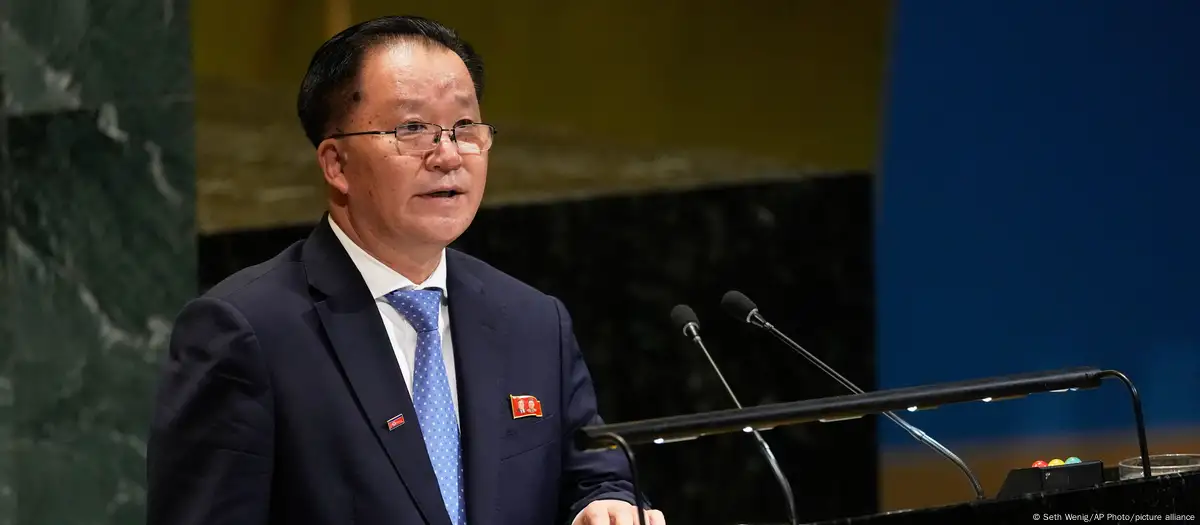
What you need to know
- US President Donald Trump used his speech to attack the UN and complained about the teleprompter not working
- North Korean official vowed never to give up its nuclear weapons
- The foreign ministers of Germany and Russia delivered their speeches to the UN General Assembly
-
Wadephul defended the decision by Germany, France and the UK to reimpose sanctions on Iran over its nuclear deal
-
Russia's Sergey Lavrov warned that any aggression from NATO or the EU would be met with a 'decisive response'
-
India's External Affairs Minister Jaishankar called Pakistan a 'global epicenter of terrorism'
-
Israeli Prime Minister Benjamin Netanyahu slammed the 'disgraceful' recognition of state of Palestine
- Palestinian President Mahmoud Abbas delivered a wide-ranging speech in which he condemned Israel's offensive as well as Hamas' October 7 terror attack.
- Iranian President Masoud Pezeshkian downplayed Iran's nuclear aims as he pushes to avert snapback sanctions from UK, France and Germany
- Ukraine's President Volodymyr Zelenskyy said the world is witnessing a destructive arms race, warns against Russia's influence in Moldova ahead of parliamentary elections
This blog is now closed. Read below for a roundup of all the news, analyses and videos on the United Nations' 80th General Assembly session:
North Korea vowed to never give up its nuclear weapons
On Monday, a high-ranking North Korean official made a rare address to the UN in which he declared that Pyongyang would never give up its nuclear weapons. However, he also left the door open to diplomacy.
Kim Son Gyong, the vice minister of foreign affairs, traveled to New York to attend the United Nations' annual high-level week — a role previously performed by the country's ambassador at a lower level.
"(The) imposition of 'Denuclearization' on the DPRK is tantamount to demanding it to surrender sovereignty and right to existence and violate the Constitution," said Kim, referring to the country's formal name, the Democratic People's Republic of Korea.
"We will never give up sovereignty, abandon the right to existence and violate the Constitution," he added.
Last week, North Korean leader Kim Jong Un said that he was open to talks with the United States provided that he could keep his nuclear arsenal.
North Korea conducted its first nuclear test in 2006 and is under a raft of UN sanctions for its banned weapons programs.
UN General Assembly to resume on Monday
The UN General Assembly debate is closed on Sunday.
It will resume on Monday, September 29.
Stay tuned for more updates and in-depth analysis.
UN sanctions against Iran come into effect
Widespread UN sanctions against Iran came back into force at midnight GMT for the first time in a decade after last-ditch nuclear talks with Western powers failed.
The sanctions will once again freeze Iran's overseas assets, ban arms deals with Iran and penalize ballistic missile development, among other measures.
The "snapback" sanctions were triggered by Britain, France and Germany at the UN Security Council. They argued that Iran violated the 2015 deal to stop it from developing a nuclear weapon, although Iran denies this.
"We urge Iran to refrain from any escalatory action and to return to compliance with its legally binding safeguards obligations," the three European countries' foreign ministers said in a joint statement.
"The reimposition of UN sanctions is not the end of diplomacy."
US Secretary of State Marco Rubio also called on UN member states to "immediately" implement sanctions to "pressure Iran's leaders to do what is right for their nation, and best for the safety of the world."
Iran said on Saturday it was recalling its ambassadors to Britain, France and Germany for consultations.
Earlier, on Friday, Iran's President Masoud Pezeshkian downplayed the threat of sanctions as he left New York.
"It is not like the sky is falling," he said.
Indian foreign minister calls Pakistan 'epicenter of terrorism'
Indian Foreign Minister S. Jaishankar said India's neighbor Pakistan is an "epicenter of global terrorism."
Speaking at the UN General Assembly, Jaishankar accused Pakistan of being behind "decades" of "major international attacks," saying UN designated terrorist lists are "replete" with Pakistani nationals.
India and Pakistan fought a brief conflict this year after a terror attack on tourists near the resort town of Pahalgam in the disputed region of Kashmir.
India accused Pakistan of being behind the April attack, which killed 26 people. Pakistan has strongly denied the allegation.
"India exercised its right to defend its people against terrorism and brought its organisers and perpetrators to justice," Jaishankar said.
What else did India's foreign minister say?
Jaishankar also used his speech to denounce the ineffectiveness of the UN, while also calling for major reforms to its institutions, including the Security Council.
He called for the body to be expanded to allow more permanent and non-permanent members so that the Security Council can "be truly representative."
"India stands ready to assume greater responsibilities," Jaishankar said.
'No choice' but to reimpose Iran sanctions — German FM
German Foreign Minister Johann Wadephul said the E3 — France, the United Kingdom and Germany — were left with "no choice" but to reapply sanctions on Iran over its nuclear program.
The so-called "snapback sanctions" are set to take effect from midnight, which will see sweeping punitive economic measures be reimposed on Tehran.
The sanctions were lifted under the 2015 nuclear deal, also known as the Joint Comprehensive Plan of Action (JCPOA).
"For us it is imperative; Iran must never acquire a nuclear weapon," Wadephul told the UN General Assembly on Saturday, adding that Tehran has "for many years" pursued a nuclear program "which goes far beyond any plausible civilian use."
In his speech to the Assembly this week, Iran's President Masoud Pezeshkian denied that Tehran wants to build a nuclear weapon.
The German diplomat said that the E3 "had no choice but to trigger the snapback of sanctions" since Iran is "clearly" not complying with its obligations under the JCPOA.
"We remain open to negotiations on a new agreement. Diplomacy can and should continue," Wadephul said.
'Aggression' to be met with 'decisive response' — Russia's Lavrov
Russia's Foreign Minister Sergey Lavrov warned members of the European Union and NATO that any "aggression" against Russia would be "met with a decisive response."
Lavrov's remarks come after several European NATO nations, including Estonia, Poland, Romania and Denmark, have reported recent airspace violations.
Russia has denied any involvement, but NATO has bolstered its eastern flank in response.
"Russia is being accused of almost planning to attack the North Atlantic Alliance and European Union countries. President Putin has repeatedly debunked these provocations," Lavrov said in his speech to the UN General Assembly.
Russia's top diplomat also repeated the Kremlin's claim that the war in Ukraine is the result of NATO's eastward expansion and a Western-sponsored "coup d'etat" in Kyiv in 2014 — a reference to the pro-European revolt in Ukraine that led to the ouster of pro-Russian president Viktor Yanukovych.
But Lavrov praised US President Donald Trump, who hosted Russian President Vladimir Putin at a summit in Alaska. Trump and his administration have grown increasingly frustrated with Moscow over the lack of progress on a ceasefire in Ukraine.
"In the approaches of the current US administration, we see a desire not only to contribute to ways to realistically resolve the Ukrainian crisis, but also a desire to develop pragmatic cooperation without adopting an ideological stance," Lavrov said.
What else did Lavrov say?
Lavrov condemned Western leaders for rejecting a proposal tabled by China and Russia to extend the 2015 nuclear agreement on Iran's nuclear programme and avoid sanctions being reimposed on Tehran.
"This has finally exposed the West's policy of sabotaging the pursuit of constructive solutions in the UN Security Council and its desire to extract unilateral concessions from Tehran through blackmail and pressure," Lavrov said.
He also slammed European governments for taking "so long" to recognize a Palestinian state, while also denouncing Israel over its "illegal use of force against the Palestinians" and "aggressive actions against several countries in the Middle East," which Lavrov said "threaten to blow up" the entire region.
While he "firmly condemned" the Hamas terror attacks, Lavrov said there is "no justification for the collective punishment of Palestinians in the (Gaza) Strip where Palestinian children are dying from bombing and starvation, hospitals and schools are being destroyed, and hundreds of thousands of people are being left without shelter."
What's happening on Saturday at UNGA?
Welcome to DW's coverage of Day 5 of the 80th UNGA's General Debate, which has seen several dramatic moments this week.
On Friday, Israeli Prime Minister Benjamin Netanyahu fiercely defended Israel's campaign in Gaza and roundly rejected recognition of Palestinian statehood, accusing Western leaders of buckling under pressure.
Several of Israel's allies, including the United Kingdom and France, made the historic step to recognize Palestine as a state, as pressure on Israel over its war against Hamas in Gaza continues to grow.
Germany, however, is not among those countries. While Berlin has criticized Israel and has stopped sending weapons that can be used in the war-torn Palestinian enclave, it remains one of Israel's staunchest international supporters.
German Foreign Minister Johann Wadephul is likely to address the conflict and Germany's stance, as well as discuss ongoing Western support for Ukraine as it continues to defend against Russia's invasion.
Russia's Foreign Minister Sergey Lavrov will also make an appearance. Moscow's top diplomat will likely denounce the West's support for Ukraine and NATO.
Several NATO members in northern and eastern Europe have reported recent airspace incursions, which have been widely assumed to be Russia's doing, although the Kremlin has denied the allegations.
Also taking the podium Saturday is India's Foreign Minister S. Jaishankar, who will address the UN one day after Pakistan's Prime Minister Shehbaz Sharif, who denounced New Delhi's "arrogance" and "aggression" during the brief war between the two nuclear neighbors this year.
Jaishankar is expected to discuss the situation in the disputed territory of Kashmir, which both India and Pakistan claim, as well as push back against what Sharif called India's "unilateral and illegal attempt" to suspend the Indus Water Treaty.
The treaty was signed in 1960 and is one of the only examples of cooperation between the two nuclear neighbors and rivals.
Stay tuned as DW brings you the main developments from the United Nations General Assembly on Saturday.
WATCH - Scores of delegates walk out before Netanyahu UN speech
Israeli Prime Minister Benjamin Netanyahu struck a defiant note as he addressed the United Nations in New York, vowing to 'finish the job' against Hamas in Gaza. Dozens of diplomats and officials staged a walkout before Netanyahu began.
US to revoke Colombian President's visa after comments at pro-Palestinian protest
The United States State Department said they will revoke Colombian President Gustavo Petro's visa following comments he made at a pro-Palestinian rally in New York, where he is attending the UN General Assembly.
Speaking in Spanish, with a translator relaying the message in English, Petro told those gathered that the "nations of the world" should use their soldiers to help create a military force "larger than that of the United States."
"That is why, from here in New York, I ask all soldiers in the United States Army not to point their rifles at humanity. Disobey Trump's order! Obey the order of humanity!" Petro said.
He posted his speech on his social media platform X. The US State Department then announced they would revoke his visa.
"Earlier today, Colombian president @petrogustavo stood on a NYC street and urged US soldiers to disobey orders and incite violence," the State Department said in a post on X.
"We will revoke Petro's visa due to his reckless and incendiary actions," it said.
Read our full story on the US revoking Petro's visa here.
Resolution backed by China and Russia to postpone Iran sanctions fails at UNSC
A resolution backed by China and Russia to avert "snapback" UN sanctions on Iran failed after the proposal did not garner enough support from the UN Security Council. The resolution would have delayed the sanctions on Iran for half a year until April 2026 to allow for further negotiations.
The draft was tabled after it only received four votes from the 15-member UNSC. It would have needed nine votes for the sanctions to be postponed.
China and Russia are key allies of Iran who sit on the UNSC. Pakistan and Algeria also supported the proposal.
"We had hoped that European colleagues and the US would think twice, and they would opt for the path of diplomacy and dialogue instead of their clumsy blackmail, which merely results in escalation of the situation in the region," Russian Deputy Ambassador to the UN Dmitry Polyanskiy said ahead of the vote.
'Snapback' sanctions on Iran slated for early Sunday
UK Ambassador to the UN Barbara Woodward said the sanctions will be imposed this weekend.
"We stand ready to continue discussions with Iran on a diplomatic solution to address international concerns about its nuclear program. In turn, this could allow for the lifting of sanctions in the future," Woodward said.
The UK, France and Germany are expected to impose sweeping sanctions on Iran early on Sunday.
The three Western countries, known as the E3, decided to go ahead with the sanctions due to concerns that Iran was not complying with the terms laid out in the 2015 nuclear deal, formally known as the Joint Comprehensive Plan of Action. The UK, Franceand Germany are particularly concerned that Iran is enriching its uranium stockpile for purposes other than civilian use.
Iranian Foreign Minister Abbas Araghchi claimed that European countries "and the US have consistently misrepresented Iran's peaceful nuclear program." Iranian President Masoud Pezeshkian has characterized the decision to impose snapback sanctions as "unfair, unjust and illegal."
China defends UN, multilateralism, calls for collaboration
Chinese Premier Li Qiang defended the multilateral world order in his speech to the UN General Assembly.
His address, which highlighted the positive impacts of the multilateral, rules-based international order that has prevailed over the past 80 years, contrasted sharply to that of US President Donald Trump, who lambasted the UN this week.
In his speech, Li traced the 80-year history of the United Nations since World War II, highlighting the organization's successes in helping maintain peace which has led to "remarkable growth" in the global economy.
But the Chinese premier warned that when "might dictates right, the world risks division and regression," cautioning against a return to the "era of the law of the jungle."
In a thinly veiled reference to Trump's protectionist and transactional policies, Li said the world has "entered a new period of turbulence and transformation" in which "unilateralism and a Cold War mentality are resurfacing."
"The international rules and order built over the past 80 years are under serious challenge, and the once-effective international system is constantly disrupted," Li said.
The Chinese leader said the "sluggish growth" affecting the world economy calls for increased cooperation and collaboration.
He blamed the "current economic doldrums" on rising "unilateralism and protectionist measures such as tariffs hikes and the erection of walls and barriers."
Unlike the current protectionist climate in the US, Li said that China has "consistently opened its doors wider to the world."
Pakistan's Sharif slams India over war, water treaty
Pakistan's Prime Minister Shehbaz Sharif slammed what he called India's "unprovoked aggression" and "arrogance" during the conflict between two nuclear neighbors this year.
India and Pakistan fought a brief war this year after 26 civilian tourists were killed near Pahalgam in Indian-controlled Kashmir.
India blamed the terror attack on Pakistan, with New Delhi reacting by striking what it said were terrorist hideouts in Pakistan.
"India sought to extract political gain from a human tragedy by spurning my sincere offer of an independent international investigation into the Pahalgam incident. Instead, it attacked our cities and targeted our innocent civilians," Sharif said.
The conflict deescalated after a ceasefire was agreed, with Sharif thanking US President Donald Trump for his "timely and decisive" intervention and "bold and visionary leadership" that "helped avert a more threatening war in South Asia."
India has denied suggestions that Trump brokered the ceasefire.
Having "won the war," Sharif said Pakistan now wants to "win peace" in South Asia, saying the country is ready for a "comprehensive and result-oriented dialogue with India on all outstanding issues."
"South Asia requires proactive rather than provocative leadership," the Pakistani prime minister said.
What did Sharif say about the Indus Water Treaty?
Sharif also addressed India's "unilateral and illegal attempt" to suspend the Indus Water Treaty, which was signed in 1960 and remains one of the only examples of cooperation between the two nuclear neighbors and rivals.
Hundreds of millions of people in both India and Pakistan rely on the Indus River and its tributaries.
Pakistan "will definitely and ardently defend the inseparable right of our 240 million people on these waters. To us, any violation of this Indus treaty represents an act of war," Sharif warned.
Allowing a Palestinian state would be 'national suicide' for Israel — Netanyahu
Israel's Prime Minister Benjamin Netanyahu has strongly rejected the notion that Israel would allow a Palestinian state to be established, saying such a move would be tantamount to committing "national suicide."
In his address to the UN General Assembly, Netanyahu said allowing a "terror state" to be set up next to Israel would be "sheer madness" as he said it would put Israel's existence at risk.
The Israeli prime minister also condemned recent decisions by Western nations including the UK and France to recognize Palestinian statehood.
He accused Western governments of "buckling" under the pressure of "antisemitic mobs" and "hostile media."
"Israel will not allow you to shove a terror state down our throats," Netanyahu said. "We will not commit national suicide because you don't have the guts to face down a hostile media and antisemitic mobs demanding Israel's blood."
Netanyahu condemns recognition of Palestinian statehood
Netanyahu said recognizing Palestine as a state, particularly in the wake of the October 7 Hamas terror attacks, would send the message that "murdering Jews pays off."
He also said that the fact that the announcements of recognition were being "effusively praised" by Hamas shows that Western leaders have done "something horribly wrong."
"Your disgraceful decision will encourage terrorism against Jews and against innocent people everywhere. It will be a mark of shame on all of you," the prime minister said.
"When the going got tough, you caved," Netanyahu said.
What else did Netanyahu say during his speech?
Netanyahu, who spoke for over 45 minutes, addressed a room that was more than half empty after dozens of delegates filed out of the chamber when the Israeli prime minister prepared to take the stage.
He began his address by outlining how Israel has fought a "seven-front war against barbarism" over the past two years.
He said Israel's campaign against Hamas in Gaza, which has killed over 65,000 Palestinians according to the Hamas-run Health Ministry, was only what "any self-respecting nation would do."
"Israel is wiping out the terror regime of Hamas and ensuring that this savagery will never threaten us again," he said, calling the military response to the Hamas attacks "one of the most stunning military comebacks in history."
He also repeated his rejection of allegations that Israel is committing genocide in the enclave, as a UN independent commission found this month.
He claimed that Israel was taking more measures to minimize civilian casualties "than any military in history."
Netanyahu mentions Trump, Merz
On Iran, Netanyahu thanked US President Donald Trump for his "bold and decisive action" during the 12-day war in June this year.
"We removed an existential threat to Israel and a mortal threat to the civilized world. We lifted a dark cloud that could have claimed millions and millions of lives," Netanyahu said.
He added that "we must remain vigilant" and not "allow Iran to rebuild its nuclear capabilities," as he urged UN sanctions on Iran to be "snapped back."
Netanyahu said that German Chancellor Friedrich Merz "admitted the truth" when Merz said that Israel was "doing the dirty work [...] for all of us" back in June.
Netanyahu's UN speech to be played over loudspeakers into Gaza
Israeli Prime Minister Benjamin Netanyahu's speech to the United Nations General Assembly will be broadcast into the Gaza Strip, his office has said.
"The Prime Minister's Office has directed civilian elements, in cooperation with the IDF, to place loudspeakers on the backs of trucks on the Israeli side of the Gaza border so that Prime Minister Netanyahu's historic UN General Assembly speech will be heard in the Gaza Strip," Netanyahu's office said in a statement.
It said the move was "part of the public diplomacy effort" and that Netanyahu had "expressly directed to make certain that this activity does not endanger IDF soldiers."
Israeli media reports citing soldiers, available footage and military sources on Friday, however, say the loudspeakers had been set up within Gaza — including some which are several kilometers into the besieged enclave.
The Israel Defense Forces (IDF) have reportedly voiced their opposition to the move, according to Channel 12. One senior officer called the order an "insane idea", the left-leaning newspaper Haaretz reported.
Another source said the move was an act of psychological warfare, according to Haaretz.