Ukraine updates: EU calls for more Russia sanctions
Published November 26, 2025last updated November 26, 2025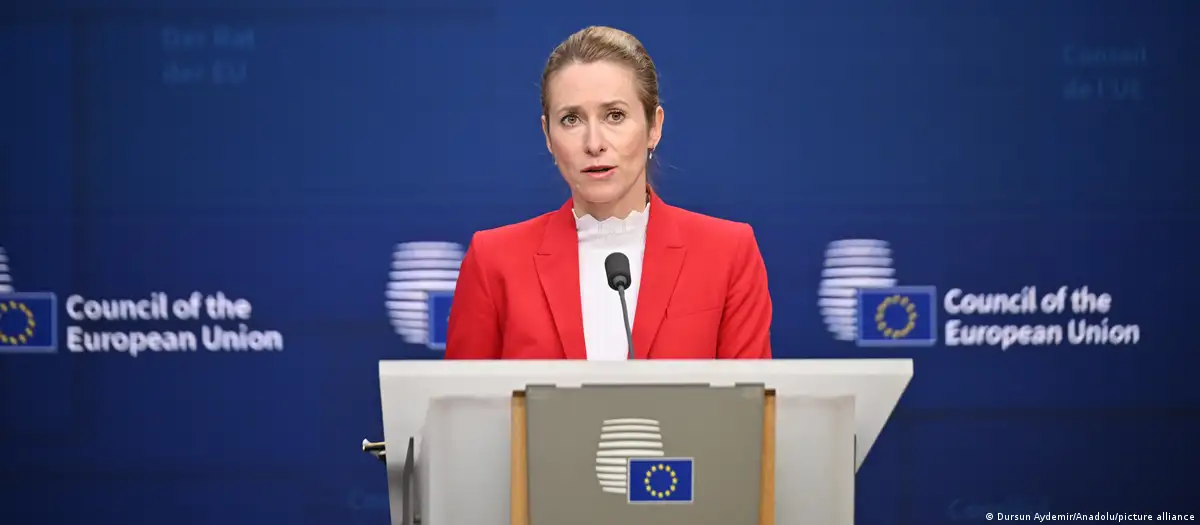
What you need to know
US President Donald Trump has adopted yet again an optimistic tone regarding a peace plan for Ukraine, saying the only deadline he sees for reaching a peace deal "is when it's over."
Trump's hopes to get Ukraine's Zelenskyy to sign his peace plan before Thanksgiving toward the end of the week, however, seem less likely to materialize. The US president said his envoy Steve Witkoff was going to Moscow next week to meet Russian President Vladimir Putin.
In Brussels, the European Union's foreign policy chief, Kaja Kallas, has said the EU must "stay the course and pick up the pace" to ensure the best outcome for Ukraine and Europe.
These updates have been closed. Thank you for reading.
Below is a summary of developments in Russia's full-scale invasion of Ukraine from Wednesday, November 26, 2025.
EU's Kallas calls for more sanctions on Russia
The European Union's top diplomat, Kaja Kallas, called for increased pressure on Russia after meeting with her EU and Ukrainian counterparts.
"To secure the best outcome for Ukraine and Europe, we have to stay the course but pick up pace," Kallas said.
"This means more sanctions to deprive Russia of the means to fight and more military and financial support to Ukraine," she added.
Kallas cast doubt on Russia's preparedness for a ceasefire, but said that pressure was pushing Moscow closer to the point where it will have to negotiate.
"Russia's summer offensive failed. US and EU sanctions are having a huge impact on the Russian economy," she said.
"Russia is losing cash and troops," Kallas stated. "If Russia could conquer Ukraine militarily, it would have already done so by now."
In an apparent reference to the original Trump peace plan that called for Ukraine to cede land to Russia, Kallas said: "The focus should be on what Russia, the aggressor, must do, not what Ukraine, the victim, must sacrifice."
She also called for the frozen Russian assets held in Europe to be used to cover Ukraine's financial needs in 2026 and 2027.
"It would send the strongest message to Moscow that it cannot wait us out, and we need to make this decision fast."
Poland to receive €44 billion loan to boost military
Polish Prime Minister Donald Tusk said his country was on course to get a €44 billion ($50.9 billion) loan from the EU's SAFE program to boost its military.
Tusk said some of the funds would go toward drone equipment for the EU's Eastern Shield, aimed at protecting the eastern border of the bloc against Russian and Belarusian threats.
Funds will also be earmarked for space projects, defense AI, military equipment, border guards and police, and the SAFE Baltic program.
"Thanks to our efforts, we will also be able to finance roads and railways directly related to the security of the Polish state through the SAFE program," Tusk added.
Poland has been one of Ukraine's strongest supporters and is one of the highest spenders on defense in the NATO alliance.
Ukraine is 'deeply suspicious' of Witkoff, says DW's correspondent
Nick Connolly, a DW's correspondent in Kyiv, said there is considerable worry in Ukraine about what Trump's envoy Steve Witkoff might agree to with Russia.
"Ukraine is deeply suspicious of Steve Witkoff, all along, it has been clear from Ukraine's perspective that this is someone who has been very much interested in the normalization of relations with Russia, come what may, he doesn't really care about Ukraine's red lines," Connolly said.
On Tuesday, Bloomberg published a transcript of a conversation allegedly between Witkoff and Russian policy adviser Yuri Ushakov, in which they discuss how Putin should frame a possible deal in talks with Trump.
Connolly said the leak had "nothing surprising," but was still "fascinating to see [Ukrainians'] suspicions about Witkoff confirmed that way if these recordings turn out to actually be true."
Germany expects Russia-Ukraine agreements 'next week at earliest'
German Foreign Minister Johann Wadephul has suggested the preliminary agreements on a peace deal between Russia and Ukraine can be expected "next week at the earliest."
He said Kyiv needs time to negotiate "the concessions it is prepared to make, if any."
The minister also expects Europe to get involved after the first stages are complete.
"We are now in a framework where there are talks between Russia and Ukraine," he said. "At a later stage, the Europeans will be involved."
No direct negotiations between Russia and Ukraine have been made public, but US representatives are in talks with both sides.
Wadephul said Ukraine needs to be able to come from a position of relative strength and that Germany was working with the EU to gain access to frozen Russian assets to be used in Ukraine.
Belgium, the country where the frozen assets are mostly located, has so far refused to unlock them.
Russia calls parts of new Trump peace deal 'positive'
The Kremlin said it has seen the most recent version of the Trump-backed peace plan for Ukraine.
Presidential adviser Yuri Ushakov told a Russian state TV reporter that "some aspects can be viewed positively, but many require special discussions among experts."
The updated draft has not been made public, but the original 28-point version — which included Ukraine ceding land — was criticized in Europe for being too conciliatory to Russia.
Following talks in Geneva between the US, Ukraine and European allies, President Donald Trump said on Tuesday that the proposal had been "fine-tuned."
Ushakov said the new version required "truly serious analysis."
The Kremlin aide also accused Ukraine's European allies of "meddling" in the peace process.
At the same time, Kremlin spokesperson Dmitry Peskov said it was "premature" to say whether a peace deal was close.
'No peace through capitulation' in Ukraine, Merz tells Bundestag
Speaking during a debate in the German Bundestag, Chancellor Friedrich Merz welcomed the efforts made by the Trump administration to bring about an end to the war, but stressed that Europe must be involved in European issues.
"Europe is not a plaything, but rather a sovereign agent for its own interests and values," he told lawmakers.
"Yes, we want this war to end as quickly as possible," he said, "but an agreement made between superpowers without the approval of Ukraine and without the approval of the Europeans is no basis for true, long-term peace in Ukraine."
Russia must be made to see that it cannot leave the war successfully, the chancellor added.
"We don't want peace through capitulation — we want peaceful cooperation of the peoples of Europe as the foundation of our democratic and free values," Merz said.
What are Europe's 'core principles' for a Ukraine peace deal?
European Commission President Ursula von der Leyen has laid out what Europe would — and would not — accept in any peace deal for Ukraine.
She reiterated that Ukraine's security is Europe's security and that "Ukraine remains a first step in a much bigger game."
For Ukraine and Europe, any peace deal must end the war and "not sow the seeds for any future conflicts."
She went on to outline Europe's "core principles" for a peace deal, including "a just and lasting peace" and clarity that "borders cannot be changed by force."
Von der Leyen said a deal should also ensure:
- Security guarantees for Ukraine
- The involvement of Ukraine in efforts to end the war
- The return of Ukrainian children abducted by Russia
- The Ukrainian military should not be weakened
- European taxpayers cannot be left to foot the bill alone
"This is why we welcome efforts made by President Trump. After months of discussions, it is important that the work on an actual text started. Of course, we know that much more work is needed," she said, adding that after talks in Geneva between the US, EU and Ukraine. "We now have a starting point."
Four held in France on charges of spying for Russia
French authorities have detained three people, including two Russian nationals, and placed a fourth under judicial supervision as part of a probe into spying for a foreign nation, Paris prosecutors said on Wednesday.
French news agency AFP reported that the people had been arrested for spying for Russia and promoting Russian war propaganda.
The investigation focuses on SOS Donbass, a French-Russian association suspected of spreading pro-Moscow propaganda and seeking sensitive economic information.
SOS Donbass presents itself as a humanitarian organization, which offers aid to people in the eastern Donbas region of Ukraine, partially under Moscow's control.
Those arrested include the group's leader, a 40-year-old woman born in Russia, a 40-year-old Russian man, and a 63-year-old Frenchman. A fourth suspect, 58, was placed under supervision and asked to report to the police station once a week.
In France, the crime of "collusion with a foreign power" is punishable by 10 years in jail.
The arrests come as Europe steps up vigilance against suspected Russian influence operations amid the war in Ukraine.
Kremlin confirms Trump envoy Witkoff's visit to Moscow
The Kremlin confirmed on Wednesday that US presidential envoy Steve Witkoff will visit Moscow next week for talks with President Vladimir Putin, amid Washington's push for negotiations to end the war in Ukraine.
"A preliminary agreement has been reached on [Witkoff's] visit to Moscow next week," Putin's foreign policy adviser Yuri Ushakov said on Russian TV, adding that several other senior officials from President Donald Trump's administration would join Witkoff.
Trump announced the trip on Tuesday, saying Witkoff would meet Putin and could be accompanied by the US president's son-in-law Jared Kushner.
The confirmation follows a Bloomberg report alleging Witkoff had privately discussed with Ushakov how Putin should frame a possible ceasefire proposal in upcoming talks with Trump.
Ushakov declined to discuss the contents of his conversations with Witkoff, calling them confidential, and saying the leak aimed to "hinder" ties and that "it is unlikely this was done to improve relations."
Russian identity must be consolidated in seized Ukrainian territories — Putin
The Russian language and identity must be bolstered in parts of Ukraine seized by Russian forces, according to a decree signed by President Vladimir Putin that was published on Tuesday.
The document, entitled "Strategy of Russia's national policy in the period to 2036," calls for measures to ensure that 95% of the population identify as Russian by 2036.
It said it was vital "to adopt additional measures to strengthen overall Russian civic identity," to ensure the use of Russian and to act against "efforts by unfriendly foreign states to destabilize interethnic and interconfessional relations and create a split in society."
Although many Ukrainians previously felt a close affiliation with Russia and most speak both Ukrainian and Russian, since Moscow launched its invasion in 2022, such sympathy has largely vanished.
The Russian language is also much less used, surveys show.
When launching the full-scale invasion, Putin said Russia's aim was to "demilitarize and de-Nazify" Ukraine and free Russian-speakers in the east from what the Kremlin described as blatant discrimination.
Although Ukrainian has been the sole state language since the collapse of the Soviet Union in 1991, authorities in Kyiv deny that Russian-speakers have been subject to any form of discrimination.
European lawmakers, media undermining US peace efforts — Russian Foreign Ministry
Russia's Foreign Ministry said on Wednesday that US efforts to secure a peace deal in Ukraine were being hindered by repeated "information attacks" by European politicians and media.
The latter are trying "to disrupt the possibility of political and diplomatic settlement" of the conflict in Ukraine, ministry spokeswoman Maria Zakharova told Radio Sputnik.
European officials, along with Kyiv, have voiced vehement criticism of the initial US proposal recently put forward amid Washington's peace efforts, saying it seemed to concede to many of Moscow's maximalist demands.
That proposal was reported to have been amended following talks in Geneva on Sunday between US and Ukrainian delegations, but few details have been made public.
More work needed on US peace proposal — NATO chief
NATO Secretary-General Mark Rutte has said a US framework for peace in Ukraine contains some promising aspects but still requires further rounds of diplomacy.
Rutte described meetings held between US, Ukrainian and European delegations in Geneva on Sunday to discuss a 28-point plan put forward by the US Trump administration as productive.
But he said they were only an initial step toward structured US-Ukraine talks.
Rutte's remarks to the German RND media group and Spanish daily EL Pais come as US President Donald Trump said only a few points in it remained disputed.
Officials from Kyiv and other European capitals, however, have said the plan heavily favors Russian demands, foreseeing as it does major territorial concessions they say would amount to a reward for Moscow's military aggression
Rutte also said Russia has lost 20,000 soldiers each month while gaining little ground, with some 1 million Russian troops killed or severely wounded since Moscow's full-scale invasion was launched in February 2022.
He said Moscow had captured only about 1% of Ukrainian territory this year while advancing just a few meters a day.
US negotiator Driscoll has 'very right moral compass,' Ukraine's US ambassador tells DW
Ukrainian Ambassador to the US Olga Stefanishyna struck an optimistic tone regarding the ongoing talks on a Ukraine peace plan and the upcoming visit to Kyiv by US Secretary of the Army Dan Driscoll. Driscoll is a key negotiator on behalf of US President Donald Trump's administration and is also close to Vice President JD Vance.
Speaking to DW's Misha Komadovsky on Tuesday, Stefanishyna said Driscoll was "extremely well briefed on the military situation," expressing hopes that this translates to an understanding of Kyiv's military needs.
She described Driscoll as having the "very right moral compass" for the task at hand.
The Ukrainian envoy also addressed the ongoing talks on Trump's 28-point peace plan, saying that ongoing discussions since the plan was unveiled last week are helping reshape the proposal. The plan had been initially criticized for favoring Moscow.
"What I heard from our delegation, from the head of delegation and the team working around the document, that there was a lively interest in going through every element of 28 points and just see how many traps were there put in by Russians in terms of possibility of misinterpretation, you know, or double interpretation," she said.
Stefanishyna said that following the Geneva talks, Ukraine succeeded in removing the "full amnesty" clause from the agenda — meaning Russia could still be held accountable for war crimes committed against Ukraine.
The Ukrainian ambassador stressed the talks "were not over," referring to Witkoff’s team that was headed to Moscow as well as Driscoll's visit to Ukraine.
Editor's note: This piece previously stated the Ukrainian ambassador referred to a Ukrainian team headed to Moscow. This was a misquote, she referred to US special envoy Witkoff's team.
Trump says US envoy Witkoff to meet Russia's Putin next week
US special envoy Steve Witkoff will meet with Russian President Vladimir Putin in Moscow next week, US President Donald Trump said, adding that his son-in-law Jared Kushner was also involved in the negotiations.
"Steve Witkoff is going over maybe with Jared. I'm not sure about Jared going, but he's involved in the process, smart guy, and they're going to be meeting with President Putin, I believe next week in Moscow," Trump told journalists aboard Air Force One.
When asked about security guarantees for Ukraine, Trump said: "We're working that out with Europe. Europe will be largely involved."
When asked about criticism of his 28-point peace plan for being too favorable to Russia, Trump described it as a "map, not a plan," saying that it has been revised down to 22 points.
Trump also stressed that Moscow too was "making concessions," adding that they come in the form that "they stop fighting, and they don't take any more land."
Trump moreover said there was no deadline for the talks.
"You know what the deadline for me is? When it's over," he said.
Welcome to our coverage
Diplomatic efforts to iron out the details of a Ukraine peace plan that is acceptable to both parties remain ongoing, with US President Donald Trump sending special envoy Steve Witkoff to Moscow and Army Secretary Dan Driscoll to Kyiv.
Ukrainian Ambassador to the US Olga Stefanishyna is optimistic about Driscoll's visit. She told DW she believes the US secretary has the "very right moral compass" for the job at hand.
This blog will bring you the latest on the diplomatic movement toward a peace plan, as well as any other updates relating to Russia's ongoing war in Ukraine.