Germany news: State election set to test Merz's popularity
Published March 7, 2026last updated March 7, 2026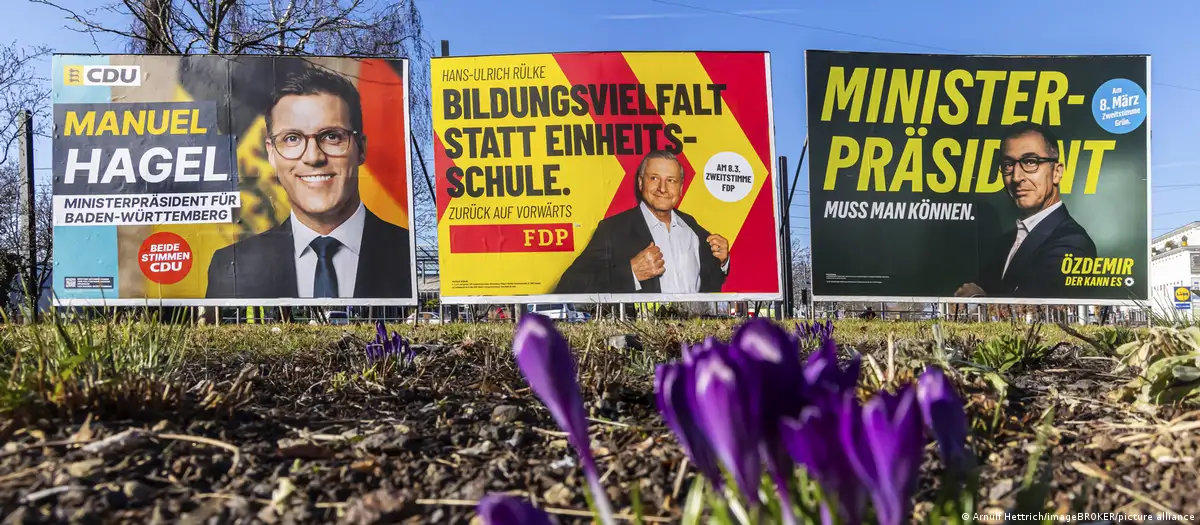
What you need to know
- The first of five state elections this year is being seen as a barometer of Chancellor Friedrich Merz's popularity
- A survey shows that many people in Germany are plagued by financial worries
- AfD's Weidel backs new state youth wing despite negative intelligence classification
- More vacationers return to Germany after Middle East stranding
These live updates have closed. Thank you for reading.
Below, you can review a roundup of news and human interest stories from Germany from Saturday, March 7, 2026:
WATCH: How a Jewish family's motorbike became a far-right symbol
Germany failed to carry out more than 60% of deportations in 2025
German authorities failed to carry out some 60% of all planned deportations in 2025 according to figures cited by the German dpa news agency.
Police speaking with dpa confirmed that 22,787 deportations were carried out in 2025, as opposed to 32,855 that were not.
Of all cases involving individuals not ultimately deported, some 11,184 had deportation requests cancelled, while bureaucratic hitches between state and federal authorities accounted for the cancellation of 21,341 deportations.
State interior ministers have sounded the alarm, saying the numbers have to change.
Among the suggestions being put forth now are the possible tracking of cellphones owned by individuals slated for deportation.
Hesse's Interior Minister Roman Poseck told the German newspaper Die Welt, that this "is not about putting everyone who is required to leave the country under general suspicion." He added that such measures would only be employed if authorities were unable to locate an individual slated for deportation.
Saxony's Interior Minister Armin Schuster seconded Poseck's plan, telling Die Welt that it would be even better if scheduled deportees were unable to go into hiding in the first place.
To that end, Schuster has called on the EU to allow member states use detention centers to detain people pending deportation.
Berlin demonstrators call for 'democracy in Iran'
Police in Berlin say that roughly 1,000 people showed up for a demonstration at the city's famous Brandenburg Gate on Saturday to call for democracy in the Islamic Republic of Iran as well as to honor the memory of those killed or imprisoned by Iran's hardline theocratic leadership.
Authorities say organizers had expected 2,000 demonstrators to attend the event. Police in Berlin say the event has remained peaceful.
German, US and Israeli flags adorned the speakers' stage on Saturday and many of those in attendance waved US and Israeli flags as well as Iranian imperial flags and placards bearing the image of Reza Pahlavi, the son of Iran's last shah, whose reign ended with he and his family fleeing the country during the 1979 Islamic revolution.
Pahlavi has repeatedly called for the overthrow of Iran's Islamic regime — from his US home — and has often been mentioned as a possible postwar Iranian leader.
Parties on far ends of political spectrum attract new members as centrists falter
The unpopularity of establishment political parties among German voters has translated into membership surges on the far left and far right of the country's political spectrum.
According to the German dpa news agency, the nation's largest parties — Friedrich Merz's Christian Democratic Union (CDU) and its Christian Social Union (CSU) Bavarian sister party, as well as their Social Democratic Party (SPD) coalition partners — all saw few voters join their parties in 2025 and even saw membership dwindle.
In contrast, new membership in the Left Party more than doubled over the year, jumping to 123,000 in December.
The far-right Alternative for Germany (AfD) also added to its membership rolls, with party treasurer Carsten Hütter telling DPA that his party had 73,108 registered members on January 1, 2026 — a jump of about 43% for the year.
The left-leaning Greens also saw an increase in membership, though theirs was not nearly as strong as the Left or AfD's. The Greens have steadily attracted a growing membership over the past decade and year-on-year growth from 2024 to 2025 was no different. The party saw its ranks grow to 184,000 during that time, an 18.3% increase.
Among coalition members, the CDU was the only party to expand its membership rolls, posting a 1.5% increase that brought total party membership to 132,000.
Satisfaction has been waning among German voters for some time. In December, an INSA poll commissioned by the German tabloid Bild found that 63% of voters held an unfavorable view of the governing coalition and 62% said they were dissatisfied with the job Chancellor Merz is doing.
More vacationers return to Germany after Middle East stranding
Altogether 640 passengers from the cruise ship Mein Schiff 4 arrived back in Germany from the Middle East on Saturday on two evacuation flights chartered from Oman by the ship's operator, TUI Cruises, a company spokesman said.
"More than 2,000 guests from the Mein Schiff 4 are now back home," said the spokesman.
He said that around 2,500 people were originally on board the ship.
Return flights are also being organized for around the same number of passengers on another company liner, Mein Schiff 5, also trapped in the region by the Middle East war.
He said it was not yet clear when those flights would take place.
The company operates eight ships under the Mein Schiff (My Ship) brand.
Tour operators said on Tuesday that tens of thousands of travelers from Germany had been stranded after Israel and the US attacked Iran last Saturday, triggering an ever-widening Middle East conflict that has led both to airspace closures and shipping disruptions. Many of them have since returned.
AfD's Weidel backs new state youth wing despite negative intelligence classification
The leader of the far-right Alternative for Germany (AfD) party, Alice Weidel, has said she stands behind a new youth wing of the party founded in North Rhine-Westphalia (NRW) despite its classication by domestic intelligence on Friday as a "suspected case" of right-wing extremism.
Weidel called the classification "another medal that we can pin to our lapel" in her remarks at the conference of the NRW chapter of her party in the city of Marl.
The NRW youth wing, named Generation Deutschland (Generation Germany), was founded only in January, succeeding another party youth organization, Junge Alternative NRW, which was also under observation for extremist tendencies and officially disbanded in 2025.
State domestic intelligence authories said on Friday that they see indications that Generation Deutschland has taken over many of the same members from the previous organization and is de facto a continuation of it under a different name.
The classification as "suspected case" means that Generation Deutschland's activities can be monitored by the domestic intelligence agency.
The AfD has said it will fight back against the decision, calling it "indefensible and partisan."
Germany gets first gold at Winter Paralympics
Skier Anna-Lena Forster has claimed the first gold medal for Germany at the Milan/Cortina Winter Paralympics, winning the women's para-alpine skiing downhill.
It is the fifth Paralympic gold medal of the 30-year-old's career, and her first in the downhill discipline.
Germany's Anja Wicker also won a bronze medal for her biathlon performance on what is the first day of the competition.
Surveys show rising AfD support ahead of Bavarian local elections
Voters in the southern German state of Bavaria will be choosing mayors and city and district councillors in an election on Sunday, with more than 10 million people eligible to cast a ballot.
Only women and men aged 18 and older will be able to vote, with Bavaria, Hessen, Rhineland-Palatinate, Saarland and Saxony the only of Germany's 16 states to not allow 16-year-olds a ballot in local elections of this kind.
Although the Christian Social Union (CSU) — the Bavarian sister party to the Christian Democrats (CDU) of Chancellor Friedrich Merz — has by far the biggest chances of winning, it will be the result gained by the far-right Alternative for Germany (AfD) party that will draw most attention.
In local elections six years ago, the party, which espouses a vehemently nationalistic, anti-immigration agenda, received only 4.7% of the vote, compared with 34.5% for the CSU and 17.5% for the Green Party.
Now, however, a new survey from broadcaster Sat. 1 has shown that the AfD, the strongest opposition force at the national level, could receive some 14% of the vote, making it the second-strongest party at the local level.
The Greens, in contrast, having achieved a record vote in 2000, were at just 10% in the survey.
The mayoral contest in the state capital of Munich is also likely to be followed with interest as Mayor Dieter Reiter of the Social Democrats (SPD) seeks a third term.
Reiter, 67, remains the favourite to win, though some scandals, including his use of the N-word at a council meeting on Wednesday — which he said was in a quote from the late musician Fredl Fesl — have clouded the last part of his campaign.
Final results might be some days in coming owing to the complexities of the voting system.
Merz rejects accusations of over-deference to Trump at Oval Office meeting
German Chancellor Friedrich Merz has defended his seemingly reticent behavior toward US Donald Trump during his visit to the White House in Washington this week, where some hoped that the German leader would express more criticism of certain of the US leader's actions.
"When the cameras are rolling, I'm not going to start arguing with the US president," Merz said at a campaign rally in the town of Stockach during a campaign event ahead of Sunday's state election in Baden-Württemberg.
Merz explained that he continued to focus on shared values in his dealings with the US in view of the fact that Europe "will remain dependent on the Americans for the time being" when it comes to defense.
Merz's talks with Trump at the White House centered on the war in Iran and trade issues amid the US president's unpredictable tariff policy.
'Europe must take its destiny into its own hands' — ex-Chancellor Merkel
Angela Merkel, who was Germany's leader from 2005 to 2021, has called on European countries to demonstrate a unified front amid the current array of global crises and war.
"Europe must take its destiny into its own hands more than ever," the conservative politician told some 400 guests at the annual St. Matthew's Day Banquet in Hamburg City Hall.
"This goes far beyond the aspect of security for me," she said, saying that a united Europe would mean one that stood up for democracy, the rule of law, human dignity, prosperity and jobs, while protecting external borders and cultural identity.
She also urged the EU to work toward becoming more independent in the digital sector.
Merkel also said she wanted the EU to support Ukraine in its fight against the Russian invasion both militarily and diplomatically.
The EU should "act both as a military supporter of Ukraine against the aggressor Russia — this is important and indispensable — but also to bring its diplomatic strength to bear in ending this war of aggression."
"This is about Europe's vital interests," she said, adding that both military and diplomatic efforts were needed so "that Russia does not win the war and thus Ukraine has a future as a sovereign state in peace and freedom."
The St. Matthew's Day Banquet (German: Matthiae-Mahl) is the world's oldest banquet still to be celebrated, the city of Hamburg said.
The day was considered the start of the business year in the Middle Ages.
One in four private households has no savings — survey
More than a quarter of households in Germany have no money set aside, despite a record growth in the overall wealth of private households, a new survey has shown.
Some 27% of 1,007 respondents in a survey conducted by polling institute Ipsos for ING bank said they had no financial cushion to fall back on, with half of those saying they did not earn enough to save anything.
Around one in five of them (22%) attributed their lack of savings to rising living costs.
A similar number (17.9%) said they had trouble sleeping because of financial worries, while more than a third (36.5%) said they agreed with the statement, "Because of my financial situation, I feel that I will never have the things in life that I want."
The result highlights the unequal distribution of wealth in Germany, where, according the central bank, the Bundesbank, around half is held by the richest 10% of households — roughly 4 million households — while about 20 million households hold just 8% of total financial wealth.
READ: Merz hopes for boost in state election
Sunday's election in Baden-Württemberg is the first of five state elections scheduled for this year.
Chancellor Friedrich Merz will be hoping that the result gives him the support he needs to push through reforms.
You can read more about the issues at stake in the election on one of Germany's wealthiest states here: German state election set to have far-reaching consequences
Merz faces popularity test in state election
Chancellor Friedrich Merz will doubtless watch Sunday's election in the southwestern state of Baden-Württemberg with some anxiety after the latest polls showed his conservative Christian Democrats (CDU) losing their monthslong lead.
If the Green Party, which has drawn level with the CDU in surveys, were to attain an unexpected third consecutive victory in the state, it would be seen as somewhat of an indictment for the German leader after 10 months in office.
The election seems nonetheless likely to confirm the state's current Green-CDU coalition government.
The Greens, with their lead candidate, former Agriculture Minister Cem Özdemir, were polling at 28% on Thursday to match the CDU, whose candidate, Manuel Hagel, has seen his support fade amid an uproar over controversial comments he made about schoolgirls eight years ago.
Özdemir is the favourite to take over the post of state premier from his party colleague Winfried Kretschmann, who has led the state since 2011, at first in a coalition with the Social Democrats (SPD), and then with the CDU since 2016.
Kretschmann, 77, who enjoys wide personal popularity across the political spectrum, will not be standing as candidate this time round.
On Friday, Merz made an appearance in the city of Ravensburg as campaigning drew to a close, stressing the importance of the election while conceding that it will be "closer than we thought."
Baden-Württemberg is one of the most prosperous states in Germany and a stronghold of the country's crucial carmaking industry.
Welcome to our Germany coverage
Guten Tag from the DW newsroom on the banks of the Rhine in Bonn!
You join us as Germany is set to kick off a year of multiple regional elections on Sunday, with voters to go to the polls in Baden-Württemberg, one of the country's biggest and wealthiest states.
The election seems likely to confirm the state's present coalition of conservative Christian Democrats and Greens, with surveys suggesting that Green candidate Cem Özdemir might have the edge over his CDU rival, Manuel Hagel, when it comes to choosing the state's premier.
The elections will be seen both as a test of CDU Chancellor Friedrich Merz's popularity after 10 months in office and a gauge of the strength of the far-right AfD party.
This comes as many in Germany say that they have no financial cushion to fall back on, either because they earn too little to save or because the rising cost of living is having an impact.
We invite you to read more about these and other stories from and about Europe's biggest economy on Saturday, March 7.