Germany news: Bundestag passes major drone deal
Published February 25, 2026last updated February 25, 2026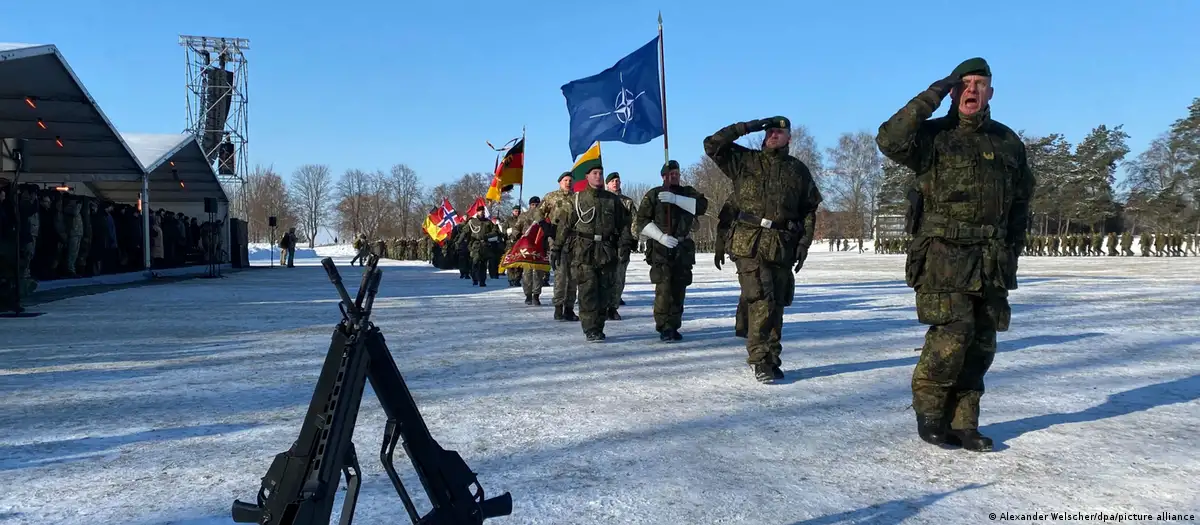
What you need to know
- Germany's Bundestag approved the major purchase of armed drones for its troops
- Some parliamentarians had been spooked by the fact that Trump/Vance-backer Peter Thiel is an investor in one of the companies set to deliver the weapons
- German Chancellor Friedrich Merz has arrived in China on a two-day visit that will touch on global security and economic partnership
This blog is now closed. Here are the headlines, reports and analyses from across Germany on Wednesay, February 25:
Bundestag passes resolution in support of Ukraine
The Bundestag, the lower chamber of the German parliament, reaffirmed Germany's support for Ukraine by passing a motion proposed by the ruling coalition of CDU/CSU and SPD.
The motion stated that Germany defends freedom, democracy, and the rules-based world order beyond its borders. "Accepting land grabs and violence in Europe would set a precedent for other states around the world to pursue revisionist or territorial expansionist policies," it said.
"We must achieve a lasting and just peace," Foreign Minister Johann Wadephul said, adding that Ukraine will only be able to achieve such a peace from a position of strength.
Against this backdrop, the Bundestag advocated providing Ukraine with sufficient weapons, ammunition, and equipment, as well as tightening EU sanctions against Russia to reduce Moscow's revenues, particularly from oil.
The opposition voted unanimously against the motion. The far-right Alternative for Germany (AfD) party and the Left Party accused the coalition of placing too much emphasis on the military aspect. The Green Party criticized the resolution for not going far enough.
German parliamentary committee passes EU asylum reforms
German parliament's Internal Affairs Committee passed two government draft laws for the implementation of a revamped EU-wide asylum policy, including one that will allow applicants to begin working sooner.
Another change will allow children and other young people to attend school within at most two months of filing an asylum application.
The number of asylum applicants in Germany has declined since mid-2023. Initial applications fell to around 113,000 last year from almost 230,000 in 2024.
The Common European Asylum System (CEAS) is expected to be fully implemented by June this year. The German parliament is to vote on the issue on Friday.
Germany should investigate Iranian crackdown on protesters, open letter argues
Prominent German-Iranian dual nationals are calling on German prosecutors to launch an investigation into the sweeping government repression against anti-regime protesters.
Mass protests swept Iran in January over worsening economic conditions and state failures, sparking calls for an end to the country's clerical leadership.
The government responded by suppressing those protests, with security forces opening fire on anti-government protesters.
In an open letter to Die Zeit newspaper released ahead of its publication on Thursday, writer Navid Kermani and around 70 other dual nationals pointed to a report by Time magazine suggesting that 30,000 people were killed by Iranian security forces on January 8 and 9 alone.
"These figures are considered realistic not only by human rights organizations, but also by the German government and other Western governments," the letter argues.
According to official figures, more than 3,000 people were killed in the unrest in Iran between late December and early January.
The signatories of the open letter argue that the killings are comprehensively documented by countless video recordings, eyewitness accounts, as well as information leaking out from within the state apparatus.
The letter suggests that the evidence points to a planned, nationwide campaign by the state leadership to break the Iranian people's desire for freedom.
"Those responsible for these inconceivable crimes must be held accountable," the letter argued.
Budget panel approves drone deal for Lithuania brigade
Germany's parliamentary Budget Committee has approved major contracts to equip the German military with thousands of combat drones made in Germany as part of deterrence efforts against Russia.
The committee approved a scaled-down scheme for the Bundeswehr, capping the overall framework well below the level originally sought by the Defense Ministry.
It cleared large-scale orders for defense startups Helsing, based in Munich, and Berlin-based Stark Defence.
The drones are intended for the Bundeswehr brigade stationed in Lithuania and involve so-called loitering munitions, unmanned aircraft that hover over a target until an operator orders an attack, either releasing explosives or crashing into the target.
The initial contract is valued at about €536 million (about $630 million), with an option to expand into the billions. Under a requirement set by Chief of Defense Carsten Breuer, the systems are to be operational in Lithuania by 2027.
The proposals were approved by the governing Union and SPD parties, while the Greens and the Left criticized the deal, particularly over the involvement of US investor Peter Thiel in Stark Defence. Thiel is known for his funding of far-right political candidates.
Far-right AfD rises to second place in Berlin poll
The far-right Alternative for Germany (AfD) has climbed to second place in a new poll ahead of Berlin's state election, marking the first time it has ranked so highly in the capital city-state.
An Insa survey for the daily Bild put the conservative Christian Democrat (CDU) of incumbent Mayor Kai Wegner at 22%, followed by the AfD at 17%. The center-left Social Democrats (SPD) stood at 16%, with the Greens and the socialist Left Party each at 15%.
The business-focused Free Democrats (FDP) and the populist left BSW were both below the 5% threshold at 4%, while other parties together accounted for 7%.
Based on these figures, the current CDU-SPD coalition would lack a majority. Potential alternatives could include three-party alliances such as CDU-SPD-Greens or SPD-Greens-Left.
Two other polls in January also showed the CDU at 22%, with the SPD, Left Party, Greens, and AfD clustered between 14% and 18%. All four parties are seeking to overtake the CDU in the September 20 vote.
In the 2023 repeat election for Berlin's state parliament, the CDU won 28.2% of second votes, ahead of the SPD and Greens at 18.4% each, with the SPD narrowly ahead. The Left Party received 12.2%, the AfD 9.1%, and the FDP failed to enter parliament with 4.6%.
Prosecutors drop case over Merz 'Pinocchio' remark
Prosecutors in Heilbronn have dropped proceedings against a Facebook user who called Chancellor Friedrich Merz "Pinocchio," citing freedom of expression.
The Heilbronn Prosecutor's Office said the remark qualifies as permissible criticism of those in power and is protected by free speech, adding that another case over the same term has also been discontinued.
The reference appeared under a local police Facebook post during Merz's October visit to Heilbronn, which drew nearly 400 comments. Authorities said 38 posts are still under review for possible criminal content.
Pinocchio first appeared in 1883 in a novel by Italian author Carlo Collodi and was later adapted into a 1940 animated film by Disney. The character is known for his nose growing whenever he lies.
The original police post related to a temporary flight ban imposed during the chancellor’s visit.
Merz is currently visiting China. Find out more about his visit here in our blog.
Germany unveils action plan against organized crime
Germany's government has approved a new action plan aimed at cracking down on organized crime by targeting money laundering, speeding up asset seizures, and strengthening coordination between authorities.
The Cabinet adopted the package on Wednesday, with Finance Minister Lars Klingbeil calling it a "gamechanger" in the fight against crime.
Under the plan, assets such as luxury cars and villas suspected of coming from dubious sources can be seized more quickly, with potential suspects required to prove they were legally acquired. Klingbeil said the goal is to hurt criminals financially while reinforcing public trust in the rule of law. Interior Minister Alexander Dobrindt added that authorities are hitting organized crime "where it hurts most — in the pocket."
Customs authorities and the Federal Criminal Police Office will be able to access each other’s data and analyze it using artificial intelligence. Investigators will receive expanded digital powers to scan large datasets with AI to better identify suspects.
Two workers killed in wind turbine fall in Hesse
Two workers have died after falling from a great height inside a wind turbine under construction in eastern Hesse.
Police said the two 32-year-old men were working in a suspended basket near the top of the turbine tower in Birstein when it plunged to the ground early Wednesday morning.
Emergency services were alerted after colleagues heard a loud impact and called police, but officers said medical help came too late as both men were apparently killed instantly.
The wind farm site in the Main-Kinzig district is still under construction.
Authorities said it remains unclear why the work basket fell, and that an expert has been tasked with reconstructing the sequence of events and determining the cause.
Police investigators, along with forensic officers, firefighters, and rescue services, responded to the scene near a national highway.
German labor market shedding engineering and car manufacturing jobs
Germany's Institute for Employment Research (IAB), part of the Federal Employment Agency (BA), released its latest employment barometer on Wednesday, warning that "the manufacturing sector is currently losing 15,000 per month."
IAB projections are based on three-month trends in Federal Employment Agency data. The BA will present its final February employment numbers on Friday.
The greatest number of job losses came in the mechanical engineering and automotive sectors.
"Overall employment is holding steady but the trend is being weighed down by the crisis in industry," said Enzo Weber, an IAB researcher.
Wednesday's announcement marked the first time since last July that the IAB forecast dropped into negative territory, falling 0.5 points below its neutral 100-point benchmark.
Police conduct nationwide raids over online far-right hate posts
German police have carried out coordinated operations across all 16 states targeting suspected far-right hate and incitement crimes on the internet.
The Federal Criminal Police Office (BKA) in Wiesbaden said the actions were based on about 140 investigations, mainly involving social media posts that allegedly included incitement to violence against refugees, images of Hitler salutes and swastikas, and other potentially criminal content.
Authorities conducted house searches, issued police summonses, and visited suspects to secure evidence from mobile phones early on Wednesday. Slightly more than half of the cases are linked to the far-right spectrum, with others involving left-wing and isolated religious or foreign ideologies.
The BKA cited suspected offenses including incitement to hatred, the use of symbols of unconstitutional or terrorist organizations, approval of criminal acts, and insults.
In Hesse, the state criminal police said 10 suspects are accused of calling for physical violence and serious injuries against others or endorsing killings by shooting or poisoning. The posts were mainly directed at people with disabilities, political opponents, or refugees.
Businessman jailed over mask deal tax evasion
A Munich court has sentenced a businessman to nearly six years in prison for tax evasion linked to multimillion-euro coronavirus mask deals.
The Munich II Regional Court handed the 39-year-old a five-year, 10-month sentence for tax evasion in nine cases, illegal possession of a firearm, and obtaining false official identification documents.
The ruling followed a plea agreement after the defendant confessed in court. It is not yet legally binding. The court also ordered repayment equivalent to the evaded taxes from the defendant and associated parties.
Judges said the man, from Gauting in Upper Bavaria, procured five million FFP2 masks for the Federal Health Ministry in 2020 and delivered them for about €22 million ($26 million).
However, he underreported the income in his tax return and underpaid taxes by €10.7 million.
According to the presiding judge, the defendant’s desire for recognition and lavish lifestyle led him down the wrong path.
When he was arrested, police found a loaded revolver, ammunition, and two forged Slovenian ID documents in his possession.
German deficit grows despite meagre economic upturn
Germany's federal deficit grew by nearly €4 billion ($4.7 billion) in 2025, according to data released by the Federal Statistical Office on Wednesday.
The jump brings Germany's overall deficit for federal, state and local governments as well as social security funds, to €119.1 billion.
The ratio of debt to GDP remained unchanged from 2024, at 2.7%.
That number is lower than the EU's 3% limit but overall spending growth outpaced social security and tax revenues, pushing the deficit beyond a prior 2.4% estimate.
Interest and social security payments were the biggest drivers according to government data, chief among expenditures was pension spending.
Germany's Bundesbank says 2026 will see the debt-to-GDP ratio jump to 4.5% as a result of increased infrastructure and defense spending made possible by constitutional exemptions to the mandatory debt limit.
Federal Statistical Office data showed fourth-quarter GDP growth in 2025 to be 0.3% and overall annual growth 0.2%. This helped Germany avoid a third consecutive year of recession.
"This meant that the economically volatile year 2025 ended with an increase in economic output," said Federal Statistical Office President Ruth Brand.
University cuts 'damaging Berlin's cultural standing'
Students and teachers at one of Germany's most prestigious arts universities, the UdK, are devastated as vital arts courses have been hit by budget cuts.
Many feel that the heart is being cut out of the city.
Read DW's full report on the cuts to Berlin's major arts university.
Heiner Wilmer is the new chief Catholic bishop in Germany
The number of Christians in Germany is declining, and society is divided.
However, Heiner Wilmer, the new chairman of the German Catholic Bishops' Conference, is calling for unity and dialogue.
Read DW's full report on the new top representative of the Catholic Church in Germany.
Criticism after coalition ditches environmental home heating law
After months of negotiations, Germany's ruling CDU/CSU/SPD coalition has announced its intention to change heating laws pushed by the previous SPD/Green/FDP government.
The presentation of the new Building Modernization Law (Gebäudemodernisierungsgesetz in German — yes, one word) late Tuesday incensed opposition parties as well as environmental groups who blasted it as a "climate betrayal" and "a gift to the fossil fuel industry."
The initial law, which went into effect in 2024 and required at least 65% of all new home heating systems to operate with renewables, will now be watered down to instead foster the installation of new oil and gas heating systems.
The coalition says the new law will do away with the finicky bureaucracy of the old law pushed by then vice chancellor and economy minister, Robert Habeck, and give homeowners the freedom to keep their existing heating systems.
The law would also do away with requiring individual heating systems to tie in to communal thermal heating systems.
Greens, for instance, say the law simply maintains German "dependence on gas and oil — and with that, autocrats."
Critics say renters will be most impacted by the change, as these would be "chained to expensive and outdated gas infrastructure" subject to rising gas and network fees.
According to the proposal presented on Tuesday, oil and gas systems will eventually be required to burn bio-methane, synthetic methane, bio-oil, hydrogen or hydrogen derivatives.
The Bund für Umwelt und Naturschutz Deutschland (BUND), a Friends of the Earth-allied NGO, called it "irresponsible to sell this sham as environmental protection."
Although the paper contained few details, critics also hammered the proposed changes for dooming Germany's chances of hitting its own climate neutrality targets.
The government claims "Germany will be climate neutral by 2045, including in the housing sector."
The coalition says the Cabinet will approve the bill by Easter and it will go into effect on July 1.