Germany news: Most expect AfD state premier after elections
Published May 30, 2026last updated May 31, 2026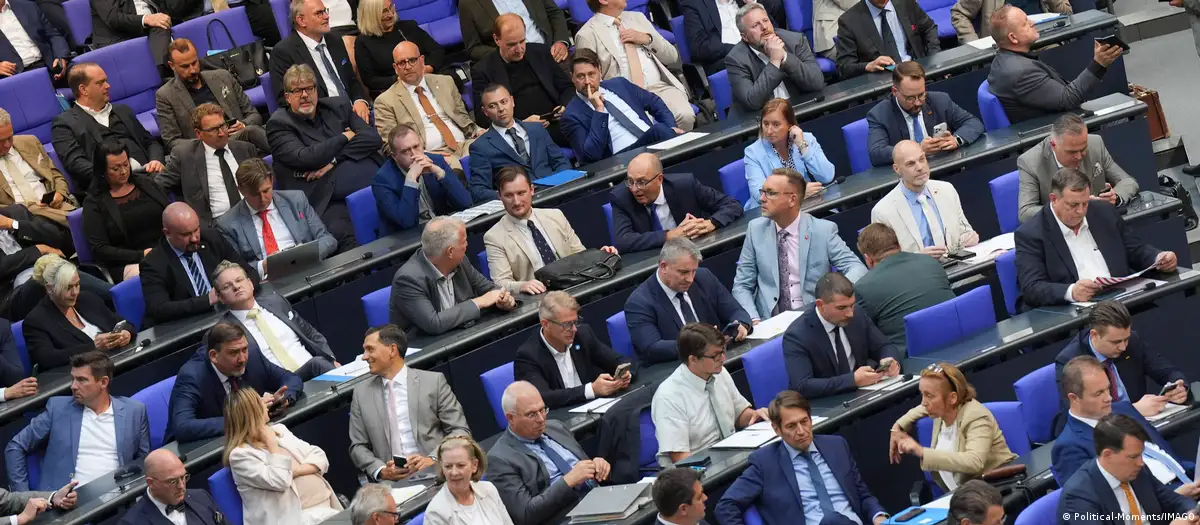
What you need to know
- A majority of people in Germany expect the far-right AfD party to lead at least one state after regional elections in the fall
- The Brenner Pass, a major Alpine route, has reopened after a closure due to a rally against traffic jams and noise pollution
- Autopsy to be carried out on 'Timmy' the whale after the corpse was brought to shore in Denmark
Here is a roundup of stories from and about Germany on Saturday, May 30, and Sunday, May 31, 2026:
Tired of missing our real-time updates? Click here to add us as a Preferred Source on Google. Then tap the "Star" or "Preferred" to keep DW News at the top of your feed.
German representatives to return to Putin's economic forum
Members of Germany's business community are set to officially attend the economic forum in the northern Russian city of St. Petersburg in early June after staying away for four years over Moscow's invasion of Ukraine.
The forum has been held under the auspices of the Russian president since 1997.
Its program says that German participants will include Stefan Dürr, a dairy producer operating in Russia with the EkoNiva Group, and Thomas Bruch, the longstanding managing director of Globus Holding.
Matthias Schepp, chairman of the German-Russian Chamber of Commerce, defended the attendance by German businesspeople to the dpa news agency.
"Not least with a view to the period following a ceasefire, we want, like other major Western countries, to maintain the economic bridge to Russia and protect the more than €100 billion ($116 billion) of German assets in Russia," he said.
"The West should not leave Russia, its large market and its raw materials to Asia in the long term," said Schepp.
US and French representatives returned to the event last year to take part in its so-called business dialogue component.
Western sanctions on thousands of Russian companies, organizations and individuals over the Ukraine invasion are still in place, with the trade volume between Germany and Russia falling beneath €10 billion ($11.66 billion) last year.
That compares with a volume of €59.7 billion in 2021 and €80 billion at its peak in 2012, making Germany Russia's biggest trading partner in the European Union before the invasion launched in 2022.
Organizers said that several German representatives will also be attending an event about culture as way of building connections in times of crisis.
They include the conductor and pianist Justus Frantz, the founder of the popular Schleswig-Holstein Music Festival, who in 2025 received an Order of Friendship from Russian President Vladmir Putin.
The chairman of the Saxony branch of the far-right Alternative for Germany (AfD), Jörg Urban, the Berlin publisher Holger Friedrich and the filmmaker and journalist Hubert Seipel are also expected to attend.
Vote on future Hamburg Olympic bid underway
Hamburg is holding a referendum on Sunday, with voters asked to say whether they are in favor of the northern city-state bidding to host the Olympic Games in 2036, 2040 or 2044.
Some 1.3 million people from the age of 16 can cast a ballot.
Hamburg is in competition with Munich, Berlin and the Rhine-Ruhr region, all three of which want to make a bid.
The decision on who will bid and for which year will be made by the German Olympic Sports Confederation on September 26.
The unofficial final result is expected by 10 p.m. (2000 GMT).
In 2015, Hamburg's plan to bid for the 2024 Olympics was canceled after a referendum in which just over half of voters cast a "no" ballot.
Germany hosted summer Olympics in 1936 in Berlin and in 1972 in Munich.
One injured after explosion at Cologne shisha bar
An explosion at the entrance to a shisha bar in the inner city of Cologne early on Sunday morning was deliberately caused, police believe.
They said all guests had left the bar by the time the blast went off.
A female tenant in the apartment above the bar suffered slight injuries from smoke inhalation and was treated in hospital, they said.
Witnesses said they saw several people who had caused the explosion fleeing the scene.
Firefighters called to the bar managed to extinguish a fire caused by the blast, but police said there had been severe damage to the front of the premises.
Police are investigating the cause of the explosion.
Majority expects at least one far-right state premier after fall votes — survey
A majority of people in Germany expects a premier from the far-right Alternative for Germany (AfD) party to take office in at least one of the three states holding elections this fall.
According to the survey from the INSA polling institute conducted for the weekly Bild am Sonntag newspaper, 69% consider this a given.
Of those, 28% expect an AfD premier in not just one but several states.
Just 16% think that the AfD will not succeed in taking power in at least one state, with 15% undecided.
If the AfD fails to win an absolute majority, 40% of respondents wanted to see cooperation between the center-right Christian Democrats (CDU) and the Left Party to form a state government, as against 36% in favor of CDU/AfD cooperation.
This tendency is clearer among conservative voters, 48% of whom would prefer the CDU to cooperate with the Left Party as against 27% in favor of the CDU working with the AfD.
Altogether 38% were in favor of banning the AfD — which has long been under scrutiny by the domestic intelligence agency for possible extremist tendencies — while 47 % were against a ban.
State elections are to take place in Saxony-Anhalt, Mecklenburg-Vorpommern and Berlin in September.
Welcome back
Danke schön for coming back to our coverage of the latest stories from Germany after our overnight pause.
We will possibly be returning to our big story about the protest at the Brenner Pass on Saturday, with authorities expecting traffic through the corridor to resurge massively after a day's closure.
Sunday in Germany is also the day when newspapers tend to print results of various surveys giving insights into the trends sweeping German society, so our blog will include several of these.
Please read on for more news from Europe's biggest economy.
We're pausing our coverage
We'll be pausing our coverage of the news coming out of Germany this weekend, but we'll be back bright and early on Sunday morning.
All lanes open at Brenner Pass after large protest
The Brenner Pass linking Austria and Italy has been reopened following a rally against heavy traffic.
"All lanes are open again," a spokesman for the motorway operator Asfinag told the DPA news agency.
Thousands of people had crowded the Alpine pass earlier on Saturday, demanding an end to pollution, noise and traffic jams caused by heavy traffic on the key road.
While officials warned of possible traffic jams due to the rally, no major disruptions were reported in the area.
Police said 219 trucks were turned back during the hourslong protest.
IN DEPTH: Vaping becoming more popular among young people in Germany
A recent study shows that e-cigarettes are becoming increasingly popular among young people in Germany, with even elementary school kids picking up vapes. Social media influencers are fueling the hype, but a senior government official hopes to ban flavors that appeal to young people.
Read our full report here.
Thousands protest new gas-fueled power plants in Germany's Hamm
Some 5,000 people took part in a protest in the northwestern German city of Hamm against government plans to construct new gas-fueled power plants, protest organizers said on Saturday.
Police estimated the number of attendees at around 2,700 people.
Germany's ambitious strategy of switching to renewable energy sources and becoming climate-neutral by 2045 has been put under increasing pressure due to the geopolitical conflict with Russia and the more recent disruption in the Strait of Hormuz.
In response to the twin crises, the government is focusing on ensuring consistent energy supply rather than managing the long-term transition. Some climate activists have decried the shift as a quiet rollback of the official environmental goals.
The government has now pledged to construct new gas-powered plants, which would eventually be fueled by environmentally friendly hydrogen.
Even so, activists in Hamm say the state should not be investing in fossil fuels. Several environmental groups, including Fridays for Future and Greenpeace, helped organize the protest on Saturday.
"We want future, not gas, and we are joining forces against the government's rollback of climate policy," the organizers said.
Thousands protest rising traffic in Brenner region
Several thousand people gathered at the Brenner Pass on Saturday to protest against the growing amount of traffic using the transport corridor, which links northern and southern Europe.
Demonstrators in the Austrian town of Matrei am Brenner carried signs reading "Enough is enough" and "Peace in the valley," while calling for measures to reduce the adverse effects of heavy traffic on residents' health and well-being.
Some protesters also criticized the delayed planning of the rail access line in Germany's southern state of Bavaria, which is intended to relieve congestion on the motorway.
Karl Mühlsteiger, the mayor of the nearby municipality of Gries am Brenner, called the number of demonstrators "sensational."
Authorities in Austria and Italy have temporarily closed the Brenner corridor to through traffic on both sides of the border.
So far, however, no major traffic disruption has been reported. Motorists were urged to avoid non-essential travel because of the planned protest.
However, a fire on a railway line north of Verona in Italy disrupted train services along the Brenner corridor, with authorities still unclear as to the cause.
The Brenner corridor is expected to remain closed on the Austrian side of the border until 7 p.m. (1700 GMT). On the Italian side, restrictions are in force until 8 p.m.
Among other things, the Brenner Pass is often used by holidaymakers from Germany wanting to vacation in southern European countries such as Italy.
According to motorway operator Asfinag, nearly 11 million cars and around 2.5 million trucks used the toll motorway in 2025, making it the busiest link from north to south in the Alps.
Steinmeier urges commitment to democracy at historic Hambach event
German President Frank-Walter Steinmeier has called for renewed civic engagement to protect democracy at commemorations of the Hambach Festival.
The 1832 event at Hambach Castle, in the state of Rhineland-Palatinate, is seen as a key milestone in Germany’s democratic tradition, where participants demanded Germany unity, freedom and democracy.
Speaking in the town of Neustadt an der Weinstrasse, Steinmeier said defending democracy is "our shared responsibility" and praised widespread grassroots initiatives across the country.
The president said citizens must counter pessimism and actively support democratic values, highlighting the role of volunteers, associations and civil society.
He warned against leaving the legacy of the Hambach Festival to those who oppose democratic principles, calling that a betrayal of history.
The far-right Alternative for Germany has frequently attempted to politically appropriate the historic festival to frame itself as a contemporary defender of German patriotism and free speech.
IN DEPTH: Germany's Havertz set for second Champions League final
Millions of eyes across Europe will be trained on television screens on Saturday night for the climax of the European football season, the UEFA Champions League final.
Holders Paris Saint-Germain take on recently-crowned English champions Arsenal in Budapest, and former Leverkusen and German international Kai Havertz is likely to feature for the London side.
His performance will be closely watched by Germany coach Julian Nagelsmann, with the World Cup in the US, Canada and Mexico just weeks away.
DW's Jonathan Harding has this to say about the 26-year-old football star and the hopes Germany is pinning on him: Kai Havertz: Arsenal and Germany's man for the big moment
'More Merz' is needed, not less — Hesse's state premier
Two prominent politicians from Chancellor Friedrich Merz's Christian Democratic Union (CDU) have rejected media speculation that there have been discussions within Germany's conservative CDU/CSU bloc on a possible change in leadership.
The premier of the western state of Hesse, Boris Rhein, told a local party congress: "We don't need less Merz: We need more Merz."
Rhein warned his party not to play the game of the political opposition with what he called rumors.
"We are the majority, we are the center, we are Merz," he said to applause.
At the same congress, the leader of the CDU's parliamentary group, Jens Spahn, called the speculation "nonsense."
In a speech, Spahn pointed to what he said were successes of the conservative-led coalition government.
Merz was a chancellor who was ready to get his hands dirty and who had a clear sense of what direction to go in to reform Germany and rebuild its economy.
"And he has our full support in this," he said.
Their statements come after media reports saying that the CDU/CSU was possibly considering replacing Merz in view of the coalition's current troubles.
The reports mentioned Hendrik Wüst, the CDU premier of the state of North Rhine-Westphalia, as a potential replacement for Merz.
People close to the chancellor have vehemently denied the reports.
Germany, France step up nuclear deterrence talks
Germany and France have begun talks on closer cooperation in nuclear deterrence, according to a report.
The news magazine Der Spiegel said Chancellor Friedrich Merz's security adviser Günter Sautter held initial discussions in Paris with several partner countries.
The report said the Bundeswehr could take part in the conventional component of French nuclear exercises for the first time as early as September.
The move follows a joint initiative by Merz and French President Emmanuel Macron to deepen cooperation on deterrence, including the creation of a bilateral steering group.
While Berlin did not confirm details of the Paris meeting, a government spokesperson described the process as ongoing, with further steps expected.
France has proposed expanding its nuclear deterrence role in Europe, including joint exercises and potentially deploying nuclear-capable aircraft in allied countries.
AfD pushes for state-run migration enforcement
The far-right Alternative for Germany (AfD) in the northeastern state of Mecklenburg-Western Pomerania has drawn up election campaign plans calling for state-level migration enforcement.
Delegates adopted a program calling for a "dedicated border and repatriation police force within the state police."
The party also proposes setting up a detention facility for deportations and tightening controls on migration at the regional level.
The plans go beyond current state powers in Germany, where immigration policy is largely handled at the federal level.
The AfD is also seeking to end funding for certain migration-related groups and introduce stricter conditions tied to political neutrality.
It also wants renewed use of the Nord Stream gas pipelines and is opposed to wind power expansion.
Meanwhile, the program calls for a return to nuclear energy and the abolition of CO2 taxation.