Germany news: Merz aiming for Poland defense agreement, 2026
Published December 1, 2025last updated December 2, 2025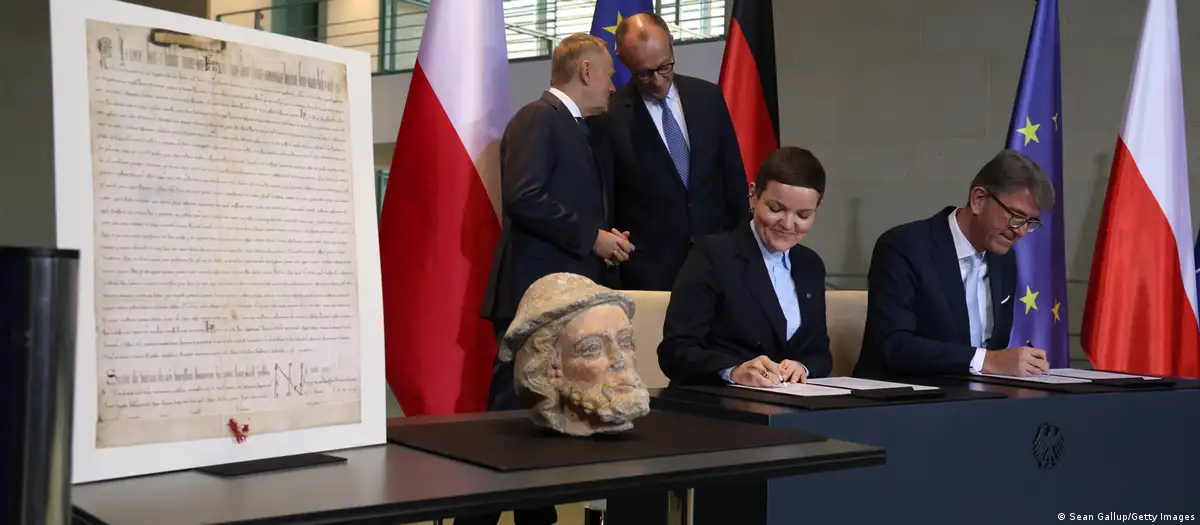
What you need to know
German Chancellor Friedrich Merz and Polish Prime Minister Donald Tusk have led intergovernmental talks in Berlin.
The two European leaders said they were aiming to sign a defense collaboration agreement between their two nations next year. Tusk also used the opportunity to push for German support for victims of Nazi crimes in Poland during World War II.
The meeting comes amid an increasingly negative opinion of Germany in Poland, with only a third of Poles saying they feel sympathy for their neighbors.
Meanwhile, a survey has shown 16% of Germans are worried of being replaced by AI.
This blog, with the latest headlines, analysis and background from Germany on Monday, December 1, is now closed.
Child rescued from burning home in Berlin dies
German authorities confirmed the death of a child who was rescued from their house that caught fire on Monday evening.
Authorities have not confirmed their age or gender, saying only that the child was treated by paramedics but succumbed to their injuries at the scene.
Firefighters said they responded to a fire that broke out at a single-family home in eastern Berlin, but that the ground floor and the roof were already engulfed in flames when they arrived.
The search for the child proved difficult because a wooden staircase had been destroyed, forcing firefighters to reach the upper floor using portable ladders before bringing the child out.
Around 70 personnel were deployed, and the blaze was extinguished later in the evening. The cause of the fire remains under investigation.
Poland, Germany prepare to sign defense collaboration agreement in 2026
Berlin and Warsaw are working toward a defense collaboration agreement due to be signed next year, Germany's Chancellor Friedrich Merz announced on Monday, as he met Polish Prime Minister Donald Tusk in Berlin.
"We have instructed our ministers to prepare an agreement on defence collaboration," Merz said at a press conference alongside Tusk, adding that they aimed to finalize it to coincide with the 35th anniversary of the Polish-German partnership agreement next year.
German reparations to Poland over Nazi crimes
Tusk used the meeting to renew calls on Berlin to support the surviving victims of Germany's Nazi occupation of Poland during World War II.
"Hurry up if you really want to make this gesture," Tusk was quoted as saying, adding that the number of surviving victims was declining every year.
Merz steered clear of going into details.
"I ask for your understanding that we cannot disclose any figures at this point. But please rest assured that the federal government, which I lead, is very aware of its historical responsibility toward our neighbor Poland and that we will continue to hold talks with each other," the German chancellor said.
The issue of German reparations to Poland has long been a source of tension between the two neighbors. Berlin argues the issue was legally settled in a 1953 agreement, but Warsaw believes the agreement is void as it was made during Communist rule and under Soviet pressure.
While Tusk's center-left government has dropped calls for reparations, it still expects a gesture toward the survivors of the Nazi occupation.
Young conservatives continue to oppose pension reform package, despite pressure
A group of young conservative lawmakers in the Bundestag is threatening to vote against a pension reform bill which is supported by the leaders of the current German governing coalition.
German Chancellor Friedrich Merz of the conservative Christian Democratic Union (CDU), Markus Söder of the CDU's sister party the Christian Social Union (CSU), and Finance Minister Lars Klingbeil of the center-left Social Democratic Party (SPD) reached a deal last week to back the package.
However, the Junge Gruppe (Young Group) — 18 young CDU/CSU lawmakers in the German parliament — has emerged as a pivotal force in Germany’s pension reform debate and raised concerns that the package would put more costs on the backs of young people.
Young Group: We consider pensions package 'not acceptable'
After days of pressure from and one-on-one talks with party leaders, they reaffirmed their opposition to the current package: "We, the Young Group, consider the pensions package not acceptable. That remains the case."
But crucially, they signaled they will decide individually rather than follow coalition discipline.
Their statement stresses balancing coalition harmony with long-term fiscal stability, effectively rejecting the idea that party unity should override personal responsibility.
This is significant: under previous chancellors, when the government had a bigger majority in parliament than Friedrich Merz and the Social Democrats have (12 votes), deviations from party lines were rare and usually reserved for moral issues, such as same-sex marriage (then-chancellor Angela Merkel voted against legalizing it, but parliament adopted the bill nevertheless in 2017, also with conservative votes).
Test vote on pension package expected Tuesday
Now, the young conservatives are asserting independence on a core policy matter, challenging Germany’s consensus-driven political culture.
With the CDU/CSU–SPD coalition holding only a 12-vote majority, every decision counts. The upcoming test vote on Tuesday in the parliamentary group may not only determine the fate of the pension law but also serve as a measure of Friedrich Merz’s authority within his own ranks and — ultimately of his leadership as chancellor.
German Aerospace Center offers €23,000 for 100-day isolation study
Six participants are being sought for a space travel study that would see the individuals isolated together for 100 days.
The study, SOLIS100, is being carried out in Cologne by the German Aerospace Center (DLR) and the European Space Agency (ESA), set to start in early 2026.
Participants are being offered €23,000 (around $26,700) and must be aged between 25 and 55, be physically fit, have a high school diploma, and have a good command of English.
Applications are open until December 12 for those who are interested.
The study aims to look at the effects of isolation on health, performance and well-being. The participants will have to complete tasks together, exercise and look after the station.
"Future space missions will leave the Earth's orbit and aim for much further targets like the moon or Mars," DLR's Amelie Therre said.
"Missions to the moon and to Mars demand psychological and physical resilience, independence, and the ability to survive in isolated and confined environments," she added.
German export losses to US to diminish in 2026 — report
Tariffs introduced by the Trump administration led to losses for companies relying on exports to the US all over the world, with Germany, a highly export-oriented economy, suffering particularly hard.
On Monday, the federal economic development agency Germany Trade and Invest (GTAI) said it expects the losses in 2026 to be lower.
"[F]ollowing the sharp decline in 2025, the loss is likely to be smaller" next year, GTAI said.
EU member states are facing a complex array of new tariffs, with customs duties of 15% applied to most goods, but exemptions for some sectors such as the car industry.
GTAI said it expects German exports to the US to fall by around 8% to 9% this year.
The agency expects the US to remain Germany's most important export market — German companies sold €161.4 billion ($187.8 billion) in 2024 — despite a weakening labor market and rising inflation that will likely stifle consumption in the coming year.
GTAI also warned that some importers had not yet passed on the tariff costs to their customers but are "likely to do so in 2026."
1 in 6 German workers worried about job losses due to AI
A 16% share of German employees are worried that their jobs may be at risk because of artificial intelligence (AI), according to a labor market survey carried out by career platform Xing.
Some 2,000 workers took part, with almost a third saying they believed AI would replace some human employees.
Younger participants were more likely to believe that AI would create more jobs.
A study from the German Institute for Employment Research (IAB) predicted that AI will likely cause upheavals in the job market, but the total number of jobs is expected to remain stable.
Family business association takes back AfD invitation
The German association for family businesses, "Die Familienunternehmer" (FU), has reversed course on a planned parliamentary evening to which representatives of the far-right Alternative for Germany (AfD) had been invited.
FU President Marie-Christine Ostermann said on Sunday evening that the invitation had been a "mistake" and that "the opposite of what we wanted happened."
In October, the far-right party was invited to join the event for the first time. In response, several member companies left the association in protest.
Ostermann said they had wanted to express to the AfD representatives that their program was bad for the economy, but that the AfD had used the invitation to imply that the association supported them.
"The opposite is true: we distance ourselves from extremists and won't let ourselves be taken in by them," Ostermann said.
The two main ruling coalitiong parties, the CDU and SPD, welcomed the reversal from the FU.
Economist Achim Truger, who is also an advisor to Finance Minister Lars Klingbeil, remained critical of the FU.
"It's a mystery to me how the FU could be so naive as to honestly hope for something positive for the economy from the AfD," he told the Handelsblatt newspaper.
German summer air travel up, still behind 2019 high
The number of air passengers flying from German airports in summer 2025 was up by 4.6% on the previous year, but still lagged slightly behind the pre-pandemic record reached in 2019, according to the German Federal Office of Statistics (Destatis).
Here are the key data points:
- 68.5 million passengers counted departing from German airports between April and October
- 4.6% more than the same period in 2024, but 2.8% below the 2019 record
- domestic flights fell 0.7% to 5.3 million, 54.9% lower than in 2019
- Spain was the most popular destination with 10.5 million passengers, 1% above the 2019 level
- Turkey came second with 7.7 million passengers, up 33.7% from 2019
- the USA was the most popular for intercontinental flights, with 4.5 million passengers, however, this number was down 1.4% from summer 2024
The fall in travel to the US may come down to anti-migration policies introduced by the Trump administration that saw several Germans detained at US airports and subjected to aggressive interrogation.
The rise in passenger numbers in general comes as the German coalition government has agreed to reduce some airline taxes in an attempt to boost the airline industry that has fallen behind its European competitors. Passenger numbers in the EU already surpassed the 2019 highs last year.
Research from the European Commission has warned that increasing air travel is a threat to the EU's goals of reaching net-zero emissions.
German arms companies benefit from Ukraine war
Last year, 2024, was a bumper year for arms manufacturers, especially those in Germany, according to a report by the Stockholm International Peace Research Institute (SIPRI).
German arms companies saw some of the highest growth, reaching 36%, just behind Japanese companies.
"It's almost all linked to Russia's invasion of Ukraine," said SIPRI author Nan Tian.
"There has been an increase in demand from the German armed forces. Whether it's Rheinmetall or Diehl, building tanks, armored personnel carriers, ammunition, of course, for the German armed forces to replenish what they've sent to Ukraine as military aid, but also to expand their number of tanks, infantry fighting vehicles, etc."
Read the full story on how the Ukraine war has boosted profits for the arms industry.
German soldiers reportedly take part in Polish response to Russian fighter jets
The German military, stationed in Poland, reportedly joined in a Polish response after Russian MiG-31 jets were detected flying toward the border on Friday.
Polish jets were deployed and two German Patriot air defense systems at Rzeszow airport were activated, with German air force soldiers involved, according to the German newspaper Bild.
"On Friday, there were activities in Russian air space and air defense systems deployed in Poland reponded, including the air force's two Patriot systems," an air force spokesperson told Bild.
Merz hosts German-Polish intergovernmental talks in Berlin
Polish Prime Minister Donald Tusk is bringing several of his Cabinet members to Berlin on Monday for talks with their German counterparts.
German Chancellor Friedrich Merz is set to receive the Polish delegation with military honors ahead of talks throughout the afternoon.
The talks are expected to focus on support for Ukraine, the NATO alliance and regional security, and economic relations between the two EU neighbors. The two sides are expected to sign a joint declaration following the talks.
High expectations for the talks may prove difficult to meet.
Merz stressed the importance of German ties to Poland, making a trip to Paris and Warsaw shortly after becoming chancellor in May. At the time, Tusk said he was "optimistic" about relations, but little has happened since then.
Polish opinions of Germany have reached a 25-year low, with only a third expressing favorability toward their neighbor and a quarter holding negative opinions, according to a recent survey cited by German public broadcaster Tagesschau.
The far-right in Poland has beat the drum over mistrust toward Germany. Under the former right-wing PiS government, the German-Polish intergovernmental talks were suspended.
The topic of German responsibility for the Nazi crimes of the Second World War has also soured relations. Poland's far-right President Karol Nawrocki has repeatedly called for reparations, something that has been rejected by Merz as well as German President Frank-Walter Steinmeier.
While Tusk's center-left government has dropped its calls for reparations, it still expects a gesture toward the survivors of the Nazi occupation.
Welcome to our coverage
Grüße from the newsroom in Bonn, where the Christmas markets are in full swing.
Today's top story is expected to be intergovernmental talks between German and Polish ministers in Berlin, lead by Germany's Chancellor Friedrich Merz and Poland's Prime Minister Donald Tusk.
And in case you missed it, our top stories from Germany over the weekend were the German Agricultural Minister Alois Rainer calling on Sunday for the protection of food production to be included in future Bundeswehr drills, and massive protests against the new youth organization of the far-right Alternative for Germany (AfD) party on Saturday.