Germany news: 13 million living at risk of poverty
Published February 3, 2026last updated February 3, 2026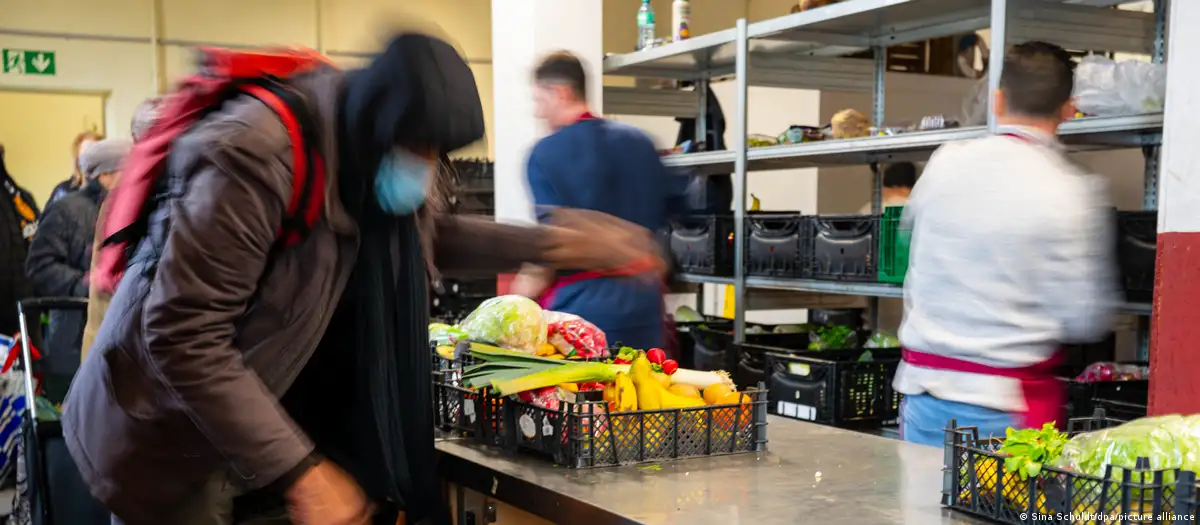
What you need to know
- 13.3 million people in Germany are living at risk of poverty, according to a new report
- The Interior Ministry has questioned whether the AfD's new youth wing is more moderate than its predecessor
- Germany has established diplomatic ties with the Pacific Island of Niue
- 40,000 military service questionnaires have already been sent out, Defense Minister Boris Pistorius has said
This blog has now closed. Read below to find out what people are talking about in Germany on Tuesday, February 3:
Indian trade deal provides opportunity for German carmakers
Up until now, German cars have barely penetrated the Indian market despite success elsewhere.
Could the new EU-India trade deal be a game changer for the struggling sector?
Read DW's full report on how the Indian trade deal could benefit the German car industry.
Police arrest 2 over sabotage of Navy ships
Two men have been arrested on suspicion of attempted sabotage on several German Navy corvettes at Hamburg port, the Hamburg public prosecutors' office said on Tuesday.
A 37-year-old Romanian man and a 54-year-old Greek man were arrested in Hamburg and Greece, respectively.
They are accused of having risked significant damage to the vessels while working at Hamburg port last year. It is believed that they put 20 kilograms of blasting grit into the engine block of one of the ships, punctured fresh water supply lines, removed fuel tank caps and deactivated safety switches on the ship's electronics.
The prosecutors' office said the acts of sabotage could have led to significant damage or delayed departure if they had gone unnoticed, with further ramifications for Germany's security.
Several agencies were involved in the case, including the European judicial authority Eurojust in the Hague and the Hamburg State Criminal Police Office as well as Greek and Romanian police.
Investigators are looking into who may have contracted the suspects to carry out the acts of sabotage.
Siemens to invest $1B in US energy production
The German company Siemens Energy is planning to invest $1 billion (€850 million) in the US energy production sector amid a surge in electricity demand.
Chief executive Christian Bruch said: "The Trump administration has made energy security, a reliable and resilient grid, and growing US manufacturing jobs a priority. This has supercharged the energy demand which is supporting new investments across the energy sector."
The increase in demand comes as data centers pop up across the country to feed the AI race.
The company plans to boost services, transformer production and large gas turbine production. The expansions will focus on sites in North Carolina, Alabama, New York, Texas and Florida.
It is also planning to build a new factory in Mississippi and recruit more than 1,500 highly skilled workers.
Merz greets Carnival groups in Berlin as 'fifth season's' peak nears
German Chancellor Friedrich Merz addressed around 140 representatives from Carnival groups around the country in Berlin, as the culmination of what is known as the "fifth season" in German approaches.
Merz praised the Carnival or Karneval groups as "a piece of our country's culture," and said they showed "how lively traditional clubs are and how exuberantly we can celebrate."
Merz's address was a little late, having been scheduled for 11:11 a.m., with November 11 the official start date of the Carnival season and many parades and other events timed for an 11:11 start. Perhaps Germany's busiest politican greeted the group at twelve minutes past the hour.
Merz noted his own personal connection to the date, having been born on November 11, 1955, and said he often had the opportunity in his youth to "celebrate my birthday with truly pleasant amounts of schnapps."
The chancellor said that the work of Carnival groups was all the more important in times of war, crisis and uncertainty, "because our clubs are places of togetherness, of diversity and above all of tolerance."
"Democracy is lived here," he said.
The peak of the Carnival season is the week leading up to and including "Rose Monday," which this year falls on Monday, February 16, before the start of the Christian festival of Lent on the following Wednesday.
40,000 military service questionnaires already sent out
The German Bundeswehr has sent out a total of more than 40,000 questionnaires to 18-year-olds across the country as part of its push to increase troop numbers, Defense Minister Boris Pistorius said on Tuesday.
"Yes, it's working, and we've already received many questionnaires back," Pistorius said at a training facility in Roth, in the state of Bavaria.
The coalition government agreed to send questionnaires as a compromise between those pushing for a return to compulsory military service and those who opposed such a move.
All 18-year-olds receive one of the questionnaires, with men being obliged to fill them out. It is a first step in assessing suitability and motivation to serve in the armed forces.
Pistorius said he was confident about being able to recruit 20,000 volunteer soldiers for military service by the end of the year, pointing to the 25,000 new soldiers recruited in 2025.
"That is an increase of 23% over the previous year and the best recruitment result in 12 years, a real trend reversal," he said.
Germany is seeking to increase its troop numbers from 180,000 to 260,000, with an extra 200,000 in reserve forces in response the threat posed by Russia.
Reporters Without Borders reports 55 attacks on journalists in Germany
The press freedom watchdog Reporters Without Borders (RSF) said in a newly published report on Tuesday that there had been 55 verified attacks on journalists in Germany in 2025.
Although this is less than the 89 verified incidents in 2024, the organization pointed to another 99 attacks in 2025 that could not be confirmed due to a lack of witnesses or video evidence.
RSF said that the majority of documented cases came from the far-right scene in Germany, with journalists covering pro-Palestine demonstrations reporting the second-highest number of attacks.
German police were also responsible for several acts of violence against journalists, despite their duty to allow journalistic reporting at protests.
RSF also pointed to the polarized media scene in Germany in regards to reporting on Israel and Gaza. While there were cases of journalists at demos being physically assaulted, the report also pointed out that journalists were under immense pressure, with accusations of antisemitism against those reporting on Israel's war in Gaza often leading to self-censorship.
Germany has oldest workforce in Europe
Nearly a quarter of the German workforce is aged between 55 and 64, according to data from the EU's Eurostat, published by Germany's Federal Statistics Office (Destatis) on Tuesday.
Of the 40.9 million people aged 15 to 64 who were working in 2024, 9.8 million were in the highest age bracket. That's equivalent to 24%.
Based on this data, Germany has a higher share of its workforce in the 55-64 bracket than any other EU country. The bloc-wide average was 20.1%.
Germany has an aging population and workers are retiring later on average. According to data from the German Pension Insurance Fund, the average age of retirement has gone up from 63 two decades ago, to 64.7 in 2024.
The current German government has introduced a new "active retirement" scheme to encourage people to stay in work beyond the statutory retirement age as it seeks to keep vacancies filled. The scheme allows employees to keep €2,000 ($2,361) per month tax-free if they stay in their jobs.
Germany establishes diplomatic ties with Pacific island Niue
German Foreign Minister Johann Wadephul has officially set up ties between Germany and the South Pacific island nation of Niue during a visit to New Zealand.
Wadephul met with Niue Prime Minister Dalton Tagelagi in Auckland, where the two signed a joint declaration.
Niue is a self-governing island with a population of around 1,700 and a size of roughly 260 square kilometers.
"It's a special experience for me to be able to attend this ceremony today," Wadephul said during a meeting with his New Zealand counterpart Winston Peters.
The recognition of Niue "shows the appreciation that Germany has for this country, the importance that we give to the right of self-determination, the importance that we give to the Pacific islands," Wadephul said, adding that the islands are under particular threat from climate change.
But why is Germany showing such interest in a small Pacific island? There are two main reasons.
Germany is giving a signal to the region that it is ready to offer support and to counter China's growing influence. Berlin is also seeking a non-permanent seat on the United Nations Security Council and while Niue is not a UN member, Pacific islands can play a big role in voting.
WATCH: Is Germany's gold safe in New York?
Germany's gold reserves have been stored in the US for decades. Some think they should be brought back.
With US President Trump breaking up the rules-based world order, they fear he could seize the gold.
AfD's new youth wing seen as continuation of extremist predecessor
The youth organization of the far-right Alternative for Germany (AfD) party, which was founded in November last year, has shown no signs of moderating its stance relative to its dissolved predecessor, according to the German Interior Ministry.
The new youth wing, known as Generation Deutschland (GD), replaced the Junge Alternative (JA) that had been classified as a proven right-wing extremist organization by Germany's domestic intelligence agency. The AfD even cut ties with JA over its repeated controversies, but the GD is officially integrated into the party.
The Interior Ministry's remarks came as a response to a question from the Green Party in the Bundestag.
The ministry said it knows of links between GD and other extremist groups and that statements made by its leaders at the GD founding event signalled that the group did not intend to moderate its stance.
Some remarks at the founding meeting of the GD indicated "efforts to undermine the free democratic basic order,” the ministry said.
It cited speeches that gave an ethnic definition of the German nation and demands for the legal discrimination of Germans with a migrant background.
More than 13 million in Germany at risk of poverty
A new report published by the Federal Statistics Office (Destatis) on Tuesday has revealed that 13.3 million people in Germany are at risk of poverty.
That's equivalent to 16.1% of the population and marks an increase from the share of 15.5% in 2024.
The figures come from the EU's Statistics on Income and Living Conditions (EU-SILC). The EU defines "at risk of poverty" as living on less than 60% of the median equivalent income — a value that splits the population in half based on weighted household incomes.
The threshold for people living alone in Germany was a net income of €1,446 per month ($1,710). For a household with two adults and two children younger than 14, that value was €3,036.
Certain groups are more likely to be living at risk of poverty:
- People living alone — 30.9%
- People in single-parent households — 28.7%
- Unemployed people — 64.9%
- Those out of work — 33.8%
- Retirees — 19.1%
No single methodology can give an accurate picture of the poverty and at-risk levels in any country, as people's unique conditions vary.
The EU-SILC also looks at the number of people threatened by poverty and social exclusion which takes into account the above data as well as households impacted by significant material and social deprivation, and households with low employment rates.
Based on this methodology, 17.6 million people in Germany were threatened by poverty and social exclusion in 2025, equivalent to 21.2% of the population. However, this was almost unchanged from the previous year.
Welcome to our coverage
Guten Morgen from a wet and dreary Bonn.
We are expecting the five suspects who were arrested on Monday on suspicion of violating sanctions against Russia to appear in court today and we will be looking into a new report about poverty in Germany.
German Chancellor Friedrich Merz is also expected to host a carnival reception at the Chancellery in Berlin, which will hopefully provide some interesting pictures.
For this and more, keep reading.