Ukraine updates: 'Ukraine's fate is our fate' says Merz
Published February 24, 2026last updated February 25, 2026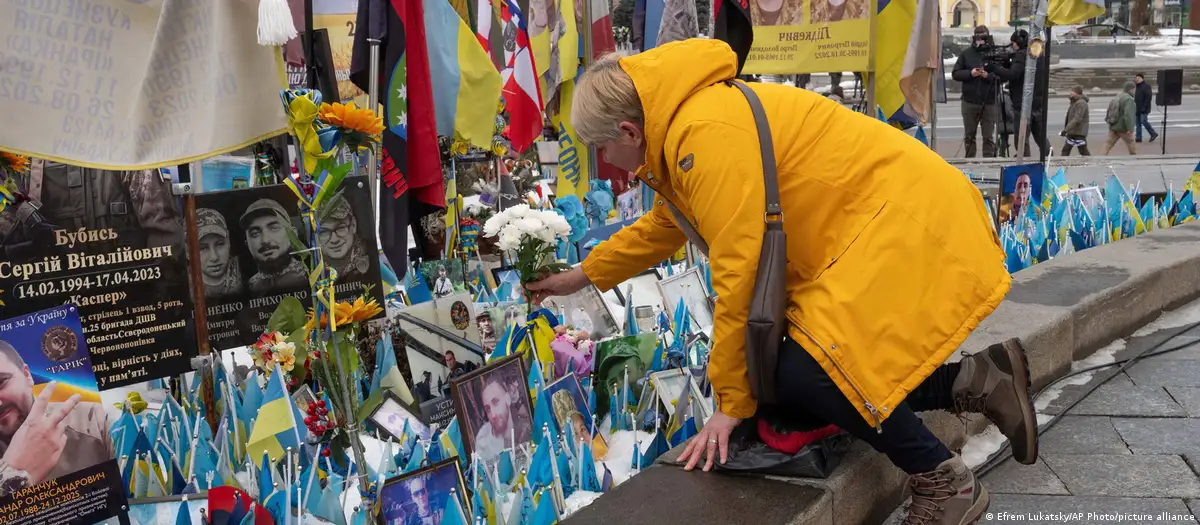
What you need to know
- Tuesday marks four years since the beginning of the Russian full-scale invasion of Ukraine
-
EU leaders travel to Ukraine to commemorate the fourth anniversary of the war
-
Russian authorities say an explosive device detonated near a train station in Moscow
It was the roundup of the latest headlines, background and analysis from Russia's war in Ukraine on Tuesday, February 24. This blog is now closed.
UN says Ukraine war is 'a stain on our collective conscience'
UN Secretary General Antonio Guterres reiterated calls for a ceasefire in the war between Russia and Ukraine, saying the conflict remained "as a stain on our collective conscience."
Guterres' remarks were read on his behalf by Rosemary DiCarlo, the UN under-secretary-general for peacebuilding.
"We have witnessed the cascading consequences of this blatant violation of international law," Guterres said.
He commended US efforts to end the war, but added concrete measures were needed to de-escalate and create space for diplomacy.
The UN chief warned that the fighting posed direct risks to the safe and secure operation of Ukraine's nuclear sites.
"This unconscionable game of nuclear roulette must cease immediately," he added.
WATCH: Ukraine marks four years of war with Russia
Europe's deadliest conflict since World War II has upended the international order, while efforts to bring about an end to the fighting appear to have stalled.
Ukraine's president says his country remains unbroken.
Zelenskyy rejects repairing the Druzhba pipeline
Ukrainian President Volodymyr Zelenskyy said that repairing the Druzhba pipeline, which is crucial for Russian oil deliveries to EU states Hungary and Slovakia, was unnecessary. He argued that the Russian military was deliberately targeting repair crews.
"So for what? To renovate for what? To lose people. I mean, I think this is a very big price," Zelenskyy said at a joint press conference with European Commission President Ursula von der Leyen and European Council President Antonio Costa in Kyiv on Tuesday.
Zelenskyy said Hungarian Prime Minister Viktor Orban should seek an energy ceasefire from Moscow to solve the problem.
"Russia destroyed these pipelines several times," the Ukrainian president said.
"But it can't be so that, for example, Russia destroys, Ukraine renovates," he added.
Zelenskyy added that Russian should have no place on the European market.
The Druzhba pipeline has caused tensions between Hungary and Ukraine, with Orban opposing to EU financial aid for Ukraine over interruptions in the flow of Russian oil to his country.
EU lays out plan to protect Ukraine from winter energy crisis
European Commission President Ursula von der Leyen unveiled a plan to strengthen Ukraine's energy supply dubbed "Repair, Rebuild, Restart."
Von der Leyen spoke about the plan during a visit to Kyiv to mark the fourth anniversary of the start of Moscow's war on Ukraine.
It all comes as Ukraine has sought help from what it says is the worst energy crisis in its history this winter from targeted Russian attacks on infrastructure, with millions of people affected by prolonged power and heating outages.
"We have seen four years of extraordinary courage from your soldiers and your citizens, whose bravery will echo through history. This will never be forgotten," Von der Leyen said in a joint statement with the president of the European Council, Antonio Costa.
Von der Leyen said the plan would be backed by more than €920 million ($1.08 billion) to ensure a reliable power supply across Ukraine in the winter of 2026-27.
"It will secure the steady flow of electricity across the country. It will accelerate the decentralized production of renewable energy," the statement read.
Von der Leyen added that for immediate assistance this winter, a new package worth more than €100 million would be available immediately.
Germany treats over a thousand of Ukraine's wounded
After four years in Russia's invasion of Ukraine, some 1,700 wounded in the war, including soldiers, have traveled to Germany for treatment, the German Health Ministry said.
The patients have been distributed to various clinics with some €25 million ($29 million) in public funds allocated for their care, the ministry said.
"The willingness to help Ukraine remains high, including in the health sector." Health Minister Nina Warken said.
"We continue to stand firmly by Ukraine's side," she added.
According to the World Health Organization, more than 2,800 health care facilities have been targeted in the war.
Germany's Health Ministry said it had also provided Ukraine with medical supplies, including protective suits, ventilators, and disinfectants.
WATCH: 11‑year‑old victim of Ukraine war shares his story in US
In Ukraine, four years of war have taken a tremendous human toll.
DW met one young survivor of a Russian attack who travelled to the United States to lobby for continued American support for his country.
Slovakia says Russian oil to flow back this week
Slovakia said that shipments of Russian oil via the Druzhba pipeline that passes through Ukraine were expected to resume on Thursday, a statement by the Slovak government said.
It all comes after Slovak Prime Minister Robert Fico said his country would halt emergency electricity supplies to Ukraine until Kyiv reopened the Druzhba pipeline that brings Russian oil to Slovakia and Hungary.
"The latest date announced for the resumption of shipments was delayed to February 26," the ministry said in a statement.
The Slovak government said that it had not received an explanation from Ukraine explaining the delay in resuming shipments.
Ukraine previously said the pipeline was damaged January 27 by Russian strikes.
The EU imposed a ban on most oil imports from Russia in 2022 due to Moscow's attack on Kyiv, but the Druzhba pipeline was exempted to give landlocked Central European countries time to find alternative oil supplies.
Since then, Slovakia and Hungary continue to depend on Russian energy and they have both sharply criticized the cut in oil deliveries.
Hungarian Prime Minister Viktor Orban had also blocked both a 90-billion-euro ($106-billion) EU loan to Ukraine as well as a fresh round of sanctions on Russia until Kyiv re-opens the oil pipeline.
WATCH: Russia enjoyed impunity for decades, Ukrainian activist tells DW
Four years ago, Russia started its invasion of Ukraine.
Oleksandra Matviichuk, founder of the Ukrainian "Center for Civil Liberties" and 2022 Nobel Peace Prize Laureate, speaks to DW about the human toll of the war.
UN adopts motion saying Ukraine must not be divided; US, Hungary abstain
The UN General Assembly has adopted a motion put forward by Ukraine supporting the country's international borders and voicing concern over intensifying Russian attacks on civilians and critical energy infrastructure, but without support from the United States.
The motion is in no way binding but does carry political weight and was seen as a gauge for international support for Ukraine.
It passed with 107 votes in favor, 12 against and 51 abstentions, as well as just over 20 countries that didn't participate.
Predictably, Russia led the minority voting against, joined by its close allies Belarus and North Korea, as well as by Iran, Niger, Sudan and others.
Two NATO members, Donald Trump's US and Viktor Orban's Hungary, abstained, while the rest of the military alliance and the European Union voted in favor.
Another Security Council veto holder, China, abstained in the vote, as did India and Pakistan, the Gulf states, Brazil, South Africa, Serbia, and multiple post-Soviet Central Asian and Caucasian states, among others.
Ukraine denies Russian claims on nuclear weapons
Ukraine called Russian claims that Kyiv was trying to obtain nuclear weapons "absurd."
Russia's Foreign Intelligence Service (SVR) accused the UK and France of seeking to secretly supply Ukraine with nuclear weapon parts and technology. The SVR did not provide evidence for the claim.
"Russian officials, known for their impressive record of lies, are once again trying to fabricate the old 'dirty bomb' nonsense," Heorhii Tykhyi, spokesperson for the Ukrainian Foreign Ministry, told Reuters news agency.
"For the record: Ukraine has already denied such absurd Russian claims many times before, and we officially deny them again now. We urge the international community to reject and condemn Russia’s dirty information bombs," Kyiv said.
G7 leaders pledge 'unwavering support for Ukraine'
Leaders of the G7 group of advanced economies said they reaffirmed their "unwavering support for Ukraine" in a statement on the fourth anniversary of Russia's invasion.
US President Donald Trump was included in the declaration.
"We express our continued support for President Trump's efforts to achieve these objectives by initiating a peace process and bringing the parties to direct discussions. Europe has a leading role to play in this process, joined by other partners," the leaders of the US, Britain, France, Germany, Italy, Canada and Japan said.
"We acknowledge that only Ukraine and Russia, working together in good faith negotiations, can reach a peace agreement," the statement read.
As Ukraine finds itself in the midst of a brutal winter of fighting, the G7 said it has provided financial support along with "critical equipment" in recent weeks such as generators and turbines to aid the country's energy supplies.
The group said that since January, "more than half a billion euros of new pledges were made to the Ukraine Energy Support Fund to purchase equipment to repair and protect the Ukrainian energy system."
How Ukraine's war effort against Russia has evolved
From traditional ground combat to survival in positions within the "kill zone" under constant drone surveillance, how has Ukraine's war against Russia changed over the past four years?
Read DW's full report on the evolution of the war in Ukraine since February 2022.
WATCH: Four years into the Ukraine War, how has Russia changed?
While the fighting in Ukraine continues, the impact on Russia itself is becoming harder to ignore.
Prices are rising, growth is slowing — yet Vladimir Putin's grip on power appears firm.
Russia says it will brief US on its nuclear allegations
The Kremlin's foreign policy adviser, Yuri Ushakov said Russia will brief the US on allegations from its security services that France and Britain intend to share nuclear weapons technology or components with Ukraine.
Russia's Foreign Intelligence Service (SVR) first made the claim on Tuesday, without providing any evidence.
"Of course, we will specifically discuss this with the Americans," Ushakov was cited by Russian news agency TASS as saying.
He made the comments when asked if the allegations would alter Russia's position in negotiations.
Meanwhile, Russia's Foreign Ministry on Tuesday issued a statement using much more vague wording warning of the risks of a direct conflict between nuclear powers, without making clear if it was trying to make a connection with the government's other unsubstantiated claims.
"We once again warn of the risks of a direct military confrontation between nuclear powers and, accordingly, of its potentially dire consequences," the mnistry said.
After the collapse of the Soviet Union, Ukraine demolished what at the time was the world's third-largest nuclear arsenal — a remnant of the Soviet era over which it had no operational control — in exchange for security guarantees from Russia and other nuclear powers.
UK's Starmer pledges support 'for as long as it takes for a just and lasting peace' in Ukraine
UK Prime Minister Keir Starmer wrote online that he had a simple message for Ukrainians on the fourth anniversary of Russia's invasion: "Britain is with you."
"Today we are stepping up military, humanitarian and reconstruction support and we will support Ukraine for as long as it takes for a just and lasting peace," Starmer wrote. "Russia will not win this war."
Meanwhile, Starmer's office was asked by reporters in London about Russian allegations that the UK and France were working to supply Ukraine with nuclear weapons of some kind, calling it a "falsehood" seeking to distract from Russian casualties in a slow-movingground campaign with high losses.
"This is a clear attempt by [Russian President] Vladimir Putin to distract from his heinous actions in Ukraine. There is no truth to this," Starmer's office said.
Starmer briefed his Cabinet on Tuesday about the almost 300 new sanctions targeting various Russian people and companies. He said the measures would impact Russian drones, banks and its nuclear and gas power industries. He also said that British voters were still feeling the affects of the war, not least in the prices they pay for energy.
"These are still 40% higher than they were before," he said. "So, every family is feeling it. And how and when this conflict ends is going to affect everybody in the United Kingdom for a very long time, which is why it is so important we make sure that it's a just and lasting peace."