Iran war: Israel, Lebanon hold direct talks in US
Published April 14, 2026last updated April 15, 2026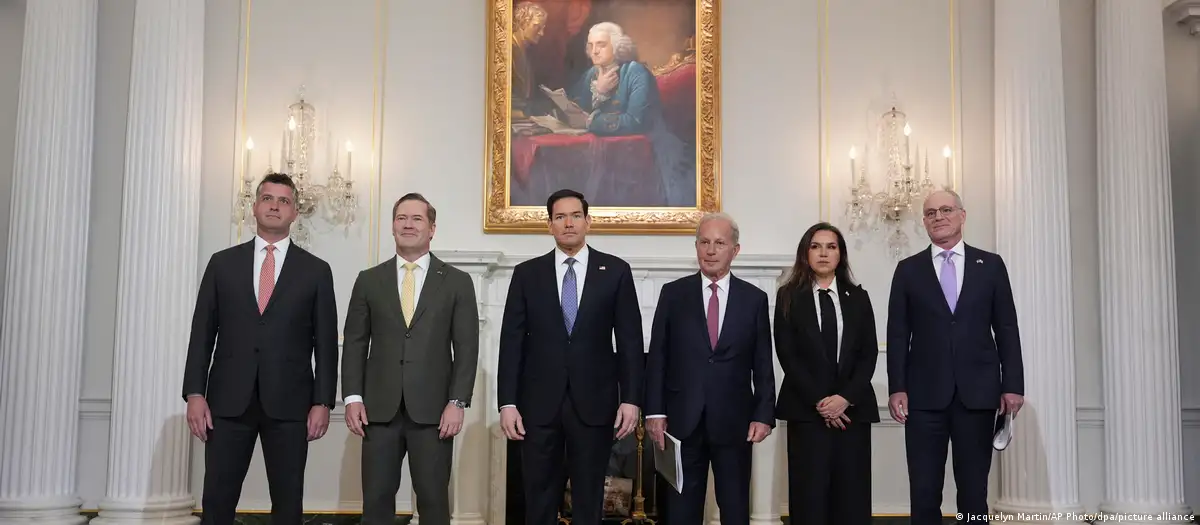
What you need to know
- Israel and Lebanon have agreed to further direct negotiations after first face-to-face diplomatic talks since 1993
- US military says no ships passed its Strait of Hormuz blockade, despite reports to the contrary
- Trump slams ally and Italy PM Meloni as lacking 'courage' for not joining Iran war, voicing criticism
- UN Secretary General Guterres says US-Iran peace talks likely to resume, Trump hints at same
This live blog on US-Israeli war with Iran and the wider conflict in the Middle East for Tuesday, April 14, 2026 is now closed.
For the latest Iran news in our new Wednesday blog, click here.
Vance: US will make Iran 'thrive' if they commit to no nukes
US Vice President JD Vance has said that mistrust between Iran and the United States can't be resolved overnight.
But Iranian negotiators wanted to make a deal, he said on Tuesday evening during a Turning Point USA event in Georgia.
President Donald Trump suggested earlier on Tuesday that talks between Iran and the US to resolve the conflict could resume in Pakistan within the next two days.
Vance, Trump's vice president, led the US delegation in the first round of talks last weekend. The talks ended in apparent failure after less than a day.
On Tuesday, Vance said he felt "very good about where we are."
"There is a lot of, of course, mistrust between Iran and the United States of America. You are not going to solve that problem overnight," Vance said.
Vance also said that Trump didn't want to make "a small deal."
"He wants to make the grand bargain, Vance said, adding that Trump is telling Iran, "If you guys commit to not having a nuclear weapon, we are going to make Iran thrive."
US military claims no ships passed Strait of Hormuz amid US blockade
In a Tuesday social media post on X, US Central Command (CENTCOM) claimed, "no ships made it past the US blockade and 6 merchant vessels complied with direction from US forces to turn around to re-enter an Iranian port on the Gulf of Oman."
That claim was disputed, however, by the Wall Street Journal, which reported that more than 20 commercial vessels had sailed through the Strait of Hormuz during that time.
US says it will not renew waiver for Iranian oil
The US Treasury Department on Tuesday announced that it would not renew a 30-day temporary sanctions waiver on Iranian oil crude and other petroleum products.
"The short-term authorization permitting the sale of Iranian oil already stranded at sea is set to expire in a few days and will not be renewed," read a statement.
The initial waiver allowed the delivery and sale of product loaded onto ships before March 20. It will expire on Sunday, April 19.
The Treasury said the decision to let the waiver lapse — a reversal of Trump administration efforts to lower skyrocketing global oil prices by giving Iran and Russia sanctions relief despite being international troublemakers — was designed to exert "maximum pressure" on Tehran and force it to relinquish its chokehold on global oil markets.
Additionally, the Treasury notified authorities in China, Hong Kong, the UAE and Oman that banks operating in each are thought to have facilitated illicit Iranian financial transactions.
The US is seeking cooperation with those nations in clamping down on such activity.
"My hope is for your swift action to identify and stop any illicit activity linked to Iran to avoid further action," US Treasury Secretary Scott Bessent informed them in the letter.
Lebanese ambassador called for 'ceasefire' and right of return during 'constructive' talks
In a statement, Lebanon's Ambassador to the US Nada Hamadeh Moawad said that talks with her Israeli counterpart and US Secretary of State Marco Rubio on Tuesday had been "constructive."
The ambassador said she had "called for a ceasefire" during the meeting as well as demanded that displaced Lebanese citizens be allowed to return to their homes.
She also said she underscored "the full sovereignty of the state" over all Lebanese territory.
Southern Lebanon has been under heavy attack for weeks and more than one million residents have been forced to flee due to heavy Israeli bombardment.
Some radical Israeli politicians have called for the annexation of parts of Lebanon.
US says Israel, Lebanon have agreed to new, direct negotiations
Israel and Lebanon have agreed to further direct talks as a result of Tuesday's two-hour, US-led trilateral exchange with both countries' ambassadors to the US, according to a US State Department statement.
"The participants held productive discussions on steps toward launching direct negotiations," said a spokesman, who added, "All sides agreed to launch direct negotiations at a mutually agreed time and venue."
Israel and Lebanon 'on the same side' versus Hezbollah
In a statement to reporters after Tuesday's historic talks between Israel and Lebanon, Israeli Ambassador to the US Yechiel Leiter said: "We discovered today that we're on the same side of the equation. That's the most positive thing we could have come away with."
Leiter said both sides want to see the destruction of the Iran-backed Shiite militant group Hezbollah.
"The Lebanese government made it very clear that they will no longer be occupied by Hezbollah," said Leiter, who added, "Iran has been weakened. Hezbollah is dramatically weakened. This is an opportunity."
Leiter praised his Lebanese counterparts for their cooperation despite pressure from Hezbollah to boycott.
Leiter highlighted several areas of consensus but made clear that Israel needs to see Lebanon "completely" separate itself from Tehran and Hezbollah.
Trump hints at second round of US-Iran talks
US President Donald Trump has said a second round of peace talks between the United States and Iran could take place in the coming days.
"You should stay there, really," Trump told the New York Post newspaper in reference to Pakistan, "because something could be happening over the next two days, and we're more inclined to go there."
An initial round of talks hosted by Pakistan over the weekend failed to produce an agreement to end the current conflict between the warring nations.
Pakistan has earned praise for its efforts and proposed hosting a second round of talks.
US officials on Monday told AP news agency that discussions were underway as to the location and timing of negotiations, and that Islamabad and Geneva were being considered as potential host cities.
Israeli Ambassador to Germany defends Merz against tirade from far-right Smotrich
Israeli Ambassador to Germany Ron Prosor vigorously defended German Chancellor Friedrich Merz on Tuesday, calling him "a great friend of Israel."
Prosor's words came after Merz was verbally attacked by far-right Israeli Finance Minister Bezalel Smotrich for speaking out against possible de facto Israeli annexation of the occupied West Bank.
Speaking on Holocaust Remembrance Day, Ambassador Prosor acknowledged, "It is possible and entirely legitimate to argue with the Germans," but he said he took issue with Smotrich's attack, which made references to Nazi Germany.
Prosor said such behavior is, "exactly what undermines the memory of the Holocaust and presents things in a completely distorted light."
UN boss says US-Iran peace talks likely to resume
United Nations Secretary-General Antonio Guterres on Tuesday said all indications so far point to the resumption of peace talks between the US and Iran amid a tenuous two-week ceasefire.
Guterres, who on Monday called for a renewal of talks that broke down this weekend, said it was highly probable that new talks would start soon.
The UN boss also singled out Pakistan on Tuesday, praising the "constructive role" Islamabad played in facilitating Saturday's negotiations and its efforts to foster regional peace and stability.
'Historic opportunity' for peace as Israel, Lebanon hold talks in US
US Secretary of State Marco Rubio on Tuesday encouraged Israel and Lebanon to seize what he called a "historic opportunity" for peace as both countries' ambassadors to the US met for the first face-to-face diplomatic talks since 1993.
"The hope today," said Rubio, "is that we can outline a framework upon which a current and lasting peace can be developed."
The US is pushing ally Israel to wrap up military operations against Iran-backed Hezbollah militants in southern Lebanon so that it can concentrate on bringing an end to the war the US and Israel launched against Iran on February 28.
Lebanon's President Joseph Aoun on Tuesday expressed hope that the talks would "mark the beginning of the end of the suffering of the Lebanese people."
Thousands of Lebanese citizens have been killed, thousands more injured and over a million have been displaced since the conflict began. There has been much discussion over whether Lebanon should be part of a two-week ceasefire between the
United States, Israel and Iran.
Hezbollah has rejected all dialog with Israel and reportedly stepped up attacks on northern Israel as Tuesday's talks got underway.
Trump slams ally and Italy PM Meloni as lacking 'courage'
A day after Italian Prime Minister Giorgia Meloni condemned US President Donald Trump's breathless attacks on Pope Leo XIV over the weekend as "unacceptable," Trump turned his fire on his far-right European ally in Italy's Corriere della Sera newspaper on Tuesday.
On Monday, a day after Trump published a long social media rant criticizing Leo as "weak" for calling for peace, Meloni said it was "right and normal" for the leader of the world's 1.4-billion-plus Catholics to call for an end to the killing of innocent people.
Trump, who has been angered by allies and their lack of enthusiasm for his war in Iran told the paper, "I'm shocked at her. I thought she had courage, but I was wrong."
Italians have begun to sour on ties with the US and Israel since the two launched their war on Iran and observers say Meloni may be repositioning herself to reflect that sentiment by the time voters head for the polls next year.
Italy recently denied the US access to a shared base in Sicily as the US ramped up attacks on Iran yet failed to inform allies until after the fact.
Last week, the vehicle of Italian UN peacekeepers in Lebanon was damaged by Israeli fire.
IMF downgrades global growth forecast in 2026
The International Monetary Fund (IMF) on Tuesday downgraded its forecast for global growth by 2 percentage points from earlier January projections, warning that the world economy could be "thrown off course" by war in the Middle East.
In its first update to forecasts since the start of the US-Israeli war on Iran and the consequent energy crisis, the IMF projected global growth of 3.1%, as opposed to its earlier projection of 3.3%. In 2025, economic expansion stood at 3.4%.
Across the eurozone, economic growth is projected to slow to 1.1%, down from a projection of 1.4%, with both Germany and France losing 3 percentage points in projections.
In Britain, the economy is now expected to grow by 0.8%, the sharpest reduction in a G7 country, down from an earlier projection of 1.3%.
The US economy as well is expected to see slightly less growth, down to 2.3%.
In the Middle East, growth is forecast to significantly slow, especially in Iran, where the GDP is projected to contract 6.1%.
Meanwhile, the IMF predicts that Russia's economy will be the biggest winner from the economic upheaval caused by the war, with a growth projection of 1.1%.
Macron urges Iran, US to return to negotiations
French President Emmanuel Macron urged both Iran and the US to resume negotiations suspended after a Pakistan-hosted round concluded with no resolution.
In a post on X, Macron said he spoke to both Iranian President Massoud Pezeshkian and US President Donald Trump, urging for "the clearing up of misunderstandings, and the avoidance of any further escalation."
Macron stressed the importance of respecting the current ceasefire, including in Lebanon, as well as reopening the strategic Strait of Hormuz "unconditionally, without restrictions or tolls, as soon as possible."
"Under these conditions, negotiations should be able to resume quickly, with the support of the key parties concerned," he wrote.
Macron also alluded to the conference Paris is hosting alongside the UK on Friday to form "a multilateral and purely defensive mission aimed at restoring freedom of navigation in the strait when security conditions allow."
Italy won't renew defense cooperation deal with Isreal
Italy has announced it will suspend the automatic renewal of a long-standing defense cooperation agreement with Israel. Prime Minister Giorgia Meloni said on Tuesday that the decision was driven by escalation of the war in the Middle East. While her right-wing government has strongly supported Israel in the past, it has in recent weeks voiced increasing concern over Israel's military actions in Lebanon.
Tensions between Israel and Italy have intensified following an incident involving Italian UN peacekeepers. The Italian government accused Israeli forces of firing warning shots at a convoy operating in southern Lebanon. Although no injuries were reported, at least one vehicle was damaged, prompting Italy to summon Israel’s ambassador in protest.
On Monday relations strained further, when Israel summoned Italy's ambassador following comments by Italian Foreign Minister Antonio Tajani from Beirut. In a post on X, Tajani had condemned what he described as “unacceptable attacks” on Lebanese civilians by Israeli forces.
The defense cooperation agreement, originally approved in 2006, is reviewed every five years and provides a framework for collaboration in defence industries, military training, research and information technology.
Talks on Hormuz naval mission set for Friday — French presidency
A video conference to discuss an international "purely defensive mission" to secure the Strait of Hormuz announced on Monday will take place on Friday, the French president's office has said.
The meeting, chaired by French President Emmanuel Macron and British Prime Minister Keir Starmer, will bring together countries ready to take part in the potential mission to "restore freedom of navigation in the Strait of Hormuz when security conditions allow it."
When announcing the meeting, Macron wrote on X that the mission would be "strictly defensive" and "separate from the warring parties to the conflict."
Reuters news agency cited a person familiar with the matter as saying the talks would look at issues of maritime security, possible sanctions on Iran if the strait stayed closed and freeing stranded vessels with their crews, among other things.
US President Donald Trump has expressed disappointment that NATO allies, in particular, have so far declined to take an active miitary part in operations to secure the strait or, indeed, in the US-Israeli war against Iran at large.