Iran's Supreme Leader Khamenei is dead, state media confirms
Published February 28, 2026last updated March 1, 2026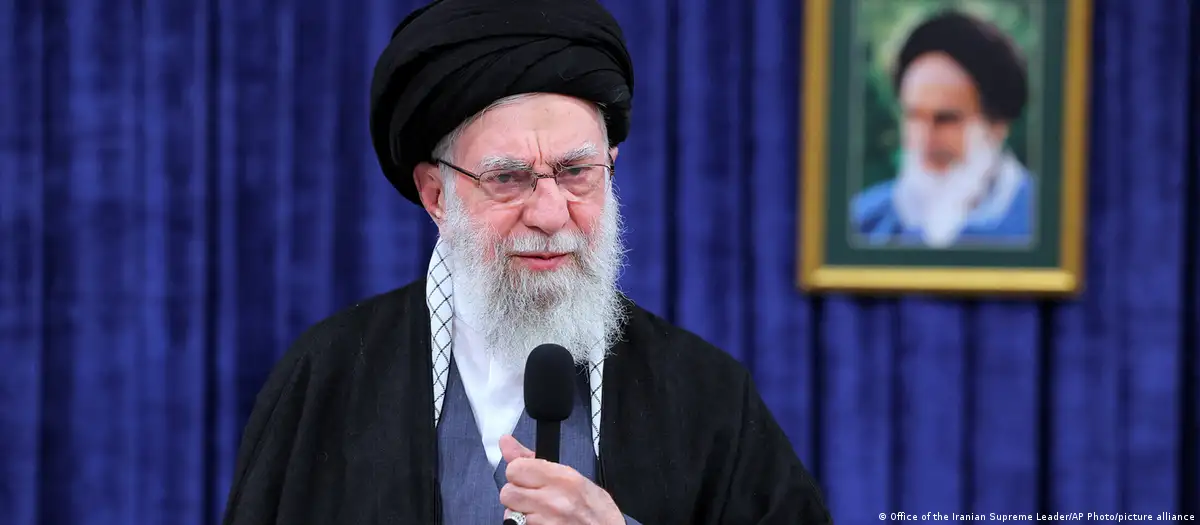
What you need to know
- The US and Israel have launched a major attack on Iran
- Tehran has responded by firing missiles at Israel and targeting US bases in Gulf countries
-
After Israel targeted Khamenei's compound, Netanyahu announced the Iranian supreme leader has been killed
-
Iranian state media later confirmed that the supreme leader has been killed
-
The US military says Iran dealt 'minimal damage' to its installations, no reports of American casualties
- Both Trump and Israeli PM Netanyahu are urging Iranians to overthrow the regime
- Germany, France and the UK have condemned Iranian counterattacks in the region
This blog, on all the latest regarding US-Israeli strikes on Iran and Iran's retaliation on Saturday, February 28, 2026, has now closed. Follow our latest coverage on this unfolding conflict on Sunday, March 1, 2026 here:
This blog is closed
Thank you for joining our live coverage of the unfolding situation in the Middle East after US-Israeli strikes on Iran and Iran's response.
This blog is now closing and we are resuming our live coverage here.
Son of Iran's exiled shah: 'I have answered their call'
Hours after the death of Iran's supreme leader was confirmed, the son of the Islamic Republic's last shah put himself forward as a possible candidate for leading the country.
The US-based Reza Pahlavi has styled himself as a major opposition figure despite not enjoying universal public support from regime critics. His father, Mohammad Reza Shah Pahlavi, ruled Iran from 1941 until his overthrow in the 1979 Islamic Revolution.
"Many Iranians, often despite facing bullets, have called on me to lead this transition. I am in awe of their courage, and I have answered their call," he wrote in an opinion piece for Washington Post, in response to Khamenei's death.
"Our path forward will be transparent: a new constitution drafted and ratified by referendum, followed by free elections under international oversight. When Iranians vote, the transitional government dissolves," he wrote.
Khamenei transition process to begin as early as Sunday, Iran top security official says
Iran's top security officials Ali Larijani announced that the transition process to a new leader following Supreme Leader Ali Khamenei's death will begin as early as Sunday, state media reported.
"An interim leadership council will soon be formed. The president, the head of the judiciary and a jurist from the Guardian Council will assume responsibility until the election of the next leader," said Larijani, the head of Iran's top security body, the Supreme National Security Council, who was an adviser to Khamenei.
"This council will be established as soon as possible. We are working to form it as early as today," he said in an interview broadcast by state TV.
Larijani also warned "secessionist groups" that they will face a harsh response if they attempt to take action amid the transition process, seemingly in reference to anti-regime protesters.
Trump has called on the Iranian people to overthrow the Islamic clerical regime in Tehran, urging: "Take over your government — it will be yours to take."
Iran says 'prepared' for all scenarios
Iranian parliament speaker Mohammad Bagher Qalibaf said on Sunday that Iran had prepared for all scenarios including Khamenei's death.
"We have prepared ourselves for these moments and have considered all scenarios," he said in a televised address, possibly hinting at an escalation in the conflict.
Qalibaf is the highest-ranking official to appear on camera since the attacks began on Saturday.
He also threatened the US and Israel, saying they have "crossed our red lines" and "will suffer the consequences,"
"We will deliver such devastating blows that you yourselves will be driven to beg," he vowed.
Trump threatens Iran with 'force that has never been seen before'
US President Donald Trump threatened to use devastating force on Iran if they retaliated against US and Israeli strikes that killed supreme leader Ayatollah Ali Khamenei.
"Iran just stated that they are going to hit very hard today, harder than they have ever hit before," Trump said in a post on Truth Social, warning: "THEY BETTER NOT DO THAT."
"Because if they do, we will hit them with a force that has never been seen before," Trump wrote in his signature all caps.
Explosions reported over Doha, Dubai, Manama
Explosions were heard over Doha in Qatar and Dubai in the United Arab Emirates after Iran vowed to carry out new strikes following the death of Khamenei.
In addition, a journalist for news outlet AFP reported explosions over Manama, Bahrain.
There have also been sirens going off in central Israel due to missiles, AFP and Israeli media reported.
Iranian state media reported that Iran is targeting 27 US military bases in the Middle East with its latest strikes, along with Israel's military command headquarters and a defense complex in Tel Aviv.
Iran forms council for transition period: state media
A council made up of Iran's sitting president Masoud Pezeshkian and two other top officials has been formed to lead in the transition period after Supreme Leader Ali Khamenei's death.
Judiciary chief and hardliner Gholamhossein Mohseni Ejei is also part of the trio, state television reported citing Mohammad Mokhber, one of Khamenei's advisors.
Though this council will govern in the interim, an 88-member panel called the Assembly of Experts is to swiftly pick a new supreme leader under Iranian law.
Explosions heard in Erbil, Iraqi Kurdistan — report
Loud explosions were heard at Erbil airport in northern Iraq's autonomous Kurdistan region, France's AFP news agency reported.
An AFP journalist saw black smoke rising from the airport area, according to the report.
The airport hosts US-led coalition troops.
Tehran has targeted US bases in the Middle East following the United States and Israel's strikes on Iran.
Iran's revolutionary guard may stand to benefit: Expert tells DW
With Iran's supreme leader confirmed dead and US President Donald Trump calling upon the Iranian people to take hold of their country's future, the question emerges: who is next in line for Iran's leadership?
DW posed the question to Iran expert Mehrzad Boroujerdi, Dean of College of Arts, Sciences, and Education at the Missouri University of Science and Technology.
Boroujerdi said it was unlikely that the Israel-US air strikes would lead to regime change due to a lack of an opposition or a "government in waiting" which could fill the power vaccum.
"We do not have too many successful cases of regime change brought about by aerial bombardments. One can think of Libya but even there we had an opposition force which was on the ground and active in a certain part of the country and was able to come and overthrow Muammar Gaddafi's regime. We don't neccessarily have that in Iran," he told DW.
Instead, Iran's revolutionary guards might stand to benefit.
"They are now less in the shadow of the clerics, they are no longer just the bodyguards," Boroujerdi said.
According to Iran's law, the Assembly of Experts, a group of over 80 men, are tasked with picking a new supreme leader.
"The regime will sooner or later declare someone as the next supreme leader," the expert said.
However, "It is likely, in this vaccum that has been created, that we see the revolutionary guards invoking the argument of an emergency situation," Boroujerdi said.
IRGC commander Mohammad Pakpour, security official Ali Shamkhani killed
Iranian state media reported that Iranian Revolutionary Guard Corps (IRGC) commander Mohammad Pakpour and top security official Ali Shamkhani were killed in joint US-Israeli airstrikes.
Pakpour had served in his role since last year's 12 day war between Israel and Iran. Shamkhani, the head of Iran's national defense council and a close advisor to Khamenei, was injured in that war in an assassination attempt.
Israel had earlier said it had killed Pakpour and Shamkani in its strikes on Saturday.
IRGC says it will soon launch 'most intense offensive operation' against Israel, US bases
Following the announcement of Khamenei's killing, the Iranian Revolutionary Guard Corps (IRGC) said it would soon launch the "the most intense offensive operation" against Israel and US bases in the Middle East.
"The most ferocious offensive operation in the history of the Islamic Republic of Iran's armed forces will begin any moment now," the IRGC said on Telegram.
The IRGC is an influential branch of the Iranian Armed Forces which is vehemently aligned with the values of the 1979 Islamic Revolution.
Khamenei 'will not be mourned,' says Australia's Albanese
Australian Prime Minister Anthony Albanese said that Iran's supreme leader Ayatollah Ali Khamenei "will not be mourned," shortly after the Islamic republic's state media confirmed he had been killed.
"Ayatollah Ali Khamenei was responsible for the regime's ballistic missile and nuclear program, support for armed proxies and its brutal acts of violence and intimidation against its own people," Albanese told reporters.
"He was responsible for orchestrating attacks on Australian soil. His passing will not be mourned," Albanese said.
In 2024, Albanese's government accused Iran of backing two arson attacks on Australia's Jewish community which led to the expulsion of the Iranian ambassador and the suspension of the Australian embassy in Tehran.
The United Nations' International Atomic Energy Agency (IAEA) has assessed that Iran shut down a nuclear weapons development program in 2003, while Tehran denies ever seeking nuclear weapons, maintaining it enriches uranium for civilian purposes.
UN's nuclear watchdog IAEA to hold special session on US-Israeli strikes on Iran
The International Atomic Energy Agency's board of governors will hold a special session on Monday at the request of Iran and Russia.
"The meeting is convened by the Char of the Board following a request from the Permanent Mission of the Russian Federation to convene 'a special session of the IAEA Board of Governors on matters related to military strikes of the United States and Israel against the territory of the Islamic Repubic of Iran," the IAEA said.
Iran's mission to the IAEA said it called for the meeting due to "ongoing acts of aggression" by the US and Israel. It's unclear if Iranian nuclear facilities have been targeted in the latest attacks by the US and Israel.
The US struck three Iranian nuclear sites last year. The US and Israel have accused Iran of enrichment in preparation for an atomic bomb, while Iran maintains its nuclear program is for peaceful purposes.
Gulf nations could 'align more clearly' with US plans, expert tells DW
H.A. Hellyer from the Royal United Services Institute for Defense and Security Studies told DW that the US and Israel strikes on Iran are "clearly about regime change," but may not be enough to reach this goal.
"I think that anytime that you've seen the fall of a regime in history, it has necessitated one of two things, either an external ground force or some sort of mass defection on the ground that then becomes the alternative source of authority," Hellyer said.
He pointed out that it was unlikely that either Israel or the US would put troops on the ground there.
"Even if the the top leadership of the Iranian regime were all to be assassinated, you still have arms, weapons, the the monopoly of force being centered almost exclusively in regime institutions, so some sort of alternative authority is likely to arise, but it would be from within the regime," he said.
Hellyer sees Iran's attack on Gulf nations as a miscalculation.
"The idea seems to be that this will put pressure on these countries to then try to pull the Americans back and to end these strikes," Hellyer said.
"I think that's a very likely scenario that these strikes on these countries by the Iranian regime is likely to push them towards thinking that, well, maybe we should align more clearly with the American plan at this point," he added.
Iran state TV confirms death of Khamenei
Iranian state-run television has confirmed the death of Iranian Supreme Leader Ali Khamenei.
Khamenei was killed at his office early on Saturday, the broadcasts said. Iranian media said the country will now enter a period of 40 days of mourning.
Hours earlier, US President Donald Trump said that Khamenei was killed in an Israeli strike on Saturday morning.
Khamenei, 86, had ruled the country since 1989, when he succeeded Iran's first supreme leader under the Islamic Republic that was established in 1979, Ruhollah Khomeini.
During his reign, Iran pursued nuclear ambitions and had also expanded support for Shiite Muslim-aligned actors in the Middle East, such as Hezbollah in Lebanon, the Houthis in Yemen and Kata'ib Hezbollah in Iraq. In addition, Iran under Khamenei's leadership funded and provided military training to Hamas, which took over the Gaza Strip in 2007 and carried out the October 7, 2023 attacks on Israel.
Khamenei also backed violent crackdowns on demonstrators opposed to the rule of the Islamic Republic.