Iran war: US to deploy thousands more soldiers — reports
Published March 24, 2026last updated March 25, 2026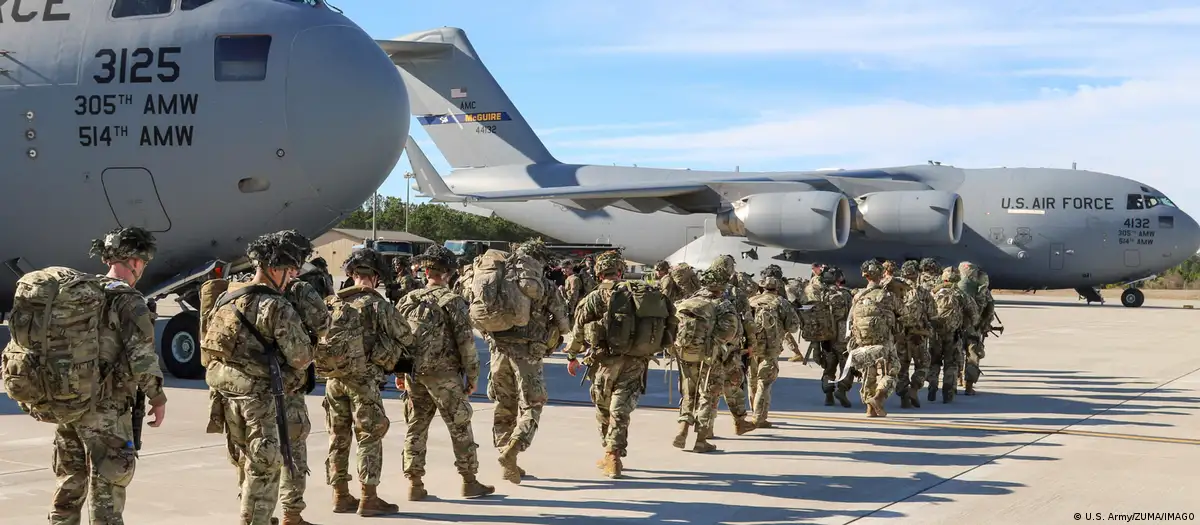
What you need to know
- Iran says 'non‑hostile' ships may transit Strait of Hormuz, the FT reports
- The Pentagon is expected to order thousands more soldiers to the Middle East
- The spokesman of Iran's top military command said its armed forces will fight "until complete victory"
- His comments come after Iran launched strikes and missiles at Israel and Gulf Arab states on the 25th day of the war
- Both Iran and Israel traded fire overnight after US President Trump claimed talks with Iran were underway to resolve the war, a claim Tehran has denied
- Oil prices rose Tuesday, with international benchmark Brent crude climbing back above $100 per barrel
This blog has now closed. Here is a roundup of our coverage of the US-Israeli war with Iran and its wider impact in the Middle East on Tuesday, March 24, 2026:
Thank you for following our coverage
We are closing this blog on all the latest headlines, videos, backgrounds and analyses on the US-Israeli war on Iran and its wider repercussions regionally and worldwide on March 24.
You can still follow our rolling coverage of the war on our Wednesday blog here.
Lebanon declares Iran's ambassador 'persona non grata', orders him to leave
Lebanon has orders Iran's ambassador to leave the country, a further sign of the Lebanese government's crackdown on Iran's influence.
Lebanon's foreign minister, Youssef Raggi, posted on X that Iran's ambassador, Mohammad Reza Shibani, will be declared “persona non grata."
He said Shibani needed to leave Lebanese territory no later than Sunday, March 29.
The Foreign Ministry later said this didn't mean that Lebanon is severing its diplomatic relations with Iran.
Lebanon's Prime Minister Nawaf Salam has blamed the Iran-backed militant group Hezbollah for dragging his country into a wider regional war.
In an interview with Saudi newspaper Al-Hadath, published on Sunday, Salam called for the expulsion of Iranian operatives from Lebanon.
"Each of Hezbollah's six missiles cost the lives of 10,000 displaced Lebanese," he said.
Kuwait: Fire at international airport as drones hit fuel tank
Kuwait's Civil Aviation Authority reported that a fire occurred at the country's international airport early on Wednesday, after drones hit a fuel tank.
In a post on X, the aviation agency said there were no reports of casualties.
Firefighting teams were at the scene, it added, with emergency procedures activated.
Kuwait International Airport was already fully closed to commercial air traffic.
The airport's official website shows no scheduled arrivals or departures for Monday, Tuesday or Wednesday.
Kuwait Airways, the country's flag carrier, halted its regular operations in late February.
It announced the indefinite suspension of all incoming and outgoing flights from Kuwait City on March 12 following a drone attack on the international airport.
Hezbollah launched 90 rockets, drones at Israel since morning — report
Lebanon-based militant group Hezbollah has reportedly launched about 90 rockets and attack drones at northern Israel since Tuesday morning.
That's according to Israel news site Haaretz, which cited Israeli military sources.
A woman was killed in northern Israel on Tuesday evening in a rocket attack by the Iran-backed Hezbollah.
Following a new salvo of Iranian missiles on Israel late on Tuesday, 12 people were evacuated to local hospitals in Bnei Brak near Tel Aviv.
Israel isn't part of any reported Iran talks – Israel's ambassador to UN
Israel's ambassador to the United Nations, Danny Danon, has said that as far as he knows, Israel isn't part of any reported talks between the United States and Iran.
He made the comments to UN reporters in New York on Tuesday.
"As we speak, Israel and the US, we continue to target military targets in Iran, and we will continue to do that," he said.
He added that the attacks on Iran had "accomplished a lot" but not everything.
US has sent Iran 15-point plan to end war — reports
The Trump administration has reportedly conveyed to Iran a plan with 15 conditions for ending the war in the Middle East.
Israel's Channel 12 reported on the proposal late on Tuesday, citing three sources.
The New York Times, citing two officials, said the plan was conveyed to Iran via Pakistan.
US envoy Steve Witkoff and Jared Kushner have proposed a one-month ceasefire in the plan, according to both reports.
During that period, the sides would negotiate a 15-point agreement.
Channel 12 said the plan would include the dismantling of Iran's nuclear program, ceasing support for proxy groups (such as the militant groups Hezbollah and Hamas) and the reopening of the Strait of Hormuz.
It is unclear whether Israel is "on board" with the plan, the New York Times reports.
Earlier on Tuesday, Pakistan had offered to host talks between Washington and Tehran.
Macron urges Iran to 'engage in good faith' in deescalation talks
French President Emmanuel Macron urged Iran to engage in "good faith" in negotiations aimed at ending the ongoing war, in a phone call with Iranian President Masoud Pezeshkian.
"I called on Iran to engage in good faith in negotiations in order to pave the way for deescalation and provide a framework which will meet the expectations of the international community in terms of Iran's nuclear and ballistic program and its activities of regional destabilization,"Macron wrote on X on Tuesday.
The French president also said he stressed in the phone call the importance of ceasing the "unacceptable" Iranian attacks on countries in the region.
He also called on Iran to preserve energy and civilian infrastructure and allow safe navigation in the strategic Strait of Hormuz.
Iran says 'non‑hostile' ships may transit Strait of Hormuz
Iran says "non-hostile vessels" will be allowed to transit the Strait of Hormuz if they coordinate with Iranian authorities, according to a letter cited by several media outlets on Tuesday.
The Financial Times newspaper cited a letter Tehran sent to International Maritime Organization member states. The Reuters news agency and AFP later reported on the same letter.
The letter said vessels linked to the US, Israel, as well as "other participants in the aggression, do not qualify for innocent or non-hostile passage."
The vital waterway has been effectively shut to ship traffic since the Israel-US war with Iran started in late February. Before the conflict, about a fifth of the world's oil passed through the chokepoint.
Hundreds of container ships, tankers, and freighters are currently stranded in the Persian Gulf, unable to transit the strait due to the threat of Iranian attack.
The letter went on to say that Iran had "taken necessary and proportionare measures to prevent the aggressors and their supporters from exploiting the Strait of Hormuz to advance hostile operations against Iran."
US President Donald Trump has threatened to strike Iran's power plants unless it reopens the strait, but Tehran has shown no sign of allowing a return to pre-war ship traffic.
IAEA calls for 'maximum restraint' after Iran says strike hit Bushehr plant
The International Atomic Energy Agency on Tuesday said it had been informed by Iran that a projectile struck the premises of the Bushehr nuclear power plant.
The IAEA wrote on X that Iran said staff members were not injured, the facility was not damaged and conditions at the plant remained normal.
IAEA Director General Rafael Mariano Grossi called for maximum restraint to avoid nuclear safety risks during conflict.
Trump says Iran gave him a 'very big present'
US President Donald Trump says talks with Iran to end the war are underway "right now," and that Tehran has offered him an energy-related gift.
Trump told reporters in the Oval Office that Vice President JD Vance, Secretary of State Marco Rubio, envoy Steve Witkoff and Trump's son-in-law Jared Kushner were involved in the talks.
He said the US was talking to "the right people" in Iran in order to reach an agreement, adding that Tehran wanted to make a deal "so badly."
Trump claimed Iran "agreed they will never have a nuclear weapon" and that the US had "won" the war.
Trump also said Iran had given him a "very big present, worth a tremendous amount of money."
"It wasn't nuclear, it was oil-and gas-related, and it was a very nice thing they did," he added. "So that meant one thing to me — we’re dealing with the right people."
Trump had previously pushed back a deadline for Iran to open the Strait of Hormuz after what he called "productive talks" with Tehran. But Iran denied any negotiations were taking place and accused him of trying to manipulate the financial and oil markets.
Pentagon to order thousands more soldiers to Middle East: reports
The US Defense Department is expected to send some 3,000 more soldiers to the Middle East to support operations in Iran, according to two officials cited by the Wall Street Journal.
Reuters news agency also reported that thousands of soldiers were expected to be deployed, citing two people familiar with the matter.
The forces would come from the army's 82nd Airborne Division, a brigade known for its ability to deploy quickly anywhere in the world.
The officials did not specify where in the Middle East the troops would go or when they would arrive.
The 82nd Airborne Division is stationed at Fort Bragg, North Carolina, and specializes in parachuting into hostile or contested territory to secure land.
The officials told the WSJ and Reuters that a decision to put boots on the ground in Iran had not been made.
But the military buildup could give US President Donald Trump options for future operations, such as reopening the Strait of Hormuz by force or seizing Iran's strategic islands, the WSJ reported.
Last week, the US deployed 2,500 Marines and sailors aboard the USS Boxer, an amphibious assault ship, to the region.
The New York Times first reported on Monday that the Trump administration was weighing the possible deployment of the 82nd Airborne Division.
Iran arrests 466 people over online activities
Police in Iran have arrested 466 people accused of trying to destabilize the country through their online activities, state media reported.
It's one of the biggest security operations since the war with Israel and the US started last month.
"These individuals sought to sow confusion in public opinion, create fear and anxiety in society, promote insecurity and spread propaganda in favor of the enemy," state news agency IRNA said, citing Iranian police.
It was not clear what date the arrests took place or what the online activities entailed.
Iranian authorities have cut off the internet since February 28, when the US and Israel began carrying out strikes on the country.
Residents can still access the local internet to communicate, but some have tried to circumvent the blackout by connecting via VPNs or Starlink.
According to Iranian media reports, police have made more than 1,000 arrests over the past month, mainly affecting people accused of filming sensitive locations, "cooperating with the enemy" or sharing anti-government content online.
Before the start of the US-Israeli war on Iran, Iranian authorities brutally put down public protests, with estimates of the number of people killed ranging from the thousands to tens of thousands.
'Talking is always better' than fighting, China tells Iran
China's top diplomat has called for peace talks to start as soon as possible in a phone call with his Iranian counterpart, Abbas Araghchi.
A statement from the Chinese Foreign Ministry said Wang Yi told Araghchi that "talking is always better" than fighting.
"All hot spot issues should be resolved through dialogue and negotiation, not by using force," he added, according to the statement.
The phone call came after Tehran denied US President Donald Trump's claim that negotiations between the parties in the Iran war were underway.
Beijing is a key partner of Iran, but has condemned Tehran's strikes on Gulf states and has urged a ceasefire.
China's Foreign Ministry said Wang told Araghchi he hoped "all parties can seize every opportunity and window for peace and start the peace talks process as quickly as possible."
According to the statement, the Iranian foreign minister said his side is "committed to achieving a comprehensive end to the conflict, not just a temporary ceasefire."
Trump had been due to visit Beijing this month but postponed the trip due to the war.
Qatar denies mediating between US and Iran
Qatar says it is not mediating between the US and Iran but supports all diplomatic efforts to end the war.
The comments from the Qatari Foreign Ministry came after US President Donald Trump said Washington had held productive talks with Tehran, which Iran denied.
"We are not involved in these talks," Foreign Ministry spokesman Majid al-Ansari told journalists.
The small Gulf country has mediated several disputes in the region and has good ties with the United States, but its relations with Iran have deteriorated following Iranian strikes on Qatari natural gas facilities.
"Our main concern and focus at present is on protecting our country and taking diplomatic steps to ensure that happens," al-Ansari said.
He added that the destruction of Iran is not an option.
"We in the Gulf believe in co-existence. We believe in reaching out to Iran," he said. "We will have to find a way past this. This is a very difficult moment, but we will find our way out of it."
While Qatar has ruled out playing a role in potential negotiations, Pakistan has said it is ready to host talks between the US and Iran.
Egypt's foreign minister has also been speaking to officials on both sides in recent days.
Philippines declares national energy emergency in wake of war in Middle East
Philippine President Ferdinand Marcos Jr. declared a state of national energy emergency, saying that high oil prices caused by the war in the Middle East were threatening the country's energy security.
Under the declaration, which would initially last for a year, Marcos would lead a contingency committee to monitor and ensure the availability and orderly distribution of fuel, food, medicines, agricultural products and other basic goods.
Authorities were ordered to take action against hoarding, profiteering and manipulation of the supply of petroleum products.
The Department of Migrant Workers, meanwhile, was asked to brace for the possible rescue and evacuation of Filipinos in the Middle East.
More than 2 million Filipinos live and work in the Middle East.