Germany updates: WWII bomb prompts mass Dresden evacuation
Published August 6, 2025last updated August 6, 2025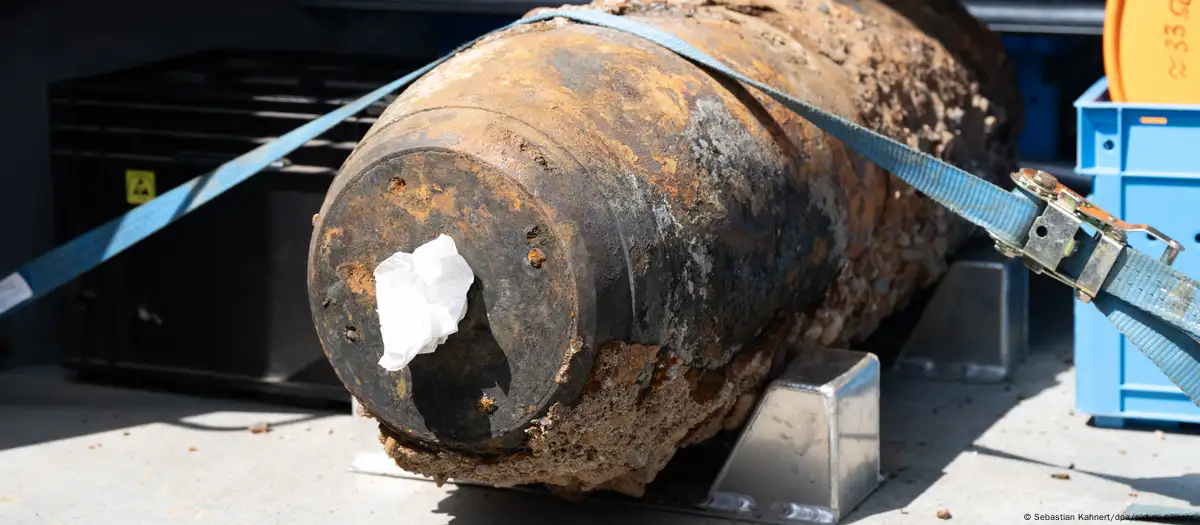
What you need to know
Tens of thousands of people were ordered to leave their homes in the eastern city of Dresden as experts set about successfully defusing a bomb left over from World War II.
Dresden's famous Frauenkirche (Church of Our Lady) was one of the monuments within the area that was evacuated.
Meanwhile, a study by the German Chamber of Industry and Commerce has shown that a majority of German companies are apprehensive about the effects of a recent deal on tariffs struck between the EU and the US.
This blog is now closed. Below you can read articles, explainers and analysis on a range of issues connected with Germanyfrom Wednesday, August 6:
German tourist in Malta fined for riding motorcycle naked
A German tourist was arrested in Malta for riding a motorcycle completely naked, local newspaper The Malta Independent reported.
The 26-year-old was charged with being indecently dressed in a public setting and reckless driving, with his lawyer saying he "was not aware that he could not be in public without clothes."
A local court handed the man a fine of €1,200 ($1,400), while also banning him from driving in Malta for six months.
WATCH: Germany's refugee program freeze strands asylum seekers
Those with official approval to travel to Germany were shocked when their flights were cancelled at the last minute.
The broken asylum promise followed an April decision this year by the new coalition government, led by Chancellor Friedrich Merz, to halt refugee admissions in line with his pledge to curb migration.
Suspected Chinese human traffickers at focus of police raids in 4 German states
German police have raided 20 properties across four states and made two arrests during an operation against Chinese gangs suspected of smuggling people into Germany for commercial gain, a spokesperson for the state prosecutor's office in Hannover has said.
The spokesperson said most of those brought into the country are women from China who are thought to have worked as prostitutes in Germany.
The police operation was said to have focused on Hannover, but there were other raids in Hildesheim, Kiel, Paderborn, Salzgitter and Wiesbaden.
Bomb successfully defused in Dresden after massive evacuation
Defusal experts have successfully disarmed a British 250-kg (500-pound) bomb in the inner city of Dresden after the unexploded weapon was found on Tuesday by workers clearing away remnants of the partially collapsed Carola Bridge.
Around 17,000 people were ordered to evacuate a wide area around the bomb site, with famous Dresden monuments such as the Frauenkirche (Church of Our Lady) and the Zwinger palace complex among the affected locations.
Around 330 police were deployed to monitor the situation.
Unexploded bombs left over from the Second World War are regularly found in Germany, causing frequent mass evacuations in major cities.
Dresden itself was spared Allied bombing attacks until the last year of the conflict, when four raids in mid-February 1945 killed up to 25,000 people and destroyed much of the historical old city.
Motorist found driving at record over the limit speed on Autobahn
A motorist in Germany has been found racing down the Autobahn at 320 kph (199 mph), a record some 200 kph over the speed limit for that section, according to police.
Police said the driver was stopped during a routine check on the A2 highway west of the capital, Berlin, on July 28.
The man was fined €900 ($1,043), received two penalty points on his license and was banned from driving for three months.
Some 70% of the Autobahn highways in Germany are without speed limits, though authorities suggest a recommended limit of 130 kmh, and those drivers traveling faster can be given increased responsibility if involved in a collision.
Although surveys have shown that a majority of people in Germany are in favor of introducing a blanket speed limit, any move to impose one has always met with strong resistance, particularly from conservative politicians.
German broadcaster ProSiebenSat. 1 comes closer to takeover by Berlusconi-family-owned group
The leadership of private German broadcaster ProSiebenSat. 1 has recommended that shareholders accept an improved takeover offer from the Italian media group Media for Europe (MFE), which is controlled by the children of former Italian Prime Minister Silvio Berlusconi, who was a media tycoon at the same time as being a politician.
An initial proposal by MFE was rejected by the company in May as "inadequate."
The updated proposal "underscores MFE's long-term investment and commitment" to the German broadcaster, a joint statement from the executive and supervisory boards said.
The revised offer includes 1.3 MFE shares for every ProSiebenSat.1 share — up from 0.4 previously — in addition to a standing cash offer of €4.48 ($5.19) per share.
Berlusconi used his media empire to further his political agenda and promote the conservative Forza Italia party.
German Minister of State for Culture Wolfram Weimer recently told the Spiegel news magazine he feared that journalistic and business independence could be compromised by a takeover by MFE, with Berlusconi's children maintaining close ties to the party despite remaining outside of politics themselves.
Germany calls for global nuclear responsibility
Germany's foreign minister, Johann Wadephul, has called for renewed global commitment to nuclear disarmament.
Marking 80 years since the atomic bombings of Hiroshima and Nagasaki, Wadephul said such tragedies must never be repeated.
"A nuclear war cannot be won and must never be fought," Wadephul said.
He praised the 2024 Nobel Peace Prize awarded to Nihon Hidankyo, which honored survivors' efforts to preserve memory and promote peace.
Wadephul stressed Germany's support for the Nuclear Non-Proliferation Treaty and emphasized cooperation with France and the United Kingdom to prevent nuclear escalation, particularly in Iran.
He also condemned Russia's nuclear threats,warning that they undermine global security.
"To safeguard peace, we must strengthen our defense while upholding international order," he concluded.
German Cabinet greenlights draft law on geothermal energy projects
Germany's Cabinet has approved a draft law to expand geothermal energy projects as the country works toward the goal of dispensing with fossil fuel-based heating by 2045.
The proposed legislation seeks to remove regulatory hurdles and accelerate approval processes for projects such as geothermal plants, heat pumps, thermal storage and district heating pipelines.
Under the law, such projects would be classified as being in the "overriding public interest," in the same category as wind and solar energy projects. The law would also impose strict deadlines for government authorization of such projects and loosen current restrictions on geothermal exploration.
According to a 2023 study by the Fraunhofer Institute, Germany holds some of Europe's largest geothermal reserves . More than a quarter of the country's heating needs could be met by their exploitation, the study said
The draft law now needs final approval by both chambers of parliament to go into force.
Sorbian passion play to be performed after 10-year break
After a break of a decade, a passion play is to be performed again in Germany's minority Sorbian language in the district of Crostwitz in the eastern state of Saxony, an event that has occurred every 10 years since 1995, with the first performance going back to 1936.
Five performances of the play are planned for September, which depicts the trial, suffering and death of Jesus Christ, Christianity's central figure, the Catholic diocese of Dresden-Meissen said on Wednesday.
The play is to be presented in a revised version and acted by some 250 amateur performers. A German translation will be provided for those who do not understand Sorbian.
The performance is also to feature a segment in which the Lord's Prayer — which Christians believe was provided as a model prayer by Jesus — is recited by all present in the Aramaic language that he is thought to have spoken as his mother tongue.
Saxony's premier, Michael Kretschmer, is expected to attend the performance on September 13.
The Sorbs, a West Slavic ethnic group that suffered extreme persecution under the Nazis, predominantly live in the parts of the Central European region of Lusatia that are located in the eastern German states of Saxony and Brandenburg.
The Upper Sorbian and Lower Sorbian languages are officially recognized minority languages in Germany.
The world's most famous version of the passion play is performed in Oberammergau, Bavaria, in southern Germany.
German cultural figures call to stop weapons exports to Israel
More than 160 German artists and media figures are now among 367 signatories to an open letter addressed to Chancellor Friedrich Merz that criticizes Israel's actions in Gaza and calls for an end to German weapons exports to the Middle Eastern country.
The campaign group Avaaz said the new signatories included musician Nina Chuba, director Fatih Akin and the actor Sandra Hüller.
"We, too, condemn the horrific crimes committed by Hamas in the strongest possible terms. But no crime justifies collectively
punishing millions of innocent people in the most brutal manner," the letter said, referring to the deadly October 7, 2023, Hamas-led raids in southern Israel that triggered Israel's ongoing Gaza offensive.
The letter also voiced concern at Israeli Prime Minister Benjamin Netanyahu's reported plans to occupy the entire Gaza Strip and urged the German government to act.
Germany is one of Israel's main arms suppliers.
New EU-US tarifff deal seen negatively by most German firms — study
German businesses largely view the new tariff agreement between the US and the EU with concern, with the majority foreseeing added burdens to their operations, according to a survey by the German Chamber of Industry and Commerce (DIHK) whose results were released on Wednesday.
More than half (58%) of the 3,355 companies included in the survey said they expected the deal to increase their burden. Just 5% saw the deal as having positive effects.
Altogether 74% of companies that maintain direct business ties with the US foresee negative fallout from the deal, the study showed.
The study indicated that more than half of firms directly involved in US markets plan to reduce trans-Atlantic trade, while 31% have revised the way they handle customs costs, among other things by passing on at least some of the increases to US customers.
"This agreement may have been politically necessary, but for many companies in Germany, it's still a bitter pill," said DIHK managing
director Helena Melnikov. "It brings new burdens instead of relief: higher tariffs, more bureaucracy and reduced competitiveness."
Under the deal struck by European Commission President Ursula von der Leyen and US President Donald Trump amid a long-running trade dispute, most EU exports to the US will be subjected to a 15% tariff as of August 7.
WWII bomb find prompts mass Dresden evacuation
Authorities in the eastern city of Dresden say some 17,000 people will be forced to leave their homes on Wednesday to allow the safe defusal of a bomb left over from the Second World War.
The British 250-kilogram (500-pound) bomb was found on Tuesday amid work to demolish remnants of the Carola Bridge, parts of which collapsed into the Elbe river last September.
The bomb has to be defused at the place where it was found.
The area to be evacuated contains several hotels, as well as the city's famous Frauenkirche, or Church of Our Lady, which is visited by thousands of people from all over the world each year.
The demolition work at the Carola Bridge already uncovered a WWII bomb in January, prompting the evacuation of 10,000 people.
Dresden was the target of four massive Allied bombing raids between 13 and 15 February, 1945, during which up to 25,000 people were killed and much of the city center destroyed.
Welcome to our coverage
Guten Tag from the DW newsroom in Bonn on this sunny summer day!
Even 80 years after the end of World War II, ordnance left over from the conflict is regularly found in Germany.
Dresden, which underwent massive bombardment in the last year of the war, is seeing its second mass evacuation of the year following the find of a British bomb on Tuesday.
In other news, a study has shown that many German companies take a negative view of the recent EU-US tariff agreement, which many commentators have denounced as a capitulation by the bloc to the whims of the unpredictable US president, Donald Trump.
In this blog, you will find a rundown on the main issues in focus in Germany on August 6, 2025. DW wishes you good reading!