Germany updates: Von der Leyen receives Charlemagne Prize
Published May 29, 2025last updated May 29, 2025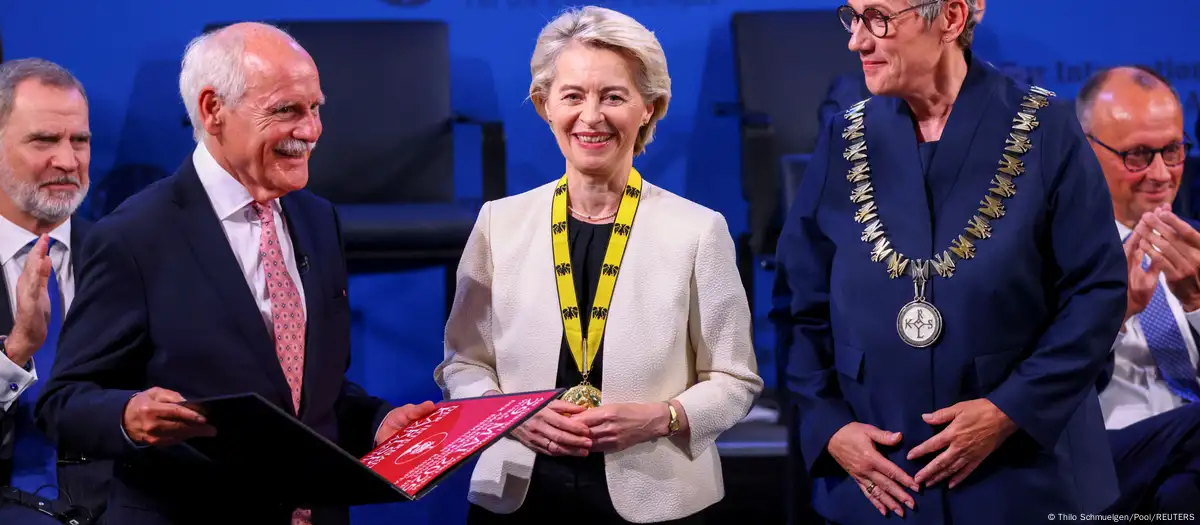
What you need to know
European Commission President Ursula von der Leyen, a former German defense minister, received the Charlemagne Prize in the western city of Aachen. German Chancellor Friedrich Merz was at the awards ceremony.
The Charlemagne Prize recognizes people who have worked to advance European unity.
The ceremony comes as Germany marks a public holiday on Thursday, Ascension Day.
This blog is now closed. Here's a roundup of news stories in Germany on Thursday, May 29:
Von der Leyen awarded Charlemagne Prize, urges 'independent Europe'
After Merz's speech, von der Leyen was awarded the Charlemagne Prize.
Shortly afterward, von der Leyen gave an address of what Europe means for her and how she views the way forward for the continent in the future.
Von der Leyen urged the building of an "independent Europe."
"The next great era, our next great, unifying project must be about an independent Europe," von der Leyen said.
She said this doesn't just mean the countries in the European Union, but also countries on the whole continent.
In light of "enormous" geopolitical tensions, von der Leyen asserted, "what we once took for granted as an international order has tranformed into international disorder within a very short time."
Von der Leyen: Europe 'must take matters in our own hands'
She said that Europe must "take matters into our own hands" and as she said the world order is once again characterized by "imperial striving for power and imperial wars."
Her comments come amid Russia's invasion of Ukraine and US President Donald Trump sowing doubt on the future of the trans-Atlantic NATO alliance.
Von der Leyen said Europe must focus on tasks like defense and economic competiveness and also the strengthening of democracy. She also noted the possible assession of Ukraine, Moldova and West Balkan countries as a the "next historic reunification" of expanding the bloc.
Merz congratulates von der Leyen, defends EU values
German Chancellor Friedrich Merz spoke at the Charlemagne Prize ceremony in Aachen, where he congratulated European Ursula von der Leyen on receiving the award. He thanked von der Leyen for providing a "European voice" in the world.
During the speech, Merz launched a aggressive defense of the European Union and its values as the bloc faces challenges due to Russia's invasion of Ukraine and tensions with US President Donald Trump's administration.
Merz said Europe stands for the conviction that freedom and democracy are worth standing up for.
He described the European Union as a "European peace project" and said it should be strong not only internally but also externally.
He said that Europe must become so strong "that it can restore peace on our continent and secure freedom in the long term."
Merz said Germany would continue supporting Ukraine not only militarily, but also economically and politically.
The German chancellor said Germany is ready to make "far-reaching" decisions at a NATO summit in June to strengthen Europe's security and the trans-Atlantic relationship with the US.
Germany marks Ascension Day
Germany on Thursday is marking a public holiday known as Ascension Day, or Christi Himmelfahrt.
Ascension Day is celebrated to commemorate the Christian belief that Jesus Christ ascended into heaven. It is typically celebrated 40 days after Easter.
Since it is a public holiday, shops, supermarkets, government offices and schools are closed in Germany.
But some cafes and restaurants may be open for Germans to spend time on their day off. Grocery stores in train stations and airports, along with gas station convenience stores, will also be open in case anyone is running low on goods in their pantry.
Ascension Day is one of the nine public holidays that is marked in all 16 of Germany's federal states (Länder).
There are also holidays which are only celebrated in certain parts of the country. Some of this is influenced by the prevalent Christian denomination in that part of the country.
For example, the heavily Catholic German states of Bavaria, Baden-Württemberg, North Rhine-Westphalia, Rhineland-Palatinate and Saarland treat All Saints' Day (Allerheiligen) on November 1 as a public holiday. States which have a lot of Protestants such as Hamburg do not have this date marked as a public holiday.
There are also holidays which are celebrated in one German state.
For example, Protestant-celebrated Repentance and Prayer Day (Buß- und Bettag) is only commemorated in the eastern German state of Saxony.
The eastern German state of Thuringia, meanwhile, is the only part of the country to mark Children's Day on September 20 as a public holiday.
European Commission President Ursula von der Leyen to be awarded Charlemagne Prize
European Commission President Ursula von der Leyen will be awarded the Charlemagne Prize during a ceremony in the western German city of Aachen, located near Belgium and the Netherlands.
Hundreds of guests are expected at the awards ceremony in Aachen's city hall, including German Chancellor Friedrich Merz and former European Commission President Jean-Claude Juncker.
The Charlemagne Prize is given to "individuals or institutions for their services to Europe and European unity," according to its website.
Why is von der Leyen receiving the Charlemagne Prize?
Von der Leyen, who is 66 years old, is being commended for playing "a key role in keeping Europe united, relient and capable of action," the awarding body said.
Von der Leyen, a German who spent much of her childhood in Belgium, stepped into the role of European Commission president in 2019.
She has been at the helm of the European Commission during some trying times for Europe, most notably the outbreak of the COVID-19 pandemic and Russia's invasion of Ukraine.
Von der Leyen also held various ministerial roles under Germany's former Chancellor Angela Merkel. Most notably, von der Leyen served as Germany's defense minister from December 2013 to July 2019.
Von der Leyen's career not without controversy
Although von der Leyen is lauded for efforts in promoting European unity, she has also been at the center of several scandals during her career.
Earlier this month, the European Court of Justice ruled that it was wrong for von der Leyen and the European Commission to block the New York Times' access to private texts between her and Pfizer CEO Albert Bourla.
The text messages between in question dated back to 2021, when the EU was trying to procure doses of the COVID-19 vaccine from the US pharmaceutical company.
Von der Leyen has also been criticized over the awarding of certain lucrative contracts without oversight during her tenure as German defense minister. Members of the German parliament, or Bundestag, have also blamed von der Leyen for not doing enough to improve the readiness of the German military during her time as defense chief.
Welcome to our coverage
Guten Tag from DW's online newsroom in Bonn, located in the western German state of North Rhine-Westphalia.
This blog will bring you the latest news, analysis, multimedia content and DW on-the-ground reporting related to Germany.
Stay tuned for more!