Germany news: Majority see Trump as threat to nation
Published January 24, 2026last updated January 25, 2026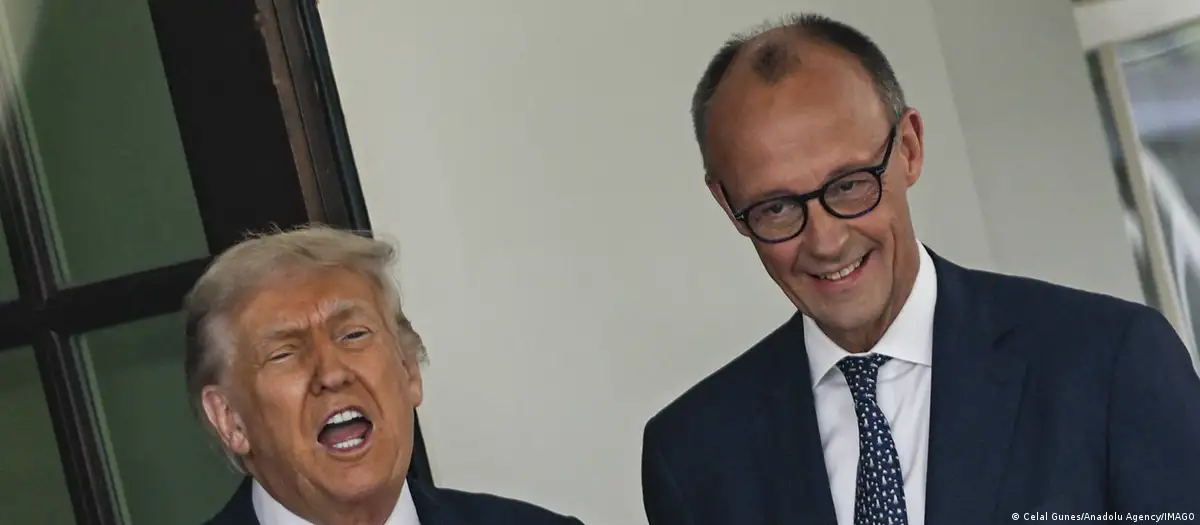
What you need to know
- A new nationwide opinion poll finds a majority of Germans feel threatened by the actions of the US, a country that helped liberate and rebuild Germany and one that has been its most important ally for more than 80 years
- Germany's interior minister has promised a new, aggressive approach to cybersecurity, vowing to 'strike back' at bad actors
- The president of Germany's Bundesbank said his institution defends itself against 5,000 attempted cyberattacks every minute
- Police in Germany shot and killed 17 people in 2025, prompting renewed calls for cops to be given additional nonlethal tools
These updates have been closed. Thank you for reading.
Here are some of the biggest news headlines from Germany from the weekend of January 24 and 25:
Germany's ruling CDU triggers pushback with pitch to limit part-time work
Members of Germany's ruling Christian Democratic Union have stirred controversy by suggesting restrictions on the right to work part time.
CDU lawmakers argue that such limits would boost the economy.
Lawmakers have based their argument on the 2025 statistics from Germany's Institute for Employment Research (IAB), suggesting that the part-time employment rate reached a record high of 40.1% last year. This comes amid a shortage of skilled workers.
CDU lawmakers argue the two are linked and therefore decreasing part-time work would raise the number of available workers.
However, the IAB says the record rise in in part-time employees has not impacted the overall hours worked, as part-time workers have worked more in 2025 than in previous years.
"Restricting the legal right to part-time work would cause great damage to many companies and the German economy," Marcel Fratzscher, head of the German Institute for Economic Research, told the Rheinische Post newspaper.
Germany's labor law gives employees the right to reduce their working hours if they have been with the company for at least six months and if the company has more than 15 employees.
Employers are only allowed to reject the request should it significantly impair workflows or incur disproportionate costs.
The CDU members' proposal would reserve this right only to employees who are raising children, caring for a relative or taking additional vocational training, according to the motion.
64 police officers injured at Magdeburg-Dynamo Dresden game
At least 64 police officers had been injured during a football match in the eastern city of Magdeburg.
Violence broke out during the half-time break of a Saturday night match of a second-division game between Magdeburg and Dynamo Dresden, said the Interior Ministry of the eastern state of Saxony-Anhalt.
Authorities say Magdeburg fans targeted police with pyrotechnics, barricades, rocks, bricks and even a manhole cover.
Some of the injured officers had to be taken to nearby hospitals for treatment.
"I strongly condemn yesterday's riots by alleged [Magdeburg] football fans and the violent attacks on our police colleagues. Hitting police officers with manhole covers and paving stones is nothing less than brutal violence," Saxony-Anhalt Interior Minister Tamara Zieschang said.
"I wish our injured colleagues a speedy recovery. I would like to thank all the police officers who were on duty yesterday to secure a football match and prevent clashes between home and away fans.
The ministry said several hundred officers were on site to safeguard the match.
Police say both fan blocs set off pyrotechnics. The authorities also claim Magdeburg fans had tried to attack Dresden supporters and committed other crimes in the city.
Half of voters in wealthy Baden-Württemberg endorse cooperation with AfD
A new YouGov opinion poll conducted in the southwestern German state of Baden-Württemberg found that half of voters there want political parties to ignore the so-called firewall against working with extremist organizations and begin cooperating with the far-right Alternative for Germany (AfD) party.
The poll, commissioned by Germany's DPA news agency, comes ahead of elections in five of the nation's 16 states.
Germany's intelligence services have labeled AfD a "confirmed right-wing extremist organization." The far-right, anti-immigrant and anti-government AfD started as a fringe party and later secured strongholds mostly in the east of the country. Currently, however, support for it is surging across the country.
Voters in industrious and wealthy Baden-Württemberg — home to Mercedes-Benz, Porsche, Bosch and a host of other tech and pharmaceutical companies — will head to the polls on March 8.
The AfD is currently the second most popular political party in the country and is polling third in Baden-Württemberg with 20% support.
Though Germany's major parties have previously upheld the pledge to refuse cooperation with anti-government outfits, the AfD's rising popularity has caused some to reconsider that stance.
Among those voters polled between January 14 and 22, 24% said parties should deal with the AfD on a case-by-case basis, with a further 26% viewing the AfD as a viable political operation that they would have no problem seeing in a government coalition.
Only 42% of respondents completely ruled out cooperation with the AfD, with another 8% having no opinion on the matter.
Chancellor Friedrich Merz's conservative CDU currently leads polling in Baden-Württemberg, followed by the Greens.
German emergency roadside system eCall switched to 4G coverage
Germany telecommunications companies have updated connectivity to the EU-wide emergency call system for vehicles known as eCall.
The companies switched coverage to 4G, updating from a four-decades-old 2G network. Not only will the update allow far more information to be transmitted, it will also do so much more quickly.
The new Next Generation Emergency Call (NG eCall) system will be supported on the networks of Deutsche Telekom, O2 Telefonica and Vodafone, which operators say are also ready for 5G.
The automated emergency call system eCall has been mandatory in all new vehicles on EU roads since March 31, 2018. The aim of eCall is to greatly reduce the time between an accident and the arrival of emergency services.
The system is automatically triggered when sensors detect airbag or seatbelt tensioner activation, but ignores minor impacts.
Though the system is automated, it can also be activated manually in emergencies.
The EU, which says the system has the potential to slash response times by half, estimates the bloc could see 2,500 fewer annual traffic fatalities by the time most cars on the road are outfitted with it.
Deutsche Bank to slash branch network, push AI assistants
Deutsche Bank says it will continue to shutter branch offices around the country while at the same time pushing customers to switch to online apps.
The bank says the shift to more reliance on artificial intelligence or AI will free employees to deal with personal consultations with customers.
Speaking with German press agency DPA, executive board member Claudio de Sanctis said, "After cutbacks in recent years, another 100 or so locations will be shed under our existing program."
Deutsche Bank and its subsidiary Postbank currently serve some 19 million customers. The two operated roughly 750 branch offices in 2025.
Explaining the expansion of the bank's plan to lean into AI, board member de Sanctis said: "Our staff currently spend far too much of their time on administrative tasks. They should have more time for consultations."
De Sanctis said the bank will roll out an AI digital assistant app this year to facilitate its action plan, noting that this will free up bank employees to provide expertise to customers when it comes home purchases and major investments — "You want to know that an important part of your life of this kind is not taking place in a cloud that you cannot reach."
De Sanctis admitted that the shift to AI will lead to job losses but claimed the impact will be minimal as those leaving are doing so due to retirement or because their jobs are being phased out anyhow.
Poll: 61% of Germans see Trump as threat to country
A new nationwide poll of Germans shows that a large majority views US President Donald Trump as a threat to their country.
Some 1,000 respondents were queried for the poll, though 15% did not respond.
In the final tally, 24% of respondents said they continue to view Trump as an ally, whereas 61% defined Trump as a "threat to the country."
The poll, commissioned by the tabloid newspaper Bild and carried out by the INSA Institute, was conducted this Friday and Saturday, in the wake of Trump's aggressive push for US ownership of Greenland while speaking at the World Economic Forum in Davos.
Trump had threatened a 25% punitive tariff on nations — like Germany — unwilling to go along with his scheme to take semiautonomous Greenland from NATO-ally Denmark.
With that in mind, 52% of respondents called on German Chancellor Friedrich Merz and his administration to take a harder line when dealing with the nation's longtime ally, while 31% argued for continued cooperation.
Beyond the Trump administration's bullying of allies in international forums such as NATO, it has also increasingly turned up domestic pressure, too.
The administration, including the president, vice president, secretary of state and others, such as part-time allies like Elon Musk, have aggressively injected themselves into German politics, offering wild assessments of the state of free speech and immigration in the country and giving full-throated support to far-right parties across Europe, especially Germany's Alternative for Germany (AfD) party.
Welcome back to our coverage
Welcome to DW's coverage of events in Germany on Sunday, January 25.
Today we are taking a look at a poll showing how Germans really feel about US President Donald Trump, among other topics.
Stay tuned for more!
We've paused coverage
We'll return Sunday morning with the latest headlines from Germany. Stay tuned!
Defense minister slams Trump NATO comments, praises troops
German Defense Minister Boris Pistorius on Saturday joined other NATO partners in pushing back against US President Donald Trump's renewed insults over the sacrifice made by US allies who came to America's aid to fight in Afghanistan after September 11, 2001.
Trump has repeatedly slighted NATO contributions as well as suggesting they could not be counted upon. Pistorius pushed back hard in an interview published in the tabloid Bild on Saturday.
"Our Bundeswehr was ready when our US allies asked for support after the Islamist terrorist attack in 2001," he said.
Germany and other US NATO allies rushed to the US' side when Washington — for the first and only time in NATO's history — invoked Article 5 of the military alliance's treaty, meaning that all must come to the aid of an ally who has been attacked.
Pistorius pointed out that German soldiers had "fulfilled their mission under the greatest danger to life and limb and under extreme conditions," during a 19-year mission.
He also underscored the sacrifice made by Germany.
"Fifty-nine soldiers and three police officers lost their lives in combat, attacks or accidents. Numerous wounded soldiers still suffer from injuries sustained during this time. We will honor the dedication and courage of our soldiers in Afghanistan. No matter who questions that. They will never be forgotten."
Leaders throughout the alliance have recoiled at Trump's comments, with UK Prime Minister Keir Starmer calling them, "frankly appalling."
Germany detains suspected Hamas member
Agents from Germany's Federal Criminal Police Office arrested a 36-year-old Lebanese man on Friday with authorities accusing him of having procured live ammunition presumably intended for use in attacks on Israeli or Jewish institutions in Germany and Europe.
Germany's Federal Public Prosecutor's Office made the announcement on Saturday.
Authorities suspect the man of being a member of the Palestinian militant group Hamas, which was behind the October 7, 2023, attack on Israel. Hamas is designated as a terrorist group in Germany as well as several other countries.
German authorities say he was arrested at Berlin's BER Airport on Friday evening upon arrival from the Lebanese capital Beirut.
Investigators say the man is believed to have purchased around 300 rounds of live ammunition for the group.
The 36-year-old is scheduled to appear before the investigating judge at the Federal Court of Justice in Karlsruhe on Saturday.
Friday's arrest is the latest in a string across Europe, after three Hamas members were apprehended during a weapons exchange in the German capital in October, as well as suspects being detained upon entry to the Czech Republic and the UK.
FM Wadephul slams EU-Mercosur delay as deeply damaging to European credibility
German Foreign Minister Johann Wadephul on Saturday criticized the European Union Parliament's decision to seek legal review of the EU-Mercosur free-trade agreement as a "very serious political mistake."
Wadephul told German public broadcaster Deutschlandfunk Radio that the Wednesday vote — the narrow passage of which was made possible by support from Germany's Green and AfD parties — was "a major setback."
Wadephul said the referral could cause "a significant delay that will harm political trust," as other countries with pending trade deals — like India — watch to see if the EU is even capable of passing and implementing such treaties.
The EU-Mercosur trade deal with Argentina, Brazil, Paraguay and Uruguay had been in the works for a quarter century before it was approved by the EU on January 9, signed by all parties on January 17, and then halted for review by the European Court of Justice (ECJ) on January 21.
Supporters of the deal say it is necessary for EU security in the face of aggressive and punitive US tariff policy.
European farmers, however, have been among the loudest opponents of the deal, which would involve reducing trade and tariff barriers on goods and services and create one of the largest free-trade zones in the world, covering some 700 million people.
German Bundesbank hammered with non-stop barrage of cyberattacks, president says
In remarks published in Germany's Tagesspiegel newspaper on Saturday, Bundesbank President Joachim Nagel said the central bank is the target of relentless cyberattacks.
"We see 5,000 attacks per minute on our IT systems alone," Nagel said, adding that in light of the fact that this comes out to more than two-and-a-half-billion attacks annually, the institution is in a "never ending race."
Nagel says the bank has implemented numerous security measures — including stringent employee background checks, secure IT systems, and business continuity management plans — to protect the institution from cyber criminals.
Interior Minister Dobrindt vows to 'strike back' against cyber crime
Nagel's remarks came at the same time Federal Interior Minister Alexander Dobrindt vowed that Germany would become much more aggressive in fighting cyber crime.
"We will strike back, including abroad," Dobrindt told Germany's Süddeutsche Zeitung newspaper. "We will disrupt attackers and destroy their infrastructure."
Dobrindt said the threshold for action would be set low and that counterstrikes would be carried out jointly by the intelligence services and the Federal Criminal Police Office.
The Interior Ministry intends to set up a new hybrid-threat defense center to improve coordination. Germany's domestic intelligence service is preparing the unit, which is due to start work later this year.
Dobrindt said Germany's institutions, infrastructure and companies are under constant threat of cyber attack, adding, "We cannot accept that."
Calls for more Tasers as German police shootings remain above average
German police shot and killed 17 individuals in 2025 according to statistics published by the Institute for Civil Rights & Public Safety at Humboldt University in Berlin.
The figure was lower than 2024, when a record 25 police killings were logged, yet well above decades-long averages.
The high number, published on the institute's online magazine Civil Rights & Police, has amplified calls for police to be equipped with Tasers in order to provide a non-lethal option for them in threatening situations.
Tasers instead of guns: Baden-Württemberg as a case study
Although special forces units in all 16 German states carry Tasers, not all local and state police do. Several states are looking to pass laws to change that.
GdP Police Union Chairman Jochen Kopelke used the southwestern state of Baden-Württemberg as a case example in arguing for the implementation of Tasers. The state registered seven police-related fatal shootings in 2025, predominantly by state and local police with no access to Tasers.
"Where no or only limited 'non-lethal' means of intervention can be used, firearms are the only proportionate means," said Kopelke. "Where Tasers are more readily available to the police, the use of service weapons is reduced."
This past October, lawmakers in Germany's Bundestag passed a legislative amendment to expand the list of equipment provided to federal police officers beyond their standard issue of truncheons and service pistols to include "distance electric pulse devices" that can deliver electric shocks from a short distanceand usually incapacitate a person.
Welcome to our coverage
Guten Tag from the Bonn newsroom, where the sun is shining and the air is crisp. After a whirlwind week of international news, we will start the day here by looking at a shifting cybersecurity posture, police violence statistics, and the tabling of the Mercosur free-trade agreement.
Cybersecurity is a topic being widely discussed here this weekend, with the president of the central bank as well as the federal interior minister addressing the relentlessness of attacks on institutions and a government pivot to more aggressive responses to such crime.
A high number of fatalities as the result of police firearm use in 2025 has amplified calls to give cops access to non-lethal means of intervention and self-defense. Police say Baden-Württemberg, where special forces carry Tasers and state police don't, serves as a case study for the difference they can make.
And as the world digests the ongoing shake-up of global alliances, German Foreign Minister Johann Wadephul has unleashed criticism of the EU Parliament's vote to seek a legal review of the massive EU-Mercosur trade agreement that looked likely to become a reality after 25 years of negotiations. Wadephul called the move a "very serious political mistake."
Follow DW here for the latest.