Germany news: Economic experts call for change of course
Published November 12, 2025last updated November 13, 2025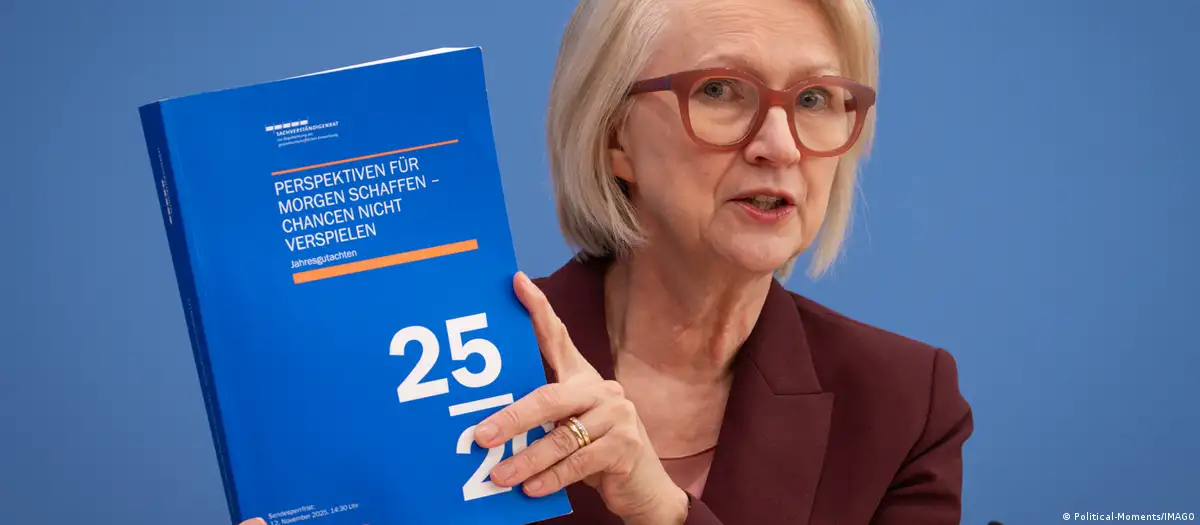
What you need to know
The German Council of Economic Experts warned the Merz government on Wednesday that there is no economic upturn in sight for 2026 — forecasting GDP growth of just 0.9%.
The council urged a change of course, calling for, among otherthings, reforms to inheritance tax law.
The Council of Economic Experts also warned the government not to squander the opportunity to invest the country's Special Fund for Infrastructure and Climate Neutrality (SVIK), saying not to do so would be to risk further economic stagnation.
German Defense Minister Boris Pistorius on Wednesday said the country's armed forces, or Bundeswehr, are doing well and getting better all the time on the occasion of their 70th birthday.
Meanwhile, inflation in Germany went down slightly in October, the Federal Statistical Office has confirmed.
This blog is now closed. Below is a rundown of stories and analyses from Germany on Wednesday, November 12, 2025:
Military service agreed upon by coalition: reports
The conservative CDU/CSU alliance and the center-left Social Democrats (SPD) have agreed on a joint model for the new military service, according to sources within the coalition and reported on by German media and the AFP news agency,
This was announced late Wednesday evening and comes after a long dispute between the coalition partners.
The model is to set to be presented to coalition lawmakers in special faction meetings on Thursday morning, German publication Der Spiegel reported.
According to the AFP, the agreement was reached during consultations between Defense Minister Boris Pistorius (SPD) and representatives of the coalition factions.
The meeting was attended by the faction leader of the CDU/CSU in the Bundestag, Jens Spahn, and that of the SPD, Matthias Miersch, along with defense experts from both groups.
Last month German Chancellor Friedrich Merz said he was "skeptical" of any new model materializing.
The aim is to enable the German armed forces, the Bundeswehr, to recruit the additional personnel.
Germany relieved to be exempted from new EU solidarity rule on migration
The European Commission has exempted Germany from having to take in illegally arrived migrants from other EU nations in 2026.
The planned EU reform of the Common European Asylum System (CEAS) — which has yet to be finalized — seeks to give relief to countries on the bloc's borders, such as Greece, Italy and Spain, by resettling some of the migrants arriving on their shores in other EU countries.
In making its decision, the European Commission recognized the extraordinary number of illegal migrants who have flowed into Germany over the past 10 years, many of whom have sought asylum, as well as the large number of Ukrainian refugees it has taken in over the past three and a half years.
"The Commission categorized Germany as being under threat due to pressure from migration," said the German Interior Ministry.
"The most important take away for Germany is that it does not have to take migrants from other EU states in 2026," added a government spokesperson.
Germany detects wild polio virus in wastewater
The Robert Koch Institute (RKI) on Wednesday confirmed to Reuters news agency that a wild form of the polio virus had been detected in Germany's wastewater system.
The last such case was registered over 30 years ago, and this recent find was reported since regular testing was initiated in 2021.
"Wild poliovirus type 1 (WPV1) has been detected in a sewage sample in Germany," the Robert Koch Institute told Reuters in a statement, adding that no infections had been reported.
The World Health Organization (WHO) said it was the first such find in Europe since 2010.
The WHO said that although risk of illness remains low in Germany thanks to high vaccination rates, the discovery shows that no country is immune to the spread of polio.
The RKI also classified risk as very low pointing to vaccines as well as the fact that the find had been "isolated."
Poliomyelitis, or polio, is a viral infection that can kill or cause paralysis but can be prevented through vaccination.
The wild polio virus is a rare strain circulating in Afghanistan and Pakistan.
The last case of wild polio infection in Germany was reported in 1990. Europe was declared wild polio-free in 2002.
WHO polio eradication spokesman Oliver Rosenbauer said in Geneva, that the RKI find highlighted how well Germany’s surveillance network was working: "They detected the virus without the occurrence of disease. And thanks to high population immunity, so far no cases have occurred."
The world has sought to eradicate polio for decades, with mass vaccination efforts reducing cases by 99% since 1988. Wiping out the disease completely, however, has proved challenging.
UNICEF sounds alarm over child poverty in Germany
The UN children's aid organization UNICEF released its annual report on the situation of children in Germany on Wednesday.
The paper highlighted shocking trends that the agency says threatens the country's future if not corrected, adding that an increasing number of children were at risk of growing up without skills, thus keeping them from becoming self-confident citizens.
According to the report, researchers from the German Youth Institute analyzed numerous official statistics and representative surveys to determine that nearly 1.3 million children have no place to do their homework, nor do they have enough money to eat warm meals or participate in leisure activities with friends and peers.
The report shows that nearly 14 million children and youth in Germany, aged 18 and under, are affected by poverty.
The situation weighs on academic performance and is getting worse, with 25% of children having poor reading skills now compared to 20% in 2018. Many poor children in Germany say they get little academic support at home and disappointingly little at school.
This goes hand-in-hand with a lack of computer skills among 40% of children and their inability to efficiently search for information and determine whether that which they find is correct.
These trends are mirrored in a sharp rise in physical and psychological complaints, which 40% of children now report.
Another alarming discovery was the increasing levels of loneliness among poor youth, especially girls.
"The report makes clear how poverty has a negative impact on absolutely every part of a child's life," said Sabine Walper of the Youth Institute. "That's why it is all the more important to reform structures so that all children have a fair opportunity to grow up well, no matter their background."
"Too little is being done for children," said Unicef Germany Chairman Georg Waldersee in Berlin.
The report, which has tracked the situation for German youth since 2006, found that Germany stacked up poorly against other nations regarding its youth — with countries such as Slovenia, Finland, Portugal and Norway having a lower percentage of children living in poverty.
Germany's 'economic gurus' warn government must reform inheritance tax
The German Council of Economic Experts, generally referred to as the "Wirtschaftsweisen" or economic gurus, warned the Merz government in its annual report that there is no economic upturn in sight for 2026 — forecasting GDP growth of just 0.9%.
Today's report forecast that growth in 2025 will remain an anemic 0.2%. Rises in consumer costs and weak investment are expected to continue their drag on the economy. The council urged a change of course.
Among the reforms the council put forth in its report, was that of inheritance tax. Experts say a more even distribution of tax liability for all types of wealth are the goal of such reforms.
To date, inheritance tax, especially when related to businesses, has been lightly taxed. The rationale behind the system is to avoid situations in which families are forced to give up businesses because the inheritance tax would be too much for them to pay.
Critics say the state is letting heirs off cheap. The council has suggested dramatically changing the tax protections for companies worth less than €26 million ($30 million) and completely removing them for companies worth more than €26 million. The council also recommends the introduction of deferment options in cases in which an heir might find themself having to consider selling a company due to tax liabilities.
The council's report found that income inequality in Germany is relatively high compared to that of its EU neighbors, with 30-50% of the country's total wealth being inherited.
Council member Veronika Grimm offered a dissenting opinion and called the idea of reforming inheritance tax law now "reckless," saying there was no way to estimate what the end effect on the economy might be if heirs stop investing their inheritance.
Council of Economic Experts: Don't waste opportunity to invest in infrastructure
Germany's Council of Economic Experts warned the current government not to squander the opportunity to invest the country's Special Fund for Infrastructure and Climate Neutrality (SVIK), generally referred to as the Sondervermögen, in infrastructure, climate neutrality and housing as promised.
Both the federal parliament and the Federal Council passed legislation allowing the state to create a €500 billion ($579 billion) fund — on credit — to be used to distribute financing for generational infrastructure and climate neutrality projects until the year 2037; from bridges and new rail to retrofitting school and business sites to be more climate friendly.
The council joined critics who say the government is fudging investment by shifting other budgeted projects into the Sondervermögen pool, hence the council's pessimism regarding the pull-on effect of investments from the fund.
Rather than misuse the Special Fund to finance niche campaign promises, the council says lawmakers must put the federal budget on more stable longterm footing.
The council made clear that the only way the Sondervermögen could conceivably kick-start the economy would be if it were used to make massive investments in infrastructure and other extra-budgetary items.
German police arrest 16 in 'grandchild scam' operation
German police say they have made 16 arrests during a large-scale operation targeting international criminals involved in a particular version of telephone fraud known as the "grandchild scam."
The operation was coordinated by the Berlin State Criminal Police Office and involved investigators from all of Germany's federal states and Europol, as well as from Austria, Poland, Switzerland, Slovakia and the Czech Republic.
Several call centers involved in the fraud were shut down during the operation, police said, while investigators succeeded in preventing 44 cases of such fraud that could have cost the victims altogether €2,007,330 ($2,323,745).
For the "grandchild scam," criminals call often elderly people, pretending to be relatives in urgent need of money.
In one variant described by the police, the criminal callers say they have caused a fatal traffic accident. Their call is then followed by one from supposed police officers who claim that large sums of money need to be paid to avoid the alleged relative from going to prison.
Police said the suspects arrested are aged between 22 and 63. Four of them are accused of calling victims, while the others collected the money. to have called victims and initiated the fraud.
According to police, one of the arrested suspects is a 26-year-old Slovakian woman from Frankfurt who allegedly committed fraud in hr home country, pretending to be either a police officer or bank official and trying to convince victims to withdraw money from their accounts and hand it over as it was no longer safe.
Police said the operation took place between mid-September and the end of October this year.
Germany's Bundeswehr turns 70
The establishment of the German Bundeswehr, or armed forces, was controversial at the time, coming as it did just 10 years after the end of World War II, which was a result of German military aggression.
But now, Germany's military plays a key role in ensuring Europe's security.
DW has this article by Nina Werkhäuser on the history of the Bundeswehr and the tasks it might be expected to take on in the future: Germany's Bundeswehr: A 70-year-long history
School enrollments down again for 2025/2026
The number of children enrolling to start school in Germany has gone down once more.
Altogether, 811,500 children started school in the year 2025/2026, 18,200, or 2.2%, fewer than the year before, the Federal Statistical Office (Destatis) said on Wednesday.
The northwestern state of Bremen, the smallest of Germany's 16 states, was the only state not to see a drop, with the western state of Saarland registering the largest fall at -8.5%.
School enrollments in Germany rose continually from 2015, before sinking again from 2024/2025.
Destatis attributes the lower rate both to the sinking birth rate in 2019 and the reduction in immigration, particularly from Ukraine.
These meant that the number of German children of school age at the end of 2024 was 1.1% lower than the year before and that of foreign children 0.8% lower.
The school year in Germany begins after the summer holidays, generally in late August or early September, depending on the state.
Small business climate continues to deteriorate — Ifo index
Business confidence among solo self-employed people and very small companies in Germany went down once more in October, according to figures released on Wednesday by the Munich-based Ifo Institute for Economic Research.
"Nineteen percent of self-employed currently fear that they will have to give up their businesses," Ifo said.
German website builder Jimdo, which compiles the business confidence index together with Ifo, said self-employed people were struggling with a lack of orders, with 46.6% of respondents reporting too few commissions were coming in.
The figures cover self-employed people and business owners employing fewer than nine workers.
Bundeswehr far better than its reputation, says Pistorius
Defense Minister Boris Pistorius has come out in defense of the reputation of Germany's armed forces, the Bundeswehr, as they mark the 70th anniversary of their existence.
"We are the ones who fly to Denmark and to Belgium to combat drones because we can do it and because we can deploy quickly," he told public broadcaster WDR.
"What I see all the time is — and this is a German phenomenon [...] — in no other country are the armed forces so maligned as in Germany," he said.
"We are much better than our reputation," Pistorius said, adding that the Bundeswehr was "in a really good place; we are growing up."
Pistorius also said he hoped an agreement would be reached by the end of the week on a new military service law that is due to go into effect in January next year.
German Chancellor Friedrich Merz also praised the Bundeswehr on the anniversary, writing in a post on X: "Our soldiers have protect us all, our peace and our freedom — every day for 70 years. They make it possible for us to live in liberty and safety."
Germany has been focusing on improving its defense capabilities in the face of the threat posed by growing Russian aggression as evidenced by Moscow's full-scale invasion of Ukraine since February 2022.
In the past, the Bundeswehr has often been accused of being under-equipped, under-staffed and inefficient.
Inflation down to 2.3% in October — Destatis
Inflation in Germany slowed slightly in October to 2.3%, the Federal Statistical Office (Destatis) said on Wednesday, confirming preliminary data.
In September, inflation stood at 2.4% year-on-year.
"After two increases in succession, the rate of inflation in October went down again slightly," Destatis President Ruth Brand said on the office's website.
"The prices for services, which are still rising at an above-average rate, were the drivers," she said
Welcome to our coverage
Guten Tag from the DW newsroom in the former West German capital of Bonn!
Today marks the 70th anniversary of the founding of the Bundeswehr, or German armed forces, prompting Defense Minister Boris Pistorius to speak out against the criticism often leveled at them.
But if the army is in ever better shape, business sentiment in Europe's largest economy remains clouded, with a new study showing that many self-employed fear for their existence.
Read on here for our coverage of the top talking points in Germany on Wednesday, November 12.