Why Brazil is in focus at Germany's Hannover Messe
April 17, 2026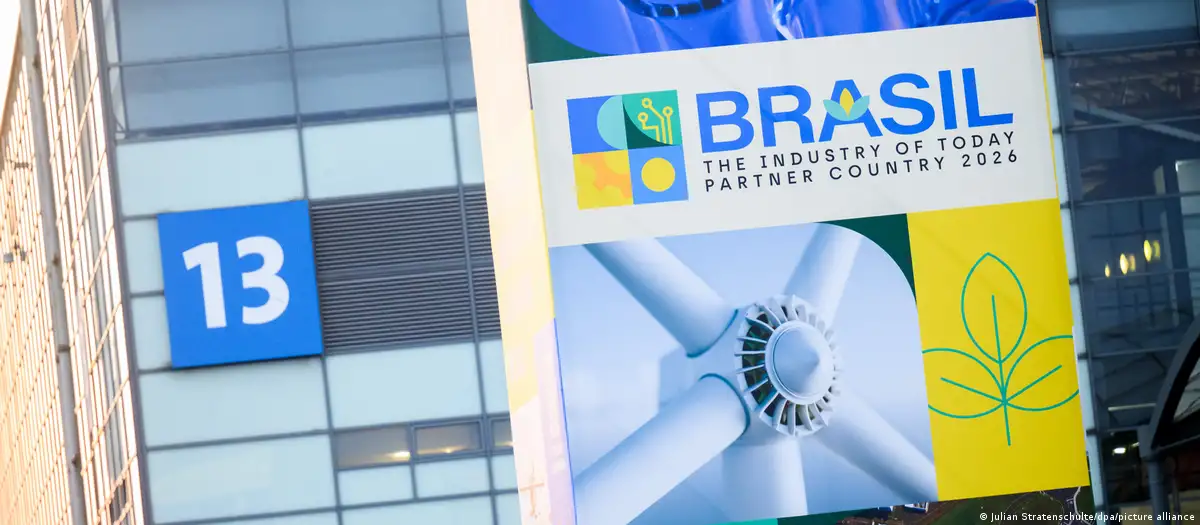
Brazil is presenting itself with confidence at the Hannover Messe, the world's largest trade fair for the manufacturing industry, opening on April 20 in Hannover, Germany.
"We want to show that Brazil is not only an agricultural powerhouse, but also a global player in industrial technology," said Patricia Gomes of the Brazilian Trade and Investment Promotion Agency.
The goal, she explained, is to position Brazil as a leader in green, digital and resilient industries like renewable energy and electric mobility.
A focus on energy and technology
Brazil is already a regional leader in Latin America when it comes to electric mobility and the expansion of smart charging infrastructure.
Last year, 224,000 electric vehicles were registered in the country — an increase of around 40% compared to the previous year.
That alone means Brazil addresses one of the trade fair's most important themes: energy efficiency and energy technology.
"Given the current geopolitical situation, topics such as energy supply, infrastructure resilience and alternative energy solutions are gaining additional relevance," trade fair spokesperson Onuora Ogbukagu told DW. "Energy security is increasingly coming into focus."
Mercosur free trade deal has raised hopes
Around 4,000 companies from 60 countries are exhibiting at the industry showcase in Hannover, including Amazon Web Services, Bosch, Siemens, SAP, Microsoft, Huawei and Accenture.
Brazil alone is represented by more than 300 companies.
The EU–Mercosur free trade agreement between the European Union and the South American countries Brazil, Argentina, Paraguay and Uruguay is expected to give the fair an additional boost.
After more than 25 years of negotiations, the agreement is set to provisionally enter into force on May 1.
"It can be expected that mechanical engineering will benefit strongly from the Mercosur agreement," said Yvonne Heidler, a trade expert at the German Engineering Federation, VDMA.
"German machinery exports to the four Mercosur countries could rise from the current €3.5 billion ($4.1 billion) to as much as €5 billion by 2040," Heidler told DW.
Iran war clouds economic outlook
These hopes, however, stand in sharp contrast to a difficult global economic environment.
According to a business climate survey conducted by the Ifo Institute, 78.6% of German companies reported in March that they are struggling to assess their future business development.
The war in and around Iran has "noticeably increased uncertainty in the German economy," said Klaus Wohlrabe, head of the institute's surveys. Uncertainty is particularly pronounced in industry, where 87.7% of respondents said they are struggling to assess the future.
Economic forecasts for this year are modest both in Germany and around the world.
Among the five largest economies — the United States, China, Germany, Japan and India — only India recorded growth above 6% recently. China still aims for growth of around 4.5% this year, though its economy has slowed compared to previous years.
Brazil is not among the major growth drivers. According to the country's central bank, economic growth is expected to reach just 1.6% in 2026, down from 2.3% last year.
At the same time, many economists warn that forecasts remain highly uncertain due to the conflicts in the Middle East and their impact on prices and consumer behavior. Still, there are bright spots.
'Being a little bit Brazilian' in Germany
Brazil's electric mobility sector is experiencing strong growth, benefiting many companies.
Among them are the German technology group Harting, which specializes in connectivity and charging equipment; SEW Eurodrive, a global leader in drive technology; and the Brazilian company WEG, which manufactures electric motors and charging systems and is proudly showcasing them in Hannover.
Brazil's largest machine tool manufacturer, ROMI, also bucked the trend in 2025 with growth of around 8%. Even more striking: two of the company's 13 production sites are now located in Germany, following ROMI's 2012 acquisition of the German machine tool manufacturer Burkhardt+Weber.
"I'm sure our colleagues in Germany enjoy being a little bit Brazilian," Luiz Cassiano Rosolen, the head of ROMI, told DW.
Referring to Burkhardt+Weber, he added that back in Brazil, the company is proud that the "Porsche of machine toolmakers" is part of the ROMI team.
Cassiano Rosolen will be present when Brazilian President Luiz Inacio Lula da Silva and German Chancellor Friedrich Merz officially open the industrial trade fair.
The two leaders met at the COP30 UN climate summit in Belem, Brazil, in November 2025.
It was a short visit as Merz only spent 21 hours in the city during a whirlwind trip and made disparaging remarks about it when he returned to Berlin.
Now tiny Hannover will likely face its own critical gaze from the large Brazilian delegation.
But the Brazilian president will likely spend more than 21 hours around the city, giving the two leaders more time to work on improving German-Brazilian relations.
This article was originally written in German.