Germany updates: Talks with Taliban ongoing for deportations
Published September 15, 2025last updated September 15, 2025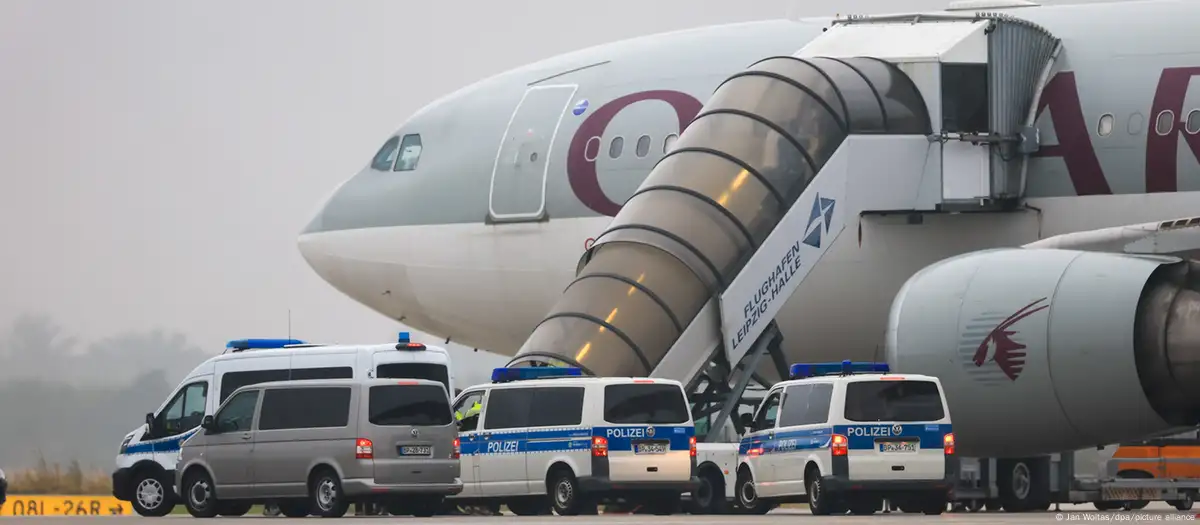
What you need to know
Interior Minister Alexander Dobrindt said German delegations have held "technical discussions with Afghan representatives" in Qatar, and would hold more meetings in the coming weeks.
Dobrindt said Germany was seeking to facilitate "regular" deportations to Afghanistan.
The German government has long had no official diplomatic ties with the Taliban, the Islamist group that returned to power in Afghanistan after the 2021 NATO withdrawal.
Meanwhile, Chancellor Friedrich Merz attended the reopening of a Munich synagogue that was set on fire by the Nazis in 1938.
Merz said he was "ashamed" by rising antisemitism in Germany, which he suggested was tied to migrants that have come to the country in recent years.
This blog has been closed. Thank you for reading.
Find out what was making headlines in Germany on Monday, September 15:
German media union slams US visa threat against ZDF journalist
The German Journalists' Association (DJV) has called on the US government to refrain from using visa revocation as a threat against critical journalists.
In a letter, the DJV criticized statements made by former US ambassador to Germany Richard Grenell, who has served as US Special Envoy for Special Missions under US President Donald Trump since February.
Grenell called for the visa of Elmar Thevessen, the head of German public broadcaster ZDF's studio in Washington, to be revoked, in a post on X.
Grenell described Thevessen as a "radical Lefty German who keeps calling for violence against people he politically disagrees with."
Grenell was referring to a video podcast in which the ZDF journalist answers questions related to the assassination of US right-wing influencer Charlie Kirk.
In the video, Thevessen said that the White House's Deputy Chief of Staff Stephen Miller has "very extreme views" which, to some extent, come from the ideology of the "Third Reich" — a reference to the Nazi Germany regime between 1933 and 1945.
In its letter to Alan Meltzer, the Charge d'Affaires at the US embassy in Berlin, the DJV stated that "as long as journalists operate within the framework of freedom of the press and freedom of expression, state coercive measures do not belong in the arsenal of liberal democracies."
Germany Merz declares 'war' on antisemitism, points to migrants
At the reopening of a restored synagogue in Munich on Monday, German Chancellor Friedrich Merz appeared to be fighting back tears as he recalled the crimes committed against Jews by the Nazis.
Merz said he was disturbed by the rise in antisemitism in Germany.
"I would like to tell you how ashamed I am of this: as chancellor of the Federal Republic of Germany, but also as a German, as a child of the post-war generation, as a child who grew up with 'never again' as a mission, as a duty, as a promise," said Merz during his speech.
He added that "we have turned a blind eye for too long to the fact that a considerable number of the people who have come to Germany in recent decades were socialized in countries of origin where antisemitism is virtually state doctrine, where hatred of Israel is taught even to children."
Merz said that he hopes "that Jewish life in Germany will one day get by without police protection again."
"I therefore declare war on all forms of old and new antisemitism in Germany on behalf of the entire federal government of the Federal Republic of Germany," he said.
Munich synagogue to be reopened with Chancellor Merz in attendance
The old synagogue on Munich's Reichenbachstrasse will be reopened on Monday after years of restoration.
Chancellor Friedrich Merz, Bavarian State Premier Markus Söder and Munich Mayor Dieter Reiter are expected to attend the ceremony in the evening.
Like many others across Germany, the synagogue was vandalized and set on fire by the Nazis during the pogroms that became known as Kristallnacht — the night of broken glass — on November 9, 1938.
By chance, the fire department managed to prevent the flames from spreading to nearby homes before the structure was completely destroyed.
After World War II, the synagogue underwent a rushed restoration, but it was never fully restored to its former condition.
Rheinmetall to buy warship maker NVL
German arms producer Rheinmetall has agreed to acquire Luerssen Group's warship division, NVL, as it eyes expansion in Europe.
Rheinmetall said both companies agreed not to disclose the purchase price for NVL. The businesses aim to complete the deal early next year, pending approval from antitrust officials.
Rheinmetall CEO Armin Papperger told investors that the deal valued NVL at roughly 4.5 times its mid-term core profit goal of €300 million, indicating a price of about €1.35 billion ($1.59 billion).
Papperger explained that the decision to enter the naval defense sector was driven by Russian aggression following Moscow's full-scale invasion of Ukraine, which has prompted many European nations to boost their defense budgets.
Germany alone is expected to spend around €31 billion on naval vessels by 2035, according to Rheinmetall.
The German company is already Europe's biggest ammunition maker. Recently, the company and Romania signed a framework agreement to build a munitions ignition powder factory.
German scam victims get back €350,000 in gold
An older married couple from Wuppertal, west Germany, has recovered almost 3.5 kg (120 ounces) of gold they had lost to scammers earlier this year.
The gold, worth over $400,000 (€350,000), was found during a routine traffic stop in the west German region of Niedersachsen this July. One of the suspects allegedly posed as a family member of the couple, tricking them into giving them gold, jewelry and cash.
A joint team of customs officials and police officers conducted the investigation, making it possible to retrieve the gold and give it back to the victims, authorities said.
Fentanyl: Germany prepares for a synthetic opioid crisis
It could be pure coincidence, but the fact that the addiction care center in the western German city of Essen, population 600,000, is located on Hoffnungsstraße ("Hope Street" ) could also be a sign.
Hope for the people struggling with addiction, who find somewhere they can get a free meal and a place to sleep. Hope Street is also the place where they can snort, smoke or inject heroin in sterile drug consumption rooms, under supervision.
Since the drug consumption room opened in 2001, there has not been a single death there. But the latest, even more dangerous drugs are already on the doorstep.
Essen, along with Hanover and Berlin, is one of three model cities conscientiously preparing for a further increase in fentanyl. The project is called "Synthetic Opioids — Prepare and Response," or "so–par" for short, and is set to serve as a blueprint for the whole country.
Emergency plans are being prepared, emergency services and hospital staff are being trained, and, above all, drug tests are being expanded to be able to detect opioids more precisely.
Dobrindt to nominate new chief for domestic intelligence service
Interior Minister Alexander Dobrindt is expected to propose to the Cabinet this week that the domestic intelligence service be led by Sinan Selen, who had been deputy president at the agency.
The 53-year-old would be the first person not born in Germany to lead the domestic spy agency. He was born in Turkey and emigrated to Germany with his family at a young age.
The agency is officially known as the Federal Office for the Protection of the Constitution (BfV).
Earlier this year, the BfV upgraded its assessment of the far-right Alternative for Germany (AfD) party from suspected to confirmed right-wing extremist. It cited what it described as anti-constitutional and xenophobic efforts.
The classification meant that the agency could have greater powers to monitor the AfD's activities. However, the label was suspended pending a court decision after the AfD took legal action.
Report: Palestinian who fled via jet ski seeks asylum in Germany
A report by Reuters news agency details the story of a 31-year-old Palestinian fleeing Gaza to Europe — via jet ski.
Muhammad Abu Dakha initially crossed the Rafah border point to Egypt in 2024, paying $5,000, according to the report, before going to China.
But after failing to win asylum in China, Abu Dakha returned to Egypt and then went to Libya, where thousands are exploited by traffickers while trying to secure a spot on a boat to Europe.
He said he failed 10 crossing attempts with smugglers before deciding to buy a used Yamaha jet ski for about $5,000 on a Libyan online marketplace. He also spent $1,500 on equipment, including a GPS, a satellite phone and life jackets.
Abu Dakha then drove the jet ski with two other Palestinians on board for about 12 hours.
According to the report, the trio used ChatGPT to calculate how much fuel they would need for the journey. They ended up running out 20 kilometers (12 miles) away from Lampedusa and called for help.
Reuters cited a Frontex spokesperson as saying that a Romanian patrol boat for the EU's border agency picked them up, describing the circumstances as "an unusual occurrence."
Filippo Ungaro, spokesperson for UNHCR Italy, confirmed that authorities recorded their arrival in Italy after a jet ski journey from the Libyan port of al-Khoms and a rescue off Lampedusa.
Reuters said Abu Dakha contacted its journalists while staying in Lampedusa's migrant center after a member of the staff told him that local media had reported his arrival via jet ski.
He eventually made his way to Germany, where he said he applied for asylum and was waiting for a court to examine his application.
He has no job or income and is staying in a local center for asylum seekers, Reuters said.
German suspect refuses interview over Maddie McCann disappearance
A 49-year-old German suspect in the case of the 2007 disappearance of a then-3-year-old British girl has refused to be interviewed by UK police, officials said.
Madeleine McCann vanished in Portugal while on holiday with her family, sparking a frenzied search and gaining media attention around the world.
British and German police named Christian B. as a suspect in 2020. He had lived in Portugal's Algarve region at the time when McCann vanished.
German police had said McCann was assumed dead and that B. was likely responsible. He denied involvement and has not been charged with any crime related to the case.
B., a convicted child abuser and drug dealer, has been in prison for raping a 72-year-old woman in the same area of the Algarve.
He is due to be released from German prison this month, but he remains a suspect in the British police's investigation.
Editor's note: DW follows the German press code, which refrains from revealing the full names of criminal suspects.
Small plane crashes in western Germany, 2 dead
Police in the western town of Bitburg, near the border with Luxembourg, said two people were killed in a crash of a light aircraft.
The aircraft had been scheduled to land at Bitburg airfield at around 8:30 p.m. local time on Sunday (1830 GMT). It lost contact with the radar and was reported missing.
Police and firefighters located the crashed plane and the bodies of the two passengers early in the morning in a field around 6 kilometres (3.7 miles) north of Bitburg.
Support for far right triples in western German local election
The conservative Christian Democrats (CDU), Chancellor Friedrich Merz's party, emerged as the strongest party in North Rhine-Westphalia's municipal elections, while the far-right Alternative for Germany (AfD) made major gains.
The center-left Social Democrats (SPD) and Greens lost ground, according to preliminary results.
The CDU has around 33.3% of the overall votes, roughly matching its historically weak 34.3% result in 2020. The SPD came second with 22.5%, slightly down from 24.3% five years ago.
The AfD nearly tripled its vote share to 14.5% from 5.1% in 2020. The Greens suffered heavy losses, dropping to 11.5% after a record 20% in the last local election.
CDU and SPD politicians have vowed not to work with the AfD, maintaining the so-called firewall against the far-right party.
Nearly 14 million residents were eligible to vote in Germany's most populous state. The municipal vote was for local councils, mayors and district administrators among other elected positions.
According to public broadcaster WDR, voter turnout was 56.5%, nearly 5% higher than in the 2020 local elections.
Dobrindt: Germany in talks with Taliban for 'regular' deportations
German Interior Minister Alexander Dobrindt has confirmed that talks are underway with the Taliban to deport Afghan nationals who were convicted of crimes from Germany.
"We want to make deportations possible on our own. And that is why we are maintaining technical contacts between colleagues from the Interior Ministry and representatives from Afghanistan," he said.
"And these technical contacts should ultimately lead to us being able to deport people to Afghanistan on a regular basis," Dobrindt added.
Separately, German Foreign Minister Wadephul Johann Wadephul also confirmed that talks about deportations were taking place in Doha — but signalled that he did not see meetings in Kabul as necessary.
In July, Germany flew 81 Afghans with criminal records and failed asylum claims to Afghanistan.
Why is the move controversial?
The Taliban took over Afghanistan's government in August 2021 following the NATO withdrawal. Since then, Germany has not had official diplomatic ties with the Taliban government, which it did not recognize as legitimate.
Marcel Emmerich, the Green Party's domestic policy spokesman, has called it a scandal.
"The public has a right to know what the terrorists are getting in return. Dobrindt is making himself dependent on an Islamist organization and is reducing security in the country," he told the Tagesspiegel newspaper.
With the rise of the far right in Germany, migration was a central topic in the CSU and CDU's election campaign in the February general election.
Chancellor Friedrich Merz has vowed to deport people to Afghanistan and Syria, and suspend asylum admission programs for German agencies' former local staff in Afghanistan.
Welcome to our coverage
Today, the German parliament is holding more readings of the 2026 budget proposal.
We are also expecting political parties to make statements after local elections in Germany's most populous state, North Rhine-Westphalia.
Also, on Monday, German Chancellor Friedrich Merz will be attending the reopening of a synagogue in Munich after years of restoration work.
We'll bring you updates and analysis on the latest news from Germany.