Germany to adjust heating law to allow fossil fuels
March 12, 2026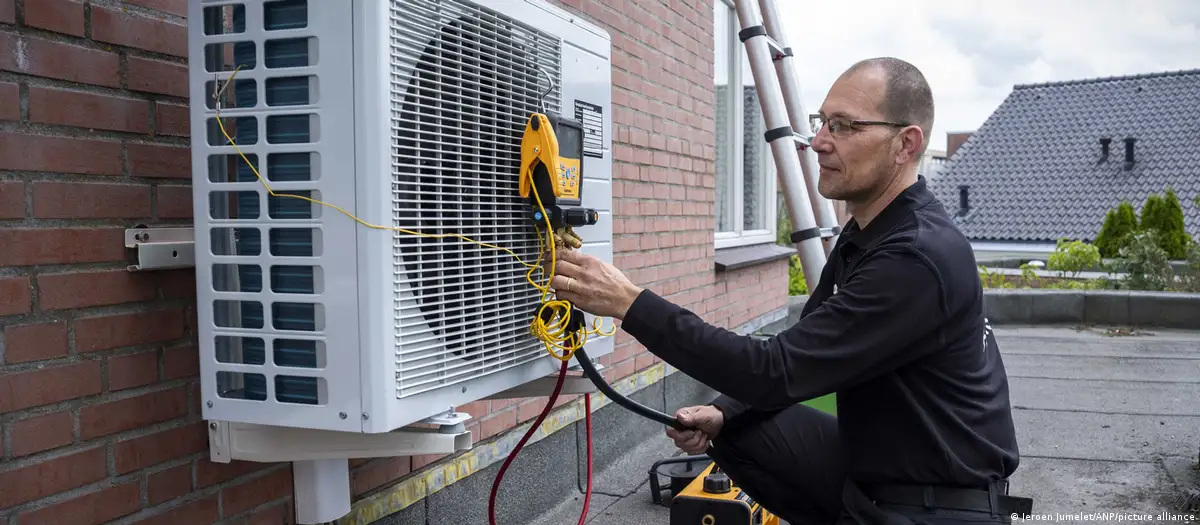
Regardless of what party happens to be in power, Germans have long seen their country as a pioneer in climate protection. Industry underwent modernization, and the state subsidized the expansion of wind and solar energy. Yet transportation and residential heating are two areas in which Germany lags, continuing to generate significant amounts of CO2 and toxic gases. As of 2024, 56% of homes were heated with gas, and 17% were heated with oil.
The previous government, made up of the center-left Social Democrats (SPD), environmentalist Greens and neoliberal Free Democrats (FDP), sought to tackle the issue of home heating. In their 2021 coalition agreement, they decided that new heating systems installed in houses and apartments should operate using 65% renewable energies instead of gas or oil. This was expected to help usher in a new era of renewable heat pumps.
Germany wants to allow new gas and oil heating systems
Those rules are set to be scrapped. A draft for a Gebäudemodernisierungsgesetz (GMG) to be agreed by the government on March 25, allows for new heating systems using oil or natural gas to be installed, but also requires that climate-friendly fuels be mixed in with the gas and oil. The law is expected to be approved in parliament by July 1.
In her explanation of the regulation, Economy Minister Katherina Reiche, of the center-right Christian Democratic Union (CDU), made direct reference to her predecessor, Robert Habeck of the environmentalist Greens: "The Heating Act eroded trust and divided society. We are setting a new course. Everyone can now decide for themselves how they want to heat their house or apartment — even in existing buildings."
Following the announcement, the current government's junior coalition partner, the SPD, noted that heating with gas and oil is likely to become significantly more expensive. This prompted Matthias Miersch, the SPD parliamentary group leader, to state at the end of February: "There will be no law under my watch that leaves tenants footing the bill. Protecting tenants is a key priority for me." Miersch announced that the agreement would need to be revised accordingly.
Many Germans felt patronized by Greens
Conservatives are making good on their commitment to revoke the heating law proposed by Habeck, which sparked anger nationwide. The Bild newspaper, the country's highest-circulation tabloid, repeatedly called it "Habeck's heating hammer," implying that the minister would personally give the order to rip out oil and gas heating from homes.
This was not true. Interfering with millions of existing gas and oil heating systems was never the plan. Habeck had merely modernized and tightened a law that originated from previous governments, including those led by the center-right Christian Democratic Union, in order to implement EU law.
According to the CDU, Habeck wanted to make the expensive installation of heat pumps mandatory. That is why the new cabinet of Chancellor Friedrich Merz (CDU) agreed in its coalition agreement to repeal the law. The new regulation now outlines the key points that the CDU and their sister-party, the Christian Social Union (CSU), have agreed upon with the SPD.
Heat pumps are in demand in Germany
What is especially surprising is that this comes as there has been a recent increase in the number of new heat pumps in Germany. This is because oil and gas are becoming increasingly expensive and scarce, partly due to geopolitical upheavals such as Russia's war of aggression against Ukraine and the latest escalations in the Middle East.
Industry also needs oil and gas. The sustainable types of gas and oil that are to be used in small quantities to heat buildings in the future are particularly scarce and contribute to rising costs.
Environmental groups such as Greenpeace are highly critical of the new legislation. Their climate expert Martin Kaiser told DW: "The war under Vladimir Putin, the tensions surrounding Greenland under Donald Trump and the war in the Middle East expose the risks of fossil fuel dependency. The fact that the CDU/CSU and SPD are still hesitating to abandon oil and gas once and for all and expand renewables more quickly is strategically short-sighted."
Although it is true that many past federal governments have been slow to act on climate protection, the current government is deliberately rolling back climate protection measures.
Physicist and climate researcher Niklas Höhne also takes a critical view. He told Deutschlandfunk public radio that the government is currently implementing measures that will lead to more greenhouse gases. And he explicitly mentioned the new heating plans.
Höhne said climate change remained an existential threat: "The only thing we can do is get rid of coal, oil and gas as quickly as possible." Despite such concerns and new proposals from the SPD, the CDU/CSU intend to stick with the new heating law. Following last week's agreement, Jens Spahn, leader of the CDU and CSU parliamentary group in the Bundestag, said: "The subject of heating is once again a private matter."
The debate about climate protection and its relevance continues. Above all, this debate revolves around the question of what the state can and cannot require. It is a debate about emotions and about one's personal life choices — all of which manifest themselves around the topic of heating.
This article was originally written in German.
While you're here: Every Tuesday, DW editors round up what is happening in German politics and society. You can sign up here for the weekly email newsletter, Berlin Briefing.