Germany news: Oktoberfest extension proposed after scare
Published October 2, 2025last updated October 3, 2025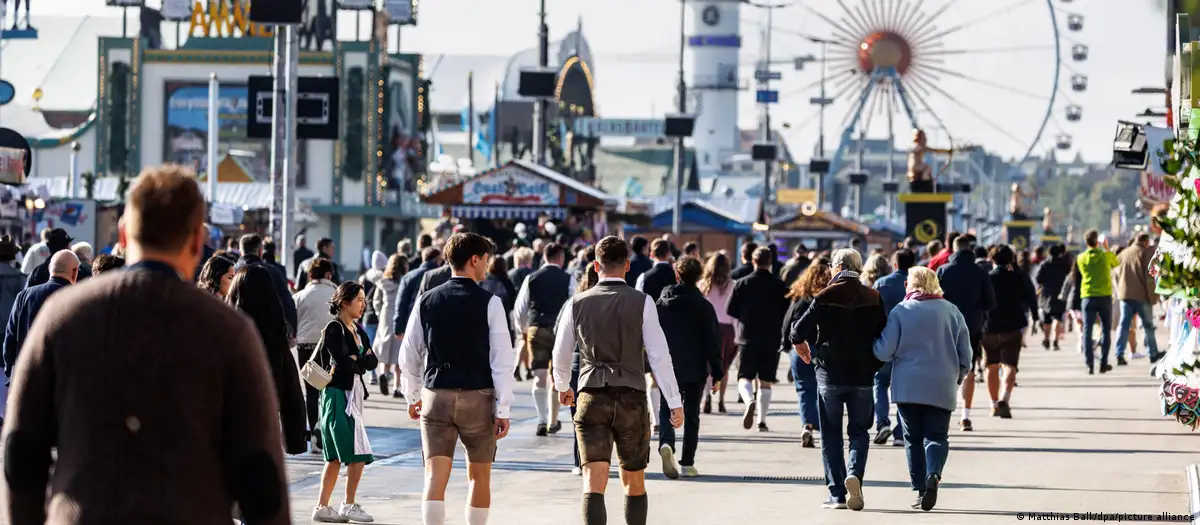
What you need to know
German hospitality group DEHOGA has suggested prolonging Munich's Oktoberfest after Wednesday's bomb threat forced an hourslong closure.
Managing director Thomas Geppert said the festival remains a symbol of Bavarian hospitality and that visitors will quickly return once tents reopen.
However, festival organizers have pushed back, saying the idea is impractical because of staffing shortages.
This blog is now closed. Thank you for reading.
Here is a roundup of the top headlines from Germany on Thursday, October 2:
Most Germans favor Israel's inclusion in Eurovision
The majority of Germans would be against excluding Israel from international sporting and cultural events such as the Eurovision Song Contest (ESC), according to a new poll.
The Deutschlandtrend survey, carried out on behalf of public broadcaster ARD, found that 65% of Germans do not believe Israeli artists and athletes should be punished for the actions of Israel's government.
Only around one in four (24%) thought that Israel should be excluded from events, such as the ESC, in order to increase the pressure on the Israeli government over its conduct in the Gaza Strip.
The 2024 and 2025 editions of the ESC in Malmo, Sweden, and Basel, Switzerland, respectively, saw street protests against Israel's participation. Some countries have threatened to boycott the 2026 contest in Vienna, Austria, if Israel is allowed to take part.
Survey puts far-right AfD level with conservative CDU
The far-right Alternative for Germany (AfD) party has drawn level with Chancellor Friedrich Merz's conservative CDU/CSU bloc for the first time in the Deutschlandtrend opinion poll.
The poll, carried out on behalf of public broadcaster ARD and released on Thursday, put both AfD and CDU/CSU on 26% – the highest rating yet for the AfD in this particular survey.
The Social Democrats (SPD), the junior partner in the current coalition government, remained unchanged on 14%, the Greens were up one percentage point to 12% and the Left Party stayed on 10%.
In another poll, however, support for the AfD has actually dropped off. The Politbarometer survey, carried out on behalf of broadcaster ZDF, has the far-right party on 25%, one percentage point down from where it was two weeks ago, and behind the CDU/CSU.
While both surveys are considered reliable in Germany, opinion polls should always be read as a snapshot of a given moment rather than an entirely accurate prediction of voter behavior in an actual federal election which, barring an unforeseen government collapse, won't take place again until 2029.
Hamas suspects in Germany sent to pretrial detention
A judge in Berlin has ordered pretrial detention for three men suspected by prosecutors of being members of the Palestinian militant group Hamas and preparing attacks on Jewish targets in Germany.
The three men were taken into custody on Wednesday in Berlin. One was born in Syria and two in Lebanon; two of them are naturalized German citizens and the other is a Lebanese national.
Prosecutors say they believe the men were foreign agents working for Hamas who were involved in procuring firearms and ammunition to be used for attacks on Israeli or Jewish institutions.
Hamas on Wednesday denied links to the suspects, calling the allegations unfounded and saying its activities were "confined to opposing Israeli occupation in Palestine."
According to the prosecutor's office, the men had been under surveillance and officials found weapons, including an AK-47 assault rifle and a Glock pistol, as well as large amounts of ammunition at a weapons handover.
The arrests coincided with the Jewish Yom Kippur religious holiday and took place amid heightened security at Jewish institutions in much of Europe.
Hamas, which governs Gaza, is designated as a terrorist organization by the European Union (and by extension Germany) and the US.
Also on Thursday, conservative politician Alexander Throm said citizenship rules should be altered to make it easier to revoke citizenship of individuals who join a terror organization domestically. Currently, German law facilitates the stripping of citizenship from someone who joins a foreign terror group.
"There is no reason why this should not also apply to terror acts committed in Germany," Throm argued in an interview with the Handelsblatt newspaper.
Deutsche Bahn expects to miss long-distance punctuality targets
German national rail operator Deutsche Bahn has reported reduced punctuality across its services in September compared both to the previous month and the previous September.
Long-distance rail services arrived on time or within 15 minutes of the stated time in only 61.9% of cases, compared to 67.9% last September and 66.7% in August.
"It currently appears that the annual punctuality figures will lie below the current target region of 65-70%," Deutsche Bahn said in a monthly statement on trains' timeliness.
Only 55.3% of high-speed, long-distance trains reached the company's stricter target for punctuality of less than six minutes later than scheduled. Last September, 62.4% of trains met that target.
Regional trains, with shorter routes, were more reliable as usual, but still a downward trend was exhibited. In September, 87.2% of these services met the 6-minute target, compared to 89.2% in the previous September and an identical tally this August.
"The still frequent construction work had effects on punctuality," Deutsche Bahn said in its statement, in reference to a major multi-year renovation project aiming to provide sustainable improvements in punctuality on German railways.
"The effects of vandalism and potenial acts of sabotage (for instance in Hanover and North Rhine-Westphalia) also negatively impacted punctuality," Deutsche Bahn wrote.
Pudding with a fork trend spreads through Germany
Dozens of people in the western German city of Bonn have joined a playful trend of eating pudding with forks, gathering on the city's Hofgarten green space to take part.
As a smooth, semi-liquid dessert, a spoon has long been the utensil of choice for pudding, but people in Germany have lately taken to the awkward experience of eating with a fork.
The unusual idea began in Karlsruhe, where a flyer invited people to a "pudding with a fork" meet-up. Posts on social media helped spread the concept quickly to other cities.
"We found the idea so charming and funny that we thought: let’s post something about it," said Mehran Nadimi, who runs the Instagram account karlsruher.memes with about 84,000 followers. The first meeting in Karlsruhe in late August drew a large turnout.
Participants film themselves eating the desserts and share the clips online. The Bonn gathering was also organized through social media.
Germany summons Georgian over diplomat dispute
The German Foreign Ministry has summoned Georgia's charge d'affaires in Berlin after Tbilisi leveled accusations against the German ambassador to the country.
"We have delivered a clear message: The baseless allegations and aggressive rhetoric of the Georgian leadership toward the ambassador in Tbilisi are unacceptable and must stop," the German ministry said on X. A ministry spokesperson in Berlin confirmed that Georgia’s charge d’affaires had been called in for talks and that criticism was made "clearly."
Georgia's Foreign Ministry had summoned Fischer in late September, warning him to respect the Vienna Convention on diplomatic relations and accusing him of encouraging a "radical agenda." Tbilisi also alleged diplomats were interfering in legal proceedings and reminded Fischer not to involve himself in internal affairs.
Saarland is special setting for German Unity Day
As part of celebrations to mark the 35th anniversary of German reunification on Friday, French President Emmanuel Macron is set to give a speech alongside German Chancellor Friedrich Merz in the western state of Saarland.
The venue is interesting, given that Saarland has its own story of reunification with Germany as well as a connection to France.
Saarland is today firmly established as one of Germany's 16 federal states, but for a time after World War II, it existed as a semi-autonomous state under French influence. Indeed, its own national football team played against Germany in a qualification match for the 1954 football World Cup, which West Germany would go on to win.
On January 1, 1957, Saarland officially became part of West Germany in what is known as the “mini-reunification” decades before the reunification of East Germany and West Germany.
One in five retirees has less than €1,400 a month
About 20% of people in Germany aged 65 and older have a monthly net equivalized income of no more than €1,400 (about $1,650), according to new data from the Federal Statistical Office.
Another 20% have between €1,400 and €1,790, while the top fifth report more than €2,870.
The median income for retirees stands at €1,990 per month, compared with €2,300 for the overall population. In 2021, retirees had a median of €1,820, meaning incomes have risen 9% since then, while the population median grew 11% in the same period.
Germany currently counts 16.3 million retirees, up from 15.9 million in 2021. Retirement households draw most of their money from pensions, which make up 92% of their income. The rest comes from assets (5%), work (2%), and transfer payments such as basic security in old age (1%).
Women in Germany aged 65 and older receive, on average, significantly less in pensions than men, new data shows.
Women collecting a pension or retirement pay averaged €1,720 gross per month, compared with €2,320 for men — a gap of 25.8%. The shortfall is linked largely to lower employment histories among women.
Germans broadly positive on reunification
As Germany prepares to mark 35 years since reunification, strong majorities in both the former East and West continue to see the process as fundamentally right.
Surveys show 90% in the former East and 92% in the former West view reunification positively in principle.
However, 57% in the East and 47% in the West believe many of its problems remain unresolved.
When asked about personal impact, 62% of people in the East reported positive effects and 9% negative ones, while 26% said it made little difference. In the West, 64% said reunification had hardly affected their lives, 29% cited positive effects, and 3% negative ones.
October 3 marks the official date of German reunification in 1990, when the former East Germany and West Germany again became one.
Officials rule out extending Oktoberfest after bomb threat closure
Munich’s Oktoberfest will not be extended by a day despite Wednesday's temporary closure over a bomb threat, officials have said.
Festival spokesman Peter Inselkammer told broadcaster Bayerischer Rundfunk that an extension "is really not possible at such short notice," noting staff contracts end Sunday and most workers leave immediately afterward. He said it was also unclear whether visitors would book tables for an added day.
Bavaria’s Interior Minister Joachim Herrmann told Bayerischer Rundfunk the decision lay with the city but would "not be easy."
Herrmann added that no risks remain after Wednesday's incident and Thursday has been a normal festival day, with investigations now focusing on the suspect’s motive.
The hospitality association DEHOGA had suggested an extension as a sign of resilience.
Hospitality group floats Oktoberfest extension after bomb threat closure
After Wednesday’s hours-long closure of the Oktoberfest due to a bomb threat, the German hospitality association DEHOGA has suggested extending the festival as a sign that "life’s joy will not be spoiled."
Managing director Thomas Geppert said the event was "a world-renowned symbol of Bavarian hospitality, joy of life, and solidarity."
He said he does not expect visitors to stay away following the bomb threat or the overcrowding seen on Saturday, adding the swift response by authorities had reassured guests. "When it’s open again, I am sure the tents will be full," he said.
Whether an extension is feasible remains unclear, with officials pointing to the city’s approval and the challenge of finding enough staff on short notice.
Geppert said it was too early to assess the economic impact of the shutdown, though he noted the festival had been "very good" so far and could still be "sufficiently profitable."
Welcome to our coverage
Guten Tag from DW's newsroom on a sunny day in Bonn by the lovely Rhine River.
You join us as a German hospitality association suggests extending Oktoberfest after Wednesday's bomb threat.
The festival grounds were shut down for hours after police linked a bomb threat to a fire and explosions at a house in the city’s north.
Follow DW for more news about this and other stories from Germany here in our blog.