Germany news: New rules aim to give asylum-seeker job access
Published February 22, 2026last updated February 22, 2026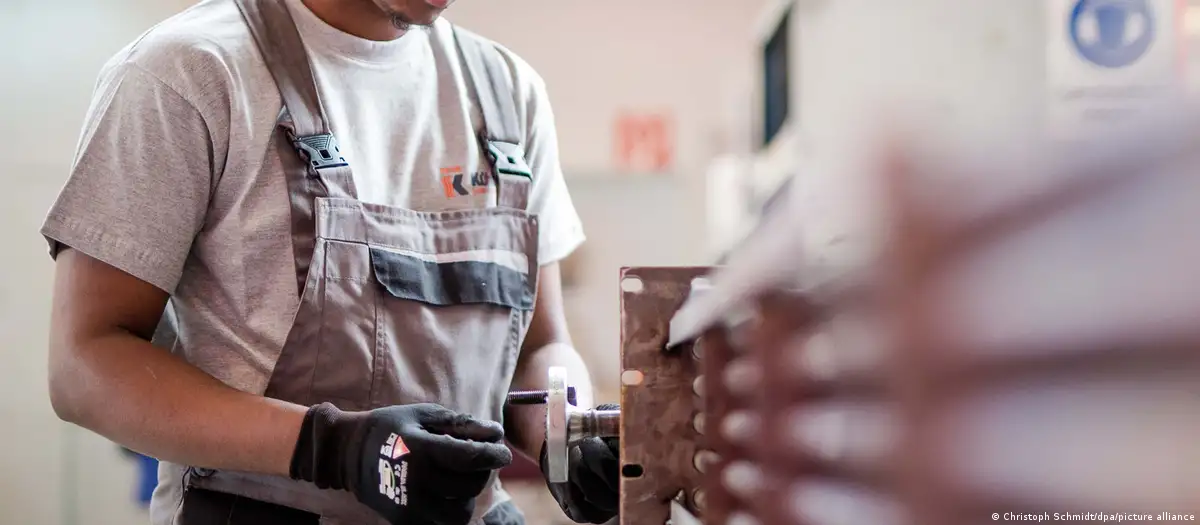
What you need to know
- Germany's interior minister wants to make it easier for asylum-seekers to start working in Germany
- German director Ilker Catak has won the top film prize at the Berlinale
- SPD welcomes CDU support for social media ban for under 14s and calls for swift implementation
This blog is now closed. Below you can read updates of the main headlines from Germany on Sunday, February 22:
Protests against AfD events in Dortmund, Düsseldorf
Over 3,000 people protested against the attendance of far-right Alternative for Germany (AfD) politician Björn Höcke at an event in the western German city of Dortmund on Sunday.
An even bigger protest is expected in nearby Düsseldorf on Monday.
Munich Airport: Snow strands 500 passengers in planes overnight
Some 500 people had to spend the night in airplanes at Munich Airport after flights were canceled due to snowfall late on Thursday.
A Lufthansa spokesperson was cited by DPA news agency on Sunday as saying that the flights were canceled after all passengers were already on board and the planes were ready for takeoff.
According to Munich Airport, the travelers could not return to the airport's terminals until the morning due to a lack of buses and parking facilities.
According to the airport, 100 flights were canceled overnight from Thursday to Friday.
Affected in the incident were three Lufthansa flights to Singapore, Copenhagen and Gdansk and two Air Dolomiti flights to Graz and Venice, according to Lufthansa.
German Jewish leader calls for 'decisive political action' against antisemitism
Josef Schuster, who heads the Central Council of Jews in Germany, on Sunday called for "decisive political action" against antisemitism.
"Since [October 7. 2023], we have seen an explosive rise in antisemitism," he said while speaking at an event commemorating the council's 75th anniversary in Braunschweig, in the state of Lower Saxony.
"If we want to stand up to antisemitism, then decisive political action is needed," he said.
Schuster stressed that political action alone would not be enough, saying, "Decency and democratic culture cannot be imposed by political decree."
He said he was proud that the council was seen as a guardian of the German constitution and its achievements and as a champion of an open society.
The Central Council of Jews in Germany was founded in 1950 in Frankfurt.
The Braunschweig exhibition commemorating the founding of the council is to run from February 24 until September 30.
German authorities and monitoring groups have registered an increase in antisemitic incidents since the Hamas-led attacks on Israel on October 7, 2023, and Israel's ensuing offensive in the Gaza Strip.
Conservative CSU criticizes plan to ban social media for children under 14
The Bavarian conservative Christian Social Union (CSU) has criticized a plan by its larger sister party, the Christian Democratic Union (CDU), to ban social media for children under the age of 14.
"This debate about bans is out of touch with reality," Alexander Hoffmann, who leads the CSU in the lower house of German parliament, the Bundestag, said in comments to regional daily Augsburger Allgemeine.
He said that the government should hold social media platforms accountable rather than imposing a blanket ban.
Hoffmann's comments come after the CDU passed a motion to impose an age limit of 14 for social media at a party conference in Stuttgart on Saturday.
The motion was welcomed by the CDU/CSU's junior federal coalition partner, the center-left Social Democrats (SPD).
Court lifts ban on Austrian far-right extremist Sellner's participation at AfD event
Far-right extremist Martin Sellner may speak at a campaign event for the far-right Alternative for Germany (AfD) in the city of Ettlingen in Baden-Württemberg, a regional court ruled.
City authorities initially withdrew from the rental agreement for the venue of the AfD event, which was to center on the concept of "remigration," citing the topic and the participation of AfD lawmaker Lena Kotre from the eastern state of Brandenburg.
The Brandenburg wing of the party has been classified as right-wing extremist by German federal security authorities, and Kotre has called for mass deportations of immigrants in Germany.
A Karlsruhe court ruled on Saturday that the city must provide the AfD with space for its campaign event but imposed a precautionary ban on Sellner's appearance.
An AfD city councilor then appealed the decision and Branden-Württemberg's state appeals court lifted the ban on Sellner's participation at the event.
Who is Austrian far-right extremist Martin Sellner?
Sellner is a leader of Austria's Identitarian Movement, an organization that agitates against migration and Islam.
He joined the neo-Nazi scene in Austria as a teenager and was mentored by Holocaust denier Gottfried Küssel.
Early in 2024, the state of Brandenburg's capital city of Potsdam secured an entry ban against Sellner after he was scheduled to speak at a far-right event, which was later lifted by a regional court.
Germany's Lochner wins second gold medal in four-man bobsled
Germany's Johannes Lochner has won gold in the four-man bobsled in the Winter Olympics in Cortina d'Ampezzo in northern Italy, marking his third Olympic medal and his second medal this season.
This was the fourth gold medal for the German bobsled team at the Winter Olympics.
Lochner won his first Olympic medal on Tuesday in the two-man bobsled.
The 35-year-old Bavarian announced in September that he would retire from the sport following the Winter Olympics.
Lochner reached first place alongside his push athletes Thorsten Margis, Jörn Wenzel and Georg Fleischhauer.
Germany's Francesco Friedrich, who also won silver in the two-man bobsled race on Tuesday, took second place.
Switzerland's Michael Vogt took the bronze, edging out Germany's Adam Ammour, who took third place in the two-man bobsled race.
Germany dominated the men's bobsled events at the Olympics, with the final medal tally: Germany 8, USA 3, Switzerland 1, rest of the world: 0.
Germany to speed up asylum-seeker access to job market
German Interior Minister Alexander Dobrindt says he wants to speed up the integration of asylum-seekers into the workforce.
In an interview with the Sunday edition of the tabloid Bild newspaper, he said he had drawn up an "immediate employment plan" that would allow asylum-seekers to get a job after three months in Germany.
"Anyone who comes here should be able to work — and quickly," Dobrindt said. "The best form of integration is into the world of work."
According to the report, migrants would be able to start working even if their asylum applications were still being processed.
A spokeswoman for Dobrindt told Bild that whether an asylum-seeker chose to work or not would have no influence on the outcome of their asylum claim. She added that those who did work would generally be able to keep their earnings, and that any income would be offset against social benefits received.
Asylum-seekers who have already been rejected or do not cooperate with authorities, for example by providing false information, would be excluded from the plan, the newspaper reported.
German chamber of commerce warns of rising risks in China business
The German Chamber of Industry and Commerce (DIHK) says doing business with China comes with increasing risks, as the country expands its position in global markets.
"This presents opportunities for German companies, for example through strong technological progress and local innovation," DIHK President Peter Adrian told the German news agency dpa. "However, this is offset by growing risks, such as government intervention and unequal competitive conditions."
The warning comes ahead of German Chancellor Friedrich Merz's planned trip to Beijing on Tuesday.
Last year, China was Germany's most important trading partner, with the volume of imports and exports totalling €251.8 billion ($296.6 billion), according to the latest German government data.
At the same time, German companies have complained of increasing barriers in the Chinese market.
Beijing has also restricted exports of rare earths — critical raw materials used in products such as mobile phones and electric motors.
"I am counting on the Chancellor to represent the interests of the German economy in Beijing," said Adrian, noting that the Chinese market still offers German companies opportunities when it comes to "renewable energies, the circular economy, medical technology and large infrastructure projects."
SPD calls for swift action on social media ban for kids
Germany's Social Democrats (SPD) have welcomed a decision by coalition partner the conservative Christian Democrats (CDU) to ban social media for children under the age of 14.
At a party conference in Stuttgart on Saturday, the CDU passed a motion to implement a ban for the age group, as well as introduce more stringent checks for teens and fines for online platforms that fail to comply.
SPD Secretary General Tim Klüssendorf told the newspapers of the Redaktionsnetzwerk Deutschland on Sunday that the ruling coalition should now move swiftly to make the ban a reality.
"We finally need clear rules on digital platforms. Addiction-inducing algorithms, hate, and bullying are a massive problem for our entire society and can be particularly dangerous and harmful to children and young people," he said.
The SPD has previously called for social media platforms to be banned for children under 14, and for children under 16 to only be able to access versions of platforms free from algorithm-controlled reward and recommendation systems.
Speaking to the tabloid Bild on Sunday, SPD parliamentary secretary Dirk Wiese also welcomed the CDU's support for the measure.
"Now we should work together to pass a concrete law in the German Bundestag very soon," he said.
Norway, Greece, the UK, Denmark, Italy and the Netherlands are among a host of European countries discussing a similar form of ban, while the EU has increasingly moved toward supporting the principle.
Australia last year enforced a law that blocks minors under the age of 16 from having social media accounts on platforms like TikTok, Instagram, YouTube, Facebook and Reddit.
German filmmaker wins Golden Bear at Berlinale
The Berlin International Film Festival's top prize, the Golden Bear, has gone to the political drama "Yellow Letters," by German director Ilker Catak.
The Turkish-language film follows a married couple whose relationship is tested as it comes under extraordinary political pressure.
"Yellow Letters" was decidedly the most political of all 22 works in the main competition, an apt conclusion to an event overshadowed by political debates.
Welcome to our coverage
Guten tag from the DW newsroom in Bonn, where we will be bringing you the latest headlines from Germany on this rainy Sunday.
Germany's interior minister has unveiled plans to make it easier for asylum-seekers to start working after just three months in the country.
He said the goal was to speed up the integration of new arrivals.
Meanwhile, Germany's Social Democrats have welcomed support from their coalition partner to ban social media for children under 14.
Stay tuned as we bring you these stories and more.