Ukraine updates: Witkoff, Kushner to meet Kyiv officials
Published December 4, 2025last updated December 4, 2025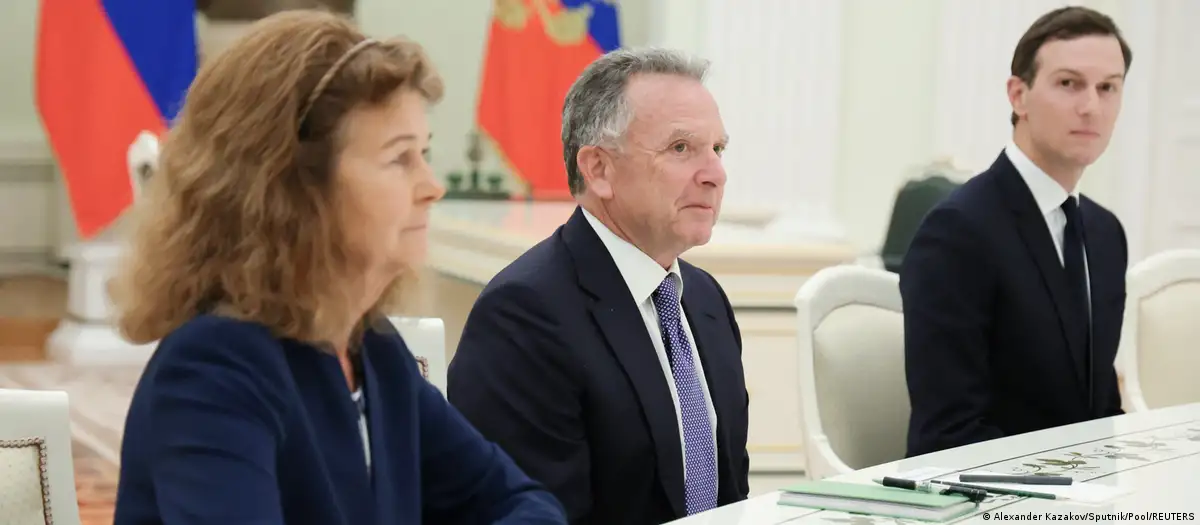
What you need to know
-
US President Donald Trump's envoy Steve Witkoff and son-in-law Jared Kushner are set to meet Ukrainian chief negotiator Rustem Umerov in Florida
-
The talks come after Witkoff and Kushner met with Russian President Vladimir Putin at the Kremlin on Tuesday
-
The leaders of France in Germany reportedly warned Ukrainian President Zelenskyy that the US could 'betray' Kyiv in talks
-
Russia says no compromise has been reached on the critical issue of territory in eastern Ukraine
-
Putin accused European nations of trying to sabotage the peace efforts, warning Russia was 'ready' for war with Europe
-
During a trip to India on Thursday, Putin says some parts of the plan are unacceptable
This blog is now closed. Below are the latest developments related to Russia's war in Ukraine on December 4, 2025:
Merz to visit Belgium after European Commission unveils Russian frozen assets proposal
German Chancellor Friedrich Merz is set to travel to Brussels on Friday evening for a dinner meeting to speak privately with Belgian Prime Minister Bart De Wever and European Commission President Ursula von der Leyen.
The meeting marks a last-minute change of plans, as Merz had originally been scheduled to visit Norway.
No official explanation was given for the shift, but the timing is notable: It comes just one day after the European Commission unveiled a proposal to raise €90 billion (about $105 billion) for Ukraine, with some of it coming from leveraging frozen Russian assets.
Merz and his government strongly support the initiative. In an opinion piece published Wednesday in the Frankfurter Allgemeine Zeitung, he argued that the financial risks should be shared fairly among EU member states, proportionate to their economic strength.
Belgium, which holds the largest share of frozen Russian assets, has voiced concerns about the legality of such a move — a position that appears unchanged despite Merz’s assurances.
German Foreign Minister Johann Wadephul reiterated Berlin’s stance on Thursday, saying the government is "pursuing the clear political goal of making these assets usable" to help Ukraine sustain its defense and basic services. He stressed that consultations with all EU partners were ongoing.
The decision to arrange a private dinner of national leaders at short notice underscores the complexity of the negotiations.
While Merz, von der Leyen, and De Wever all identify as conservatives, De Wever’s party sits with the hard-right bloc in the European Parliament, which includes euroskeptic and nationalist forces. The stakes are high: Proponents of the plan hope EU leaders will reach an agreement at their summit from December 18 to 19.
A just peace for Ukraine guarantees Germany's security, defense minister says
German Defense Minister Boris Pistorius said Thursday that peace and security for Germany and Europe can only be secured through a fair peace deal for Ukraine.
Pistorius made the remarks during a debate in the German parliament, the Bundestag.
"If we cannot achieve a lasting and just peace for Ukraine, we will also have no guarantee for our own security," the politician from the center-left Social Democrats (SPD) said.
The defense minister also urged Germany and Europe to do more for both Ukraine's and the continent's defense.
He warned that the "geopolitical chessboard" is shifting rapidly, which requires parliament to allocate additional funds to the German military to boost personnel and materiel.
Germany and Ukraine's other European allies have been insisting that Russia not be allowed to dictate the terms of a peace deal to end the war.
The Bundestag debate was focused on Germany's ongoing support for Kyiv, as it continues to defend against Russia's full-scale invasion that began in February 2022.
NATO must address hybrid threats, supreme commander says
NATO Supreme Allied Commander Europe General Alexus Grynkewich told reporters on Thursday that the military alliance has to be capable of responding to hybrid threats Russia could pose to NATO territory.
"Hybrid threats are a real issue, and I do think that we can anticipate more of that happening. We saw the unmanned aerial system (UAS) events. We've seen the sabotage on the Polish railway. All of those things are part of this this hybrid network of activity. Some of it reckless, some of it intentional. It's something that we have to be able to respond to," Grynkewich said.
Hybrid threats can be both military and non-military actions aimed at undermining an adversary's security. They typically include cyberattacks, disinformation, sabotage of important infrastructure and the use of drones.
He added that it was important for NATO to make clear it knew Russia was behind at least some of the recent drone incursions in Europe.
"It's important that we attribute it and that we say that we know Russia is behind some of this, maybe not all of it, but certainly some of it. This doesn't represent an existential threat to anything that the alliance is doing. It's not undermining our unity. We're able to respond and manage it."
Grynkewich added that NATO would examine hybrid responses to hybrid threats and that for NATO, as a defensive alliance, "there's nothing offensive about this."
"If Russia is attempting to provide dilemmas to us, then maybe there are ways that we could provide dilemmas to them. I'll just leave it at that because I don't want to get into the specifics of how we might be providing those dilemmas."
Grynkewich also addressed peace talks set to happen in the US on Thursday, saying "everyone wants peace." The US Air Force general attended recent negotiations on the US peace proposal in Geneva, though not in his capacity as a NATO commander.
"All the Ukrainians want peace," he said. "Of course, they want a just and lasting peace."
Additional reporting from Teri Schultz
Ukraine accuses Russia of sending Ukrainian children to North Korea 're-education' camps
Some of the thousands of Ukrainian children who have been abducted by Russia from occupied territory have been sent to North Korea for "re-education," Ukraine said.
Kyiv's human rights ombudsman, Dmytro Lubinets, did not specify how many children had been taken by Russia to North Korea. Moscow has not publicly commented on the allegation.
Lubinets cited testimony reported by the Kyiv-based Regional Center for Human Rights, which said there is a network of 165 "re-education camps" in occupied eastern Ukraine, Belarus, Russia and North Korea.
North Korea is a hermetic, highly repressive regime that has deepened its ties with Russia since the start of Moscow's full-scale invasion of Ukraine.
Kyiv says Russia has forcibly displaced nearly 20,000 children since it invaded in 2022.
Russia has admitted to moving some children since the offensive was launched, but it says the move was for the children's safety and to reunite them with their relatives. Ukraine rejects that claim.
Meanwhile, US first lady Melania Trump has said that seven children who were separated from their families by the war have been reunited with their relatives.
In October, Melania Trump announced that eight children had been returned to their families, after she said she had personally written a letter to Russian President Vladimir Putin.
European leaders reportedly voice distrust of US in Ukraine talks
The leaders of Ukraine's European allies held a conference call this week in which they reportedly warned Ukrainian President Volodymyr Zelenskyy that the US could "betray" Kyiv during talks with Russia to end the war.
German weekly Der Spiegel reported on Thursday that German Chancellor Friedrich Merz and French President Emmanuel Macron told Zelenskyy that they do not trust that the Trump administration has Ukraine's best interests at heart.
According to Der Spiegel, which said it had obtained a transcript of Monday's conference call, Macron warned of the "possibility that the US will betray Ukraine on the issue of territory without clarity on security guarantees."
Russia is demanding that Ukraine cede territory in the east of the country that is occupied by Moscow.
Merz, for his part, warned Zelenskyy to be "extremely careful in the coming days" and that the US was "playing games, both with you and with us."
In remarks to AFP, the German Chancellery refused to comment on the media reports. "Furthermore, we cannot, as a matter of principle, report on confidential conversations."
Similarly, Dmytro Lytvyn, the Ukrainian president's communications adviser, told AFP that "we do not comment on provocations."
Trump administration lifts some sanctions on Russian oil giant Lukoil
The US Treasury Department has suspended some sanctions against the Russian energy giant Lukoil, easing some of the West's economic pressure on Russia over its war in Ukraine.
On Thursday, the Treasury said it was extending authorization for Lukoil-branded fuel stations outside Russia.
The Treasury Department said it was making the move to "mitigate harm to consumers and suppliers seeking to engage in ordinary transactions" with service stations that are involved with Lukoil and its entities.
The measure means Lukoil petrol stations can continue operating in countries such as the United States without money flowing back to Russia.
A ban preventing money from reaching Russia remains in place.
Russia has been slapped with broad Western sanctions over its 2022 invasion of Ukraine.
President Donald Trump imposed sanctions on Lukoil in October as part of his administration's efforts to pressure Moscow to agree to a peace deal.
The Treasury's measure was announced as Putin was visiting New Delhi, where he told India Today that if the US can buy Russian fuel, "why shouldn't India have the same privilege."
Putin says parts of US plan are unacceptable to Russia
Russian President Vladimir Putin, who was in India on a state visit Thursday, has said that Moscow "can't agree" to some of the peace plan proposed by the US.
Putin made the remarks during an interview with broadcaster India Today after he met with US envoys Steve Witkoff and Jared Kushner in the Kremlin on Tuesday.
The latest version of the plan includes revisions after discussions with Ukraine and its European allies.
The key sticking points blocking progress are thought to be the issue of territory in eastern Ukraine, much of which is occupied by Russia, as well as Ukraine's long-term security guarantees.
Witkoff, Kushner set to meet chief Ukrainian negotiator in Miami
US President Donald Trump's special envoy, Steve Witkoff, and Trump's son-in-law Jared Kushner are due to meet with Ukraine's chief negotiator, Rustem Umerov, in Miami on Thursday.
Officials from the Trump administration, speaking to AFP and AP news agencies on condition of anonymity, have confirmed the meeting but did not provide any further details.
Although a meeting of his envoys earlier this week with Russian President Putin in Moscow did not result in a breakthrough, Trump said Wednesday that the talks in the Kremlin were "very good."
He also said that Kushner and Witkoff had left their meeting with the impression that Putin would "like to make a deal."
Welcome to our coverage
White House special envoy Steve Witkoff and Donald Trump's son-in-law and former adviser Jared Kushner are set to meet senior Ukrainian negotiator Rustem Umerov in Florida on Thursday.
The meeting comes after Trump's envoys failed to secure a breakthrough in negotiations to end the war in Ukraine after they met with Vladimir Putin this week.
Witkoff and Kushner had traveled to Moscow to present a revised version of Trump's 28-point plan for peace in Ukraine, which Kyiv and its European allies had denounced as too favorable to Russia.
The Kremlin rejected the revisions, with territory in eastern Ukraine and long-term security guarantees for Kyiv the main sticking points.
Stay tuned as DW brings you the latest on the latest push for peace in Ukraine, nearly four years after Russia's full-scale invasion.