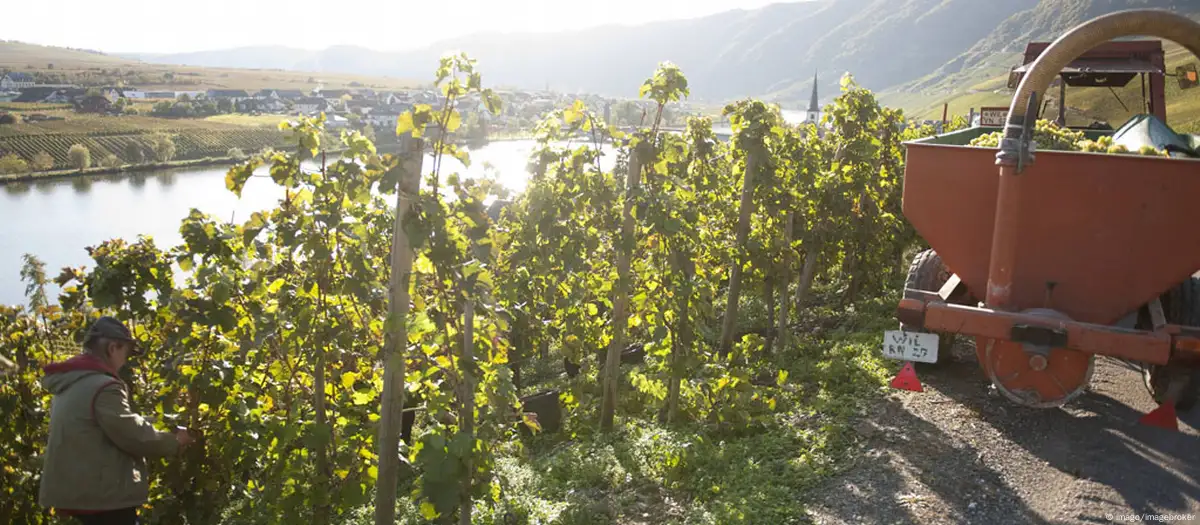
Police in the southern German town of Hassloch reported on Monday that thieves had made off with an entire vineyard of wine grapes in broad daylight. The devious criminals made off with €8,000 ($9,242) worth of riesling white wine grapes.
"The unknown offenders … used a professional harvesting machine over the entire surface" of the vineyard, according to the police report.
The crime was carried out on Wednesday between 4 p.m. and 6 p.m.. The thieves absconded with 1,600 kilograms (3,527 pounds) of grapes in the village of Deidesheim, just north of Hassloch.
Deidesheim lies in the state of Rhineland-Palatinate, which despite its small size is home to six of Germany's 13 wine-producing regions. The area is especially famous for riesling, but is also home to the Schloss Wachenheim Group, the worldwide leader in sparkling wine production. The 13,000 vintners in the area account for 90 percent of Germany's wine exports.
-
Germany’s wine regions
Germany's wine regions
German wine differs from wines of other countries - it's light, lively and fruity, thanks to Germany's unique climatic and geological conditions. The diversity of German wine stems from the many soil types and grape varieties. This diversity is reflected in Germany's 13 wine-growing regions.
-
Germany’s wine regions
Rheinhessen
The vineyards here are between Worms, Mainz and Bingen and cover an area of 26,000 hectares. This is Germany’s largest wine-growing region, in part dating back to the 9th century. It is home to Germany’s oldest vineyard, the Niersteiner Glöck.
-
Germany’s wine regions
Rheingau
There are six different wine-growing regions along the Rhine, including the Rheingau. The monastery in Eberbach was founded by Cistercian monks from Burgundy. They brought the skills of wine-making to the monastery and its wines are exported the world over.
-
Germany’s wine regions
Middle Rhine
The Middle Rhine region begins in Bingen. The river becomes narrower here and the region is famous for its steep vineyards beside the Rhine. The region with its castles and medieval towns became a UNESCO world heritage site in 2002.
-
Germany’s wine regions
Palatinate
This is a wine-growing region with superlatives that include the largest wine festival and the world’s largest wine barrel. Along the 85 kilometer long German wine trail you will find 130 wine-growing towns and villages. Every year the German wine queen is crowned in Neustadt.
-
Germany’s wine regions
Franconia
The famous round wine bottles are the trademark of wines from Franken in northern Bavaria. The region is home to many young vintners whose motto is quality, not quantity. The region has been home to wine-growing for over 1,200 years.
-
Germany’s wine regions
Moselle
Here you will find steep vineyards on the river banks. This one is in fact the steepest vineyard in Europe with 68 degree gradients. The only equipment here is the cog wheel railway. Everything else has to be done by hand. This is Germany’s oldest wine-growing region. The tradition was brought here by the Romans 2,000 years ago.
-
Germany’s wine regions
Baden
This area enjoys plenty of sunshine. It is Germany’s third largest wine-growing region and stretches from Lake Constance in the south along the Rhine to Mannheim in the north. Baden is the most important wine region for pinot noir.
-
Germany’s wine regions
Württemberg
The centers of this wine-growing region are Stuttgart and Heilbronn. The amount of wine consumed by the locals is twice the national average. The region is famous for its red wine. Stuttgart produces more wine than any other German city and stages an annual wine-tasting event.
-
Germany’s wine regions
Ahr
The village of Mayschoss on the River Ahr is surrounded by vineyards. The Ahr valley is one of the northernmost wine-growing regions in Germany and also one of the smallest. A 35 kilometer hiking path links the vineyards. Wine tasting is encouraged!
-
Germany’s wine regions
Saale-Unstrut
Germany’s northern-most wine-growing region is along the Saale and Unstrut rivers. The wines from this region are rather rough and the yields are small. Nevertheless the local vintners have learned how to produce top quality wines and they are in huge demand.
-
Germany’s wine regions
Saxony
This wine-growing region, like Saale-Unstrut, is in the former East Germany. It enjoyed a revival after the fall of communism. It is now well-known for its sparkling wines, for example from Schloss Wackerbarth, the second oldest cellar for sparkling wines in Germany. During the last weekend of August more than 25 local vineyards open their doors to the public for wine tasting and guided tours.
-
Germany’s wine regions
Nahe
This region with some 4,000 hectares of vineyards lies between the Rhine and Moselle rivers. It is one of Germany’s smaller wine-growing regions. It is best explored by hiking or cycling but it also has its own wine route.
-
Germany’s wine regions
Hessische Bergstrasse
This region is located north of Heidelberg. Just 452 hectares in size, it boasts 233 different types of soil. Wines differ from place to place. They are rarely found on shop shelves because they are almost all sold and drunk locally.
Author: Anne Termèche