Spain train crash: PM Sanchez vows to 'find out the truth'
Published January 19, 2026last updated January 19, 2026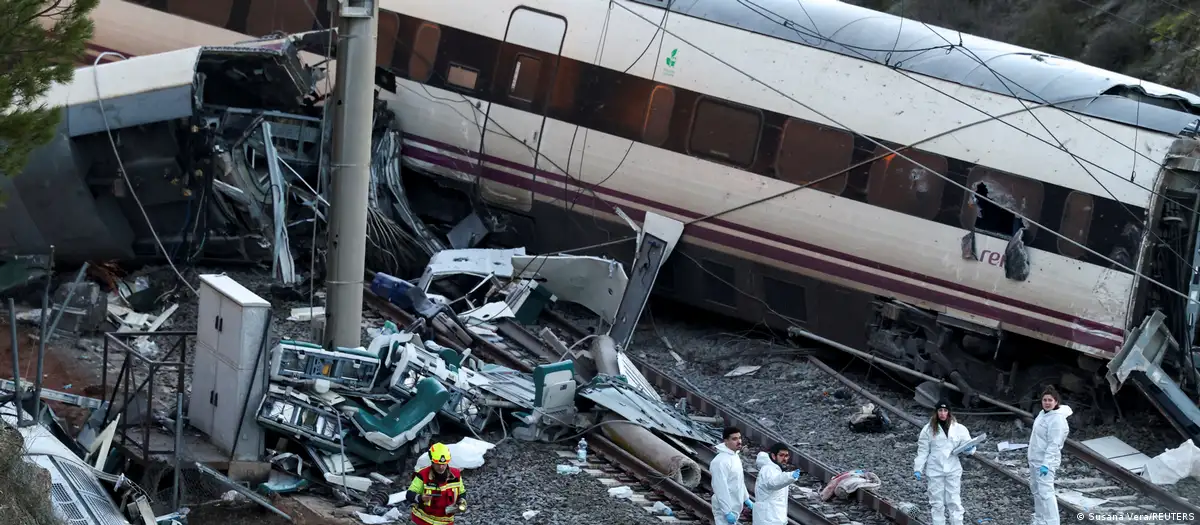
What you need to know
- Spain's prime minister announces three days of mourning starting at midnight on Monday
- Death toll rose to 40, the president of Andalusia, the Spanish southern region where the accident happened, confirmed
- A high-speed train derailed on Sunday around 7:30 p.m. local time (1830 UTC), jumping the track and hitting an oncoming train
- A train carrying around 300 people from Malaga to Madrid crashed into a train carrying around 200 people from Madrid to Huelva
- Crash is deadliest train accident since 2013
Follow below for more news and information on the train crash in southern Spain here:
Spain train collision death toll rises to at least 40 people
The death toll following a high-speed collision between two trains in southern Spain has risen to at least 40 people, according to the head of the regional government of Andalusia. The toll could rise as rescue efforts continue.
"There are currently 40 confirmed deaths," Juanma Moreno told a news conference on Monday, adding that it would take another 24-48 hours "to know with certainty how many deaths have resulted from this terrible accident."
TIMELINE — Spain's deadliest train disasters
Sunday's tragic crash brings to mind dark memories of deadly crashes in the southern European country, most of which occurred in the previous century. Here's a look at Spain's deadliest train crashes:
- 1944 - Torre del Bierzo: Three trains crashed in El Bierzo region of Spain's Leon province, killing at least 78. The death toll remains debatable as it was issued under the regime of late dictator Francisco Franco and the true toll is believed to have been censored
- 1965 - Grisen: A train on the Madrid-Barcelona route caught fire, killing dozens. The declared death toll of 30 is also disputed, having also come during Franco's regime, with later reports estimating a toll of up to 80
- 1970 - Urduliz: Two trains collided head-on near the Basque city of Bilbao in the north, killing 33. The stationmaster blamed for the accident had been working 16-hour shifts for four days prior to the crash
- 1972 - El Cuervo: Another head-on collision between two trains on the southern Cadiz-Seville route killed 86 people. An investigation by the state-owned rail operator Renfe blamed the accident on the driver for failing to stop at a red light at El Cuervo station
- 2013 - Santiago de Compostela: An eight-carriage high-speed train veered off the track near the northwestern city of Santiago de Compostela, killing 80 people. A Transport Ministry commission blamed the accident on speeding and a distracted driver, but a victims' association also highlighted the role of the railway's security systems
Adamuz residents eager to help out in time of crisis
The willingness of the residents in Adamuz to help is impressive. Many have kept their doors open all night and day.
Many relatives have traveled to the town after learning of the accident, trying to find out what happened to their loved ones.
At the same time, people here are asking more and more questions about what caused the accident.
Some local media reports are emerging that passengers and train staff had warned of bumps and strange noises on the affected section of track months ago.
European leaders express condolences and concern over lives lost in train crash
Heads of government from across Europe have expressed their sympathy and condolences for the victims of the train crash in southern Spain that has left at least 39 people dead and others seriously injured.
"My thoughts are with the victims, their families and the entire Spanish people," said French President Emmanuel Macron. "France stands by your side."
Italian Prime Minister Giorgia Meloni said: "Italy stands close to Spain in its grief for this tragedy."
The Dutch prime minister, Dick Schoof, called the news "horrific" and said: "I have expressed my support and condolences to prime minister Sanchez. My thoughts are with all the victims and their families affected by this enormous disaster."
In Germany, Chancellor Friedrich Merz said he was "deeply shaken" by the news. "My thoughts are with the families and loved ones of the victims, I offer them my sincere condolences," he said. "To the injured, I wish strength and a speedy recovery. Germany stands with Spain at this time."
The Greek Foreign Ministry also expressed "deepest condolences to the families of the victims," adding, "At this time of sorrow, Greece stands in solidarity with the people and the government of Spain."
Spanish PM Sanchez: 'We will get to the truth'
Spain's Prime Minister Pedro Sanchez has vowed to provide answers following the deadly train accident that killed at least 39 people.
"It is true that society is asking itself what has happened and how," Sanchez told a press conference, adding that time and the "work of experts" would provide the answer.
"We will get to the truth, we will find out the answer and when we know it, we will release to the public with absolute transparency and clarity," the prime minister added.
Sanchez, who praised the emergency responders and workers, vowed to assist the victims of the accident "for as long as necessary."
He also declared a three-day mourning period in the wake of the accident.
Train drivers warned of AVE safety issues — report
A Spanish train drivers’ union warned rail operator ADIF last August about severe wear and tear on high-speed rail tracks, including on a line where two trains collided in a fatal crash on Sunday, according to a copy of the letter seen by Reuters.
The letter said potholes, bumps and imbalances in overhead power lines were causing frequent breakdowns and damaging trains. It added that drivers had alerted the operator "daily" to their concerns but that no action had been taken.
The document, published on X, was verified by a member of the train drivers' union SEMAF to the Reuters news agency.
WATCH — Footage from deadly crash site
Two high-speed trains collided following a derailment in Cordoba, a city in southern Spain. Rescue efforts continue as investigators probe the cause.
Guardia Civil continues response after Adamuz train crash
Spain's Guardia Civil has continued operations following the train crash in Adamuz, deploying more than 220 officers, the force said on X.
It said personnel from citizen security units, the traffic division, rapid response groups, and the air service are working at the scene in Adamuz, in the province of Cordoba.
The Guardia Civil said its Central Criminalistics team is carrying out victim identification.
Sanchez cancels Davos trip
Spanish Prime Minister Pedro Sanchez has canceled his planned trip to the World Economic Forum in Davos following the high-speed train collision.
His office said the decision was taken after Sunday's crash, the deadliest rail accident in the country in more than a decade.
Operator says train last inspected on Thursday
The rail operator Iryo has said the last inspection of the train that derailed and then collided with another service in southern Spain was carried out on Thursday.
In a statement sent to the AFP news agency, the company said the train, built in 2022, left Malaga for Madrid with 289 passengers, four crew members, and one driver on board.
The operator said that at 7:45 pm local time (1845 GMT/UTC), and for reasons that remain unknown, the train entered the adjacent track near the town of Adamuz, where it collided with a train traveling in the opposite direction.
Sanchez to visit site of deadly Spain train crash
Spanish Prime Minister Pedro Sanchez is to visit the site of the collision later on Monday, his office has said.
The purpose of the visit is "to get first-hand information on" Sunday's crash, which officials described as Spain's deadliest rail accident since 2013.
Spain says cause of train crash still unknown
The Spanish Red Cross has set up a help center in the town of Adamuz, near the crash site.
It is offering assistance to emergency services and people seeking information.
Members of Spain's civil guard and civil defense have been working at the site throughout the night
Spanish Transport Minister Oscar Puente has said the cause of the crash remains unknown.
He described it as "a truly strange" incident, noting it occurred on a flat section of track that was renovated in May.
Puente said the train that derailed was less than four years old and operated by the private company Iryo. The second train, which absorbed most of the impact, belonged to Spain's state-owned rail company Renfe.
Crash death toll rises to 39
A total of 39 people have died in the train accident that occurred yesterday, Sunday, in the town of Adamuz, in southern Spain's Cordoba province.
A total of 73 people remain hospitalized, 24 of them in serious condition, including four minors.
At least 75 train passengers hospitalized
At least 75 passengers were hospitalized after a high-sped train derailed and collided with an oncoming train, Andalusia's regional President Juanma Moreno told reporters.
Among them were 15 people with serious injuries.
Most of the injured passengers were taken to hospital in Cordoba, close to the town of Adamuz where the crash happened.
Moreno said rescuers would work through the night to remove bodies from the wreckage. Andalusia's regional health minister earlier warned of "a very difficult night ahead."
Train services from Madrid to Andalusia canceled
Spain's state-owned railway infrastructure operator Adif announced that high-speed services between Madrid and the Andalusian cities of Cordoba, Seville, Malaga, Granada and Huelva would be suspended for all of Monday at least.
The rail network added that assistance zones had been set up at stations in Madrid, Seville, Cordoba, Malaga and Huelva for the relatives of the victims.