Iran war: White House mulling fresh talks with Tehran
Published April 15, 2026last updated April 16, 2026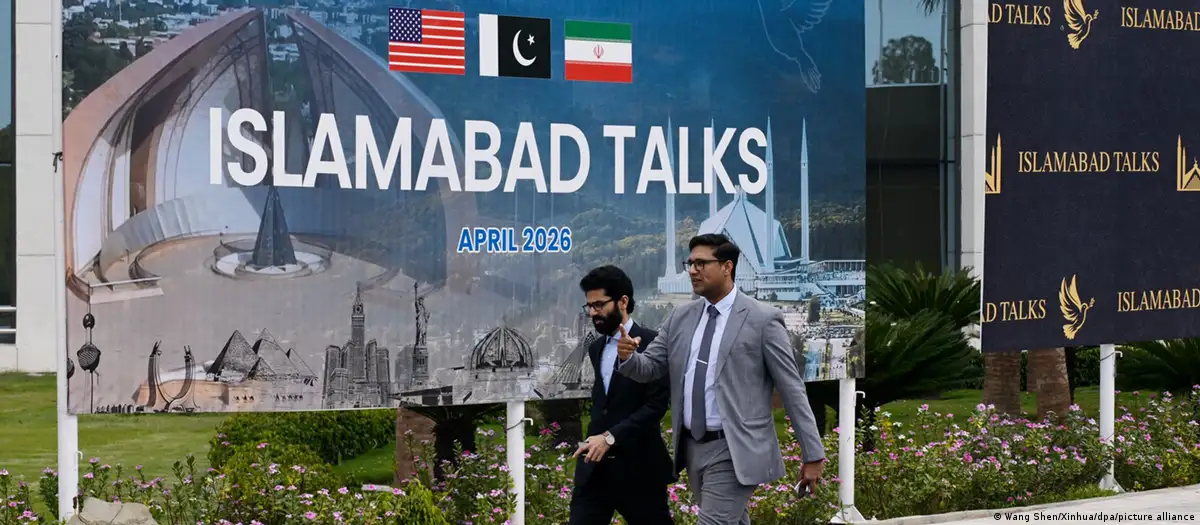
What you need to know
- Iranian military says it will block trade in the Persian Gulf, Sea of Oman and Red Sea if US naval blockade continues
- Israel and Hezbollah trade attacks a day after Israeli talks with Lebanese officials in Washington, DC
- Trump says he told China's Xi not to give Iran weapons
- Trump hoping for a 'grand bargain' with Iran, says JD Vance
- UN chief Guterres says 'highly probable' US-Iran talks will resume
- Canada, UK call for 'urgent' stop to fighting in Lebanon
These updates have been closed. Thank you for reading.
For our latest coverage of the war in Iran and the situation across the Middle East, please continue reading here.
Below, you can review a round-up of developments from Wednesday April, 15, 2026.
China asks Tehran to restore navigation in the Strait of Hormuz
Chinese Foreign Minister Wang Yi on Wednesday urged Iran to help restore normal navigation in the Strait of Hormuz during a phone call with his Iranian counterpart, Abbas Araghchi, the Chinese Foreign Ministry said.
Wang said Iran's sovereignty and security in the strait should be respected, but stressed that freedom and safety of navigation must also be ensured. He highlighted a broad international consensus on restoring normal shipping through the waterway.
The situation is at a critical stage of transformation, and the window for peace is opening, Wang said.
He reiterated China's support for maintaining a ceasefire and advancing negotiations, calling them in the interests of Iran, the region and the wider international community.
Earlier reports said that amid the chaos in the Middle East, following the US-Israeli war on Iran, China has projected itself as a stabilizing force and potential mediator in the conflict.
WATCH — What's at stake for China as Iran war drags on?
China is feeling the impact of the Iran war both economically and through the added strain it places on relations with the United States. As the conflict in the Middle East drags on, we examine what Beijing's next moves might be.
Top adviser to supreme leader says Iran will sink US ships in Strait of Hormuz
Mohsen Rezaei, the top military adviser to Iran's Supreme Leader Mojtaba Khamenei, threatened the US on Wednesday during an interview with Iranian state television.
Khamenei appointed Rezaei, a former commander-in-chief of Iran's Revolutionary Guards between 1981 and 1997, his top military adviser last month.
Rezaei, who is opposed to the notion of a ceasefire, said: "Mr. Trump wants to become the police of the Strait of Hormuz. Is this really his job? Is this the job of a powerful army like the US?"
"These ships of yours," he continued, "will be sunk by our first missiles and have created a great danger for the US military. They can definitely be exposed to our missiles and we can destroy them."
Trump has responded to Iran closing the Strait of Hormuz with his own blockade. The prospect of US warships being exposed to direct Iranian attack in the narrow waterway is a major concern for the US and something that Iran has been seeming to egg on.
Rezaei, who has a reputation as an extreme hardliner even within the IRG, said he would welcome a US ground invasion, claiming, "We would take thousands of hostages and then for each hostage we would get a billion dollars."
Senate Republicans block bid to reign in Trump on war powers
The US Senate voted 52-47 against demanding President Trump seek Congressional backing for his military operation in Iran on Wednesday.
Passage of the Democratic bill would have forced an end to the war until Trump received Congressional approval under the War Powers Resolution.
The War Powers Resolution requires the president to notify Congress within 48 hours of committing armed forces to military action. It also forbids armed forces from remaining in a conflict zone for more than 60 days, with a further 30-day withdrawal period in the absence of Congressional Authorization for Use of Military Force (AUMF), or a formal declaration of war.
Trump has been promising that the war in Iran is "almost over" since he launched it more than seven weeks ago.
Only one GOP senator, Rand Paul of Kentucky, sided with Democrats. John Fetterman of Pennsylvania was the only Democrat to side with Trump on the issue. Republican Jim Justice of West Virginia did not cast a vote.
Democrats have vowed to continue bringing similar resolutions until the conflict ends or Congress authorizes fighting.
The Republican-controlled House of Representatives is expected to consider a similar measure later this week.
US Treasury to conduct 'financial equivalent' of bombing campaign says Bessent
US Treasury Secretary Scott Bessent on Wednesday said his agency is getting ready to deliver "the financial equivalent" of Washington's bombing campaign on Iran by introducing new secondary sanctions against banks that do business with the Islamic Republic as well as anyone who purchases its oil.
Bessent said more nations, especially in the Gulf, are willing to join the US sanctions regime in the wake of Iran striking out against its regional neighbors in response to US and Israeli strikes.
"We have told countries that if you are buying Iranian oil, that if Iranian money is sitting in your banks, we are now willing to apply secondary sanctions," he said.
Bessent, who was touting the administration's tax policies, also struck a very optimistic tone when asked about the state of gas prices — which have skyrocketed to over $4.00 a gallon (€0.896 per liter) since the US launched its war on February 28.
Asked if Americans would have to use money saved in taxes to pay for higher fuel costs, Bessent said: "Americans have more money. They can decide how they want to spend it."
He then added, "I'm optimistic that sometime between June 20th and September 20 that we can have $3 gas again."
READ MORE: How is the Iran war impacting India’s aviation sector?
India's aviation sector had been one of the fastest-growing in the world before the Middle East conflict.
Now, the ongoing geopolitical crisis is reshaping flight paths and the economics of air travel for Indian carriers.
DW’s Shakeel Sobhan from New Delhi explains in this article how the situation is exposing vulnerabilities in India's airline sector: India's aviation boom hits turbulence amid Iran war
Kremlin says US rejected plan for Russia to control Iran's uranium
Kremlin spokesman Dmitry Peskov on Wednesday said the United States had rejected a Russian offer to take control of Iran's enriched uranium and convert it into civilian reactor fuel as a way to ease tensions over the Islamic Republic's contentious nuclear program.
Moscow said it had initially made the offer last June and repeated it again earlier this week.
"Russia was prepared to accept Iran's enriched uranium on its territory," Russian state news agency RIA quoted Peskov as saying.
"This would be a good decision. But unfortunately the American side rejected this proposal," Peskov explained.
The Trump administration and Israel have both pointed to Iran's enriched uranium stockpile, among other things, as grounds for their attacks on Iran.
Israel continues to pound what it calls 'kill zone' in Lebanon
Israeli Prime Minister Benjamin Netanyahu on Wednesday said his country's military operations in neighboring Lebanon would continue as he vowed to crush Iran-backed Hezbollah militants there.
Israel has come under pressure to back off from its offensive in Lebanon, which has killed and injured thousands of Lebanese civilians as well as displaced over a million more.
The international community has desperately urged Israel to halt its offensive and engage in dialogue, but Israel has so far ignored such entreaties.
Instead, Army Chief of Staff Lieutenant General Eyal Zamir on Wednesday told Israeli troops in Lebanon, "I have ordered that all of the area of south Lebanon up to the Litani (River) line be turned into a Hezbollah terrorist kill zone."
"We are advancing and striking Hezbollah and they are retreating," added Zamir.
IMF boss warns, 'We must brace for tough times ahead'
International Monetary Fund (IMF) Managing Director Kristalina Georgieva on Wednesday warned of the negative impact of sustained high oil prices as the US-Israel war against Iran exerts drag on the global economy.
"We must brace for tough times ahead" if the conflict persists, Georgieva told reporters at a press briefing during IMF and World Bank spring meetings in Washington.
Georgieva added that beyond surging oil prices, inflation could seep into food prices.
With energy prices spiking as the conflict drags on, she said, "We are concerned about risks for inflation, moving into food prices should the delivery of fertilizers at a reasonable price (not be) restarted soon."
White House says new talks may happen in Pakistan
The United States is discussing holding a second round of peace talks with Iran in Pakistan, the White House said on Wednesday.
"Those discussions are being had" and "we feel good about the prospects of a deal," Press Secretary Karoline Leavitt told reporters.
She added that further talks "would very likely" be in Islamabad.
The Pakistani capital hosted the first round of talks between US and Iranian delegations last weekend, the first high-level direct diplomatic engagement between the two sides in decades.
China tells Iran it wants to play 'constructive role' and 'promote peace'
In a Wednesday call, Chinese Foreign Minister Wang Yi told his Iranian counterpart Abbas Araghchi that Beijing "supports maintaining the momentum of the ceasefire and peace talks."
The call took place as Pakistani mediators arrived in Tehran to discuss a potential second round of US-Iran talks.
Talks, said Wang, are "in the fundamental interests of the Iranian people and are also the shared hope of regional countries and the international community," according to a Chinese Foreign Ministry statement.
A Chinese readout of the call quoted Iranian Foreign Minister Araghchi as saying that Tehran "looks forward to China playing a positive role in promoting peace and a cessation of conflict."
Araghchi spoke of "Iran's willingness to continue seeking a rational, realistic solution through peaceful negotiations," according to Beijing.
Wang said Iran's "sovereign security and legitimate rights and interests should be respected and safeguarded, but at the same time…," he continued, "freedom of navigation and security [in the Strait of Hormuz] should be guaranteed."
Pakistan actively laying groundwork for next round of US-Iran talks
Pakistan's political and military leaders are working hard to ensure that peace talks between the US and Iran quickly resume as a ceasefire between the two sides remains tenuous.
On Wednesday, Prime Minister Shehbaz Sharif traveled to Saudi Arabia, where he will discuss the current situation in the Middle East with Crown Prince Mohammed bin Salman.
Sharif, accompanied by a high-level delegation including Foreign Minister Ishaq Dar and Information Minister Attaullah Tarar, will then visit Qatar for further meetings before heading to Turkey for a meeting with President Recep Tayyip Erdgogan.
At the same time, Field Marshal Asim Munir, the head of Pakistan's army, has arrived in Tehran for talks aimed at resolving the war.
Munir is considered one of the most influential intermediaries between the US and Iran and Iranian state broadcaster IRIB reported Wednesday that he was expected to deliver a message from Washington, possibly related to a potential ceasefire extension as well a second round of negotiations.
Peace talks held in Pakistan's capital Islamabad last weekend broke down after one day. Regional partners have been keen to get both sides back at the negotiating table as soon as possible while the conflict weighs heavily on the world economy.
Pope Leo XIV says world needs to hear message of peace
Pope Leo XIV on Wednesday told reporters flying with him from Algeria to Cameroon that the message "the world needs to hear today" is one of peace and dialogue.
The leader of the world's 1.4 billion Catholics has come under fire from US President Donald Trump, who has aggressively attacked Leo in numerous social media posts and public statements.
Trump's ire has been sparked by Leo's unflinching criticism of war, especially US-led wars — and most recently its attack on Iran.
The pontiff did not take questions Wednesday, nor did he make any mention of Trump. Beyond the president, Vice President JD Vance, a recent convert to Catholicism, also maintains an ongoing antagonism toward Leo and publicly defended Trump in the latest feud.
Leo has said he is a man of faith, not a politician, adding that he has no desire to "debate" the president.
In Algeria, Leo visited the ancient home of St. Augustine and spoke of the great theologian and philosopher's message of "unity among all peoples and respect for all people in spite of the differences."
He further cited Augustine's role in modern-day, Muslim-majority Algeria, saying he is revered by all as "one of the great sons of their land," a potential bridge between Christians and Muslims.
Speaking of his visit to the Great Mosque of Algiers, Leo said, "I think the visit to the mosque was significant to say that although we have different beliefs, we have different ways of worshiping, we have different ways of living, we can live together in peace."
"And so I think that to promote that kind of image is something which the world needs to hear today."
Wealthy nations call for 'coordinated emergency support' in Middle East
One day after the International Monetary Fund (IMF) slashed global economic growth forecasts as a result of the war in Iran, finance ministers from eleven countries — Australia, Finland, Ireland, Japan, The Netherlands, New Zealand, Norway, Poland, Spain, Sweden and the UK — called for an immediate end to hostilities and the implementation of "coordinated emergency support" measures for the Middle East in an effort to aid countries impacted by the conflict.
"We call on the IMF and World Bank to provide a coordinated emergency support offer for countries in need, tailored to country circumstances and drawing on the full range and flexibility of their toolkits," read a joint statement.
"Renewed hostilities, a widening of the conflict or continued disruption in the Strait of Hormuz would pose serious additional risks to global energy security, supply chains, and economic and financial stability," the statement continued. "Even with a durable resolution of the conflict, impacts on growth, inflation and markets will persist."
Pakistan army chief visiting Tehran to 'narrow gaps' between Iran and US
Chief of Army Staff of Pakistan Asim Munir is visiting Tehran amid hopes of new diplomatic talks between the US and Iran.
A senior Iranian source told Reuters that the visit will "narrow gaps between Iran and the US."
Trump has said that a new round of talks between Iran and the US could be held in Pakistan in the coming days.