Germany updates: Air conditioner sales up as heat wave hits
Published August 12, 2025last updated August 12, 2025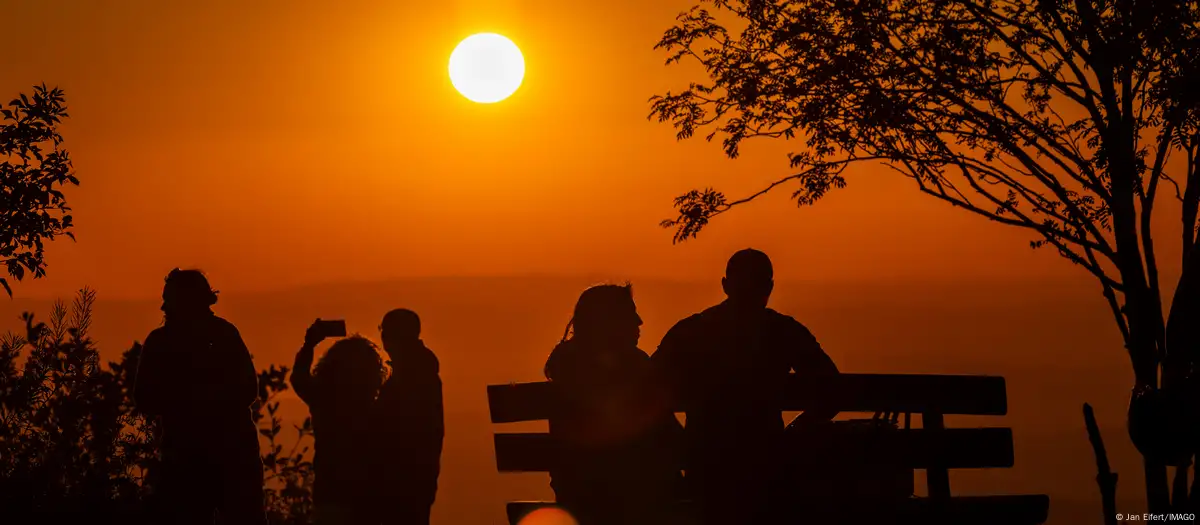
What you need to know
A heat wave has descended on Germany with temperatures expected to climb across the country over the next several days.
Temperatures are expected to go as high as 38 degrees Celsius (100 degrees Fahrenheit) in many parts of the country, with meteorologists also predicting high humidity.
Health officials are imploring citizens to hydrate and stay out of the sun as much as possible during the day.
The production and import of air conditioners have also increased dramatically this year as summer heatwaves increase in intensity and frequency.
This blog is now closed. Below, you can read articles, explainers and analyses on a range of issues connected with Germany from Tuesday, August 12:
Hundreds protest in Berlin against River Spree swimming ban
Several hundred people took part in a demonstration against a ban on swimming in Berlin's River Spree on Tuesday – by jumping in and doing just that.
Bathing in the Spree (pronounced "shpray") has been verboten (banned) since May 1925, but local civic groups have long called for the ban to be lifted.
On Tuesday, they received political backing, with Mathias Schulz, a Social Democrat (SPD) lawmaker in Berlin's state parliament, saying: "It would be a symbol that we can unite nature and city."
Kerstin Wolter of the Left Party (Die Linke) lamented that Berlin was lacking in swimming facilities, both indoor and out, and demanded: "The bathing ban must finally be lifted."
Stefanie Remlinger, a Green Party lawmaker who serves as the local mayor for the central Berlin district of Mitte, shouted to the obliging protesters: "I want to see you swim!"
However, the Berlin Senate — the city's executive branch — pointed out that parts of the Spree and the connected Spree Canal are federal waterways designed for shipping. They also cast doubt on the cleanliness of the water.
Berlin police said that several groups of people had been ordered to get out of the Spree after jumping in outside of the registered protest area.
Disapproval of Merz and CDU grows, AfD now most popular party
A new RTL/ntv "Trendbarometer" opinion poll published on Tuesday shows dwindling approval numbers for German Chancellor Friedrich Merz and the work he has done since taking office in May. Thursday will mark Merz's 100th day in office.
Only 29% of those polled said they were satisfied with the Christian Democrat's performance so far, as opposed to 67% who voiced disapproval — three percentage points more than the week prior.
However, the bad news for the ruling coalition did not end with Merz's declining popularity. His Christian Democratic Union (CDU) and the smaller Bavarian Christian Social Union (CSU) also lost ground, garnering just 24% approval from voters, meaning that the far-right Alternative for Germany (AfD) is now the most popular party in Germany at 26% — a gain of one percentage point.
Merz's coalition partners from the Social Democratic Party (SPD) are currently polling at 13% alongside the Greens, who gained a point.
Although Merz has scored points for his performance on the international stage he has been dogged by problems domestically as well as within his own government, raising doubts about the coalition's potential longevity among those polled.
Although 52% of those polled expressed confidence that the government would survive until spring 2029, when the current legislative period is due to end, 43% believed that it would not.
While you're here: Every Tuesday, DW editors round up what is happening in German politics and society. You can sign up here for the weekly email newsletter, Berlin Briefing.
German economic confidence suffers hit as drag of US trade agreement takes hold
A new study released by the Leibniz Center for European Economic Research (ZEW), a German think tank, shows economic confidence in the country dwindling — largely as the result of a recent trade agreement signed between the EU and the US, as well as weak second-quarter output.
The ZEW's latest Indicator of Economic Sentiment documents a significant drop over the month prior and marked a new three-month low.
"Financial market experts are disappointed by the announced EU-US trade deal," said ZEW President Achim Wambach.
The ZEW Indicator tracks confidence projected over the coming six months.
The combination of the already sluggish German economy paired with the dread of a trade deal that has not even fully kicked in but has already begun to weigh on Germany's export-heavy economy has raised concern among the 182 economic investors and analysts polled by the ZEW.
Though politicians initially breathed a sigh of relief after European Commission President Ursula von der Leyen reached agreement with US President Donald Trump last month to avoid a potential 30% tariff on EU goods, the reality is that European products have become far more expensive now that they carry a 15% tariff and the dollar has weakened so dramatically.
German exports to the US — the largest importer of its goods — dropped 3.9% to €77.6 billion ($90.3 billion) in the first half of 2025, amid great uncertainty over the fate of the trade deal.
Chancellor Friedrich Merz marks 100 days in office
German Chancellor Friedrich Merz will be marking his 100 days in office this week. Usually seen as a leader's honeymoon phase, Merz has frequently come under fire for apparent U-turns in his policy.
His term has been marred by fractures in his government, most clearly during his failed first investiture, and a tricky foreign policy arena dominated by a less-than-cooperative president in the White House as well as an ongoing war and humanitarian crisis in the Middle East.
Read the full story on Merz's first 100 days as German chancellor.
More than half of Germans say they play video and computer games
Some 52% of Germans say they regularly or occasionally play computer games, according to a new study published by the organization bitkom, which tracks digital culture and the digital economy.
In a poll of 1,206 people 16 and older, 626 identified themselves as gamers.
By far the largest age group of those who said they play video games are between the ages of 19-29 (87%), though so-called "silver gamers," those over 65, now make up 20% of all those who play. Many people said they casually played games on their smartphones.
Among users, women were as well represented as men, making up fully one-half of all gamers. Surprisingly, however, women logged more time playing, clocking an average of 2.2 hours at the screen each day as opposed to 1.9 hours for men.
Among respondents, some 45% said they could no longer imagine a life without video games. This also ties into concerns about allowing children to play them, with respondents pointing to social isolation and addiction as real threats to child well-being.
Many of those polled also pointed to the perceived military benefits that can come from gaming, namely the training of certain skills such as multitasking and quickened reaction times.
Some 43% of respondents suggested that Germany's Bundeswehr army should develop its own games as a way to harness that potential when training soldiers. Another 38% suggested the Bundeswehr use computer games to attract new recruits.
German police union calls for improved offices and equipment
Germany's GdP police union on Tuesday called on authorities to allocate more funds to update facilities and equipment that it says threaten the safety of law enforcement officers.
Speaking in the southern German Münchener Merkur newspaper, GdP federal board member Hagen Husgen described conditions at many departments as deplorable.
"Decades-old toilets, mold in the offices, pests, broken heating systems and ceiling holes dripping water," he said, "At times, the conditions we expect our people to work in can threaten their health."
Husgen said planned federal investments simply aren't enough to cover the required improvements, pointing to the rotten state of many of the country's police properties but also the need for newer equipment, such as vehicles.
Husgen went on to describe the state of many police cruisers as "shameful" and "an embarrassment for the police who have to use them."
He then listed specific problems: "Vehicles with torn up seats, 500,000 kilometers on the speedometer, broken shifters… if citizens see that it reflects poorly on the police."
European heat wave reaches Germany
A heat wave that has gripped Europe for weeks has now arrived in Germany, with temperatures reaching 30 degrees Celsius (86 degrees Fahrenheit) on Monday and national weather service DWD forecasting them to climb as high as 38 degrees by mid-week. Temperatures along Germany's northern coast will be a few degrees cooler.
Adding to the discomfort of those high temperatures comes increased humidity, with the threat of major thundershowers increasing as temperatures and humidity reach their high point on Thursday.
On Tuesday, the DWD advised citizens to "drink a lot, try to stay in the shade, avoid physical exertion and keep your home cool."
Meteorologists say it is unclear exactly how long the current heat wave will last before it moves eastward.
Germany becoming an A/C country
Germany has dramatically increased the number of air-conditioning units that it produces and imports as heat waves in the country grow in both frequency and intensity.
Germany's Federal Statistical Office recorded a 92% increase in domestic production in 2024, which jumped from 164,000 units produced in 2023 to 317,000 in 2024.
Overall, production has risen 75% over the past five years.
Imports, too, remain high, with Germany purchasing €949 million ($1.1 billion) worth of units in 2024, slightly less than the record of €957 million set in 2023.
One-in-four imported A/C units was manufactured in Italy, followed by China and Sweden.
Welcome to our coverage
Guten Tag from Bonn, where summer is definitely making itself felt.
Temperatures have crossed the 30-degree Celsius mark and are forecast to climb higher over the next few days.
Those temperatures are driving sales of air conditioners and even their wildly increased domestic production.
We'll be looking at this and other German news here in this blog.