German police say AfD membership incompatible with service
Published June 10, 2025last updated June 10, 2025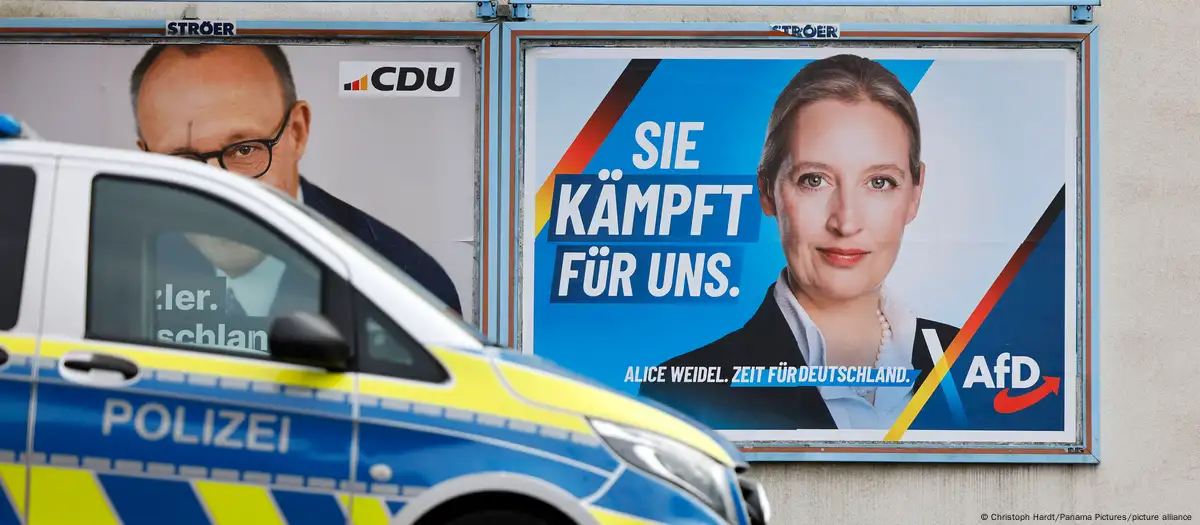
What you need to know
- German police commissioner says AfD membership incompatible with service
- Number of naturalized German citizens reached record high in 2024
- The Federal Administrative Court is to hear a case regarding the ban on the right-wing extremist magazine Compact
-
Germany plans to increase its use of AI to combat hybrid threats, the interior minister says
This blog, is covering the latest news from Germany on Tuesday, June 10, has now closed.
Merz signals rethink on voluntary military service
German Chancellor Friedrich Merz has said the government may need to reconsider its plans for a purely voluntary military service amid a growing personnel shortfall in the Bundeswehr.
"I share the assessment of the defence minister that we are already short of a high five-digit number of soldiers in the Bundeswehr," Merz told reporters after meeting Dutch Prime Minister Dick Schoof in Berlin.
The chancellor said the government would "have to take a close look" at whether current recruitment programs and voluntary service are sufficient to meet NATO targets. "If voluntary service is not enough, then we will have to discuss additional steps very soon," he said.
Merz added that such steps would not violate the coalition agreement with the centre-left Social Democrats. That deal commits the government to creating "a new, attractive military service that will initially be based on voluntary participation."
He underscored the term "initially," suggesting that compulsory measures could be considered if shortfalls persist.
'I am the dictator,' says editor as German court hears far-right magazine ban
The editor-in-chief of Compact, Jürgen Elsässer, has described himself as the sole decision-maker at the far-right magazine during a court hearing on its ban.
"In the publishing house, I am the dictator. I decided everything," the 68-year-old told judges at the Federal Administrative Court in Leipzig. He argued this meant Compact GmbH could not legally be considered an association.
The Compact-Magazin GmbH group was outlawed nearly a year ago by the Federal Interior Ministry, which cited the magazine's anti-constitutional aims. The court is now reviewing whether the prohibition is legally justified.
In an earlier interim ruling in August 2024, the court allowed the publication to continue operating while legal proceedings unfolded. At the time, it said it could not definitively assess whether Compact opposed the constitutional order, although it noted signs of potential violations of human dignity in some articles.
Compact argues that the ban is disproportionate and that the legal grounds for it are lacking. It also claims that a press and media company cannot be banned under association law, which is the legal basis for the action.
The court has scheduled two more possible days of hearings on Wednesday and Thursday. It is not yet known when a verdict will be announced.
Germany slams Dutch citizen border checks as unlawful
Germany's interior minister and the head of its federal police union on Tuesday criticized unofficial border checks by Dutch citizens near Ter Apel, calling for firm action from the Netherlands to halt the practice.
Local media reported that a group of citizens stopped vehicles on Saturday evening to search for asylum seekers. That came just days after Dutch far-right leader Geert Wilders brought down the ruling coalition over a migration policy dispute.
German Interior Minister Alexander Dobrindt said there was "no legal basis" for such actions and urged authorities to step in if the behavior persists. "I also assume that the authorities will end such measures," he told the Reuters news agency.
Andreas Rosskopf, head of Germany's Federal Police Union, warned of escalation if Dutch officials fail to act decisively.
"Citizens without legal authority have no right to intervene or take on the tasks of police," he said.
Dutch police reportedly found no criminal offense at the scene. Caretaker Dutch Justice Minister David van Weel acknowledged citizens' frustrations but urged them not to "take the law into their own hands."
According to Eurostat, the Netherlands' asylum rate in 2024 was slightly below the EU average.
Deutsche Bahn is increasing price of seat reservations
Starting June 15, Germany's state-owned national rail operator, Deutsche Bahn, is raising the prices for seat reservations.
The company announced that a reserved seat in second class on long-distance trains will cost €5.50 ($6.30) instead of the previous price of €5.20.
In first-class, a reserved seat will cost €6.90 instead of €6.50. Seat reservations will still be included with Flexpreis tickets in first class.
In addition, the family reservation, which allowed families to reserve seats for all family members for a fixed price of €10.40, will be abolished.
This means that a family with two children will pay €22 for a family reservation instead of €10.40.
The German Ecological Transport Club (VCD) sharply criticized the move. "Families with children rely on reserved seats in particular," explained VCD head Kerstin Haarmann. "They are now effectively facing another price increase."
However, Deutsche Bahn emphasized that children and young people up to and including 14 years of age will continue to travel for free on DB long-distance services when accompanied by an adult.
Germans leave parental home earlier than people in most EU countries
Young people in Germany tend to move out of their parents' homes at an earlier age than in most other EU countries, although men take longer to leave the nest.
The mean age at which Germans departed from their familial abodes in 2024 was 23.9, according to the German statistical agency Destatis, which cited computations conducted by the EU's statistical office, Eurostat.
This was significantly below the EU-wide average of 26.2 years. According to the figures, young people in the EU move out earliest in Finland, at an average age of 21.4 years, followed by Denmark, Sweden, the Netherlands, and France.
People tend to live at home the longest in Croatia, where they leave at an average age of 31.3.
On average, German men take longer to leave their parents' home than women do. On average, they were 24.6 years old when they moved out, while women were 23.1 years old.
In 2025, 33.8% of 25-year-old men in Germany still lived with their parents, compared to 22.4% of 25-year-old women.
Merz praises BioNTech founders as they receive German award
Germany's National Prize has been awarded to the co-founders of BioNTech, a German drugmaker that was among the first to develop an effective vaccine against the coronavirus.
In his laudatory speech, Chancellor Friedrich Merz praised Özlem Türeci and Ugur Sahin for their "extraordinary courage."
"You both embody the future strength of a liberal society. As scientists who seek solutions. But also as entrepreneurs for whom responsibility is at the center of their work," Merz said during the award ceremony in Berlin.
In 2020, the two scientists developed a coronavirus vaccine in less than a year.
The chancellor also praised Türeci and Sahin, who have Turkish roots, as examples of the importance of "skilled labor immigration as a driver of progress."
"I want to live in a Germany in which talent is promoted to the best of our ability, regardless of social or ethnic background," Merz said.
Since 1997, the German National Foundation has awarded the German National Prize to individuals or organizations for their efforts to promote a democratic society. The award is endowed with a total of €50,000 (approximately $57,000).
German intelligence chief says Russia plans to test NATO's resolve
Germany's federal intelligence chief said that Russia is determined to test the resolve of the NATO alliance by extending its confrontation with the West beyond Ukraine's borders.
According to Bruno Kahl, head of the Federal Intelligence Service, his agency has clear intelligence indicating that Russian officials believed that the collective defense obligations enshrined in the NATO treaty were no longer enforceable.
"We are quite certain, and we have intelligence showing it, that Ukraine is only a step on the journey westward," Kahl told Table Media in a podcast interview.
"That doesn't mean we expect tank armies to roll westwards," he added. "But we see that NATO's collective defence promise is to be tested."
Kahl's remarks, which did not specify the intelligence sources he was referring to, suggested that Russian officials were envisaging confrontations that fell short of a full military engagement.
These confrontations, as Kahl implied, were intended to test whether the US would truly uphold its mutual aid obligations as outlined in Article 5 of the North Atlantic Treaty.
"They don't need to dispatch armies of tanks for that," he said. "It's enough to send little green men to Estonia to protect supposedly oppressed Russian minorities."
Russia's 2014 annexation of Crimea involved the occupation of buildings and offices by Russian soldiers wearing unmarked uniforms or civilian clothes. These soldiers came to be known as the "little green men" because Moscow initially denied their identity.
Spy agency says number of extremists in Germany increased in 2024
In its annual report for 2024, the Federal Office for the Protection of the Constitution (BfV) revealed that it had monitored significantly more extremists last year than in previous years.
The fact that the number of right-wing extremists increased by around 23% to 50,250 within a year is partly due to the growth in membership of the far-right Alternative for Germany (AfD) party.
According to the report, 20,000 members of the party were classified as potentially right-wing extremists last year. In November, the AfD stated that it had 50,000 members.
Last month, the agency classified the party as a whole as "extremist" on the basis of a 1,100-page expert report, which enabled it to increase its monitoring of the AfD. However, the party has legally challenged this decision.
Meanwhile, the number of right-wing extremists classified as violent rose again last year, by 800 people, reaching a total of 15,300.
The agency also observed an increase in the number of so-called Reichsbürger ("Reich Citizens") movement. According to the report, these groups' potential number increased by 1,000 to around 26,000 people.
Reichsbürger do not recognise the Federal Republic of Germany as a state. They also reject democratic and constitutional structures, such as parliament, laws and courts. They refuse to pay taxes, social security contributions or fines.
Following a slight decline in previous years, the Federal Office for the Protection of the Constitution has seen a slight increase of almost 4% in the number of individuals belonging to Islamist groups, bringing the total to 28,280.
The report reveals the security authorities' estimate of the number of violent Islamists for the first time: 9,540 people.
The number of left-wing extremists also increased from 37,000 to around 38,000 in 2024. However, the number of violent left-wing extremists remained at the previous year's level of 11,200.
Temporary work on decline in Germany, while part-time work on rise
An increasing number of people in the German labor market have permanent positions.
According to the country's statistical agency, Destatis, last year, 74.8% of the workforce was employed in a "standard employment relationship." This proportion was significantly higher than in 2010, when it was 65.8%.
Statisticians define a standard employment relationship as a permanent position subject to social insurance contributions of at least 21 hours per week; however, temporary work is excluded.
Destatis explained that one reason for this development is that more people are working part-time for more than 20 hours per week: their share almost doubled between 2010 and 2024, from 7.3% to 14.1%.
Meanwhile, so-called atypical employment, such as temporary and agency work, as well as mini-jobs, has declined in Germany. Their share fell from 22.6% in 2010 to 17.2% last year.
The share of self-employed individuals has also slowly but steadily decreased since 2010, dropping from 11.1% to 7.9% last year.
Retiring small and medium-sized business owners struggle to find successors
Thousands of owners of small and medium-sized enterprises (SMEs), collectively known as the Mittelstand, may have to close their businesses if they cannot find a successor.
According to a survey conducted by the state-run development bank KfW, approximately 231,000 small and medium-sized business owners are planning to close their companies by the end of this year. This figure is 67,500 more than the number recorded a year ago.
Age is a major factor; demographic data shows that more than half of Mittelstand owners are over 55 years old, up from 20% ten years ago.
They are also aging faster than the population as a whole — 39% of them are 60 or older, compared with 30% of Germans overall.
Number of naturalized German citizens reached record high in 2024
Last year, a record 291,955 foreign nationals received German citizenship, according to the country's statistical agency, Destatis.
The agency said this was the highest number of naturalizations since records began in 2000, up 46% year-on-year.
Syrians continued to make up the largest share of new citizens (28%). They were followed by people from Turkey (8%), Iraq (5%), Russia (4%), and Afghanistan (3%).
The agency cited changes to immigration law initiated by the previous center-left government, which took effect in June 2024.
These changes allow individuals opting to apply for German citizenship to retain their nationality. The required period of residence in Germany was lowered from eight to five years.
Those who can demonstrate significant academic or professional achievements can apply for citizenship after three years. According to the statistical agency, some 7% of naturalizations in 2024 were granted based on special achievements.
However, the new conservative-led government, which took office on May 6, has vowed to crack down on irregular migration and reverse some of the previous government's changes, including the special achievements path.
Germany to increase its use of AI to combat hybrid threats
Amid rising concerns over sabotage and espionage, German Interior Minister Alexander Dobrindt has called for increased use of artificial intelligence in national security.
"We must enhance our technical, legal and organizational capabilities in Germany," he told the Funke Media Group.
"Artificial intelligence must be used more extensively than before in the intelligence services to defend against hybrid threats," Dobrindt said.
According to the minister, hybrid threats involving sabotage and espionage are constantly increasing.
Dobrindt said the government strongly feels the impact of the growing number of attacks on infrastructure, including civilian facilities such as energy grids and rail networks, as well as military sites such as barracks.
The minister added that the government would allocate "substantial financial resources" to strengthen the defense mechanisms of Germany's security agencies.
German court to hear case on right-wing extremist magazine ban
The Federal Administrative Court in Leipzig is set to hear a case regarding the ban on the right-wing extremist magazine Compact.
In August, the Federal Administrative Court temporarily lifted the ban on the magazine, which was issued by Federal Interior Minister Nancy Faeser (SPD).
The court expressed particular doubts about the ban's proportionality. This allowed the magazine, which was based in Brandenburg at the time, to resume publication under certain conditions.
The Interior Ministry first banned Compact in mid-July, describing the publication as a "central mouthpiece of the right-wing extremist scene."
In response, Compact filed a lawsuit and an urgent motion against the immediate enforcement of the ban.
The final decision is now pending in the main proceedings.
Top police official says AfD membership incompatible with service
Germany's Federal Police Commissioner Uli Grötsch has voiced disapproval regarding police officers' membership in the far-right Alternative for Germany (AfD) party. Grötsch called it "incompatible" with serving in law enforcement.
"AfD membership and working as a police officer are incompatible," Grötsch told the Rheinische Post newspaper.
Grötsch also said that officers who demonstrate clear commitment to the AfD should be dismissed.
"For me, commitment means openly supporting the party, running for local or city council or even for the Bundestag," he added.
In early May, Germany's domestic intelligence agency classified the AfD as a "confirmed right-wing extremist" organization.
Grötsch pointed to this decision, saying there was concrete evidence that the party threatened Germany's free democratic order.
However, the agency suspended the classification while the AfD pursues legal action. The agency will continue to treat the party as a "suspected" extremist case pending a ruling from the Cologne administrative court.
Welcome to our Germany coverage
Guten Tag! DW is bringing you updates from across Germany, where the top police official has spoken out against law enforcement officers' affiliation with the far-right Alternative for Germany (AfD) party.
Meanwhile, the Federal Administrative Court in Leipzig is set to hear a case regarding the ban on the right-wing extremist magazine Compact.
We'll have the latest headlines, analyses, multimedia content, and DW's on-the-ground reporting on all things Germany.