US, Iran give conflicting claims over Hormuz fees
Published June 23, 2026last updated June 23, 2026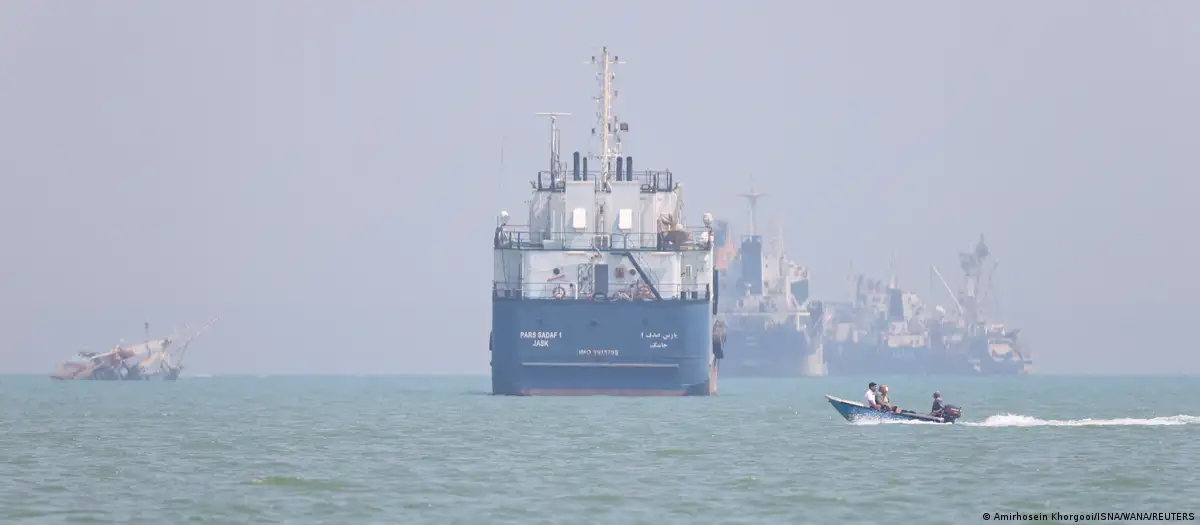
What you need to know
- US top diplomat Rubio says Washington won't accept tolls or fees in the Strait of Hormuz
- Iran and Oman exploring costs to administer Hormuz; Iran has pushed for 'maritime service fee'
- UN agency says plan underway to escort stranded Gulf sailors and escort them through Hormuz
- Iran's president visits Pakistan, a mediator country which brokered the US-Iran Memorandum of Understanding
- Israel, Lebanon meeting for a new round of talks in Washington
Here are the latest developments on the Iran war and the wider Middle East on Tuesday, June 23:
Tired of missing our real-time updates? Click here to add us as a Preferred Source on Google . Then tap the "Star" or "Preferred" to keep DW News at the top of your feed.
US Senate votes for Iran war powers resolution in rebuke to Trump
The US Senate voted in favor of a war powers resolution which seeks to block US President Donald Trump's ability to conduct military action against Iran.
The measure was approved by the Republican-majority Senate in a 50-48 vote.
The Senate approval comes after the Republican-majority House passed the measure.
The measure is largely symbolic and does not carry the full backing of the law. However, it brings to light that even some congressional members of Trump's Republican Party are growing skeptical of US military operations against Iran.
The passing comes amid a ceasefire between the US and Iran following the signature of the Memorandum of Understanding.
Lebanese authorities say Israeli fire kills 2 in southern Lebanon
Lebanese government authorities said Israeli fire killed two people in southern Lebanon.
A shaky ceasefire between Israel and Hezbollah has largely held since Sunday as tensions threaten ongoing negotiations between the US and Iran.
The Lebanese National News Agency reported that Israeli troops "opened fire with their machine-guns" at the direction of people "near an excavator that was unblocking a road" in Nabatieh al-Fawqa in southern Lebanon.
Hezbollah condemned Israel actions as a violation of the ceasefire.
Israel, meanwhile, said it hit "armed terrorists who posed an immediate threat" to its troops in the Ali al-Taher ridge area.
Ali al-Taher is near Nabatieh al-Fawqa.
The trading blame comes as Israeli troops have set up a "security zone" in southern Lebanon, which Lebanese authorities and Hezbollah view as an occupation. Hezbollah leader Naim Qassem has called for a scheduled withdrawal of Israeli troops from southern Lebanon.
Israeli and Lebanese government officials are due to meet Tuesday in Washington for talks.
Israel, meanwhile, has defended its presence in southern Lebanon and has said it is necessary to fend off attacks by the Iran-backed militants who began targeting northern Israeli communities after the war broke out on February 28.
Israel, along with the US, Germany and some other nations, have designated Hezbollah as a terrorist organization.
FIFA: US eases restrictions on Iran national team
The US Department of Homeland Security announced it is easing travel restrictions for the Iranian World Cup team.
The Iranian players can now travel into the United States 48 hours before their match starts. Previously, the team had to arrive one day earlier before their two matches in Los Angeles.
The players are expected to leave their base camp in Tijuana, Mexico on Wednesday to head for their match in Seattle which takes place Friday. The Iranian players will still have to leave later on Friday when the match finishes.
Iranian players have called for more travel time so they can adapt to their host city's environment before the match. The Iranian players also prefer more time to rest once the match ends.
Iran, Pakistan defend Iranian right to ballistic missiles
Iran's president visited Pakistan for talks as efforts continue to secure a lasting end to the Middle East conflict.
The visit comes as gaps remain over what has been agreed and violence has flared again in Lebanon.
President Masoud Pezeshkian and Foreign Minister Abbas Araghchi held meetings in Islamabad with Pakistani President Asif Ali Zardari and Prime Minister Shehbaz Sharif.
Pakistan has been acting as a mediator in negotiations between Tehran and Washington.
Araghchi had previously been in Oman as part of parallel diplomatic efforts.
During a news conference between Pezeshkian and Sharif, Pezeshkian asserted that Iran's ballistic missiles are not part of the US-Iran Memorandum of Understanding and "will never be."
Sharif said Iran has a right to ballistic missiles like other nations and that the issue was never on the table when it came to the discussions regarding the US-Iran Memorandum of Understanding.
Rubio in UAE, says no country will be allowed to charge tolls in Hormuz
US Secretary of State Marco Rubio has arrived in the United Arab Emirates, kicking off a series of meetings with US Gulf allies.
The trip is focusing on the US-Iran Memorandum of Understanding (MoU) and is seen as providing a chance for Rubio to listen to concerns about the deal from Gulf Arab leaders. He landed in Abu Dhabi where he will meet with Emirati leaders, before heading to Kuwait and Bahrain.
After arriving in the UAE, Rubio said the US would not accept any tolls or fees in the Strait of Hormuz, reiterating that any final deal with Tehran would forbid Iran from charging for passage.
"It's an international waterway. No country is allowed to charge tolls or fees on an international waterway. That's existing international law," Rubio said.
"I don't think we have anybody to convince around here in that regard. I think all the countries in this region would agree with us.," he added.
Rubio's comments come after Iran's chief negotiator Mohammad Bagher Ghalibaf on Tuesday told Iranian state media that "everyone should know that the administration of the Strait of Hormuz will never go back to the way it was before the war."
Also on Tuesday, Iran and Oman said they would explore how navigation in the Strait of Hormuz should be "administered," including related services and charges.
Iran has repeatedly indicated it wants to introduce a system of what it calls "maritime fees" for the Strait after a two-month negotiation period with the US expires. The MoU says that Tehran will allow the passage of shipping without tolls for 60 days only.
Plan underway to rescue stranded ships in the Gulf, UN agency says
The International Maritime Organization, a UN agency, said a strategy is underway to save 11,000 stranded seafarers on ships and escort them through the Strait of Hormuz.
"We have secured the necessary safety guarantees and have thoroughly verified the conditions for safe navigation to support these operations," the IMO's Secretary General Arsenio Dominguez said in a statement.
He added the operation would be "carried out in close cooperation with Iran, Oman, all other coastal states in ther region, the United States and the maritime industry."
A spokesperson for the IMO told Reuters news agency, "we have now started contacting ships to start the evacuation."
The crews on the ships stranded in the Gulf may be concerned about the safety in the Strait of Hormuz. Parts of the Strait had been earlier mined by Iran to prevent passage.
Around 20% of the world's oil and natural gas moves through the Strait of Hormuz, making it a vital passageway for global energy supplies.
Dozens of cargo ships transited Strait of Hormuz — vessel trackers
Commercial traffic through the Strait of Hormuz on Monday reached the highest level since the US-Israeli attacks on Iran began, shipping analysists said on Tuesday.
It comes after the US Treasury agreed to waive sanctions on oil, and remove a blockade against Iranian shipping as part of a peace roadmap agreed during negotiations in Switzerland.
At least 37 commodity carriers transited the Strait of Hormuz on Monday, according to maritime tracker Kpler.
Another ship tracker, AXSMarine, which tracks all commercial vessels including container ships, counted 42 crossings on Monday.
"This may be one of the clearest signs so far of a tentative normalization in traffic," Mihail Todorov from AXSMarine told the AFP news agency.
The Strait of Hormuz is a vital conduit for oil and gas exports, as well as dry bulk cargo like fertilizer.
Trump says Iran has agreed on nuclear inspections to 'infinity'
US President Donald Trump says Iran has agreed to far-reaching nuclear inspections, sharply contradicting denials from Tehran as talks on ending the Middle East war continue.
"Iran has fully and completely agreed to highest level Nuclear inspections long into the future (Infinity!!!)," Trump said on Truth Social, dismissing what he called Iran’s "protestations and false statements."
Washington has already moved to ease pressure, granting a 60-day sanctions waiver after initial talks under a fragile peace framework agreed last week.
Trump also maintained that unfrozen Iranian assets would be tightly controlled and used to buy US humanitarian goods, including "Corn, Wheat, and Soybeans from our great American Farmers."
Iran has already rejected both assertions. US Vice President JD Vance on Monday said negotiations in Switzerland had laid a "solid foundation for a final deal," with Tehran ready to allow inspectors back in.
But Iran dismissed that account. Foreign Ministry spokesman Esmail Baghaei said there had been no agreement on inspections and no plans to invite the UN nuclear watchdog back to the country.
Iran's ambassador to the United Nations in Geneva pushed back against the use of frozen assets to buy food from the US, insisting that Tehran alone would decide how any released funds are used.
The conflicting accounts underscore deep divisions between the two sides, even as diplomatic efforts to end the conflict continue.
Oman, Iran to discuss Hormuz navigation 'costs'
Oman and Iran have agreed to form a joint working group to seek an agreement on how navigation in the Strait of Hormuz should be administered, including related services and charges.
In a joint statement, the two countries said the talks would be held through their Foreign Ministries and would also involve countries bordering the waterway and other relevant parties.
The statement said the working group would aim to reach agreement on the future "administration of navigation in the Strait of Hormuz and the services that will be provided in this regard and the costs associated with them."
Oman and Iran also reaffirmed their commitment to keeping the strait open to international navigation, while saying any arrangements must respect their sovereignty and sovereign rights as coastal states.
The Memorandum of Understanding (MoU) signed last week called for Iran to hold talks with Oman and other Gulf coastal states on the future management of navigation and maritime services in the strait.
However, earlier Tuesday, Iran's chief negotiator Mohammad Bagher Ghalibaf said the "administration of the Strait of Hormuz will never go back to the way it was before the war."
Vice President JD Vance, who led the US delegation in the Switzerland talks, previously said negotiations with Iran are based on the assumption that shipping through the strait will be "toll free" for the "long term," setting up the potential for friction after the 60-day window, during which Iran has promised free passage, expires.
The European Union has said any long-term US-Iran deal must "guarantee toll free full freedom of navigation," in the Strait of Hormuz.
Iran rejects US claims over frozen assets
Iran has said it alone will decide how to use billions of dollars in frozen assets due to be released under a deal with the United States.
US Vice President JD Vance said on Monday that the assets had not yet been released. He said that if they were unfrozen, they could be used to purchase US goods such as soybeans and would not be allowed to fund terrorism.
However, Iranian Ambassador Ali Bahreini told reporters in Geneva on Tuesday that Tehran would have sole authority over the funds once they were unfrozen.
"Iran is the only country who will decide what to do with its assets, which are going to be defrozen," he said.
"I reject any claim by [Washington] about that there should... be any role for any other country to have an influence on those decisions or on those processes."
US President Donald Trump doubled down on Tuesday, reiterating Vance's statements in a social media post.
"The Money and/or Sanctions that the US Treasury is releasing goes into escrow, controlled by the USA, and will be used for the purchase of food and medical supplies, exclusively from the United States, including Corn, Wheat, and Soybeans from our great American Farmers," Trump wrote. "These are things that are desperately needed by Iran. This is a humanitarian crisis, and I feel it is necessary to help, NOW, before it is too late."
Iranian state media reported that Washington had agreed to release $12 billion in frozen Iranian funds and temporarily ease sanctions on Iranian oil as part of negotiations aimed at ending the conflict.
Iran has faced US sanctions and asset freezes for much of the period since the Iranian Revolution in 1979 and the subsequent seizure of the US embassy in Tehran.
Tehran says IAEA not scheduled to see nuclear sites bombed by US
International Atomic Energy Agency (IAEA) inspectors are not scheduled to see the nuclear sites bombed by the United States last year, Iranian Foreign Ministry spokesperson Esmail Baghaei told reporters on Tehran on Tuesday.
On Monday, US Vice President JD Vance had said that Iran had agreed to allow in nuclear inspectors.
"That is a major milestone for the American people and the first step in permanently denuclearizing or permanently ending a nuclear weapons program in Iran," he said.
IAEA Director General Rafael Grossi has pushed for Iran to allow inspectors to view damaged nuclear sites that were hit by US and Israeli attacks.
Iran says to retain control of Strait of Hormuz
Tehran said that Iran will retain the administration of the Strait of Hormuz and that it will "never" go back to pre-war days, state media reported on Tuesday.
"Everyone should know that the administration of the Strait of Hormuz will never go back to the way it was before the war," Iran's chief negotiator Mohammad Bagher Ghalibaf said in an interview, according to IRNA.
"Of course, international regulations will be observed, but Iran will administer the Strait of Hormuz."
This is in direct contrast to US President Donald Trump's demand of an unconditional reopening of the strait to marine traffic.
Since the interim peace deal between the US and Iran, ship traffic in the important waterway had picked up, but Tehran's announcement on Saturday it had closed it again in response to Israeli attacks in Lebanon raised questions regarding its long-term plan.
It also remains unclear whether Tehran plans to charge vessels to cross Hormuz.
Passage was free through the strait, which borders both Iran and Oman, before the war, but Iran last month established a new governmental authority to collect money from ships. Tehran has said it still expects vessels to register with the Persian Gulf Strait Authority before crossing.
The closure of the strait during the Iran war choked a major supply route and sent global oil prices soaring, fueling inflation.
US-Iran technical talks conclude, Iranian media reports
Technical talks between Iran and the United States in Switzerland ended with a proposal to set up negotiating groups on nuclear issues and sanctions, Iran's state media said on Tuesday.
According to IRNA state news agency, Deputy Foreign Minister Kazem Gharibabadi said the envoys "decided that four working groups would be established: Sanctions Termination, Nuclear Affairs, Reconstruction and Economic Development, and Monitoring and Implementation."
New round of talks between Israel, Lebanon in US
Israel and Lebanon are due to start their fifth round of talks in Washington DC on Tuesday, as the fragile ceasefire in Lebanon seems to be holding for now.
Lebanon was drawn into the wider Middle East conflict in early March, when the Iran-backed Hezbollah militant group attacked Israel, in retaliation for the US-Israeli attacks on Iran. Israel responded with strikes across the country and later invaded the south, where Israeli soldiers remain stationed.
Beirut has sought the US-mediated talks with Israel as a means to secure peace. Lebanese leaders, including President Joseph Aoun, maintain that Tehran cannot negotiate on Beirut's behalf.
Still, the interim peace agreement between the United States and Iran calls for ending all hostilities, including in Lebanon, a key condition of Tehran which it has on more than one occasion halted negotiations over.
Fighting in Lebanon has abated since Saturday night, a significant development which earlier rounds of Lebanon-Israel talks failed to sustainably secure.
Israel is not a party to the US-Iran peace agreement.
Israeli Prime Minister Benjamin Netanyahu said on Monday the Israeli military will keep its "freedom of action" against Hezbollah in southern Lebanon.
"Iran wanted us to withdraw from it but I stood firm," Netanyahu said. "We are keeping our freedom of action and we are keeping the security zone to protect" citizens in northern Israel.
Beirut has maintained that Israeli withdrawal from its territories was a prime goal of the talks.
Welcome to our coverage
Hello! Here are the latest updates regarding the peace efforts between the US and Iran, as well as other events relating to the wider Middle East conflict and the ongoing efforts to resolve it.
On Tuesday, Iranian state media reported that technical talks with Washington in Switzerland have concluded. Meanwhile, Israel and Lebanon are due to start a new round of talks in Washington.
Earlier on Monday:
- US waived Iran oil sanctions for 60 days
- US Vice President JD Vance cited the existance of a 'foundation' for a successful final deal, adding that Iran had agreed to nuclear IAEA inspections
- Mediator Pakistan said the US and Iran agreed on a roadmap toward a final deal within 60 days
For more, make sure you stay tuned to our liveblog.