Iran war: Second attempt at peace talks takes shape
Published April 24, 2026last updated April 24, 2026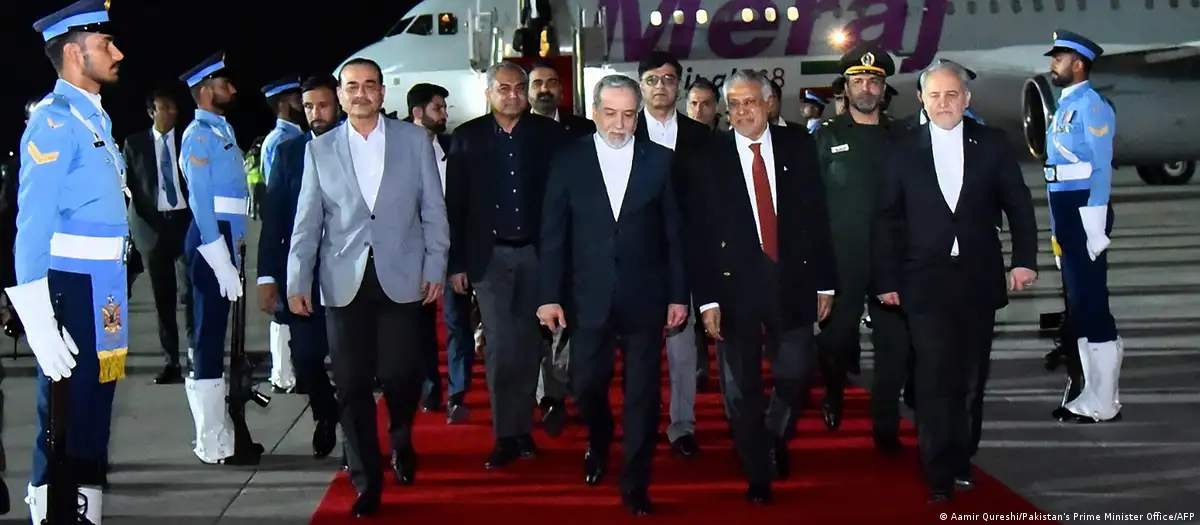
What you need to know
- President Donald Trump to send envoys to Pakistan, with JD Vance, who led talks with Iran in Islamabad the last time, on 'standby'
- Iran's Foreign Minister Abbas Araghchi confirmed he's headed to Islamabad too but did not confirm talks with the US
- Iran and the US remain locked in a standoff over the Strait of Hormuz, with Pentagon chief Pete Hegseth saying blockade on Iranian ports will remain in place 'until necessary'
- Israel and Lebanon agreed to extend the ceasefire by three weeks, US President Donald Trump said
Here are the latest developments in the Iran war and the Middle East on Friday, April 24:
Iranian Foreign Minister Abbas Araghchi lands in Islamabad
Iran's embassy in Pakistan said an Iranian delegation led by Foreign Minister Abbas Araghchi arrived in Islamabad on Friday.
Araghchi was received by Pakistani Foreign Minister Ishaq Dar, Chief of Army Staff Field Marshal Asim Munir and other senior officials upon arrival, Pakistan's Foreign Ministry said in a statement.
The statement said that, during the visit, Araghchi is expected to meet Pakistan's senior leadership to discuss the latest regional developments and ongoing efforts to promote regional peace and stability.
Earlier, White House press secretary Karoline Leavitt told reporters that US envoys Jared Kushner and Steve Witkoff will go to Pakistan on Saturday (see below).
White House says JD Vance willing to go to Pakistan if necessary
Vice President JD Vance, who led the first round of negotiations with Iran in Islamabad nearly two weeks ago, will not be headed to Pakistan for now, White House press secretary Karoline Leavitt told reporters.
"Everybody will be on standby to fly to Pakistan if necessary," she said. "The president is dispatching Steve and Jared to see what they have to say."
"We’ve certainly seen some progress from the Iranian side in the last couple of days," she added. Leavitt did not offer any details about what US officials were hearing.
Trump sends envoys to Pakistan
US President Donald Trump is sending his envoys Steve Witkoff and Jared Kushner to Pakistan, the White House said on Friday.
The two US officials are set to depart for Islamabad on Saturday, White House press secretary Karoline Leavitt said in an interview on Fox News Channel.
The pair are scheduled for talks with Iranian Foreign Minister Abbas Araghchi, who said he was traveling to Islamabad but didn't confirm talks with the US.
"We're hopeful that it will be a productive conversation and hopefully move the ball forward to a deal," Leavitt said.
She said that Vice President JD Vance would not be traveling but that he remains "deeply involved."
Iranian foreign minister confirms he's heading to Islamabad
Iranian Foreign Minister Abbas Araghchi said in a social media post that he was heading to Islamabad, Pakistan; Muscat, Oman; and Moscow to "closely coordinate with our partners on bilateral matters and consult on regional developments."
Araghchi's comments didn't address any possible resumption of talks with the US, though the Iranian foreign minister spoke with senior Pakistani officials on the phone earlier Friday.
Pakistani officials have also been intensifying efforts in recent weeks to get the US and Iran to a second round of ceasefire negotiations.
Macron says ready to support reconstruction efforts in Lebanon 'when times comes'
French President Emmanuel Macron said his country was ready to "mobilize its partners, when the times comes, by organizing a conference in support of Lebanon's armed and security forces and of the country's economic reovery."
Macron's comments came after Lebanese President Joseph Aoun called upon the European Union to support reconstruction efforts in his country.
Aoun was speaking from the Mediterranean island of Cyprus, where he's a guest at the European Union summit.
Aoun said in a speech that "Lebanon's stability is part of the region's stability" and added that Lebanon refused to be a bargaining chip in regional conflict.
He was apparently referring to Iran, which has put a permanent ceasefire between Israel and the militant Hezbollah group on top of its list in talks with the US.
Aoun said Lebanon, like other countries in the region, "places great importance on de-escalation, stability, and peace."
What to know about the situation in Lebanon
Israel has unleashed waves of strikes across Lebanon, saying it is targeting Hezbollah operatives and command infrastructure.
But the fighting has displaced more than one million people in the country, nearly a fifth of the population, as Israel aims to create a buffer zone to shield northern Israel from Hezbollah attack, while the militant group says it maintains the "right to resist" Israeli occupation.
Lebanon in 2025 said it would disarm Hezbollah but its army treaded carefully, wary of igniting internal tensions. The US and Israel criticized Lebanon for not moving fast enough.
IN DEPTH: What is Europe's plan to secure the Strait of Hormuz?
France and the UK are leading efforts to establish a multinational mission to safeguard shipping through the Strait of Hormuz.
Learn more about the scope of the operation and whether it can bring lasting stability in this report by DW's Brussels correspondent Anchal Vohra.
Indonesia says UNIFIL peacekeeper injured in March by Israeli strike in Lebanon has died
Indonesia's government on Friday announced the death of a fourth Indonesian peacekeeper in the UNIFIL mission in Lebanon and called for a UN investigation into its peacekeeper's deaths in the country.
The blue helmet, identified as Chief Private Rico Pramudia, "sustained severe injuries from an artillery explosion by an Israeli tank near Adchit Al Qusayr on March 29, 2026," the Foreign Ministry wrote.
Despite medical teams' best efforts his injuries were too serious and he did not survive.
"Indonesia once again condemns the attack by Israel that resulted in the death of an Indonesian peacekeeper. Any attack against peacekeepers constitutes a serious violation of international law and may amount to a war crime. Indonesia reiterates its call for the United Nations to conduct an immediate, thorough, and transparent investigation to establish the facts, and stresses that full accountability must be ensured," the ministry said.
IN DEPTH: Iran: Daily life shadowed by war, scarcity and fear
The US naval blockade aims to put pressure on the Iranian regime, but ordinary Iranians mostly feel the effects. Many of them find their lives shaped by growing exhaustion.
Learn more about how the war is straining the Iranian economy in this report by DW's Shabnam von Heim.
Israel's PM Netanyahu confirms successful treatment for malignant prostate tumor, says he's now healthy
Israeli Prime Minister Benjamin Netanyahu said in a lengthy social media post on Friday that he had asked for his annual medical report's publication to be delayed for two months "so it would not be released at the height of war."
He said that during routine monitoring after the earlier surgery for an enlarged benign prostate, a very small malignant tumor in his prostate was identified.
Given the choice by doctors to either wait and watch and live with the condition or undergo treatment, he said he opted for treatment to try to remove the problem.
"You already know me. When I'm given information in time about a potential danger, I want to address it immediately. This is true on the national level and also on the personal level. That's what I did," Netanyahu wrote.
The 76-year-old said the treatment had completely removed the tumor, thanking the doctors and medical teams.
Aharon Popovtser, the director of Hadassah Hospital's oncology unit, said Netanyahu was diagnosed at an early stage, noting that prostate cancer is common among men his age.
"We can say based on the findings of these tests that the disease has disappeared," he said, referring to imaging and blood work.
Von der Leyen: 'Our shared goal is to negotiate a lasting end to the war,' also in Lebanon
European Commission President Ursula von der Leyen said any peace agreement with Iran would have to address its ballistic missile program, and involve the complete reopening of the Strait of Hormuz "without tolls."
She also appealed for Lebanon's sovereignty and territorial integrity to be respected, without calling Israel out explicitly for its military actions in the south of the country.
"A key lesson of the past weeks is that security is indivisible. You cannot have stability in the Middle East or the Gulf while Lebanon is in flames," von der Leyen said, nodding at visiting President Joseph Aoun as she did so. "So we call for the respect of Lebanon's sovereignty and territorial integrity. A temporary pause is not enough. We need a permanent path to peace. And on the way we will continue to support the Lebanese people."
Von der Leyen also said that the EU and Gulf countries had agreed in recent weeks "that our partnership needs to become a broader partnership," and said future bilateral and multilateral talks would seek ways to achieve this.
"The events of the past months have taught us a hard truth. Our security is not just related, it is intrinsically linked," von der Leyen said. "A threat to a merchant vessel in the Strait of Hormuz is a threat to a factory, for example, in Belgium. So today I propose we move beyond reactive crisis management."
She suggested various potential projects, like expanding the size and scope of naval operations and considering some kind of cooperation on defensive efforts against threats like drones and missiles.
Antonio Costa: EU ready to contribute to diplomacy efforts in Gulf
President of the European Council Antonio Costa has called for a ceasefire in Iran and the wider region after the EU leaders' summit in Cyprus.
"The war in the Middle East has already had disastrous consequences, for people, for instracture, for the global economy," Costa said in Nicosia. "And with every day that passes without a solution, the situation is only getting worse."
He said the current situation "clearly underscores" how closely European security is linked to that of the Middle East, and how vital cooperation on security and defense had become.
He told a delegation of visiting leaders from Egypt, Jordan, Lebanon and Syria that this was why their exchange on Friday had been "so timely and so useful."
"The European Union stands in full solidarity with your countries and your people. You can count on us," he said. "Since the beginning we have consistently called for the deescalation and negotiation in full respect of international law and international humanitarian law."
Costa welcomed the announcement from US President Donald Trump of a ceasefire extension and called for the Strait of Hormuz to "immediately reopen, without restrictions and without tolling," in accordance with international law and the freedom of navigation.
"This is vital for the whole world," Costa said.
Hegseth says Iran has 'historic chance to make a serious deal'
US Defense Secretary Pete Hegseth said on Friday that Iran had a "historic chance to make a serious deal" with the US to end hostilities that began on February 28, saying that the "ball is in their court."
He was commenting around the same time that news emerged of Iran's plans to send Foreign Minister Abbas Araghchi to the stalling negotiations in Pakistan.
Hegseth said that the US naval "blockade" of Iran, declared shortly after the ceasefire, would continue for "as long as it takes" to accomplish the US' "bold and dangerous" mission.
He added that the blockade had turned back 34 ships to date and was "growing and glowing global," as evidenced by the seizure of two alleged Iran dark fleet ships that sailed prior to the blockade.
"No one sails from the Strait of Hormuz to anywhere in the world without the permission of the United States Navy," he said.
But Hegseth also stressed that the US was not facing fuel shortages and said Europe needed the Strait of Hormuz "much more than we do."
He again criticized NATO and other allies for inactivity amid the war in Iran, saying "Europe and Asia have benefitted from US protection for decades" and that the "time for free riding is over." He said that being an ally was a "two-way street."
This comes as his newly-renamed Department of War leaks word of an internal email purportedly seeking to punish Spain and other NATO members for inactivity on non-cooperation in the Iran war.
Meanwhile, Hegseth sought to shrug off President Donald Trump's verbal feud with US-born Pope Leo XIV, saying that the pontiff was "going to do his thing" and saying that his was fine.
Iran's foreign minister to travel to Pakistan
Several news agencies — including AFP, AP and Reuters — are all citing unnamed Pakistani sources as saying that Iran's Foreign Minister Abbas Araghchi is set to travel to Islamabad for talks with the US brokered by Pakistan.
Soon after, Iran's state media said that Araghchi would depart on a visit to Islamabad, Muscat and Moscow.
Earlier on Friday, Iran's foreign minster spoke with senior Pakistani officials on the phone.
Iran had not yet sent a delegation for renewed talks in Pakistan, after the first round earlier this month generated the uneasy ceasefire that's been punctuated by continued tension, particularly at sea in and around the Strait of Hormuz.
A subsequent round of talks had originally been planned for Tuesday of this week but did not take place as Iran said it was not prepared to dispatch delegates at that time.
US President Donald Trump uniltaterally declared a two-week ceasefire extension at the eleventh hour to allow more time.
However he has appeared to put that pledge into question with some of his other statements, not least an order to "shoot and kill" any minelaying boats in the Strait of Hormuz.
Swiss government says its Tehran embassy is trying to gradually reopen
The Swiss government says a "small team" from its embassy is "present in Tehran again" as of this week.
The embassy was closed on March 11 given the outbreak of fighting.
"The technical team made up of four Swiss employees is preparing the gradual restarting of embassy activites," the government said in a statement.
The government in Bern said that the decision to gradually reopen the embassy "took place after a risk analysis and amid discussions with Iran as well as the United States, whose interests Switzerland represents" as part of its special neutral status known in German as its Schutzmachtmandat.
The Swiss staff's preparations for reopening the embassy were "dependent on how the situation in Iran develops," the government said.
It warned that consular services like visa approval could not currently be offered.
"The return of the remaining staff is then planned, when all evaluation for a full reopening have been completed," the government added.
Bern said it was closely following developments in the region and that it was prepared to "offer its services, if partners desire this," saying it supported all diplomatic initiatives that coould lead to a deescalation and a lasting peace.
Switzerland said that even during the Embassy's closure it had maintained contact to Iran on the US' behalf as part of its diplomatic role. The talks that were ongoing when Israel and the US first attacked Iran on February 28 had been taking place in Geneva.
Hezbollah MP says continued Israeli attacks render ceasefire 'meaningless'
Ali Fayyad, a lawmaker in Lebanon with Hezbollah, has called the ceasefire with Israel "meaningless" given continued attacks on villages and towns in the south of the country.
Fayyad's comments come a day after US President Donald Trump announced a three-week extension of the ceasefire after talks with Israeli and Lebanese ambassadors at the White House.
The ceasefire, which has reduced the scope and frequency of hostilities but not stopped them altogether, was previously set to expire on Sunday.
Responding to the extension, Fayyad said, "It is essential to point out that the ceasefire is meaningless in light of Israel's insistence on hostile acts, including assassinations, shelling, and gunfire."
"Any Israeli aggression against any Lebanese target, regardless of its nature, gives the resistance the right to respond proportionately," Fayyad said, adding that Israeli forces had also demolished villages and towns in southern Lebanon.
The latest hostilities between Hezbollah and Israel restarted on March 2, when the Iran-backed group opened fire on Israel in support of Iran as it came under Israeli and US attack.
The April 16 ceasefire led to a significant reduction in hostilities, but both sides have continued to trade blows, mainly in southern Lebanon near the de facto border where Israel has placed soldiers in a self-declared "buffer zone."
Hezbollah is an Iran-backed Shiite political party and militant group in Lebanon. It is considered a terrorist organization by Israel, the US, Germany and several Sunni Arab countries, while the EU lists its armed wing as a terrorist group.