Iran war: US says ceasefire still holds despite clashes
Published May 5, 2026last updated May 5, 2026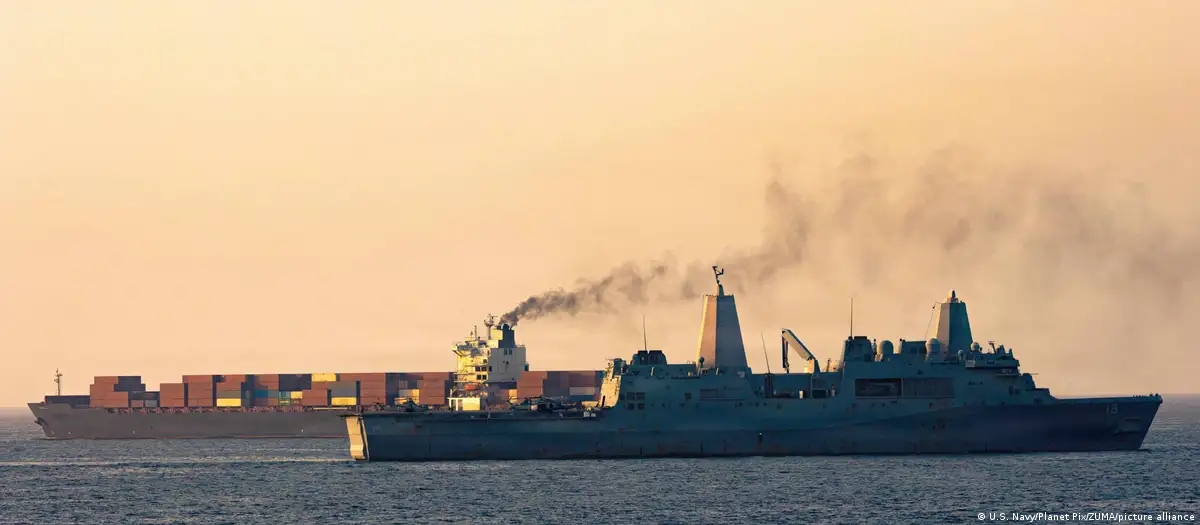
What you need to know
- US says ceasefire not over, but warns Iranian attacks on ships will be met with 'devastating' response
- Earlier, Iran's lead negotiator warned it is prepared for a standoff in Hormuz
- World leaders criticized an Iranian attack on the Fujairah oil hub in the UAE on Monday
- Iran neither confirmed nor denied attacking the UAE
This blog is now closed. For the latest on Wednesday, please click here.
IN DEPTH — Will tensions escalate in the Strait of Hormuz?
Could US President Trump's "Project Freedom" clear the congestion in the Strait of Hormuz? Or could it lead to an escalation of hostilities? Questions and answers.
Read DW's full report on what might happen next in the Strait of Hormuz.
IN DEPTH: Strategic neutrality: How Syria is winning in the Iran war
Syria's new government has deliberately not become directly involved in the Iran war. It's presenting itself as neutral and as a possible solution to the Strait of Hormuz blockade.
Read the full story here.
Iran denies carrying out strikes on UAE this week
Iran on Tuesday denied attacking the UAE in recent days, hours after the Gulf country reported a second round of Iranian missile and drone attacks from Iran.
The strikes were the first attacks on the UAE since a fragile ceasefire came into effect last month. One of the projectiles is reported to have struck a major oil transport site on Monday, setting it ablaze.
Despite denying responsibility, Iran's Khatam al-Anbiya joint military command said in a statement that the UAE would suffer a "crushing response" if it carried out military action against Iran.
The UAE is a top US ally and an Arab country with ties to Israel. Its oil infrastructure and relative proximity to Iran have made it a top target of Iranian strikes since the war began.
Pakistan says progress made in US-Iran mediation
Pakistani Foreign Minister Muhammad Ishaq Dar said Tuesday that progress is being made in negotiations between Iran and the US on a ceasefire, Iran's semi-official Tasmin news agency reported, without sharing details of how talks were progressing.
The US and Iran have only held one round of direct negotiations, with Vice President JD Vance traveling to Islamabad for talks in April that did not lead to any breakthroughs.
Since then, the US and Iran have indirectly expressed their interests and competing proposals, with Islamabad as a mediator.
"Our goal as mediators is to bring the parties to a peace agreement; something the region and the world need," Dar said, according to the report.
"Our goal is to end the crisis with a win-win agreement for both sides."
The statement comes as US officials indicated a ceasefire was still in place, despite the UAE saying it had been targeted by Iranian rockets and drones on Monday and Tuesday. The US also reportedly destroyed several Iranian small boats.
Iran firing rockets and drones at the UAE on Monday and Tuesday, and the US reporting to have On Tuesday, US President Donald Trump said Iran "plays games … but they want to make a deal."
WATCH — Iranian strike hits UAE as Strait of Hormuz crisis widens
The UAE restricted flights and activated emergency protocols after a missile strike on an oil facility it blames on Iran.
The attack followed a US effort to reopen the Strait of Hormuz amid the ongoing conflict.
IN DEPTH — Germany prepares for mission in the Strait of Hormuz
The German minesweeper Fulda has set course for the Mediterranean.
The German armed forces may assist in clearing mines in the Strait of Hormuz — although only under certain conditions.
Read the full report on Germany's plans to deploy ships to the Strait of Hormuz.
Trump downplays Iran's military capability, says war 'little skirmish'
US President Donald Trump on Tuesday again framed Iran's military as "defeated," claiming its forces have been reduced to firing "peashooters."
Trump also claimed, as he has in the past, that Iran wants to "make a deal" despite Tehran continuing to "play games."
"They want to make a deal. And who wouldn't, when your military is totally gone?" he said.
The president's comments come a day after the UAE reported the heaviest Iranian missile and drone assault since a ceasefire was announced earlier in April. On Tuesday, the UAE reported new Iranian missile and drone attacks.
"We're in a little skirmish military. I call it a skirmish, because Iran has no chance. They never did. They know it," Trump said in comments at the White House during an event on physical fitness for students.
Pakistan has tried to mediate a permanent end to hostilities and reopen the Strait of Hormuz, but there has yet to be any breakthrough.
Despite the recent clashes, the US has said it does not consider the ceasefire to have been violated.
When asked by a reporter what Iran would need to do to violate the ceasefire, Trump said "you'll find out, because I'll let you know ... They know what not to do."
French president to push Iranian counterpart on opening Hormuz
French President Emmanuel Macron said he would speak with his Iranian counterpart, Masoud Pezeshkian, about reopening the Strait of Hormuz.
Speaking to reporters while in Armenia's capital, Yerevan, Macron underscored the need for "the restoration of freedom of navigation" in the strait, where about 20% of the world's oil supplies pass through in normal circumstances.
"France has maintained a consistent position from the start. We call for the cessation of all hostilities, the return to diplomatic negotiations, and respect for all countries in the region," Macron said.
"The only possible option is the reopening of the Strait of Hormuz ... and the absence of any tolls or coercive measures."
"Any unilateral escalation against tankers, container ships, or third countries is a mistake that fuels war and leads to escalation," Macron said.
France and the UK have been leading efforts in Europe to establish an international naval coalition to ensure safe shipping in the strait once major hostilities cease.
UAE says air defenses dealing with Iranian missile and drone attacks
The United Arab Emirates said Tuesday its air defenses are "actively engaging" with Iranian missiles and drones.
The UAE's Defense Ministry reported attacks on X that the sounds of interception of ballistic missiles, cruise missiles and drones could be heard.
On Monday, the UAE reported attacks from Iranian missiles and drones, including at an oil facility.
US military says ceasefire holds, despite Hormuz tension
US Defense Secretary Pete Hegseth said Tuesday that the ceasefire with Iran was still in place, despite reports of strikes by both sides on Monday.
The Pentagon chief told a press conference that the US was "not looking for a fight," but added that Iran would not be allowed to block shipping in an "international waterway."
If Iran were to attack US troops or innocent commercial shipping" it would face an "overwhelming and devastating" US response, Hegseth said.
Hegseth added that the US military is in contact with hundreds of individual ships, along with shipping companies and insurers.
General Dan Caine, the chairman of the Joint Chiefs of Staff, said Tuesday that Iran had fired at commercial vessels nine times and seized two container ships, along with attacking US forces, since the ceasefire. However, Caine added the attacks "fell below the threshold of restarting major combat operations at this point."
Caine added, however, that US forces are ready to resume major combat operations against Iran if ordered to do so.
"No adversary should mistake our current restraint with a lack of resolve," said Caine.
Here is what happened on Monday
- Merchant ships in the Gulf reported explosions and fires, and an oil facility in the UAE caught fire after reports of Iranian missile strikes, officials there said.
- The US military said it sank six small Iranian boats and intercepted Iranian cruise missiles
- The strikes were the largest reported since a ceasefire was called on April 7
- With negotiations deadlocked, and shipping blocked, US President Donald Trump has said the US Navy would escort tankers through the Strait of Hormuz in what he has dubbed 'Project Freedom'
- Hegseth said the mission was 'temporary'
Iranian foreign minister to depart for China on Tuesday
Iranian Foreign Minister Abbas Araghchi will travel to China on Tuesday for talks, the foreign ministry announced.
"During the visit, he will meet his Chinese counterpart (Wang Yi) to discuss bilateral ties and regional and international developments," the ministry said in a statement.
Araghchi's visit to Beijing comes amid stalled negotiations with the United States aimed at ending the war in the Middle East.
China is considered the main buyer of Iranian oil and gas.
Iran war: What you need to know now
The Strait of Hormuz remains de facto closed despite Donald Trump's "Project Freedom" intiative.
The US military said two American-flagged merchant ships successfully passed through the Strait of Hormuz on Monday with the support of Navy guided-missile destroyers.
Iran's parliament speaker and chief negotiator, Mohammad Bagher Qalibaf, accused the US of jeopardizing security in Hormuz and warned that his country had not "begun" testing the vital energy chokepoint.
Iran imposed a blockade on foreign shipping using the strait soon after the war began with a US-Israeli attack on Iran at the end of February.
The US then imposed a blockade on all traffic entering and leaving Iranian ports to strangle the Islamic Republic's main economic corridors.
Pakistan prime minister condemns attacks on UAE
Pakistan, a mediator between the US and Iran, condemned attacks on US-allied UAE and urged respect for US's ceasefire with Iran.
"Pakistan strongly condemns the missile and drone attacks on civilian infrastructure in the United Arab Emirates last night," Prime Minister Shehbaz Sharif wrote on X.
He expressed solidarity with the Emirati people and the government of the United Arab Emirates "at this difficult time."
"It is absolutely essential that the ceasefire be upheld and respected, to allow necessary diplomatic space for dialogue leading to enduring peace and stability in the region," Sharif added.
The UAE said Iran attacked oil facilities in Fujairah on Monday.
What is 'Project Freedom' and is it working?
On Sunday, President Donald Trump announced on Truth Social that the US would help guide ships stranded due to Iran's closure of the Strait of Hormuz.
Trump announced that the mission, dubbed "Project Freedom," would begin on Monday and involve vessels belonging to "neutral and innocent bystanders."
"The Ship movement is merely meant to free up people, companies, and Countries that have done absolutely nothing wrong — They are victims of circumstance." Trump wrote.
"This is a humanitarian gesture on behalf of the United States, Middle Eastern Countries but, in particular, the Country of Iran," he said.
How many ships have passed through the Strait of Hormuz so far?
According to the US military, two American-flagged merchant ships successfully passed through the Strait of Hormuz on Monday with the support of Navy guided-missile destroyers.
Iran denied that any such crossings had taken place, but Danish containership operator Maersk said its Alliance Fairfax, a US-flagged ship, exited the Gulf via the Strait of Hormuz on Monday with the help of US military.
The commander of US forces in the region also said his fleet had destroyed six small Iranian boats, as well as cruise missiles and drones.
However, Iranian media quoted a military commander as saying that US forces had targeted civilian boats, killing five people.
On Monday, Iran also claimed to have fired on a US warship approaching the Strait of Hormuz, forcing it to turn around.
Iran warns it will continue to block shipping in Hormuz
Mohammad Bagher Qalibaf, Iran's parliament speaker and chief negotiator in talks with the United States, has warned that his country has "not even started" with its standoff in the Strait of Hormuz.
"We know full well that the continuation of the status quo is intolerable for America; whilst we have not even started yet," he wrote on X.
Qalibaf added that the actions of the US and its allies had put shipping security at risk, but said their "malign presence will diminish."