Iran: Exiled crown prince calls for protests to continue
Published January 10, 2026last updated January 11, 2026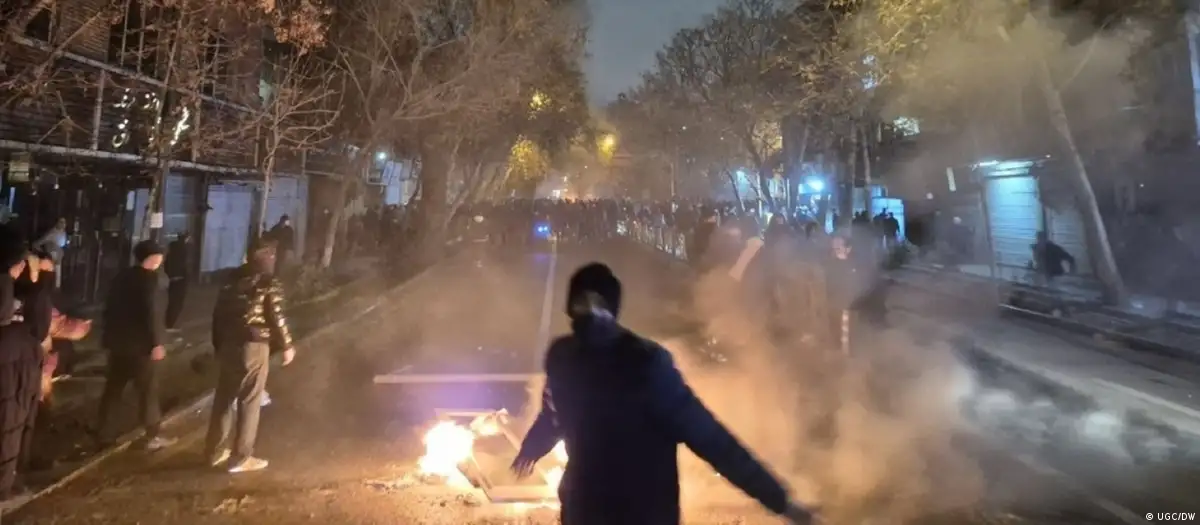
What you need to know
- Protests sweeping across Iran are nearing the two-week mark with fresh demonstrations in large cities
- Reza Pahlavi, son of the last shah of Iran, had called for the mass rallies to continue this weekend
- The demonstrations began in Tehran in late December in protest at the severe economic crisis in the country
- They have since evolved into calls to overthrow the Islamic regime
- The internet has been cut off for more than 48 hours in a bid to keep the lid on the protests
- Human rights lawyer tells DW she fears 'very brutal' crackdown
- Rights groups say at least 100 demonstrators have been killed since the uprising began
- Iran's Supreme Leader Ayatollah Khamenei has said the clerical regime won't back down
- He has called the protesters 'vandals' and 'saboteurs' who are trying to please US President Donald Trump
- US President Donald Trump says the US stands 'ready to help' but previously said any US action would stop short of 'boots on the ground'
This blog has been closed. Thank you for reading. For the latest coverage on Iran, follow Sunday's blog.
Below is a roundup of the latest developments on the protests in Iran on Saturday, January 10, 2025:
Activists say deaths in Iran protests reach 116 — report
The death toll from the violence surrounding the nationwide protests in Iran has risen to at least 116, according to the US-based Human Rights Activists News Agency, cited by AP.
The rights group said that over 2,600 people have been detained.
Meanwhile, Iran's state television has reported casualties among the security forces, but has not addressed the deaths of protesters, whom it has labelled "terrorists."
UK Foreign Secretary lauds courage of Iranian protesters
British Foreign Secretary Yvette Cooper on Saturday praised the courage of protesters in Iran who are carrying out demonstrations amid violent repression by Tehran's regime.
"It takes real courage to speak up in an authoritarian system, especially for young women, but it should not require courage just to make your voice heard," she said.
"These are fundamental rights: free speech; peaceful assembly," Cooper added, stressing that the exercise of those rights should never come with "the threat of violence or reprisals."
On Saturday, a protester tore down Iran's flag from its embassy in London.
Visuals on social media showed a man scaling the embassy's balcony and removing the flag. He was then seen waving the pre-Islamic revolution lion and sun flag, which is often used by opposition groups in Iran.
Later in the day, the Iranian embassy published a picture on X of the flag back in place.
"Iran's flag is flying high," the embassy's post read.
Scotland Yard said two arrests had been made, one on the charges of aggravated trespass and assault on an emergency worker and another one for aggravated trespass.
Iranian human rights lawyer fears 'very brutal wave of crackdown'
Shadi Sadr, an Iranian human rights lawyer based in London, has told DW that the scale of the violence may be greater than that seen in previous protest waves.
Sadr noted that the United Nations and international human rights organizations had previously confirmed that Iranian authorities committed crimes against humanity during earlier protests, including murder, rape, enforced disappearance, and arbitrary imprisonment.
She said there was no reason to believe the current crackdown would be any different, and warned that the wider scale of protests made the number of killings especially alarming.
"There is a brutal crackdown taking place at the moment," Sadr said. "The scale of killings is very worrying and could be much larger than before."
"If there is no meaningful intervention from the outside world," she said, "we will very soon witness a very brutal wave of crackdown involving death penalty, torture, and mass arrests."
"The only way to calm the situation is to stop the violence against the people," Sadr stressed, "and create a space where Iranians can freely and securely decide their own political future."
Trump says US 'ready to help' as Iran crackdown intensifies
US President Donald Trump has again said the United States is prepared to assist as protesters in Iran face an intensifying crackdown by authorities.
"Iran is looking at freedom, perhaps like never before. The USA stands ready to help!!!" Trump said in a post on Truth Social on Saturday, without giving details.
His comments came a day after he said Iran was in "big trouble" and again warned he could order military strikes. Trump suggested any possible US strike wouldn't "mean boots on the ground but that means hitting them very, very hard where it hurts."
Iran protests spark rallies in Berlin and Frankfurt
Mass protests in Iran have prompted demonstrations in Berlin and Frankfurt.
Berlin police said about 1,400 people marched from the city's Kurfürstendamm shopping street to Adenauerplatz, with another 300 gathering at Wittenbergplatz, while police in Frankfurt put turnout there at around 1,300.
Demonstrators in Berlin waved flags and held placards in solidarity with protests in Iran, where rallies against the government have taken place in several major cities.
Only limited information has emerged from Iran after authorities imposed an internet blackout.
Some protesters in Berlin displayed images of Reza Pahlavi, the son of the shah overthrown in 1979.
Placards included slogans such as "Democracy just with Pahlavi."
Protesters 'don't have anything to lose' — NGO founder
Negin Shiraghaei, the founder of the Azadi Network organization, told DW that people in Iran have been driven to protest the government despite repression due to inflation and other economic woes the country is facing.
The organization is made up of diaspora Iranians that support the "Women, Life, Freedom" movement that was launched in 2022 after the death of Mahsa Jina Amini in police custody.
"I think people are fed up. They don't care at this moment," Shiraghaei said, having pointed to reports of high death tolls from the crackdown on protests.
"People are hungry and they don't have anything to lose," she added.
She said that there were indications that parts of the Iranian government were considering having Supreme Leader Ali Khamenei step down.
"We've heard a lot of rumors about back channeling from [factions] in the government trying to talk to Trump and finding a way of succession for the supreme leader," she said.
"Don't forget: the supreme leader has been in power for 37 years .. so for him, the legacy of the Islamic Republic is really important."
She said that Iranian leadership has been faced with the question of whether to have "some other [factions] … take over for the sake of keeping the Islamic Republic in place."
Iran has been run by a clerical regime since the 1979 revolution that established the Islamic Republic.
Iran internet blackout enters second day amid protests
Iran's nationwide internet blackout has entered its second full day amid major protests, according to internet freedom monitor Netblocks.
"Iran has now been offline for 48 hours, as telemetry shows the nationwide internet blackout remains firmly in place," the group said in a social media post on Saturday.
"Meanwhile, regime leaders have continued to post their version of events online while their kill-switch silences the voices of 90 million Iranians," it added.
Protester swaps Iran flag at London embassy
A protester briefly replaced the flag of the Islamic Republic of Iran at its London embassy with the pre-1979 flag during a demonstration.
Images showed a man on the embassy balcony swapping the current flag for the tricolor bearing the lion and sun, used before the Islamic revolution, as hundreds of demonstrators cheered below.
Witnesses said the former flag remained in place for several minutes before being removed.
London's Metropolitan Police said additional officers were sent to the scene in Kensington, where a number of people had gathered.
Iran's London embassy is best known as the site of the 1980 Iranian Embassy siege, one of the most prominent counterterrorism incidents in modern British history.
EU chief urges Iran to free protesters, restore internet
European Commission President Ursula von der Leyen has urged the release of all imprisoned protesters in Iran, as well as the full restoration of internet access there.
"Tehran's streets, and cities around the world, echo with the footsteps of Iranian women and men demanding freedom. Freedom to speak, to gather, to travel and above all to live freely," von der Leyen wrote on social media.
"Europe stands fully behind them. We unequivocally condemn the violent repression of these legitimate demonstrations. Those responsible will be remembered on the wrong side of history.
"We call for the immediate release of all imprisoned demonstrators. We call for the restoration of full internet access. And we call, at last, for fundamental rights to be respected."
Iranian authorities have maintained a nationwide internet blackout since Thursday, according to monitoring groups, with telephone lines also cut.
WATCH: Iran protests near third week amid standoff with authorities
Recent protests in Iran, sparked by economic woes, have widened into broader discontent with the country's theocratic rule, as the exiled son of the last shah, Reza Pahlavi, urges demonstrators to reclaim public spaces.
WATCH: Amid Iran's unrest, is Reza Pahlavi gaining support?
As ongoing protests grip Iran, some activists are calling for the return of exiled Crown Prince Reza Pahlavi, ousted in 1979. But how much support does he have inside the country?
WATCH: Iran protests surge amid internet blackout and crackdown
DW asked Cornelius Adebahr of the German Council on Foreign Relations how these protests differ from earlier waves, and what Trump's threat against Iran's leadership could mean for protesters cut off from the outside world.
Iran: A timeline of mass protests since 1999
By using violence and repression, Iran's theocratic regime has managed to cling to power and overcome several anti-government movements in recent decades.
Read more about the various protests that have taken place in Iran since the student protests 1999 in this overview.
Iran protests: 'Fear is no longer working the way it used to,' DW's Niloofar Gholami says
Unrest is continuing to grow in Iran, with street demonstrations raging in cities across the country amid an internet blackout.
Niloofar Gholami from DW's Persian Service has been watching developments closely and provided her insights on what has been taking place.
"I was all up all night following the developments, and what I'm hearing and seeing is that the crowd are dramatically different from previous waves of protest, both in scale and in intensity," Gholami said, adding that the numbers of protesters involved "is unprecedented compared to past years."
And as the numbers of those involved in protests grows, the government's response has become "significantly more violent," Gholami said, pointing to the dozens reported to have been killed.
"Due to severe communication restrictions, verified deaths still [remain] extremely difficult to calculate and to obtain," Gholami said.
On the question of government not backing down, Gholami said: "The scale of official threats have been extremely high. Authorities openly warn people that if live ammunition is used, they should not complain."
Protesters have been "labeled as terrorists and agents of foreign enemies," something Gholami said she had not seen happen before.
"Fear is no longer working the way it used to, despite these warnings and increasingly violent crackdown, people are still coming out," Gholami said.
"I guess for many Iranians, the sense of injustice and desperation now outweighs the fear of repression," Gholami said.
As to whether or not Reza Pahlavi, the exiled son of the last shah of Iran, has any sway on demonstrators and the situation in Iran, Gholami said: "Given his support base and the current situation in Iran, yes: today, anyone who can have an impact on the protests carries weight."
"So Reza Pahlavi has the support of a significant portion of people inside Iran. But it is important to stress that not all protesters are his supporters," Gholami pointed out.
She said that Reza Pahlavi stands out because "monarchists have a public figure, while other opposition forces do not."