Germany-US rift is looming after a year of Trump
January 20, 2026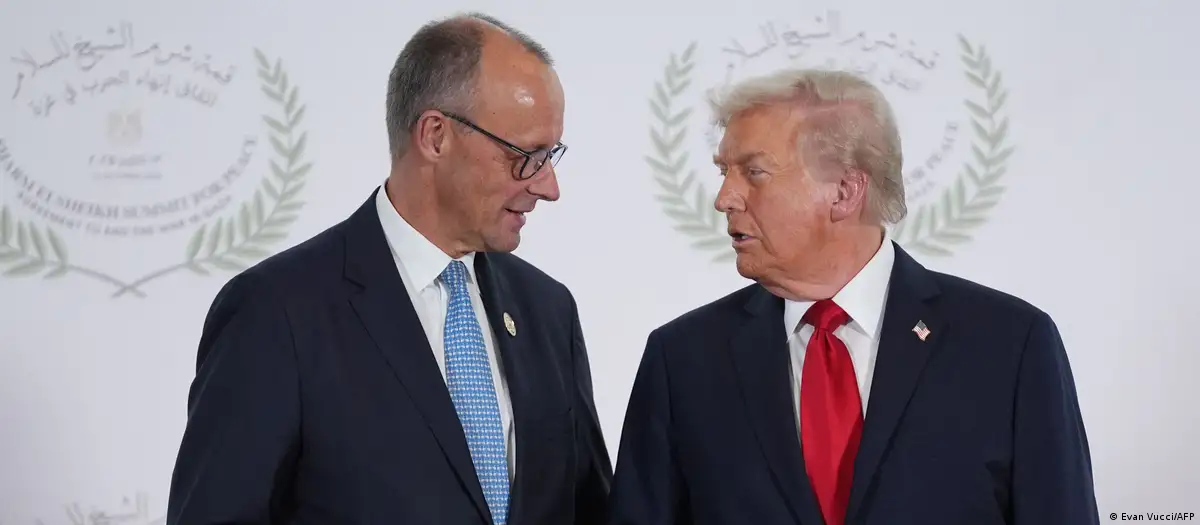
The dispute between NATO partners in Europe and the US is becoming more heated by the day: most recently, US President Donald Trump exacerbated the dispute over Greenland by announcing special tariffs for several European countries, including Germany. Germany and other European countries had sent soldiers to Greenland following Trump's demand to take the island by force. Now the EU is considering counter-tariffs on goods from the US.
Just a few days ago, during a visit to Washington, Germany's Foreign Minister Johann Wadephul optimistically announced, "Our partnership is strong, we are capable of acting, and we are determined to continue to develop this partnership." The US stood, politically and militarily within NATO, "fully and completely at Europe's side," Wadephul said.
There are growing doubts about this support, not only that the US would really protect European NATO countries in the event of a Russian attack. If the US were to actually violate the sovereignty of its NATO partner Denmark, the alliance would be over, as Denmark's Prime Minister Mette Frederiksen has said.
"This is a really dramatically tense time," Rachel Tausendfreund, an American researcher at the German Council on Foreign Relations (DGAP), told DW. "Germany is wondering right now if it has to be preparing for an attack by its most important NATO ally. In that sense, the relationship has never been worse. On the other hand, by all accounts, Chancellor [Friedrich] Merz and Donald Trump have a pretty good working relationship."
But that has its limits. Regarding the intervention in Venezuela and the kidnapping of President Nicolas Maduro by US Special Forces, the chancellor remained cautious and called the legal situation "complicated," although others called it out as a clear breach of international law. Such restraint is becoming increasingly difficult.
Johannes Varwick, professor of international relations at the University of Halle, thinks that a takeover of Greenland "would indeed be the straw that breaks the camel's back. I believe that the trust relationship with the US would probably be irrevocably broken. In principle, you must then press the reset button and see on what basis you can work together in the future. That would, however, be very, very difficult because Germany is dependent on the US in many matters. And this breakup would be expensive, it would be risky, but then probably unavoidable."
Germany's enormous dependence on the US
As a staunch trans-Atlanticist, Merz absolutely wants to avoid such a breakup. Trump, who on January 20, 2025, began his second term as US president, has however disregarded almost all previously held beliefs regarding the close partnership.
Merz was not yet chancellor when Trump humiliated Ukrainian President Volodymyr Zelenskyy in front of the world's media in February 2025. Merz said at the time: "Since the statements from Trump, it is clear that this segment of Americans is largely indifferent to the fate of Europe." It was his top priority to help Europe "achieve independence from the US, step by step."
But that is not so simple, Varwick said: "The only thing that really, if ever, could make an impression [with Trump], is a truly united European position. Friedrich Merz is working on that, but the European countries have hugely differing interests."
Relations worsened during the year. US tariffs on European goods especially affected the German economy due to its high export ratio. Regarding the war in Ukraine, Donald Trump made it increasingly clear that he would go a long way in accommodating Russian President Vladimir Putin to achieve peace.
Despite all the conflict — or perhaps because of it — Merz travelled to Washington for his inaugural visit in early June. The meeting went better than expected, probably because Merz could say that Germany wanted to spend a lot more on defense — something Trump had called for. There were no such concessions from Trump.
The return of imperialism
Since December, events have been unfolding rapidly: In its new National Security Strategy, the US administration warned Europe of "civilizational erasure" via immigration. The western hemisphere was declared to be within the US sphere of influence. Then came the operation in Venezuela and the ongoing threat to Greenland.
The German government seems clueless as to how it can, on one hand, keep Trump on board in the quest for peace in Ukraine and as a protector of Europe and, on the other, remain true to its self-proclaimed values: adherence to international law and a rules-based international order.
Rachel Tausendfreund of the German Council on Foreign Relations doesn't believe the US will completely turn away from Europe.
"I actually don't think that we are seeing consistent signs of the US wanting to abandon Europe. The US wants to recalibrate the relationship with Europe, the US wants to take a much smaller burden of securing Ukraine, but actually even the Trump administration still thinks of Europe as a partner, although elements of it are very anti-EU," Tausendfreund said.
Varwick, the University of Halle professor, sees turbulent times ahead for Germany because with Trump, imperialism and the "might makes right" approach have returned.
"That is, of course, very, very bad news for Germany because, more so than hardly any other country, it relies on a stable international environment, both for security policy and economic policy. The German business model is going down the drain, and there is no better one in sight."
Hostile reception possible in Trump's ancestral home
Late last year, the chancellery announced that Trump had accepted Merz's invitation to visit Germany during their meeting in Washington in June. At that time, Merz presented Trump with the gold-framed birth certificate of his grandfather, who had emigrated to the US from the German town of Kallstadt in Rhineland-Palatinate.
Trump may have felt flattered that Germany recognized his family history. However, Tausendfreund cautions: "I think [Trump] will welcome the fact that Germany seems to be appreciating his German connection. Does it mean anything long-term in terms of some kind of alliance or allegiance to Germany because his ancestors came from here? No, I don't think he has any kind of strong feeling of long-term allegiance."
The German public's attitude toward Trump became clear in an ARD Deutschlandtrend survey conducted in early January: Only 15% of respondents said they see the United States as a reliable partner. About 76% said they could no longer trust the US, a radical turnaround from the prevailing sentiment under former US President Joe Biden.
Merz invited Trump to Germany when relations were already very tense, but long before the latest escalation over Greenland. Under current circumstances, it seems almost unthinkable that Donald Trump would visit soon.
This article was originally written in German.
While you're here: Every Tuesday, DW editors round up what is happening in German politics and society. You can sign up here for the weekly email newsletter, Berlin Briefing.